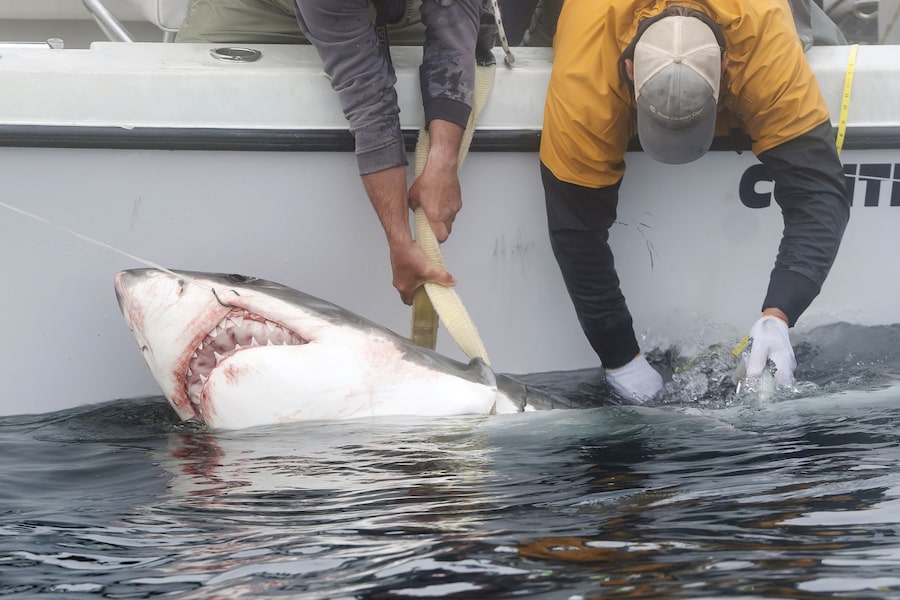

An assistant noticed it first – a tug on the rope attached to the side of the boat bobbing in the fog off Cross Island, in the middle of Mahone Bay, N.S.
A white shark had detected the tang of a large chunk of defrosted seal meat, dragging metres below the research vessel.
The seal meat was attached to a hook, suspended by stainless-steel wire and rope.
Seconds later, more tugs.
Beneath the surface, the shark bumped and nudged the meat. It mouthed the seal flesh between its jaws, deciding whether to go for it.

The blanket of fog is thick as the researchers hope their bait can bring in a shark.
It’s often a waiting game. Many days, the researchers bob in the open ocean for 12 hours without a bite, eyeing the baited buoys situated around the boat. The sun beats down on their necks, seasickness sets in. The only sound is the moan of the whistle buoy.
But on a misty morning at the end of July, it was as if the white shark had been waiting for them.
The shark bit hard on the meat as a researcher pulled the rope tight, prompting a circle hook inside the meat to twist and catch in the side of the animal’s jaw.
“It took the bait,” said Nigel Hussey, a white-shark researcher from the University of Windsor who is leading this expedition as the director of the Tancook Islands Marine Field Station in collaboration with Ocearch, a U.S.-based non-profit that studies white sharks worldwide.
So far this summer, Dr. Hussey and his team have tagged eight of these creatures – a feat that enables scientists to track their movement, providing crucial data for management (white sharks are protected under Canada’s Species at Risk Act) and information that could help protect against human-shark interactions.

What happens on the boat is akin to a Formula One pit stop. The crew, in fishing gloves and rubber overalls, jump into action – an all-hands-on-deck manoeuvre to capture and tag a white shark from a moving boat.
Directions are shouted. Dr. Hussey spins the wheel of the 28-foot Contender. The rope is reeled and the shark surfaces. It’s a juvenile female, about the length of a kayak. Her charcoal snout bears the white scratches of recent skirmishes with a seal.
The researchers secure yellow straps around her tail fin and belly, and roll her on her back against the side of the vessel. Flipped over, the shark, which researchers later named Cayo, falls into a state of calm.
Dr. Hussey leans overboard with a scalpel, cutting a three-centimetre incision into her sandpapery flesh. He inserts the acoustic tag that emits sound waves for tracking, about the size of a mini-flashlight, and sutures the cut with blue surgical thread.
At the same time, researchers draw blood and clip a fingernail-sized piece off the edge of her tail fin. Then they roll her back onto her front. Researchers drill two more tags into the dorsal fin on her back – a spot satellite tracker used by the Ocearch team, which gives near real-time data when she comes to the surface, and another device which records depth and temperature.
Finally, a scientist twists the hook out of the shark’s jaw with pliers. Researchers slip off the straps from her body and release her into the inky sea.


White sharks have been listed as endangered in Canada since 2011, but scientists believe their growing presence in Canadian waters could be because of a combination of factors, including conservation measures in the Northwest Atlantic, warming ocean temperatures and an abundance of seals.
A paper published in May says the white sharks have likely been migrating in greater numbers to Atlantic Canadian waters for four to six years. The Marine Ecology Progress Series journal found a likely increase of 2.4 times the number of white sharks detected off Halifax between 2018 and 2022. Farther north, the chance of white sharks being detected in the Cabot Strait that separates Nova Scotia and Newfoundland increased almost four times over.
The research confirmed what fishermen and others who use Atlantic Canadian waters have observed for years: a white-shark boom. This summer alone, a white shark bit into the board of a paddleboarder off Cherry Hill Beach, not far from where Dr. Hussey’s team tagged Cayo in Mahone Bay. In June, a lobster fisherman encountered a white shark off of western Cape Breton. And within days of each other, two groups of divers and snorkellers at Fox Point Beach in St. Margaret’s Bay came face to face with white sharks in the past several weeks.
Earlier in 2021, a woman suffered serious injuries from a suspected white-shark bite off western Cape Breton, and in 2023, a duck hunter’s dog was killed by a white shark near Port Medway.
While rational scientists like Dr. Hussey tell us that white sharks prefer eating seals over humans, he also admits it’s inevitable that their curiosity can and will result in a fatality or serious injury at some point. This is why he says it’s important to gather data – to know where the sharks are and the locations of their preferred feeding grounds.
“It is only a matter of time, unfortunately,” he said, adding that gone are the days of anchoring your sailboat off an island and jumping overboard for a swim.


Back at the field station, Windsor master's student Joseph Fotso checks on the supply of frozen seal meat. Once defrosted, it will make tempting bait for sharks.
It made sense to set up the field station on Big Tancook Island, home to an active fishing community with generations of knowledge that Dr. Hussey and his team rely on to do their work.
As a tribute to the residents, they named two newly tagged sharks after locals – Baker, for the convivial harbour master David Baker, who is actively involved in the operation, and Percy, after a baby boy born this summer to the eighth-generation Cross family.
Over the past few years, the marine field station has dropped a total of 70 acoustic receivers in the bay that are now listening for sharks equipped with tags. The station is one part of a broader network of researchers tracking animals in the Northwest Atlantic.
In September and October, the crew will motor back to Cross Island, hoping to tag more sharks. In November, they’ll recover and download the data before redeploying the acoustic receivers again next June, when the white sharks migrate back to Canada.
Cayo, meanwhile, has zigzagged up and down coast of Nova Scotia, travelling 700 kilometres over the past month and a half, likely gorging on seals. Her latest ping was on Sept. 20, when she popped up at sea, off the Eastern Shore.
It’s a wild world: More from The Globe and Mail
The Decibel podcast
Like sharks, bears are feared by the public in ways that makes coexistence difficult. Reporter Joy SpearChief-Morris spoke with The Decibel about common bear misconceptions and what to do if you find one. Subscribe for more episodes.
Oceans and environment
Shifts in habitat make North Atlantic right whales harder to track – and to save from extinction
Baby eels wade into high-stakes battle over treaties and fisheries in the Maritimes
A mysterious illness killed billions of sea stars. Scientists say they’ve solved the case