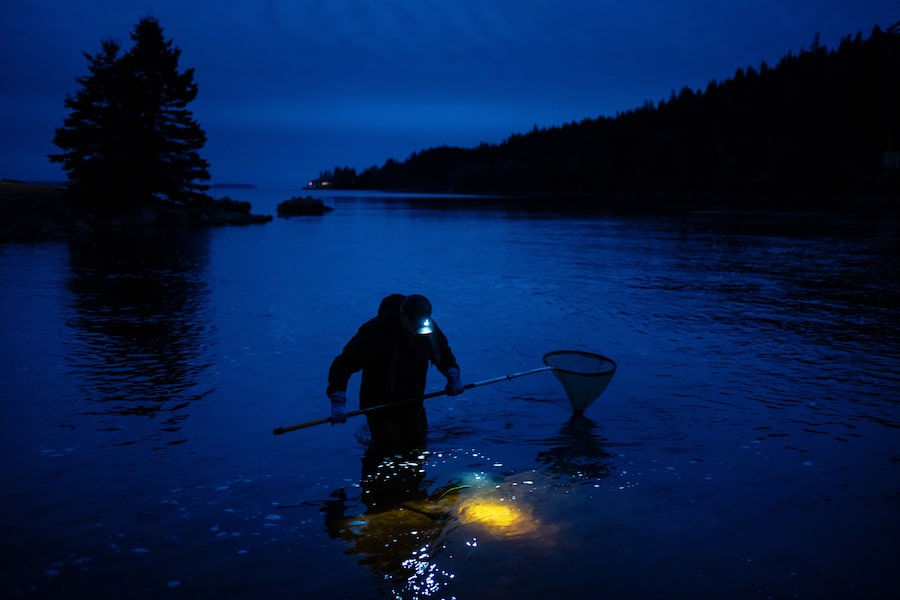
Above a river south of Halifax, the sky darkens to a deep indigo – a signal to millions of baby eels to emerge from under the rocks and crevices of the brackish water. They wriggle near the surface like spermatozoids, pushing against the current.
Making it this far was a feat. They drifted thousands of kilometres as larvae on ocean currents from the Sargasso Sea, landing on the eastern coasts of Canada and Maine. By then, they had transformed into baby eels – or elvers – translucent but for two black specked eyes.
Soon, they will pigment and journey up the river to adulthood – if they don’t meet the net of a harvester such as Stanley King.

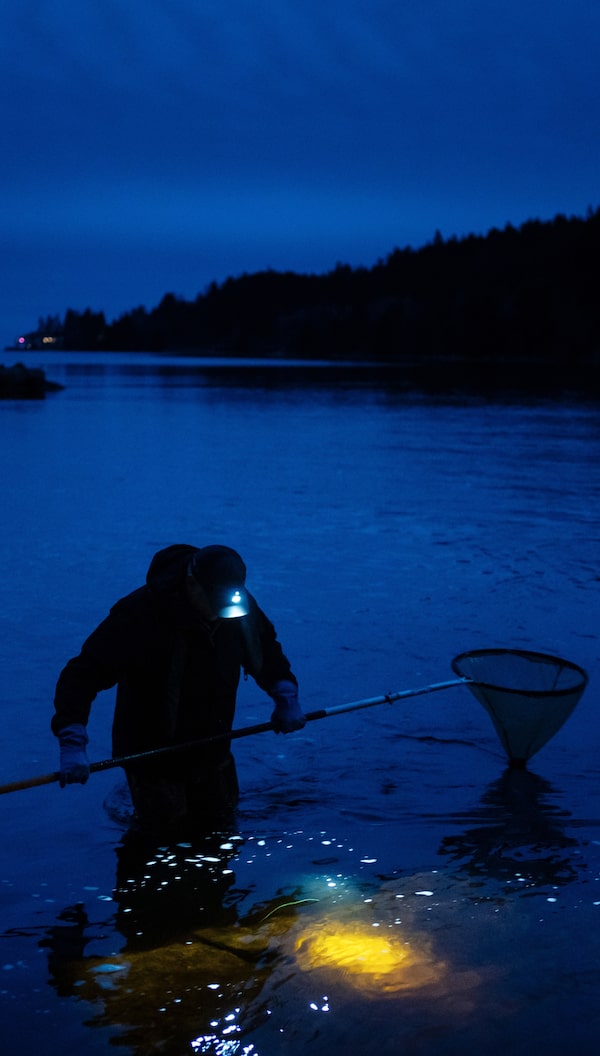
Suzie Edwards dumps elvers from her net. She and colleague Stanley King, in the top photo, are licensed for this work.
Mr. King strides into the river on this chilly April night in neoprene waders and merino wool long johns. From nightfall until early morning, he dips and swishes his net, every so often tipping his catch – about a golf-ball size worth of eels – into a submerged holding bag tethered to a rock. Across the river, his co-worker Suzie Edwards does the same.
As serene as the scene appears, every headlight, every dog bark, sets the two licensed fishers on edge. This coastal river is ground zero for what has been a violent and highly contested battle over the glass eel, a federally regulated resource that has soared in market value over the past few years. One kilogram of these squirmy creatures has been worth up to $5,000 in recent years, making it, by weight, the most expensive fish sold in Canada.
At the heart of the conflict is a lack of clarity around Indigenous fishing rights. In 1999, a landmark Supreme Court ruling known as the Marshall decision affirmed the treaty rights of First Nations to fish and hunt to earn a “moderate livelihood.” It stemmed from the famed case of Mi’kmaq man Donald Marshall Jr., who was arrested and charged for illegally fishing eels in Pomquet Harbour on the north shore of Nova Scotia. A second decision two months later clarified that the treaty right was subject to federal regulation to ensure conservation.
Twenty-five years later, however, there remains ambiguity as to what actually constitutes a “moderate livelihood.” So many of the same conversations and conflicts are still happening – and for those who built up businesses around the $39-million baby eel fishery, the stakes are high.
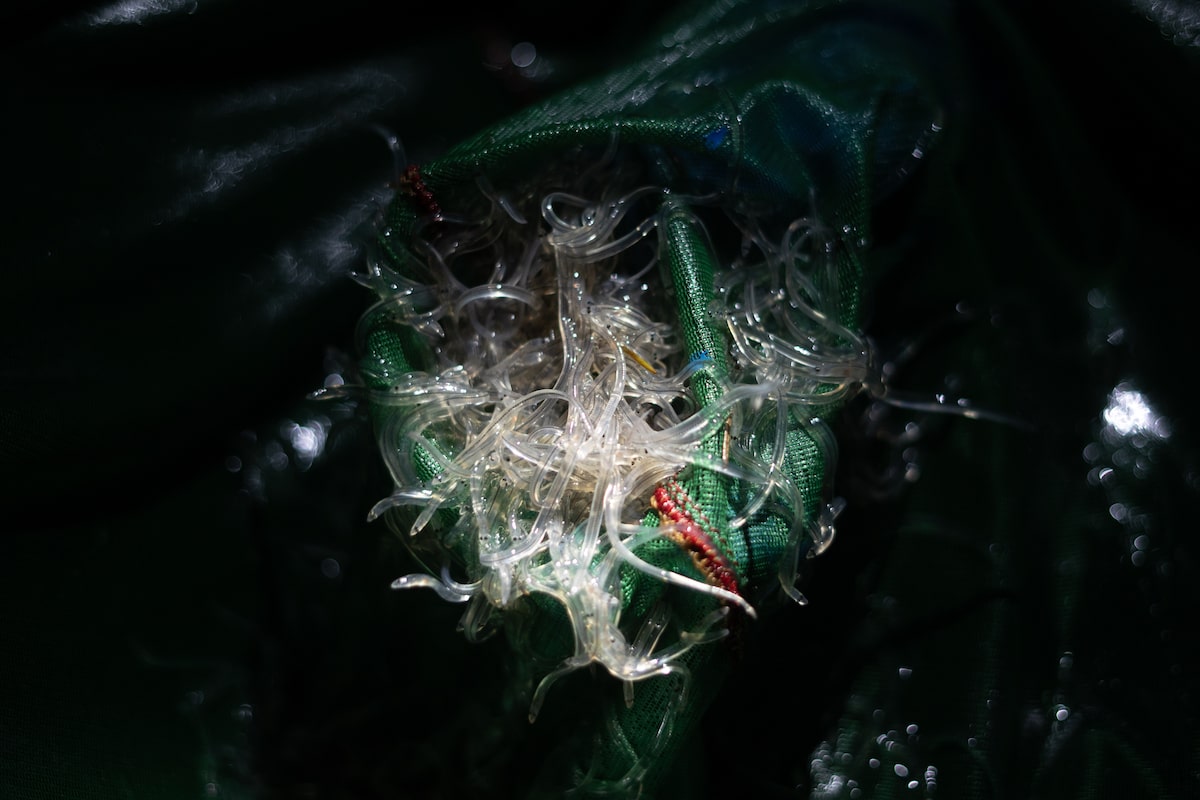
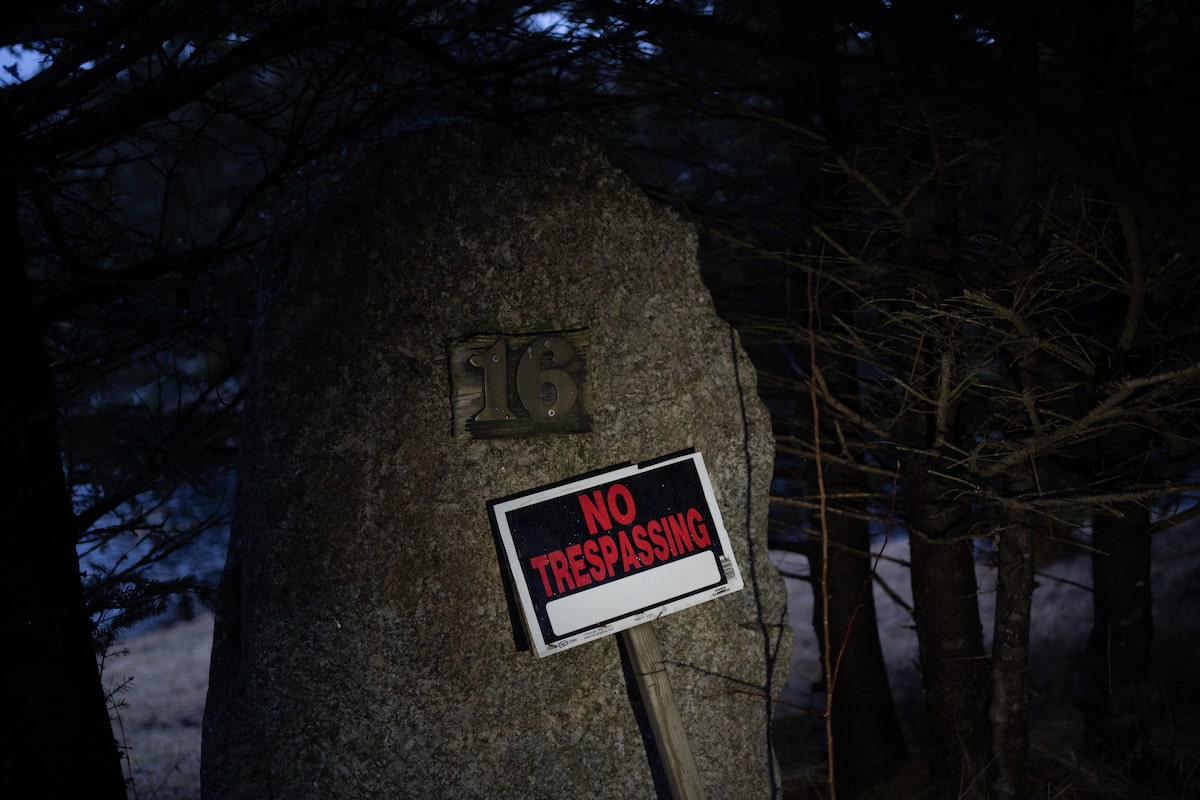
The turmoil restarted in earnest two years ago on this very river, when unlicensed fishers – some of whom were members of Mi’kmaq First Nation communities – inundated the prime spot. There were brawls, an assault with a pipe, a kidnapping, gun violence, robberies, death threats and intimidation of local property owners.
There was so much mayhem that the Department of Fisheries and Oceans cut the 2023 fishing season short and cancelled it altogether in 2024, returning with new regulations this year.
But the fight for the right to fish baby eels ramped up again this spring, with arrests, safety concerns and stolen gear.

The Mi’kmaq people, whose red-and-white flag flies at this home in Millbrook First Nation, have long asserted their treaty rights to fish, navigating complex questions about who can regulate fisheries.
Contributing to the tension is that the DFO took the unprecedented step of dividing the glass eel quota, giving – or expropriating, depending on whom you talk to – half of it to First Nations to support access to rights-based fishing in pursuit of a moderate livelihood. The Assembly of Nova Scotia Mi’kmaw Chiefs signed on to work within the DFO’s regulatory plan, saying a careful approach with the government-managed fishery is vital to protect the species as a resource. But three First Nations, including the province’s largest, are not members of the assembly and rejected it.
In March, the chief of Millbrook First Nation, near Truro, N.S., told the DFO that his community won’t abide by federal rules that limit the catch of baby eels this year and is asserting its own treaty right to fish baby eels for a “moderate livelihood.”
Citing the Marshall decision, Chief Bob Gloade said his community does not recognize the Canadian government’s jurisdiction and has authorized its own fishery under the treaties. “We are not regulated by your colonial commercial licensing schemes, nor do we accept your proposed management plan,” he wrote in a letter to the department.
Even though the Marshall decision came down a quarter century ago, University of New Brunswick law professor Nicole O’Byrne says we’re still in the early stages. “We’re still trying to figure out the scope and nature of the right as it’s actually implemented on the ground. And people have different interpretations of how broad that should be, how it should be regulated, in whose interest, et cetera,” she said.

Donald Marshall Jr. – at left in a family photo with Daniel Francis's stepfather Arthur Kennedy – fought in court to create much of the modern legal landscape for Indigenous fishing and treaty rights.
Those inconsistencies came into focus on April 11, just around suppertime in the rural community of Tangier, east of Halifax. Daniel Francis, 46, a member of Pictou Landing First Nation who lives in Millbrook, was at the mouth of the Tangier River, doing exactly what he says Mr. Marshall told him to do. “He told me never to stop fishing,” said Mr. Francis, who was a teenager when the older man, a family friend, shared the advice. “He said, ‘We’re allowed to.’ I was really scared at the time – I didn’t know anything about eels, but now I do, so I know where he’s coming from. It’s our right to fish.”
Mr. Francis had set up a fyke net, which funnels the fish into a smaller net and was instructing a younger band member when DFO enforcement officers arrived and seized his gear. He said he tried to explain that he was authorized by Millbrook First Nation, but that officers slammed him to the ground. He was arrested and charged with obstruction and assault, which he says he plans to fight.


Daniel Francis shows the injuries to his head and arm from an alleged encounter with fisheries officers in April.
After the Marshall decision, which was considered a giant leap forward in the recognition of the scope and meaning of treaty rights, Ottawa took steps to help Indigenous people exercise a “moderate livelihood.”
The federal government bought back lobster licences from non-Indigenous fishers so that Indigenous fishers would have more access to the resource, as they did long before Ottawa’s regulatory regime was established in the 1920s and 30s
But disagreements persisted – in large part because the original Peace and Friendship Treaties of 1760 and 1761 were much more about a mutual exchange of resources and a recognition of a continuing relationship, rather than a hammered-out government agreement, Dr. O’Byrne said.
“What this all boils down to is the federal government, through DFO, really needs to work harder on establishing a consultation process that’s a lot more meaningful and has a lot more input,” she said.
In the meantime, conflict continues on several related fronts. Fyke nets from licensed baby eel fishers were stolen in the dead of night in April. In May, the DFO seized 300 Indigenous lobster traps that belonged to Lennox Island First Nation in PEI, leading Chief Darlene Bernard to vow to take the fight to court.
A recent Federal Court judge ruled that the DFO failed to properly consult commercial fishers when it transferred 14 per cent of their elver quota for the 2023 season away from Shelburne Elver Ltd. and South Shore Trading Co. Ltd. without compensation. And there is continued criticism from some commercial licence holders that fisheries officers aren’t responding to multiple complaints of unlicensed baby eel fishing on Nova Scotia rivers.

Mr. King says he’s reported unlicensed harvesting for weeks this spring, but no one from the DFO has shown up. In correspondence with federal Fisheries Minister Joanne Thompson and others, he pleaded for enforcement.
“After more than two weeks of unfettered fishing, this band of organized criminals have now profited immensely off their complete disregard for the conservation and management strategies that are designed to keep this fishery operating and sustainable,” he wrote on May 11. “Why will DFO not respond to our repeated calls to stop them?”
DFO spokesperson Debbie Buott-Matheson wrote in an e-mail to The Globe that, “Enforcement activity is not always visible, and it may not look the way people expect it to look. Fishery officers use both overt and covert means to observe activity.”
After two major seizures of elvers last year – one worth $500,000 at Toronto Pearson International Airport, and another worth $250,000 at an industrial park in Halifax – DFO implemented a traceability app (Maine has had a similar tracing tool since 2013) to keep better track of the supply chain and battle illegal sales.
This elver season, 11 people were charged for violations of the Fisheries Act and the Possession and Export of Elvers Regulations, Ms. Buott-Matheson said, adding that more charges may come, as investigations can take up to two years. Fisheries officers arrested 100 people after 1,077 riverside inspections, as well as 146 checks at holding facilities and 321 at airports.
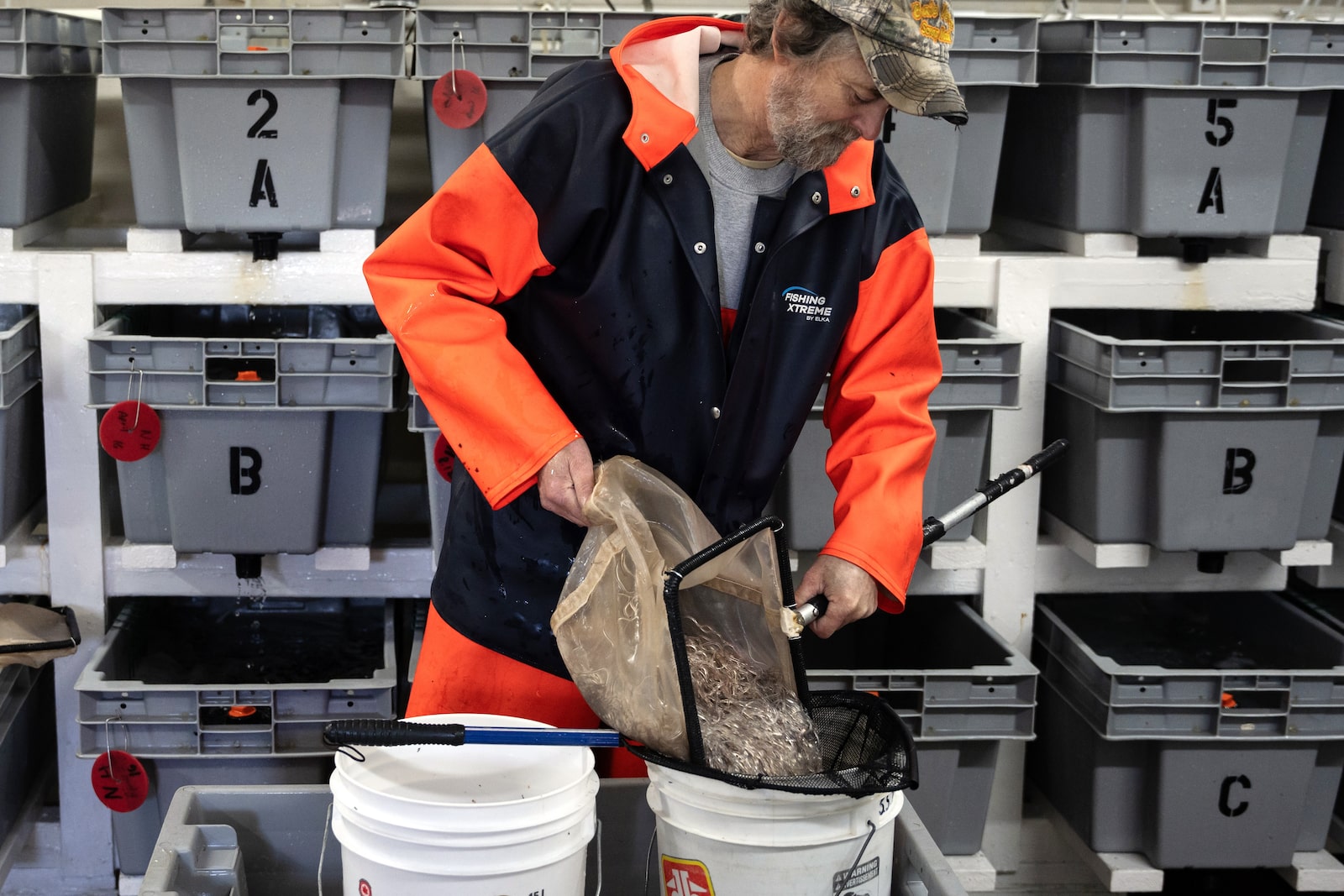
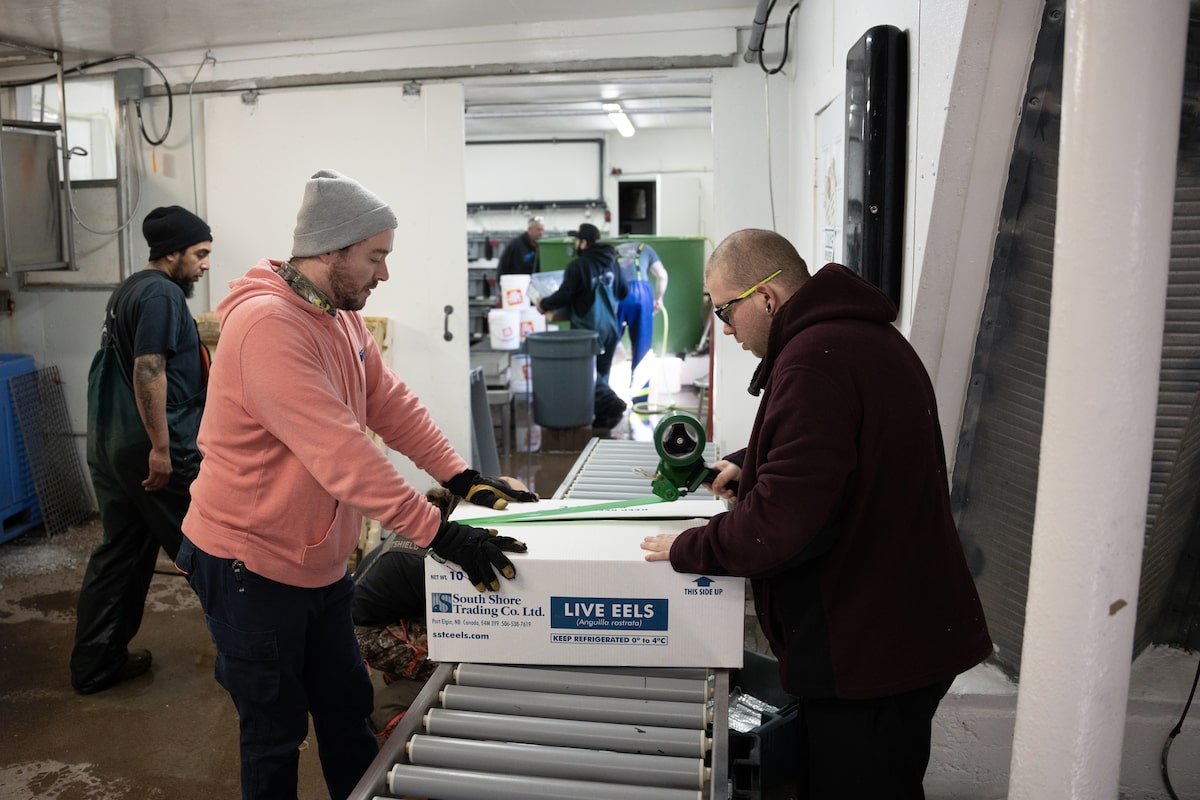
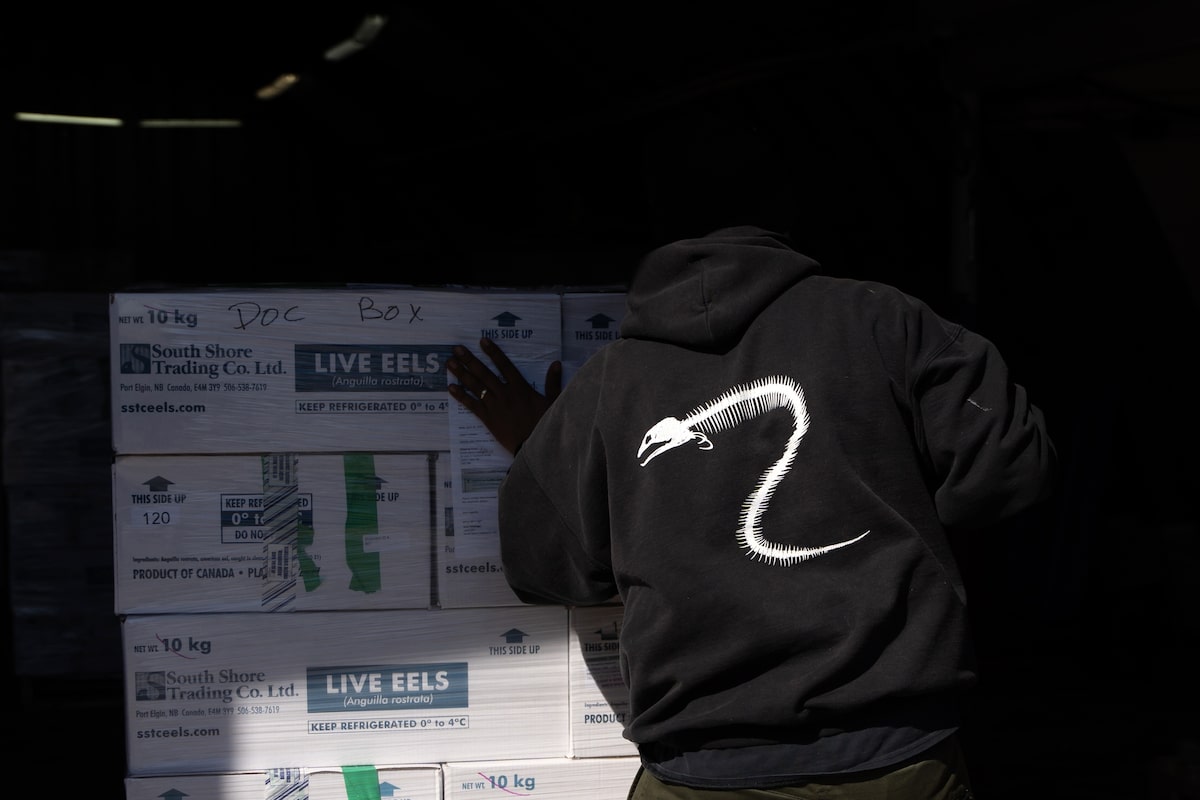
Despite the conflict and questions, thousands of kilograms of baby eels captured in estuaries along the eastern coastline of Nova Scotia this year were sent to packing facilities in Ontario, Nova Scotia and Port Elgin, N.B. – the same plant where Mr. Marshall once sold his eels.
There, the fish were poured into holding tanks and drained like spaghetti to be counted and weighed. Next, they were put into plastic bags oxygenated by a hose, packed and carefully labelled in cardboard boxes, and loaded onto pallets. The baby eels processed in the Maritimes were trucked to the Halifax Stanfield International Airport and flown to Hong Kong to be distributed to aquaculture sites. The eels are then raised to full size (up to a metre long), processed and sold as unagi (Japanese for freshwater eel), likely to be prepared as unagi kabayaki (grilled eel dipped in sweet soy sauce), said Mitchell Feigenbaum, president of South Shore Trading Co. in Port Elgin.
“It’s consumed en masse in the sushi restaurants everywhere around the world,” he said. “There’s a good chance that a lot of what we’re eating here was … sourced here.”
