
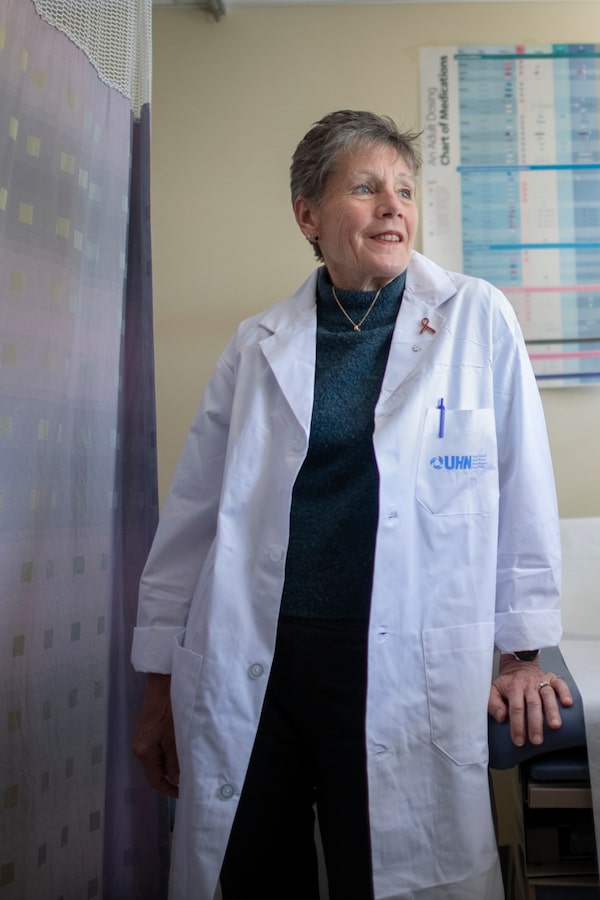
Sharon Walmsley was just a medical intern in 1983 when she stood helplessly at the bedside of one of Toronto’s first AIDS patients. It was her first shift, and HIV didn’t yet have a name, let alone a treatment or cure. She went home that night in tears.
On Saturday, four decades after that fateful shift, Dr. Walmsley attended a conference in Winnipeg to present a historic achievement: One of her patients was poised to become the first Canadian cured of HIV.
The case, announced at the Canadian Conference on HIV/AIDS Research, is now the subject of a research collaboration between Unity Health Toronto, the University of Toronto and University Health Network, where Dr. Walmsley is director of the HIV clinic.

Over four decades since encountering one of Toronto’s first AIDS patients in 1983, Dr. Walmsley announced of her patients was poised to become the first Canadian cured of HIV.Fred Lum/The Globe and Mail
When she first diagnosed her patient in 1999, he also had cancer and wasn’t expected to survive past six months. Now, the Toronto man – who has requested anonymity – is 62 years old, off antiretroviral therapy, or ART, and in prolonged HIV remission after a stem cell transplant in 2021, supplied by an international donor with natural immunity against the virus.
If he continues testing negative for HIV over the next 20 months – as his doctors are confident he will – he will be considered cured.
Globally, only 10 HIV patients are known to have achieved this milestone after a stem cell transplant. It’s an exclusive club that began with “the Berlin patient” in 2009 and has since grown to include a London patient, Dusseldorf patient, Oslo patient – and now, if all continues to go well, the Toronto patient.
A Toronto patient who has been living with HIV for 27 years is in remission after a bone marrow transplant from a donor naturally resistant to the virus.
The Canadian Press
“I’ve been able to care and do research on this disease for over 40 years. And I’ve watched it move from something that kills people in six months to a possible cure,” said Dr. Walmsley, who is also a professor with U of T’s Temerty Faculty of Medicine.
“It’s just been amazing.”
But Dr. Walmsley and her collaborators are quick to emphasize that stem cell transplants are not a safe or realistic treatment option for the vast majority of the 41 million people living with HIV worldwide, most of whom live in lower-income countries.
As with the prior 10 patients, the Toronto patient only underwent a risky stem cell transplant as a last-resort treatment for life-threatening cancer; simultaneously curing their HIV was a bonus.

A volunteer lights candles around a red ribbon, the symbol of awareness and support for people living with HIV, during a World AIDS Day event in Nepal in 2020. The success seen by Dr. Walmsley and her collaborators represents another step forward in the global fight against HIV.PRAKASH MATHEMA/AFP/Getty Images
Nowadays, HIV patients are living longer than ever thanks to ART, often with undetectable viral loads. Subjecting these patients to complex and dangerous stem cell transplants as an HIV treatment is neither safe nor feasible. The treatment is also expensive, costing hundreds of thousands of dollars per transplant.
But the Canadian milestone represents another step forward in the global fight against HIV. And with every patient cured, scientists glean fresh insights that could pave the way for more widely accessible cures.
When Dr. Walmsley first met the Toronto patient, he was battling Stage 4 Burkitt lymphoma, a rare and aggressive cancer that had already invaded his brain and lymph nodes.
This form of cancer is often associated with HIV, so he was further tested for the retrovirus. The results came back positive. “That was pretty devastating,” Dr. Walmsley recalled. “I thought he would probably die.”
But she was determined to give him every chance at survival, aggressively treating him for HIV alongside his cancer therapies. Against all odds, he pulled through. “That was miracle one for this patient,” she said.
His diagnosis in 1999 came at a pivotal moment. ART had just been introduced, and these drug combinations stopped the virus from reproducing, dramatically boosting average life expectancies for HIV patients.

Dr. Mario Ostrowski, one of Dr. Walmsley’s research collaborators, is a clinician-scientist with St. Michael’s Hospital in Toronto and Ontario HIV Treatment Network Applied Research Chair.Fred Lum/The Globe and Mail
Many patients on ART were able to suppress their virus to undetectable levels, giving doctors hope the medications could some day be stopped, said Mario Ostrowski, a clinician-scientist with St. Michael’s Hospital in Toronto and one of Dr. Walmsley’s research collaborators.
But when patients tried going off ART, the virus always came surging back within weeks, he said. “That told us that you can’t stop,” Dr. Ostrowski said. “You have to be on therapy for the rest of your life.”
As it turned out, HIV can insert its genetic material in the immune system’s memory cells, creating a reservoir where the virus can hide – and wait to resurge.

Timothy Ray Brown, also known as the "Berlin patient," the first person to be cured of HIV infection, in March, 2019.Manuel Valdes/The Associated Press
But in 2008, German physicians sent shock waves throughout the HIV community when they announced a patient had been effectively cured.
The Berlin patient, later revealed to be a Seattle native named Timothy Ray Brown, underwent a stem cell transplant for his acute myeloid leukemia. His doctor decided to find a donor with a mutation in a gene called CCR5.
The gene encodes for a protein that HIV uses as a gateway to invade cells. People with two copies of this gene mutation – particularly prevalent in Europeans – lack this protein, making them naturally resistant to HIV infection.

Dr. Jonas Mattsson, an expert in stem cell transplantation with a special interest in HIV, serves as director of the Hans Messner Allogeneic Transplant Program at Toronto’s Princess Margaret Cancer Centre.Sammy Kogan/The Globe and Mail
When news of the Berlin patient reached Jonas Mattsson in Sweden, he found it “mind-blowing.” Dr. Mattsson is an expert in stem cell transplantation but has a special interest in HIV, partly thanks to his wife, an HIV research nurse. He has also worked at Oslo University Hospital, where friends and colleagues were treating the “Oslo patient” – the 10th person cured of HIV through stem cell transplant.
In 2019, Dr. Mattsson was recruited to Toronto’s Princess Margaret Cancer Centre, where he now serves as director of the Hans Messner Allogeneic Transplant Program.
He implemented a policy that all physicians who refer cancer patients to his program must first check a box on the referral form, indicating HIV status. He didn’t want to waste any opportunities to perform a stem cell transplant that could “kill two birds with one stone.”
An HIV-positive patient did come along a few years ago, and received stem cells from a donor with the gene mutation. But the patient died of their cancer before their HIV status could be determined.
Then, in July, 2020, Dr. Walmsley was reviewing the latest blood test results for the Toronto patient when her heart sank. “His blood counts were off,” she said. “Something was wrong.”
The patient had developed myelodysplastic syndrome, which progressed to leukemia – known risks from the toxic cancer treatments that he underwent two decades ago for his Burkitt lymphoma. After he underwent chemotherapy and radiation, his doctors recommended a stem cell transplant.
The search for a donor began. Globally, there are more than 45 million people registered as stem cell donors, all searchable through a centralized website. But finding a match is tricky; in Canada, only half of patients in need find a suitable donor, according to Canadian Blood Services.

Dr. Mattsson and Dr. Tommy Alfaro Moya, left, who cared for the Toronto patient post-transplant.Sammy Kogan/The Globe and Mail
A match is more likely when a donor is of the same ethnicity as the patient. So the Toronto patient, who is Caucasian, had an advantage; the majority of the world’s registered stem cell donors are white – a persistent and problematic inequity, Dr. Mattsson said. An initial search likely would have yielded thousands of potential matches, he said.
From there, Dr. Mattsson’s search team winnowed down the options to find the most optimal donors; people who are younger, for example, or share a blood type.
The last step was to screen their short list for donors with two copies of the CCR5 gene mutation. They had a hit – finding not just one donor, but three.
How did Dr. Mattsson react? He makes an exaggerated fist pump. “It’s like when the Leafs score,” he said, laughing.
But stem cell transplantation is a “dangerous and difficult business,” so Dr. Mattsson knew better than to celebrate prematurely. Countless things could go wrong, said his colleague Tommy Alfaro Moya, who cared for the Toronto patient post-transplant. The patient had to first undergo a battery of tests to ensure his eligibility for transplantation. He also had to endure five days of “conditioning,” where his immune system would be wiped out with chemotherapy and radiation.
Death is also a risk. At Princess Margaret – which performs roughly a quarter of stem cell transplants in Canada, according to Dr. Mattsson – about 31 per cent of patients who undergo transplantation don’t survive past three years, either because of their cancer relapsing or postprocedure complications.

When Dr. Walmsley first met the Toronto patient, he was battling a rare and aggressive cancer. Twenty-one years later, she told him a stem cell transplant had the potential to cure his HIV.Fred Lum/The Globe and Mail
When Dr. Walmsley first told the Toronto patient that his upcoming stem cell transplant had the potential to cure his HIV, it was like the inverse of their first encounter 21 years earlier. Back then, his cancer revealed a second, devastating diagnosis. This time, his cancer journey offered the possibility of a double cure.
“He was shocked,” Dr. Walmsley said. “But his focus was really on the cancer at that point.”
The patient’s blood tests after the transplant revealed that his HIV levels had immediately begun to decline. But Dr. Walmsley didn’t want to stop his HIV treatments until she was confident it was safe to do so.
She recruited Dr. Ostrowski to conduct the lab tests necessary for monitoring the patient’s viral reservoir – analyses that involved lengthy medical procedures, specialized assays and tests conducted inside a high-containment lab facility.

Dr. Ostrowski conducted the lab tests necessary for monitoring the Toronto patient’s viral reservoir inside a high-containment lab facility.Fred Lum/The Globe and Mail
Meanwhile, the patient was still going in and out of the hospital to deal with several post-transplantation complications, including multiple infections and a fractured hip, according to Dr. Walmsley. He also developed graft-versus-host disease, a common post-transplantation complication that can be fatal, but may also play a role in clearing the HIV reservoir, Dr. Ostrowski said.
In July, 2025, four years after his stem cell transplant, the patient was finally stable. But his most recent lab tests turned up a single cell with a complete genome of the virus, according to Dr. Ostrowski.
The virus could have been defective, he said, but a single cell was potentially enough to cause a viral rebound. He and Dr. Walmsley were nervous about stopping the patient’s medications, but he was insistent. “Let’s go for it!” Dr. Walmsley recalled him saying excitedly.
Nearly 10 months later, the Toronto patient continues to show no signs of HIV. While his prolonged remission hasn’t changed his day-to-day life, the patient is excited to have made a contribution to HIV research, Dr. Walmsley said.
His story also provides hope for what might be possible in the years to come, she added.
“When I started my job, I used to sit on someone’s bedside every night and watch them die,” she said. “Bone marrow transplant is not the way to go for the average person, but it does provide a pathway to understand what needs to be done in order to try and develop a cure.”
Age of breakthroughs: More from The Globe and Mail
2025 was a year of breakthroughs in health and medicine. Here are five
Meet Canada’s next generation of researchers
In groundbreaking procedure, Ontario doctors perform rare heart surgery on pregnant woman
The Decibel
Maryam Fatima had her first seizure within minutes of being born. On bad days, she had hundreds. To save her brain, doctors would have to destroy part of it with a radical surgery, never used in Canada before. Health science reporter Jennifer Yang spoke with The Decibel about what happened next. Subscribe for more episodes.