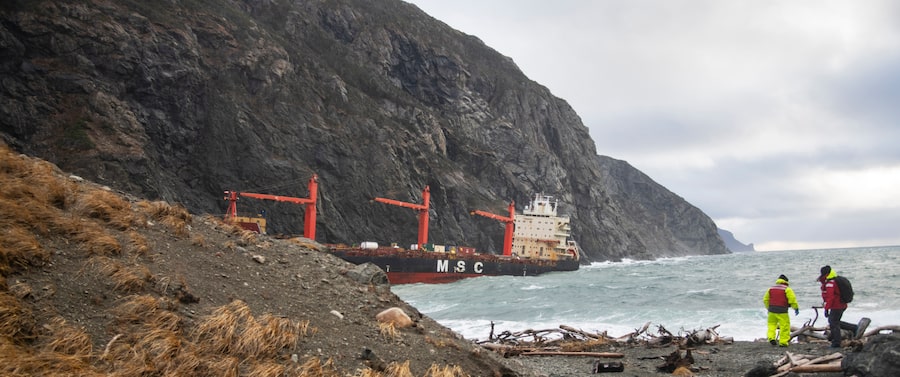
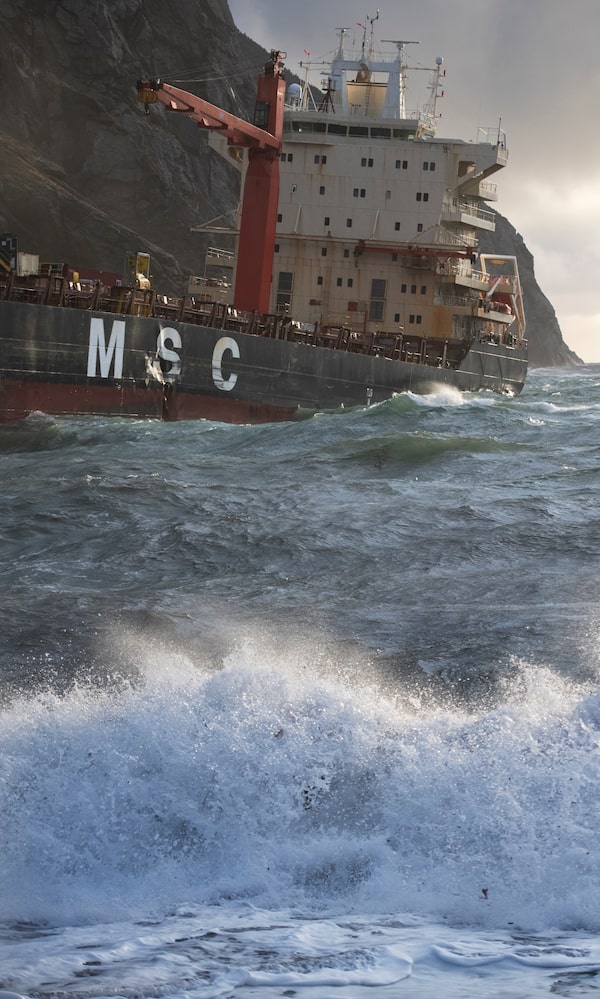
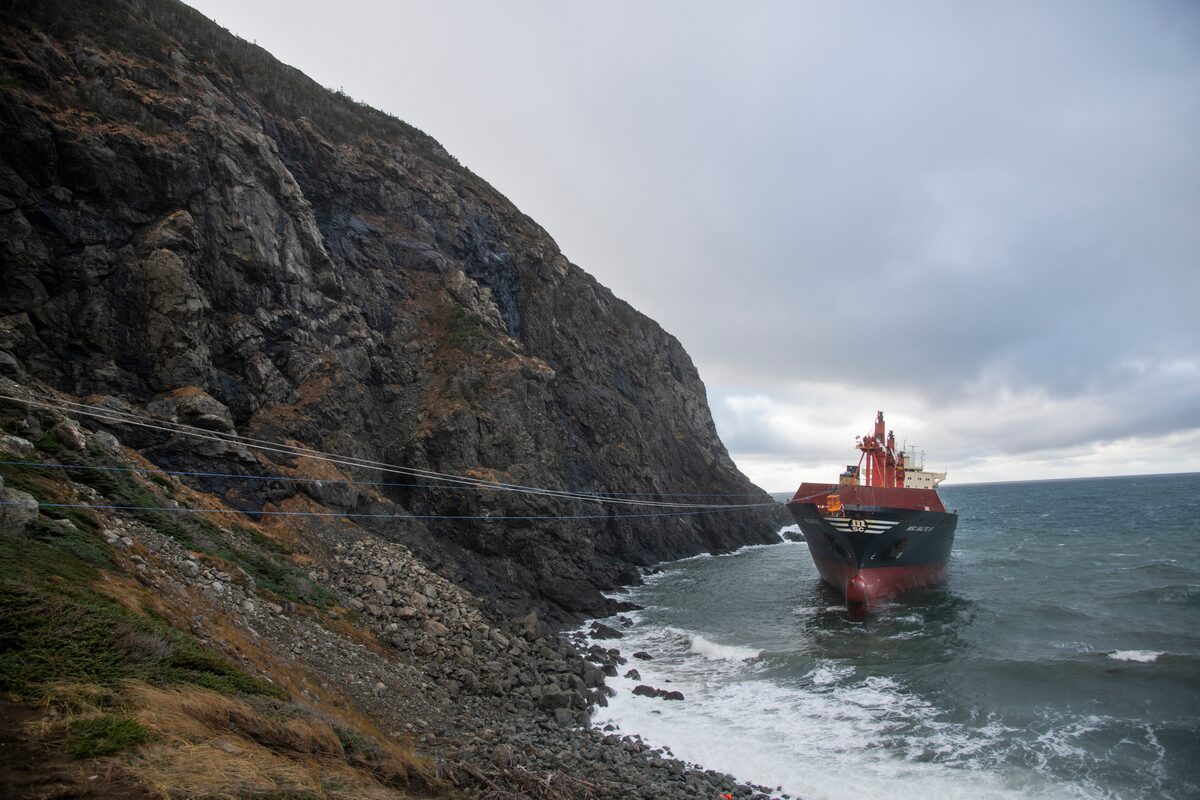
On a damp and blustery morning, three-metre swells crash into the cracked hull of the MSC Baltic III, which was grounded on a pinnacle of rock on the west coast of Newfoundland earlier this year. The wind carries whiffs of rotten egg. Salvage crews in hard hats and neon yellow jackets inch along in a temporary cable car suspended high over the churning Atlantic.
In a province with a long and dangerous maritime history, the Baltic’s grounding in the roiling shallows of Cedar Cove last February is a story Newfoundlanders retell with incredulity.
The cargo ship, en route to Corner Brook from Montreal, lost power in the early morning of Feb. 15 during a ferocious blizzard. The ship, packed with hundreds of containers of lumber, textiles, plastic beads, legumes and car parts, plus 1,600 metric tonnes of fuel, careered into the only safe harbour along a coast of towering cliffs.
All 20 crew members were airlifted off the ship in a harrowing rescue by the Royal Canadian Air Force.
Over the following months, salvage crews offloaded most of the 470 containers and siphoned out the fuel, which had hardened into an asphalt-like substance, in a multistage operation that involved heating it for days.
At risk were local wildlife – migratory birds and the capelin and lobster that local fish harvesters rely on for their livelihoods.
The goal of the work is to ready the ship for eventual dismantling and removal from the shoreline.
But now, winter weather has arrived, slowing down what’s considered the longest and largest operation in the history of the Canadian Coast Guard, said Bruce English, senior response officer with the federal agency’s Marine Environmental and Hazards Response team.
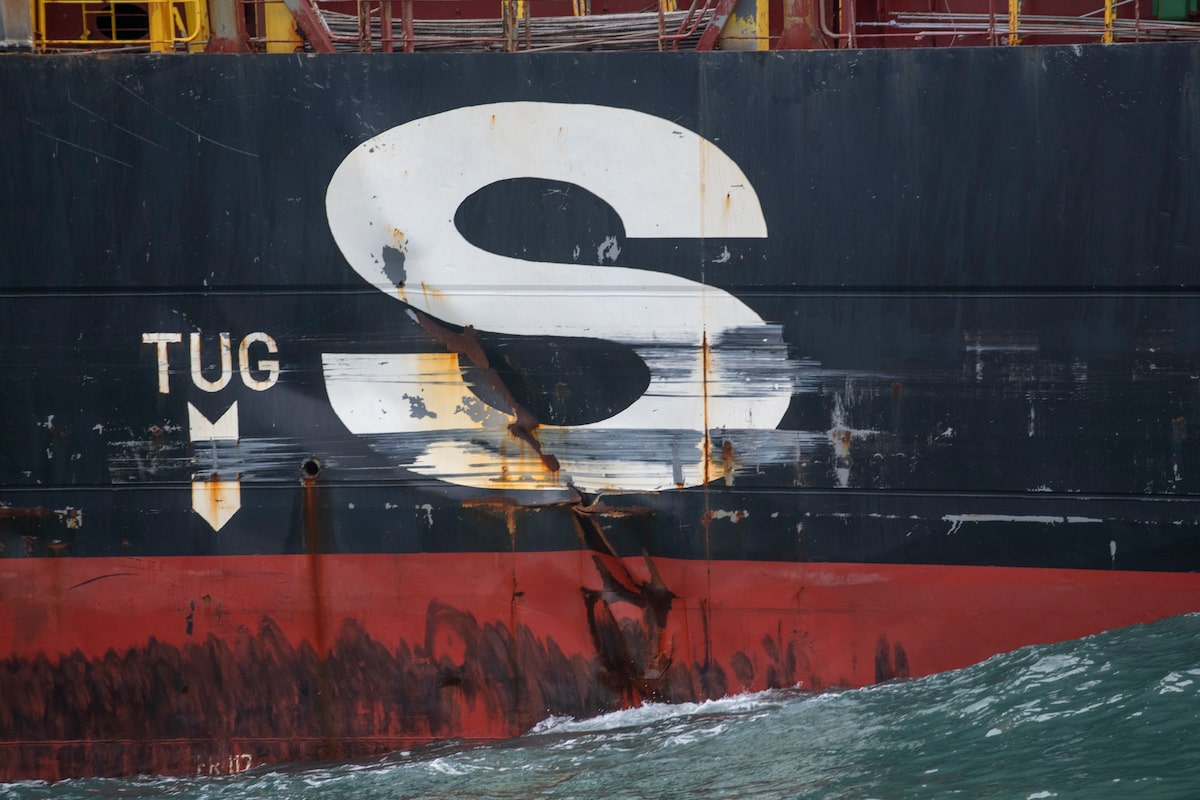
Recent severe weather has pounded the 200-metre steel cargo ship, buckling the hull even more and causing the stern to drop a few metres lower into the sea. Oily debris has washed ashore. And a recent snowstorm prevented Coast Guard crews from coming to work at all.
“You’re at the mercy of the environment,” Mr. English said. “You can’t haul the vessel in, you can’t put more lines on it. You can’t do anything.”

Newfoundland weather is wild at the best of times. But, on the strip of the province’s west coast where the Baltic is grounded, it’s downright biblical, as anyone in the neighbouring historic fishing towns will tell you.
Nearby Lark Harbour and York Harbour, about 45 minutes from Corner Brook, are clustered around a picturesque fjord, framed dramatically by the granite-topped Long Range Mountains. The same violent winds that have overturned trains and tractor-trailers south of here funnel through these mountains, gathering speed and bringing weather that rolls in like images in a slideshow. One moment, it’s a snow rainbow. The next, it’s eyelid-stinging sleet. And when the wind is really whipping, white sea foam whirls through the air like snow.
From an incident command post inside the town hall in York Harbour, Coast Guard crew watch the ship on monitors as if it’s an enemy target, overseeing a complex, often risky operation that’s wide open to the elements.
Only a skeleton crew of workers remain: the salvage crew hired by the ship’s owner, Switzerland-based Mediterranean Shipping Company, as well as federal environmental emergencies staff and environmental response workers. On days when it’s considered safe – and there aren’t many – the Coast Guard flies a drone overhead and patrols the choppy seas around the Baltic for debris.
It’s inevitable that the ship will crack in two this winter, Mr. English said. This poses a threat to the marine environment, mainly because of the residual fuel still on board and the 46 remaining shipping containers, some of which contain substances harmful to marine life such as flaxseed oil.
“If it breaks in two, it’s not going to float away,” Mr. English said. “It may be harder to get at, but salvage work will continue.”

About 100 tar balls, or blobs of congealed oil, have been collected from Cedar Cove and the surrounding shoreline.Supplied
The priority now is removing the residual fuel, he said. On days when the wind is less vengeful, salvage crew members ride a cable car from a steep embankment in Cedar Cove to the ship. On board, they scrape hardened heavy oil lining the walls of six massive fuel tanks. Already, sticky lumps of the hardened oil have been recovered from the shoreline by workers with Environment and Climate Change Canada, as well as the privately owned oil-spill response company Eastern Canada Response Corporation and the Coast Guard, all of whom patrol Cedar Cove and the surrounding coastline daily to look for potential signs of pollution.
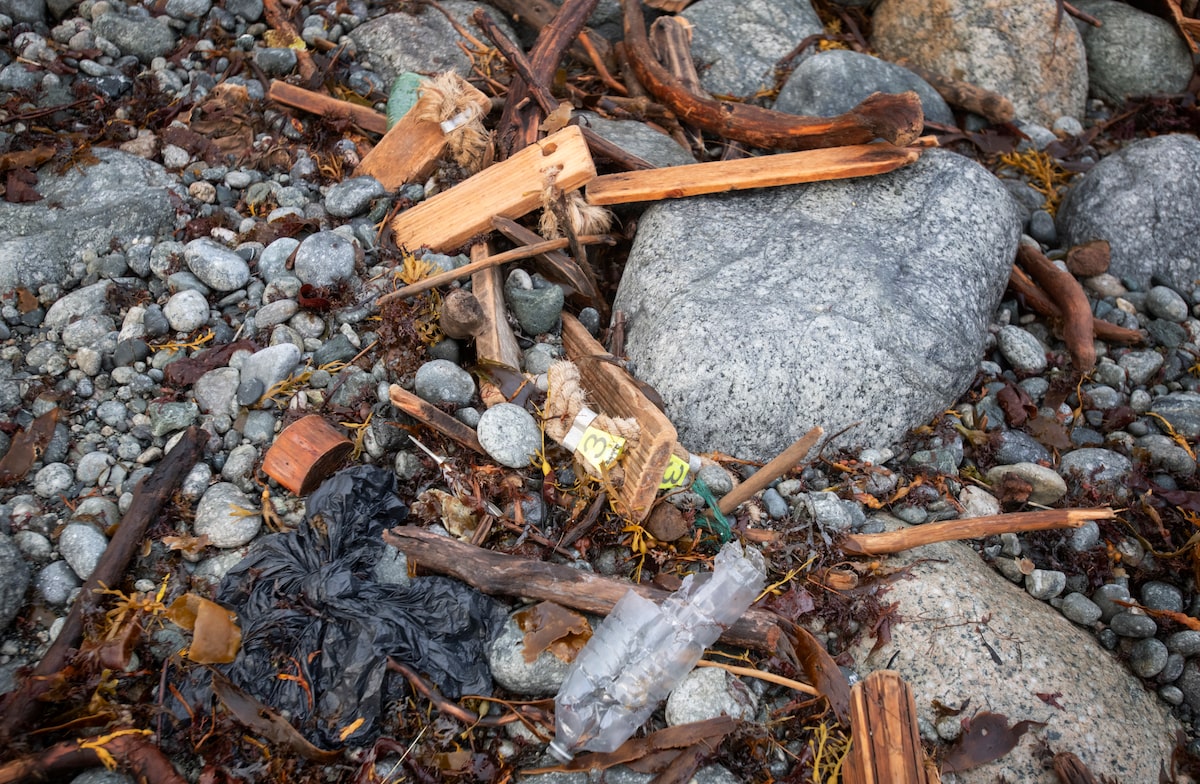
So far, they’ve collected 100 oil tar balls, ranging from the size of a fingernail to a Ping-Pong ball, and more than 300 tar coats, oil stuck to the surfaces of rocks and pebbles on the shore. After an early November storm that brought waves crashing over the deck of the nine-storey ship, they recovered about 30 garbage bags of debris coated in oil.
During one such beach scan in mid-November, Margo MacGregor, ECCC’s National Environmental Emergencies Centre senior officer, spotted a plastic bag coated in oil. She photographed it, documented its GPS location and slipped it into an evidence bag.
On her life preserver, Ms. MacGregor wore a monitor that tested for five different dangerous gases, including that rotten egg smell flushing off the ship. The acrid odour comes from beans and lentils decomposing in shipping containers, producing hydrogen sulfide that in high doses can be lethal to humans and animals. She was also on the lookout for dead wildlife – five or more dead fish have to be reported to Fisheries and Oceans Canada.
“That’s why we really want to have a look, to make sure that if there are any potential impacts to the environment, that they are captured,” Ms. MacGregor said while documenting a lone black-and-white dead bird lying in the surf.
Eventually, after the remaining containers and residual oil are taken out, a salvage company will be hired to remove the vessel, a project that will likely include dismantling the ship in pieces, Mr. English said.

Despite its threat to the environment, the shipwrecked Baltic has also enraptured the public, appearing as a “tourist attraction” on Google Maps and bringing more people into the sleepy fishing towns than ever before.
“It’s been an economic shot in the arm for sure,” Lark Harbour Mayor Wade Park said.
This past summer, during the fish harvesters’ busiest time of year, carloads of people showed up on the narrow access roads and working wharf, hoping to get a look at the ship. Security guards were eventually hired to help manage the traffic.
More visitors than ever have also turned up at local restaurants.
The towns’ one small grocery store and coffee shop were bustling too, selling out of locally made MSC Baltic III coasters and key chains.
The local church has perhaps benefited the most. Its volunteers cook hot lunches for crew with the Eastern Canada Response Corporation. The meals are paid for by their employer, meaning tens of thousands of dollars for the Saint James Anglican Church, said Ruth Travers, president of the Anglican Church Women.
“They’re like family to us now,” Ms. Travers said while serving loose meat burgers and fries to a group of rotational workers from Nova Scotia and Newfoundland.

Saint James Anglican Church is in Lark Harbour, one of the towns near the MSC Baltic III's current resting place.

The Coast Guard co-ordinates the recovery job from an incident command centre inside the town hall of York Harbour.
But as the weather turns and the months drag on, the battered ship weighs on the minds of those who stand to lose the most.
While the Coast Guard has said work will continue when the weather allows, Mr. Park laughed at the prospect of favourable weather. “Not being negative here, but good luck with that.”
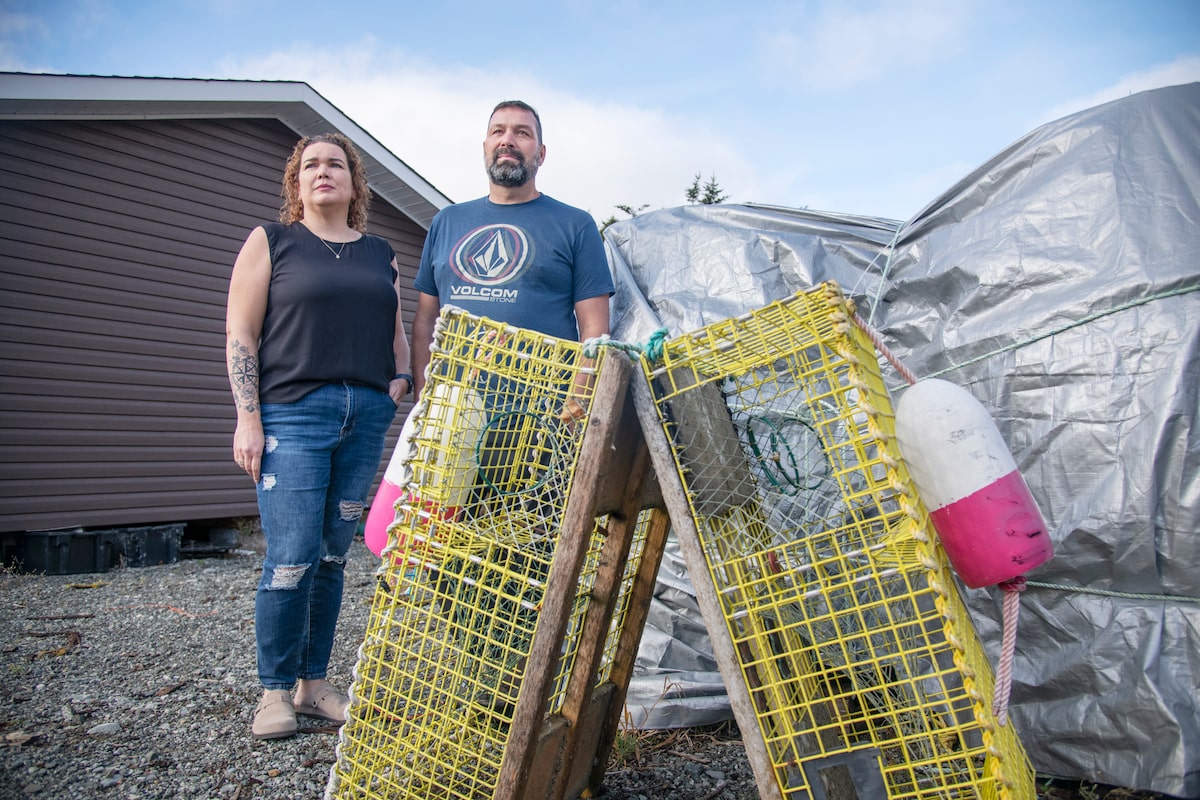
A nautical mile around the Baltic is blocked off while the recovery is under way. The ship sits in a rich lobster, capelin and herring fishing area that was inaccessible to fish harvesters last summer and likely will be again next season, said Lark Harbour lobsterman Gerard Joyce and his wife, Melanie, who are both worried about the environmental impact on marine life.
“That’s ground not being fished. Is it a good thing? I don’t know – all these chemicals aboard the boat leaking on these lobsters that’s there. There’s always something coming out of the boat,” Mr. Joyce said.
Ms. Joyce lamented the prolonged recovery of the Baltic, which understandably is dependent on the mood of the seas.
“It’s got to get removed before something big happens,” Ms. Joyce said. “If the fishery shuts down here, this community is done.”
The shipping news: More from The Globe and Mail
The Decibel podcast
Noise from ships and other human activity is stressing out North Atlantic right whales, and scientists are just beginning to grasp how that hurts the endangered animals. Journalist Jenn Thornhill Verma spoke with The Decibel about threats to whales from noise pollution and fishing gear. Subscribe for more episodes.
The industrious ocean
Greg Mercer: Canada’s lobster industry is on a roll. But we can’t take the good times for granted
Norway’s high-stakes gamble on sustainable salmon farming
Editor’s note: A previous version of this article incorrectly stated that Lark Harbour and York Harbour are located south of Corner Brook. Each is located about 45 minutes northwest of Corner Brook.