

Christie Little moved to a small community outside Winnipeg to live under a big prairie sky, where the nights would be lit by a canopy of stars and the quiet disturbed only by the wind.
But this winter, she saw a Facebook post about plans to build a hyperscale AI data centre near her home in Île-des-Chênes, a community of 1,500 people. She started reading and she started to worry, she said.
Data centres used for artificial intelligence are essentially large barn-like facilities filled with networked processing units. The work they do – sifting through huge amounts of data – requires an enormous amount of power and special cooling systems to keep the servers from melting down.

Ms. Little moved to the small community near Winnipeg to find peace and quiet under a big prairie sky.Shannon VanRaes/The Globe and Mail
In her mind’s eye, Ms. Little imagined the looming presence of a power-sucking warehouse, lit up with security lights and pulsing with the hum of thousands of cooling fans. The effects on local energy, the drain on the water supply, the light pollution and noise would all be disastrous, she thought. She decided to get organized, fast.
“I began to panic a bit,” the realtor said. “So I met with some neighbours and we decided that we’re all going to work together to try and stop it.”
After months of locals’ advocacy, on June 4, Manitoba Premier Wab Kinew announced he had heard their concerns and put a halt to the proposed data centre by deprioritizing its hookup to Manitoba Hydro, the provincial electric utility.
On that same day, in Southern Ontario, hundreds of citizens bearing signs and chanting slogans flooded a committee hearing at Hamilton City Hall to demand that a zoning application for an AI data centre be denied. Observers had never seen a crowd so large for a decision so small – a proposal to carve out a portion of the former Stelco lands as a potential data centre location. Even though the application was in order, it was denied due to the overwhelming public response.

Prime Minister Mark Carney announces Canada's new federal AI agenda, at Toronto General Hospital on June 4.Cole Burston/Reuters
And that very morning, at a hospital in downtown Toronto, Prime Minister Mark Carney released a long-anticipated national AI strategy, about six months late. The document devoted several of its opening paragraphs to addressing public anxiety about AI, describing trust as the “north star” of the strategy. But it moved quickly to an emphasis on economic opportunity, with the government citing a need to quintuple the share of small businesses using AI.
The events of June 4 are a microcosm of the tensions that animate the race to adopt, wrangle and reckon with artificial intelligence.
It is suddenly omnipresent, summarizing our text messages, filling social media with slop and making it harder to know whether what we see is genuine or not, from the e-mail at work to the speech at a wedding. The march of AI is happening quickly, often in domains over which individuals feel they have little control.
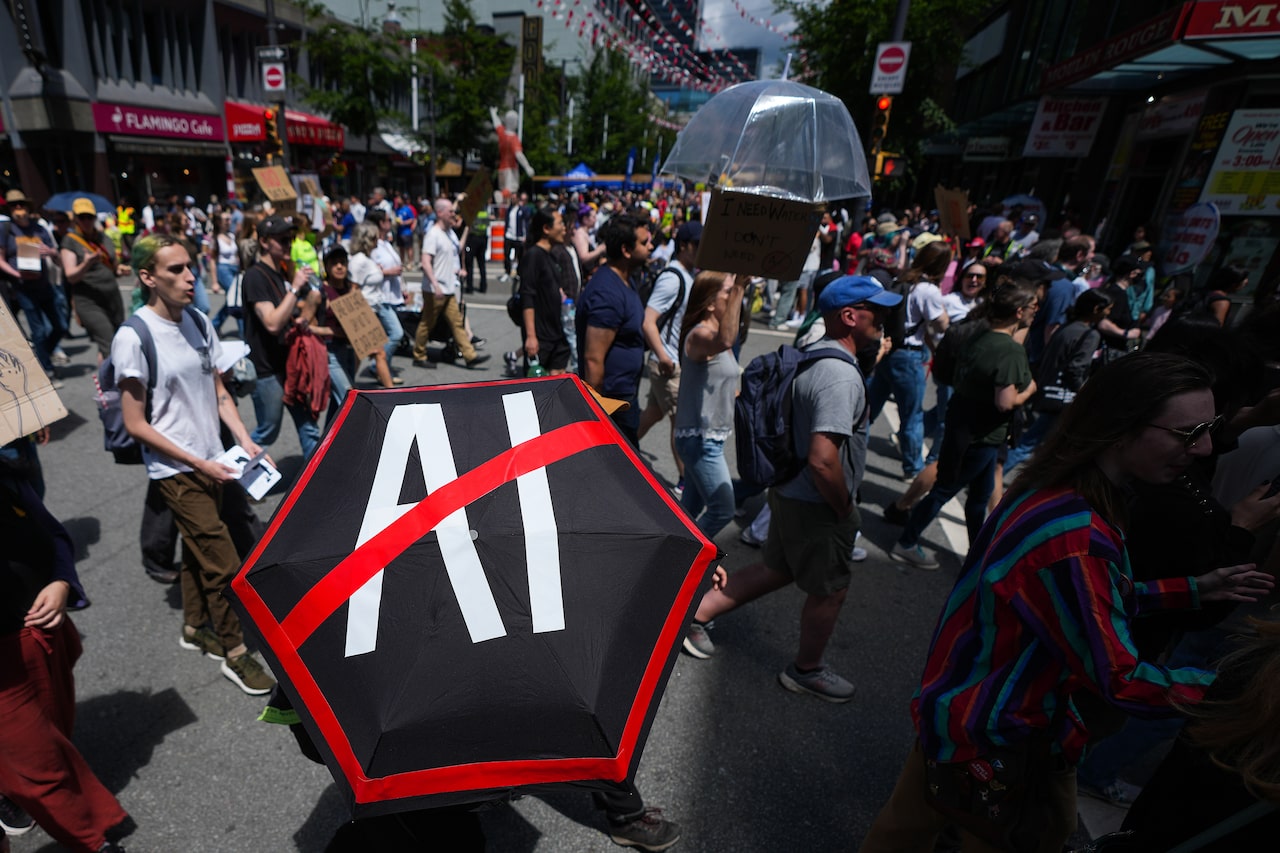
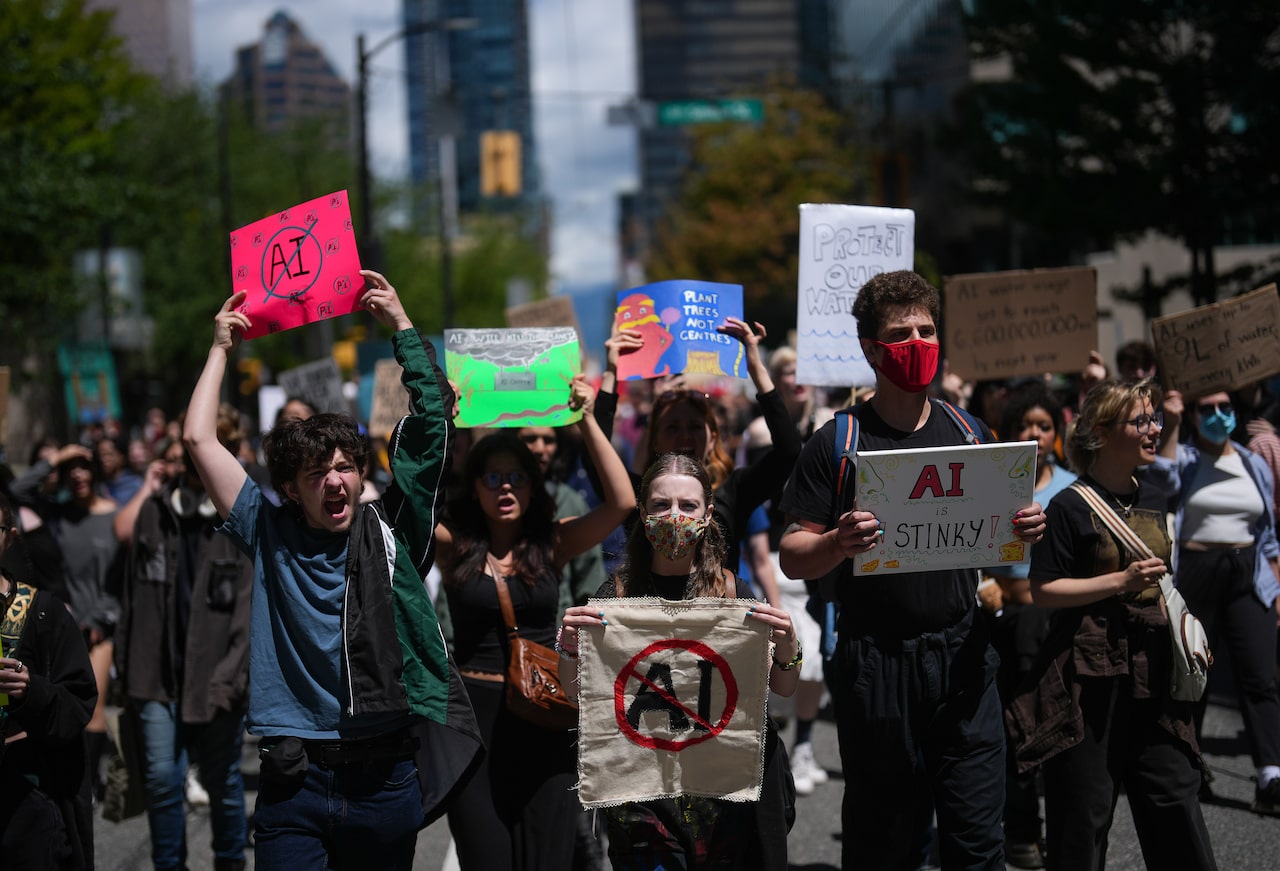
The data centre fight represents AI’s collision with actual communities, and creates a democratic opening to push back.
Battles have been festering in Saskatchewan and Alberta, where the vast majority of new data centres are being planned. Across the country, a recent study found 143 announced and under-construction AI data centre projects with an average capacity 10 times greater than existing facilities.
Last week, Meta announced it will build a $13-billion data centre in Sturgeon County, Alta. It will consume a gigawatt of power, nearly three-quarters the amount of energy required for the entire city of Edmonton. It’s expected to create 3,000 construction jobs and 300 permanent operational jobs.
It will require building a new natural gas power plant that is being touted as a boon to local utilities and would bring, by the provincial government’s estimate, $250-million annually in economic benefits. But it’s also going to rely, at least initially, on non-renewable energy that could drive up power costs for the broader community, according to environmental advocates.
It’s clear a hyperscale boom is coming. Business leaders and governments have trumpeted potential gains in productivity and profits. But citizens are also starting to make calculations of their own.
An average hyperscale data centre is estimated to use between 438,000 and 700,800 megawatt hours of power annually, according to one study, equivalent to the energy required for 40,000 to 64,000 homes. If the Meta data centre proposed in Alberta is any indication, new data centres can be even bigger than that.

Alberta Premier Danielle Smith (left centre) shakes hand with Sturgeon County Mayor Alanna Hnatiw, as government officials and a representative of Meta look on. Meta announced it will build a $13-billion data centre in Sturgeon County, Alta.AHMED ZAKOT/The Globe and Mail
Polling by the Angus Reid Institute shows about 70 per cent of Canadians would oppose construction of an AI data centre near their home. Nearly 70 per cent of the population want the government to heavily regulate AI. And about 45 per cent of respondents believe AI will significantly reduce the number of available jobs over the next decade.
From North American university campuses to the Vatican, warning signs are flashing about a broader societal pushback against AI. In Canada, the data centre fights may be where the conflict over an epoch-defining shift – one that will affect how we live, work and think – bursts into the real world.

Eric Schmidt, former Google CEO, in November, 2025. While delivering a commencement speech at the University of Arizona earlier this year, Mr. Schmidt was booed by students upon mentioning AI.Alexander Tamargo/Getty Images
A visceral example of popular unease about AI came in mid-May at a convocation ceremony at the University of Arizona.
Speaker Eric Schmidt, the former Google CEO, was enthusiastically booed by students after mentioning artificial intelligence. The graduates booed even louder when Mr. Schmidt went on to describe its rise as a technological transformation that would be larger than anything that had come before.
It’s fitting that such a visible public expression of worry about AI would occur in a university context. Ever since generative AI burst into the public consciousness, campuses have been a site of conflict. Thousands of students have been accused of academic dishonesty. Those who have played by the rules feel cheated; professors who’ve been fooled feel disillusioned.
Beth-Anne Schuelke-Leech, an associate professor of engineering at the University of Windsor, said universities have been struggling to respond to AI. Its ability to write pages of fluent text in mere seconds has upended the centuries-old model of evaluation based on written responses.

Beth-Anne Schuelke-Leech, associate professor of engineering at the University of Windsor, has already seen AI upend traditional modes of teaching and evaluation.Dax Melmer/The Globe and Mail
She was astonished a few years ago to find that when she asked her students what they thought of AI, about two-thirds, in her estimation, resorted to AI for their answer.
“There was no originality. There was nothing interesting about what they’d written. They were simply echoing the exact same phrases in exactly the same way,” she said.
The lack of basic effort made her question the whole enterprise of teaching in the AI era.
Her experience is increasingly common at universities. Jorge Sanchez-Perez, a professor of philosophy at the University of Alberta, discovered just as AI chatbots were gaining popularity that roughly one in five students in his class had used the same AI-invented quote in their essays.
“They are outsourcing the cognitive labour,” Prof. Sanchez-Perez said, adding he sees it as a warning sign of what happens when a culture of safe use doesn’t yet exist. “It’s a death wish for intellectual development.”
Prof. Schuelke-Leech has studied moments of technological upheaval throughout history.

Ms. Schuelke-Leech says she predicts massive social and political unrest in the next 20 years as the pace of change continues to accelerate.Dax Melmer/The Globe and Mail
Most of the students she knows are dumbfounded by the pace of change, and terrified of what it will mean for their job prospects, she said.
“I am very confident that in the next 20 years, our economy and our society will look nothing like it does now. The upheaval that we’re going to experience is going to be massive, and that’s going to lead to a lot of social and political unrest,” she said.
Maia Cassie, a student entering third year at Victoria University in the University of Toronto, said when she first encountered generative AI, she was annoyed that less scrupulous peers were succeeding at skipping the hard work and still getting good grades.
She now uses AI in some cases, to help her study by preparing quizzes, for example, and is more understanding toward peers who use it. But she’s still wary. She worries that if she fell into the AI habit, it would degrade her ability to think imaginatively.
Ms. Cassie, who is studying sociology, said she enjoys the struggle of sitting for hours with an essay, working through her thoughts and finding the right words. When she produces a written text, however simple, it contains something of herself.
“It’s about the sacredness of what I’m producing,” she said. “It’s kind of an intense word, but I like to maintain realms in my life that are sacred.”

People participate in the All In AI conference in Montreal in September, 2025. Thousands of innovators and stakeholders from around the world attended Canada's largest AI conference to discuss the future of the industry at home and abroad.Christopher Katsarov/The Canadian Press
There is something resonant about the link between written expression and the sacred.
Already, AI has entered intimate areas of our lives. People are using it to take short cuts, such as composing texts and e-mails, or even to create dating profiles. They’re also taking comfort in its counsel, a model that has already gone tragically off course as some have died by suicide or committed violent crime after consulting AI chatbots.
The federal government recently introduced age minimums for social media, concluding it was wrong to have allowed the online platforms to grow without policy constraint. But AI is growing in a similarly unregulated environment, and it, too, will affect young people.
In his first encyclical, published in May, Pope Leo XIV asked his audience to reflect on what they are building with AI. He took aim at what he called a “technocratic paradigm.”

Pope Leo XIV's first encyclical, 'Magnifica humanitas,' focuses on protecting humanity and human dignity amid the rise of artificial intelligence.Yara Nardi/Reuters
Although AI may surpass human intelligence in speed and computational capacity, it lacks a moral conscience, he wrote. It doesn’t understand what it produces. It gives the impression of objectivity, and it makes life easier, but it can also “weaken personal creativity and judgment,” he warned.
Its imitation of human compassion, with kind words and positive affirmations, is dangerously risky, he stated. And the way it can amplify the influence of those with wealth and resources could have negative consequences.
The new technology threatens “to normalize an anti-human vision,” the Pope added. “Merely regulating it is insufficient; it must be disarmed,” he wrote. “We cannot consider AI to be morally neutral.”
Nearly 30 per cent of Canadians are Catholic. How many will heed the Pope’s writing is an open question, but it’s notable that a force as influential as the Church is urging caution.
Echoing concerns that have surfaced beyond the Church, the Pope also devoted attention to the potential impact of AI’s development on human work, calling unemployment, a “grave evil” and a “social calamity.”
AI’s impact on jobs and the economy is central to much of the anxiety that surrounds its adoption.

In Olds, Alta., Synapse Real Estate Corp. is planning an AI data centre and attached natural gas plant to supply power to the complex.Lauren Krugel/The Canadian Press
André Côté, executive director of the Dais think tank at Toronto Metropolitan University, said concerns about AI expressed in the media tend to focus on energy requirements and environmental impact. But many people are also concerned about their livelihoods, he said.
“The Eric Schmidt commencement booing was a holy smokes moment that showed just how upset and scared young people are,” Mr. Côté said.
Data from the Pew Research Center in the U.S. shows those aged 18-29 are about 10 percentage points more likely than those in older age groups to say the impact of AI over the next 20 years will be negative.
Technological jumps that wipe out entire categories of work tend to take years to play out, Mr. Côté said, so he thinks “jobs apocalypse” scenarios likely aren’t imminent. He expects the disruptions will be significant, however, and it’s clear many people believe we aren’t ready for the social consequences.
Mr. Côté said he believes the government’s AI strategy was delayed by several months in part due to a need to gauge public mood on AI. While the substance of the document focuses on opportunity, much of the language is devoted to assuaging fears.
He said he wonders whether people are skeptical because they don’t understand AI, or if it’s that they’re starting to understand it and don’t like what they see.
“The data centre protests are a really interesting manifestation of the whole thing.”

In Milton, a growing municipality in the Greater Toronto Area with swaths of open land, the local government says it has received general inquiries about data centre developments.Keito Newman/The Globe and Mail
In Milton, Ont., resident Mary Brown believes plans are afoot to build a hyperscale data centre.
The local government says it has received general inquiries about data centre developments, which is unsurprising given the available land in the municipality and its proximity to power transmission corridors, according the town’s senior public relations adviser Rob Faulkner. He said there are currently no active applications under consideration.
But Ms. Brown is worried. As the chair of Sustainable Milton, she describes herself as a bit of a YIMBY (Yes in My Back Yard), someone who favours development because she wants to see greater density. However, she fears hyperscale data centres may be forced on locals.
“They don’t seem to be that transparent about how they’re going to get the energy that’s going to be required,” Ms. Brown said, referring to tech firms and developers. “They’re treating the place as an all-you-can-eat buffet. And we’re going to run out of power. It’ll just put more pressure to burn more fossil fuel, and that’s not the right way to go.”
Her concern is that governments seem to be allowing development to be regulated at the local level, without broader provincial or federal oversight.
“There doesn’t seem to be any control around who can build one or how fast they can build one. Nobody seems to be going, okay, we can afford three data centres, and that’s what we’ll install. It’s almost as though it’s a free-for-all.”

People march through downtown Vancouver protesting plans to build and operate massive AI data centres in the province.DARRYL DYCK/The Canadian Press
The municipality’s position is that proposals for AI data centres will, at a minimum, need a site-specific zoning bylaw amendment “due to the potential impacts that would require mitigation,” Mr. Faulkner said.
When hundreds of people lined up to attend the committee hearing in Hamilton on June 4, they came bearing signs with slogans such as “You can’t drink AI” and “Rage against the machines.”
Nrinder Nann, a Hamilton city councillor, said it is clear that data centres are becoming a flashpoint. It was the biggest crowd to show up at city hall in many years, she said.
There are three applications in process for large data centres in Hamilton, and residents are anxious about what that will mean, Ms. Nann said.
“Folks have concerns, fears and anxieties. The best way to deal with that is to give people information,” she said. “What is the energy use going to be? What does the water use look like? What’s the noise impact?”
But some constituents are firmly opposed for deeper reasons.
“Some people are strongly in the camp of no because they’re really concerned about the future of AI altogether,” Ms. Nann said. “Is AI evolving in a way that maintains people’s autonomy? Is AI evolving in a manner that’s going to result in further entrenching inequities in our society?”
The committee said the decision to turn down the severance application was driven by the evident public opposition that was on display June 4.
In the wake of the protests, Ms. Nann proposed another motion, which passed Hamilton council’s planning committee on June 16 and will be voted on again this month, that would impose a one-year moratorium on large-scale data centre developments in the city.
As protesters in Hamilton celebrated a victory, in Manitoba, the premier was responding to growing opposition to the data centre planned in Île-des-Chênes.

The field in Île-des-Chênes that was the proposed site of a hyperscale AI data centre. Due in part to organized opposition by locals, the project never got off the ground.Shannon VanRaes/The Globe and Mail
Ms. Little said she started an online petition in February to galvanize support.
“This is not just a piece of land; it’s our home, our community, and our future at stake,” she wrote. “The construction and operation of this massive AI Data campus threatens to bring significant negative impacts to our tranquil lives.”
The petition eventually garnered more than 13,000 signatures. Ms. Little argued the only jobs the project would create would be in short-term construction work, while power demands could lead to increased electricity costs. Residents would be dealing with air pollution from turbines, as well as noise from the hum of the fans and the glare of security lights.
“It’s clear as a community, I think, and it’s pretty clear as a province, most people don’t want these,” Ms. Little said, preaching the need for caution. “Honestly, as a nation we should be slowing down and saying we need to move responsibly.”
Wayne Lloyd, CEO of B.C.-based Consensus Core, which partnered with a U.S. company called Jet.AI on the proposed 500-megawatt data centre, said many of the public concerns he has heard reflect an out-of-date picture of the facilities, which now use much less water than many assume.
He said he wasn’t certain the Manitoba project would even need to be connected to the municipal water system. As for its power needs, the plan was to connect to the TransCanada natural gas pipeline and generate power locally, in combination with some electricity from the provincial hydro grid and battery power.
Manitoba’s Premier, though, was not persuaded.

In June Manitoba Premier Wab Kinew rejected the proposal to build the hyperscale AI data centre near the community of Île-des-Chêne.Adrian Wyld/The Canadian Press
“There are big threats to the environment and not much benefit to the economy,” Mr. Kinew told reporters on June 4.
Mr. Lloyd said the Premier’s negative reaction came “as a very big surprise,” although his company has still not received a formal response from the province. He said he now plans to concentrate his efforts in the many other jurisdictions – such as Alberta – that look favourably on data centre development.
“I think this is a very important thing for Canada to embrace. We’re going to need this type of industrial capacity,” Mr. Lloyd said. “Île-des-Chênes had great potential, but it’s not the only place in the world where you can develop these projects.”
Mr. Carney has argued for a different perspective. His June 4 speech at Toronto General Hospital, which trumpeted the many potential beneficial uses of AI in health care, seemed to be aimed squarely at winning over those who, like Ms. Little, are wary of what feels like an unstoppable tide.

During his visit to Toronto General Hospital in June, Mr. Carney spoke favourably of the many potential beneficial uses of AI in health care.Chris Young/The Canadian Press
He said AI could spawn 250,000 new jobs over the next five years. He pledged to double the capacity of Canada’s electric grid to provide the necessary power, and promised to put in place protections that would address the concerns of a population that he said ranks near the bottom in AI literacy, training and trust.
Mr. Carney asserted that in the years ahead, national well-being will depend on a safe, reliable and sovereign AI. He challenged citizens to embrace the flood.
“Prosperity and sovereignty in the age of AI belong to those nations that can build, adopt and govern AI on their own terms – nations that encourage the deployment of AI to make the lives of their citizens better,” he said.
But for many, the doubts are hard to shake.
As Mr. Carney said himself that day, the question is whether AI will improve the lives of all Canadians, or benefit only a few.
The Decibel: Carney’s plan for AI in Canada, explained
In June the federal government released its plan for AI, and it includes a lot of new money ($2.3-billion, to be precise) toward training, adoption and supporting Canadian businesses and tech companies. There was a lot of anticipation leading up to this strategy’s release, both from those excited about how Canada plans to build and harness the technology, and also from those who are concerned about the potential ramifications and safety of AI.