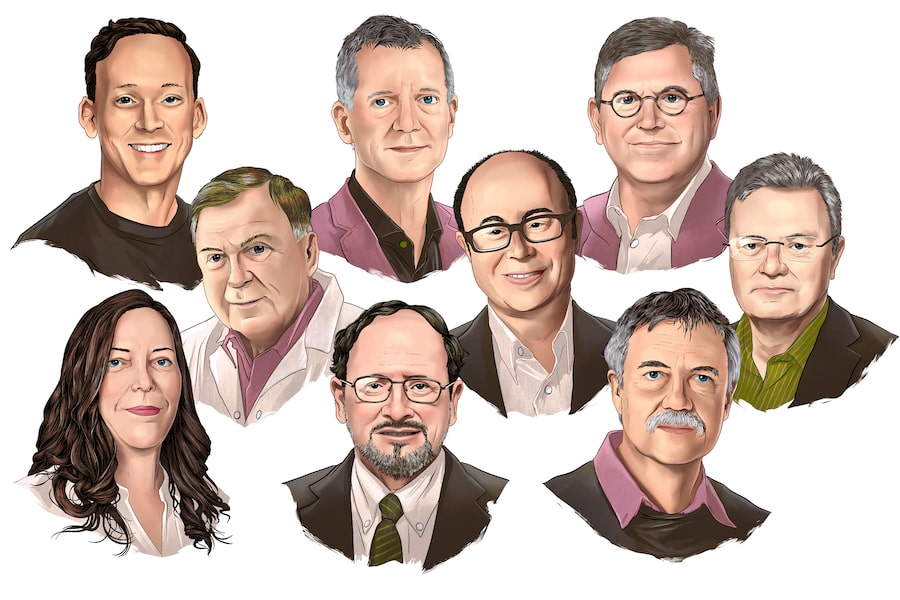
Each year, Canada’s Gairdner Foundation considers nominations from around the world with the goal of recognizing the most significant advances in human biology and medicine.
The foundation bestows five international awards of $250,000 as well as a global health award of $100,000. Two additional awards of $100,000 each are given to Canadian researchers who have produced exceptional work in the past six years.
Many Gairdner laureates have gone on to win Nobel Prizes for their discoveries. The awards offer a deep dive into the amazing leaps and achievements being made at the frontiers of biomedicine. This year’s crop of awardees – announced on Tuesday – captures the ingenuity and dedication exhibited by scientists working to change the world for the benefit of all.
Canada Gairdner International Awards
John Yates III, Ruedi Aebersold and Matthias Mann
The Weight of Life


In the late 1980s, researchers were preparing to take on one of the most ambitious efforts in the history of science: reading the entire sequence of DNA that makes up a human being. The Human Genome Project promised to reveal the molecular recipe that make us who we are and help spot the errors in the code that could account for a myriad of diseases.
But the idea that genes alone can answer all questions about life and disease proved “overly optimistic” said Ruedi Aebersold, a professor emeritus at the Federal Institute of Technology in Zurich, Switzerland.
Genes are instructions for building proteins – the molecular parts that make up the bulk of living organisms. While the genome provides a list of those parts, based on their DNA, it “did not explain how biological systems function,” Dr. Aebersold said.
What was needed was a way to connect the unchanging letters of the genome to the dynamic and mutable assemblage of proteins that represent the physical state of a cell, tissue or organism. By some estimates, the different types of proteins and their variants in the human body number in the hundreds of thousands. Collectively, this vast and fluctuating landscape is called the human “proteome.”
Proteins make for challenging research subjects because they are large and complex molecules with shapes that can be hard to differentiate. In the early days of molecular biology, it was painstaking and tedious work to identify proteins one at a time.
But some researchers saw an opportunity for speeding things up. The idea was to break proteins down into their constituents to identify them more easily. The key instrument for doing this is the mass spectrometer, “the bathroom scale of science,” said John Yates, a professor at the Scripps Research Institute in La Jolla, Calif.
A mass spectrometer shoots out molecules like bullets and weighs them by measuring how much a magnetic force bends their flight. The heavier the molecule the harder it is to divert it from a straight line. Large molecules such as proteins can be sent through in pieces, with each kind of protein producing its own unique pattern of fragments.
Dr. Yates, who earned his PhD in 1987 at the University of Virginia, went west to the California Institute of Technology where he became convinced that newly available genetics sequences for various proteins could serve as a guide to identify which of those proteins are present in a sample. Armed with that information, “we’d be able to observe experimentally what proteins were doing in the cell,” Dr. Yates said.
Over the next several years he worked on algorithms that could take the output from a mass spectrometer and match it up with predictions based on the genetic codes of proteins, including those with unknown functions. This made it possible to identify many proteins at once, which in turn opened up new avenues for studying a wide range of diseases, from cancer to neurological disorders.
Dr. Aebersold received his PhD at the University of Basel and was later at the University of British Columbia before moving to Seattle to co-found the Institute for Systems Biology. During this time he hit upon a series of improvements to protein identification that further boosted the field.
A key outcome of these innovations is a better sense of how different proteins vary in kind and quantity in response to biological conditions. In some cases, such measurements now make it possible to associate changes in the proteome with the onset of disease and help determine the cause.
“You can trigger the cell to do something and you follow the proteins with their attributes over time, then you can start to piece together these mechanistic links,” Dr. Aebersold said.
Matthias Mann began as a physics student in Germany when he was introduced to new developments in mass spectrometry by a visiting professor from Yale University. He followed him there and went on to earn his PhD using a technique know as “electrospray” that makes it easier to weigh and identify biological molecules.
After a stint in Denmark he joined the Max Planck Institute of Biochemistry in Martinsried, Germany, where he and his team have continued to pioneer techniques that make it possible to identify and measure the quantities of thousands of proteins in a single experiment.
Together with Dr. Yates and Dr. Aebersold, Dr. Mann has accelerated a now-indispensable branch of biomedicine.
All three are among the most highly cited researchers in the world.
Dr. Mann said that while it is gratifying to find ways to improve laboratory techniques, the real reward is knowing that the improvements lead to real breakthroughs and to benefits for patients.
“That’s the ultimate,” he said. “Not just to develop technology for its own sake but to use that technology to solve a problem that couldn’t be solved before. That’s a really good feeling.”
– Ivan Semeniuk
Jeffery W. Kelly
The Shape Changer

Some scientists toil their entire lives in pursuit of that “eureka” moment. But Jeffery Kelly’s moment arrived at the start of his career, when he was still a postdoctoral fellow casting around for something meaty to research.
Dr. Kelly was in the library at the Rockefeller University in New York City when he stumbled across a paper about amyloidosis, a group of diseases caused by a buildup of abnormal proteins, or amyloids, in the body’s tissues and organs.
The thinking at the time was that an abnormal breakdown of proteins was causing them to form toxic clumps. But as a chemist, Dr. Kelly had a different hunch: What if shape changes to the proteins were actually driving these diseases?
“The way that these mostly medical people were thinking about these diseases didn’t make a lot of sense from a purely scientific perspective,” said Dr. Kelly, who is now a chemistry professor with Scripps Research.
“I was so confident at that time that I had figured out these diseases from reading the data.”
Dr. Kelly barely left the library for a week, inhaling every paper he could find on the subject. He went on to build his entire career on studying amyloid diseases, transforming our scientific understanding of their role in neurodegenerative diseases.
Building on his discoveries, Dr. Kelly also developed tafamidis, the first effective treatment for transthyretin amyloidosis, the third-most common amyloid disease.
Transthyretin amyloidosis often affects the heart – and in these patients, it’s historically had a median survival rate of just two to six years after diagnosis. Once considered rare, the disease is now estimated to affect more than 400,000 people worldwide.
“Dr. Kelly’s approach has inspired new prospects for therapies for Alzheimer’s disease, ALS and other protein-misfolding disorders,” the Gairdner Foundation said in its announcement of Dr. Kelly’s 2026 Canada Gairdner International Award.
Growing up in Medina, a village near Niagara Falls, New York, Dr. Kelly was the kind of boy who loved taking things apart just to decipher how they worked. When he discovered chemistry in college – a subject he’d never considered as a teenager working on a dairy farm – he found himself similarly fascinated by the mysteries of how things worked on a molecular level.
“It was magic, in a way,” Dr. Kelly said. “When I was an undergrad, you had to infer the structures of your molecules through [various] techniques and I just loved that kind of detective work.”
Dr. Kelly’s molecular sleuthing confirmed the hypothesis he first formed inside the Rockefeller library in the late 1980s, which is that transthyretin amyloidosis is actually triggered by shape changes to the transthyretin protein.
Transthyretin is a “tetramer,” made up of four protein components. Dr. Kelly’s research revealed that when these pieces come apart, they can undergo shape changes that enable them to misassemble or clump together, eventually building up inside the heart and impairing function.
The key, he realized, was to stop these tetramers from breaking apart in the first place. So he spent about a decade making 1,000 small molecules in hopes of finding one that can stabilize transthyretin.
The successful molecule, tafamidis, is now a blockbuster drug, sold by Pfizer and generating US$6.38-million in revenue last year.
Today, Dr. Kelly marvels at how far the field has come since he was a postdoc, burning the midnight oil in the library and realizing he was seeing something that the medical establishment had missed.
“I would say, to students of science, it’s not always the absolute smartest student that’s going to make the profound discoveries,” Dr. Kelly said. “Creativity and thinking differently than what’s in the medical and scientific textbooks – that’s how we move fields forward.”
– Jennifer Yang
Wolfgang Baumeister
A View from the Inside

The invention of the light microscope in the 17th century may have been the key that opened the door to modern biology. But by the time Wolfgang Baumeister was a student at the University of Bonn in Germany in the 1960s, the practice of looking through an eyepiece and making drawings of what he saw seemed like a “pretty boring” way to spend time, he said.
But then he discovered an abandoned electron microscope that someone had left behind after moving to a different university.
“I basically taught myself how to use it,” Dr. Baumeister said.
Instead of light, electron microscopes blast charged particles that can pass through or bounce off a sample and reveal details less than one billionth of a metre across – small enough to discern individual atoms.
In 1970, Dr. Baumeister moved to the University of Dusseldorf, a renowned centre for electron microscopy, where he spent the next decade mastering the technology.
While electron microscopes had already been around for decades, their suitability for imaging biological molecules was hindered by the fact that a sample can be damaged by the microscope’s high energy particles and by the vacuum in which a sample must be placed.
During the 1980s, a big leap forward was the development of cryo-electron microscopy, which involves keeping the molecules in sample steady by carefully freezing them to liquid nitrogen temperature (-196 C). The innovation earned its inventors a Nobel Prize in 2017.
Long before then, Dr. Baumeister imagined going a step further.
By 1981, he had moved to the Max Planck Institute of Biochemistry (where he now is an emeritus director). It was there that he began thinking about how to image molecules that were not isolated in purified samples but rather in their natural environment inside cells. Only this could show how different molecules and structures interact to enable the basic functions of life. But it was a daunting challenge.
“I think most people though this was never going to work,” Dr. Baumeister said
Through the 1990s, Dr. Baumeiter and his team made slow but steady progress as they learned to freeze and then section samples so that the desired target could be seen in place. They automated how the beam was directed to minimize damage and obtain views from multiple angles to show molecules in three dimensions.
The method, called cryo-electron tomography, has provided a new way to image and examine life at the smallest scales possible.
Among their subjects for investigation is the proteasome, a tiny barrel-shaped component of cells whose job is breaking down and recycling proteins in the cell.
Now 79, Dr. Baumeister, who is also an adjunct professor at ShanghaiTech University in China, is continuing to develop the technology he pioneered.
“If you believe in something, you have to be persistent,” he said. “I think persistence is maybe the most important ingredient to success.”
– Ivan Semeniuk
John Dirks Canada Gairdner Global Health Award
John Clemens and Jan Holmgren
Turning the Tide on Cholera


Scientists began the quest to create a cholera vaccine in 1865 but, time and time again, they failed to produce an effective shot.
In the early 1980s, however, Jan Holmgren, an immunologist at the University of Gothenburg in Sweden, demonstrated how immunity develops, and it became clear an oral vaccine would be much more effective.
(Cholera is a severe diarrheal illness caused by ingestion of water or food contaminated with the bacterium Vibrio cholerae. It kills an estimated 143,000 people a year.)
That early work led to the development of the vaccine Dukoral, which John Clemens, then a researcher at Yale University, field tested in a massive study in Bangladesh.
That landmark research showed Dukoral to be effective and led to the licensing of the vaccine in 1991. But the drug was relatively expensive, and difficult to administer in developing countries, since it required at least two doses.
Dr. Clemens worked with Dr. Holmgren, as well as scientists in Vietnam, to develop a much simpler and inexpensive version of the oral vaccine, one credited with saving millions of lives. The two are joint recipients of this year’s global health award.
Dr. Holmgren said the pair’s decades-long collaboration has been fruitful, and fulfilling, but the politics of getting a vaccine widely used have been frustrating.
“The vaccine was a scientific success but, for a long time, a public health failure,” Dr. Holmgren said. Public health officials, particularly at the World Health Organization, felt the way to combat cholera was with better sanitation and clean water, and feared a vaccine would undermine those efforts.
Dr. Clemens also bemoaned the fact that “the future of the vaccine depends on politics and financing,” both of which are volatile in the global health field at this time.
The cholera vaccine is now used predominantly in response to large outbreaks. Both researchers said that, ideally, it should be used to prevent spread of the disease in the first place, like other vaccines.
– André Picard
2026 Peter Gilgan Canada Gairdner Momentum Awards
Karen Maxwell
An arms race in miniature

Karen Maxwell was a PhD student at the University of Toronto in the late 1990s when she first took notice of the entity known as bacteriophage.
It is a virus that infects bacteria. In doing so, it has generated a microbial arms race that’s played for over three billion years.
Initially, Dr. Maxwell, now professor of biochemistry at UofT, was interested in the way the tiny virus built itself out of proteins, like an autonomous space probe preparing to invade other worlds.
“I just became fascinated with this system and the idea that we could use it to study how things assemble,” she said.
At that time her focus was on the structures she was studying, but as a postdoctoral researcher at what is now the Structural Genomics Consortium in Toronto, she found herself increasingly moving into the biological function of what she was seeing.
Bacteria may seem simple from a human perspective, but they have evolved astonishingly clever ways to fight viral infection. And, in turn, bacteriophages have found ways to evade those defences. By studying these strategies, researchers can gain insights that lead to new treatments for infections.
For Dr. Maxwell, that includes the potential of using bacteriophages as a weapon against the growing threat of antibiotic resistant microbes.
After working as a senior research associate at UofT, Dr. Maxwell joined the faculty in 2016 and has since become a leading expert in understanding how bacteria and their viruses attempt to counter each other.
Her work includes discovering new phenomena, such as the “anti-Kronos effect,” which bacteriophages employ so that their copies do not circle back and try to infect the cell that they have already taken over. Another discovery, published last month in the journal Nature, described a protein that inhibits the assembly of viruses in an infected cell.
In studying these systems, Dr. Maxwell says her aim is to push forward into meaningful therapies for patients.
“If I’m treating someone, I want to know that it’s going to work,” Dr. Maxwell said. “But when it doesn’t work, I also want to know why it failed and figure out how to prevent it from failing the next time.”
– Ivan Semeniuk
Aaron Phillips
Taking the pressure off spinal patients

In the world of spinal cord injury research, hundreds of millions have been poured into efforts aimed at helping patients walk again.
But while pursuing his PhD in experimental medicine, Aaron Phillips befriended someone with a spinal cord injury who veered his research toward a different goal. Digging deeper into the scientific literature, he noticed that when patients were actually asked to rank their medical priorities, their top responses often had nothing to do with walking.
“Most of the medical issues that people with spinal cord injuries focus on are these hidden consequences,” said Dr. Phillips, an associate professor with the clinical neurosciences department at the University of Calgary. “And a big one is their massive blood pressure instability.”
More than 27 million people worldwide live with spinal cord injuries, a devastating condition that can cause paralysis and loss of sensation but also highly unstable blood pressure. This often results in chronically low blood pressure causing episodes of dizziness or fainting – sometimes as many as a dozen per day – or dangerous spikes in blood pressure elevating their risk of stroke or heart attack (cardiovascular disease is a leading cause of death for people with spinal cord injuries).
“They can’t participate in university any more, or go to school. Or they’re so light-headed that they can’t be transported in a car very long,” Dr. Phillips said. “I think it’s pretty scary living on that knife’s edge.”
Dr. Phillips wrote his PhD thesis on blood pressure regulation in spinal cord injury patients in 2013. Thirteen years later, his research has not only unearthed foundational scientific insights, it’s led to the development of an innovative new medical device that could prove life-changing for millions.
The scope – and speed – of this “bench-to-bedside” research journey is remarkable. First, Dr. Phillips and his collaborators sought to quantify the problem, publishing research estimating that more than half of people with spinal cord injuries suffer from blood pressure instability.
He also developed an animal model to conduct experiments that uncovered why people with these injuries have unstable blood pressure. This work led to the discovery and elucidation of the “hemodynamic hotspot” – a cluster of specialized neurons in the spine that act as a kind of control centre for blood pressure regulation.
Partnering with a Netherlands-based company called Onward Medical, Dr. Phillips went on to develop an innovative medical device that can be implanted in the spine, acting on the hemodynamic hotspot to restore blood pressure regulation in people with spinal cord injuries.
The device, called ARC-IM, is now being fast-tracked for FDA regulatory approval, meaning it could be available within a year or two.
Meanwhile, about 30 people worldwide have already been implanted with the device through clinical trials, with game-changing effects.
“We’ve had folks that have been able to re-enroll in education, university, feeling alert and spending more time with friends and family,” Dr. Phillips said. “There’s an immense amount of positive improvement in quality of life.”
– Jennifer Yang
Editor’s note: This article has been updated to correct the value of the two additional awards of $100,000 each given to Canadian researchers who have produced exceptional work in the past six years.
Age of breakthroughs: More from The Globe and Mail
The Decibel podcast
Maryam Fatima had her first seizure within minutes of being born. On bad days, she had hundreds. To save her brain, doctors would have to destroy part of it with a radical surgery, never used in Canada before. Health science reporter Jennifer Yang spoke with The Decibel about what happened next. Subscribe for more episodes.
From our health and science team
Canadian researcher Gerry Wright is searching for the next generation of life-saving antibiotics
Meet Canada’s next generation of researchers
How Ontario doctors gave a pregnant patient a rare heart surgery