
Mounties in Surrey, B.C., touted their success this past October in shutting down what they called 'the largest and most sophisticated fentanyl and methamphetamine drug superlab in Canada.'Darryl Dyck/The Canadian Press
Seven months after federal RCMP officers raided Canada’s biggest and most sophisticated meth and fentanyl lab, only one person has been charged: a 32-year-old whose only previous conviction was for lower-level drug dealing near Vancouver.
The bust of the so-called “superlab” occurred last October, just weeks before U.S. President Donald Trump was re-elected and started making false claims about Canadian fentanyl “pouring” into his country, part of his pretext for the tariffs that have ignited a trade war. The discovery of the lab in British Columbia’s rural Shuswap region made headlines in major U.S. media.
The authorities have touted the hundreds of millions of dollars in potentially lethal drugs they took off the street, but Gaganpreet Singh Randhawa remains the only person now awaiting trial. Before he was caught allegedly trying to export 310 kilograms of meth overseas, Mr. Randhawa had only ever been charged with delivering drugs locally and is not considered a kingpin.
The lack of other arrests appears to be linked to a less publicized bust of a second facility located down the highway in Enderby, B.C., where 30 tonnes of chemicals used to make methamphetamines were stashed and discovered a month-and-a-half earlier. Although it had ties to the superlab, the separate units investigating the two properties don’t appear to have been sharing information before the busts.
The details of the twin raids underline the challenges Canada faces as it tries to crack down on a growing number of facilities making meth and fentanyl for sale here and abroad – all while the Trump administration pillories Canada’s war on drugs as vastly inadequate.
The Globe and Mail has been examining the opioid crisis and the impact it has had on the country as part of its Poisoned series. The Globe set out to find out why the flow of fentanyl and even more dangerous derivatives has appeared unstoppable and what law enforcement can – or can’t – do about it.
Investigators on both sides of the borders say Canadian legal precedents guiding evidence disclosure make it difficult for them to secure justice in these complex cases, while critics note officers can work in silos or even at cross-purposes to their colleagues in other units or agencies.
“These files are very complicated and to get charges you have to conduct investigations, which take time, and – because you’re dealing with transnational organized crime groups involving many, many people – the moment you charge the first person it‘s unlikely you’re gonna get charges on the others,” said RCMP Corporal Arash Seyed, a spokesperson for the Federal Serious and Organized Crime unit that led the superlab investigation.

Five hours east of the Port of Vancouver, the coastal Cascade Mountains fade to a high plateau that eventually meets the temperate valleys of the Shuswap region. There lies Falkland, an unincorporated community of nearly 1,000 people, which gained a modicum of fame after erecting one of the country’s largest maple leaf flags in 1992.
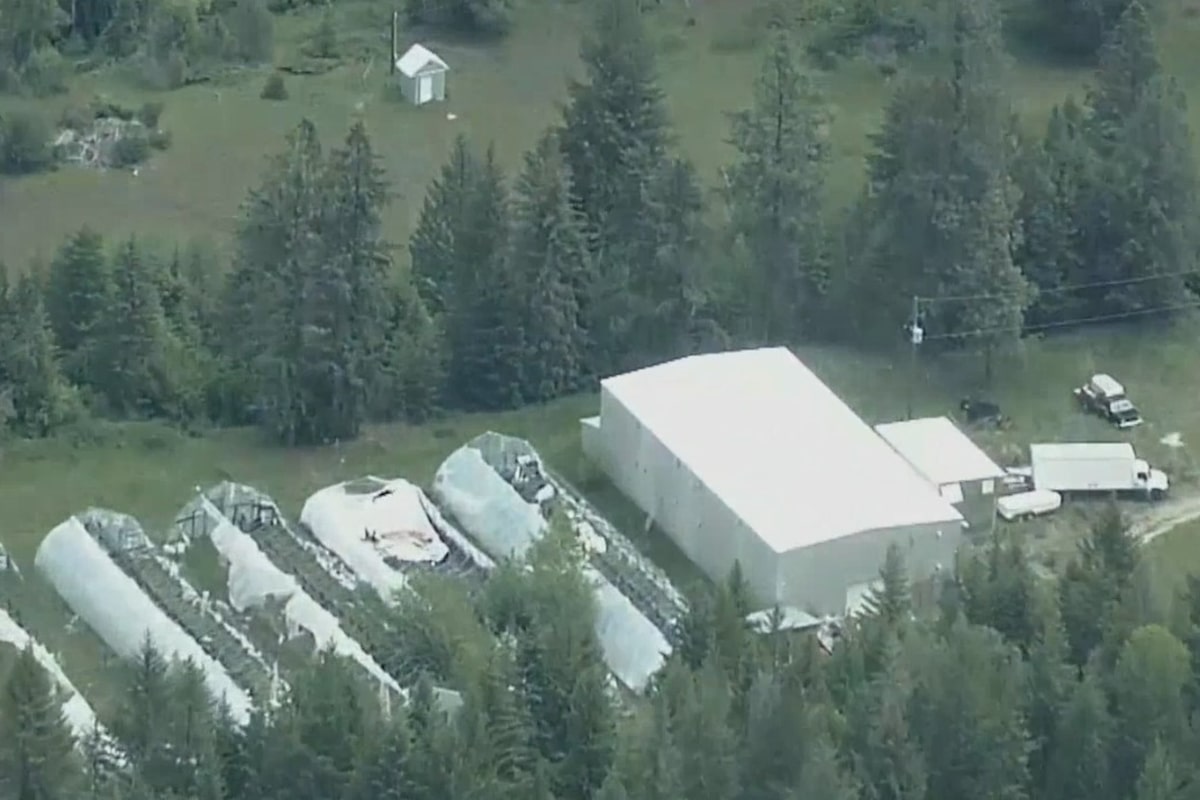
Just off the highway southeast of town, a large Bible retreat is among the properties strewn along Hoath Road. At the road’s dead end, a long driveway winds through a copse of conifers to a property with a three-bedroom house, a couple outbuildings and the massive structure containing the lab. On the other side of the lab are the husks of five greenhouses that once grew cannabis a decade ago.
No one knows how long the superlab was operating on the 66-hectare property, but a civil suit launched by B.C.’s Civil Forfeiture Office alleges it was pumping out product since at least January of last year.
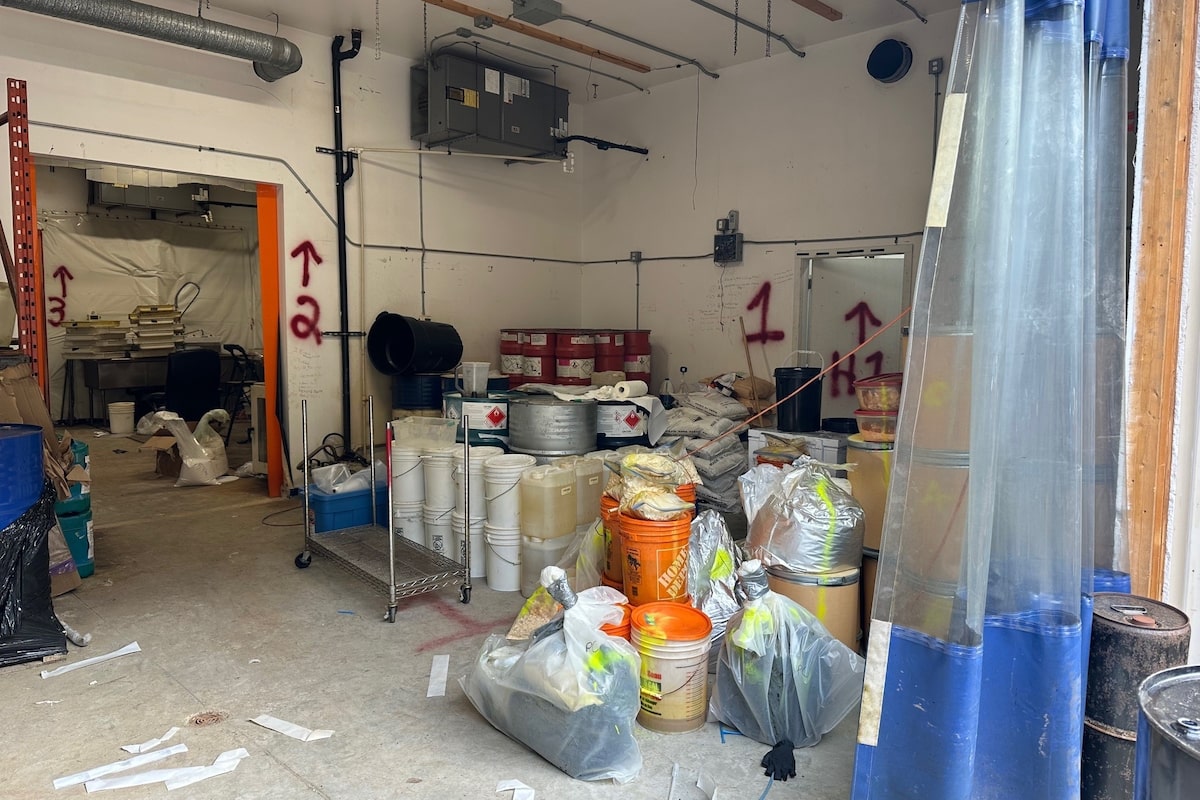
On Oct. 25, Mounties in white hazmat suits descended upon the compound and found several bombs, ammunition, silencers, high-capacity magazines, body armour and enough guns – including AR-15 assault rifles and submachine guns – to arm a small militia. They also discovered half a million dollars in cash, several tonnes of the base chemicals used to make the narcotics and nearly half a tonne of uncut drugs: 54 kilograms of fentanyl, 390 kilograms of methamphetamine and 30 kilograms of MDMA.
Everyone had vanished some time before the raid, including the “cook,” who police presume has at least a Master‘s degree in chemistry given the professional set-up of the lab and the various pieces of high-priced equipment.
That same day, Mounties arrested Mr. Randhawa in Surrey, B.C., and executed search warrants at the superlab’s “associated locations,” according to their news release after the raids. His indictment shows the RCMP had been surveilling him since Oct. 11 over suspicions he was carrying an explosive substance. He was charged with possessing that substance, illegal guns, meth, cocaine and fentanyl when Mounties arrested him at an undisclosed location as they prevented him from allegedly attempting to ship hundreds of kilograms of the superlab’s meth overseas.
During the police news conference to announce the raids and arrest, there was so much powder piled on the tables in front of the stage that RCMP leaders were only visible from the waist up. They said the lab’s operation clearly involved numerous transnational gangs and noted the meth was made by combining solely synthetic chemicals, a method not seen in Western Canada before but long favoured by Mexican cartels.
Three months later, B.C.’s Civil Forfeiture Office, which can seize assets from people who haven’t been charged with a crime, filed a lawsuit targeting the $938,000 superlab property as well as a spectrometer and chromatograph, both worth tens of thousands of dollars.
Named in the suit were Mr. Randhawa and Michael Driehuyzen, a Vancouver-area electrician who owns the land on which the lab sits. Mr. Driehuyzen is fighting the forfeiture attempt and denying any knowledge of the lab on the acreage he bought in 2007, which he said he purchased as a place to eventually retire.
Mr. Driehuyzen, who has no criminal record, told The Globe and Mail he is simply an absentee landlord and has never met Mr. Randhawa. He said he rented his place to someone other than Mr. Randhawa in late 2023, but said police have told him not to discuss that tenant.
Mr. Randhawa‘s lawyer did not respond to a request for comment as his client sits in the Surrey jail awaiting his coming criminal trial, which federal prosecutors recently moved to B.C. Supreme Court.
At the time of his arrest, Mr. Randhawa appeared to be in violation of a past prohibition on possessing a firearm. Court records show that in 2017 he pleaded guilty to possessing cocaine, heroin and meth for the purpose of trafficking as part of a dial-a-dope ring in Vancouver‘s suburb of Burnaby.
Once investigators become aware of a potential superlab location they are required to secure a warrant and raid the place as quickly as possible so that more poisoned substances don’t make it to the open market, Cpl. Seyed said.
But, two landmark judgments by the Supreme Court of Canada are hamstringing these complex investigations, say RCMP and American police experts. These rulings force investigators to share nearly all their evidence – and swiftly – after the first person is charged, in the process tipping off accomplices to what officers know about their wider operation and how they know it.
Since the 1991 R. v. Stinchcombe decision, Crown prosecutors have been required to disclose all evidence relating to the criminal charges in their cases. For police, that can mean months of downloading, analyzing and documenting pictures, text messages and other information if they seize just two cellphones from the accused, according to Cpl. Seyed.
This disclosure requirement was complicated in 2016 when the R. v. Jordan ruling sped up legal proceedings to enshrine people’s Charter right “to be tried within a reasonable time.” The strict timelines now mean anxious prosecutors may give police only 30 days to disclose their evidence after charges have been laid, which Cpl. Seyed said is “physically impossible.”
U.S. law-enforcement agencies know that these hurdles often make it harder to prosecute international trafficking rings in Canada than in American states.
“Our laws are extremely problematic and nobody on the planet operates this way, so that‘s why the Americans are frustrated with a lot of these files,” Cpl. Seyed said.
Last month, Mounties executed at least three warrants across different properties in and around Vancouver that have possible links to the superlab, he said. But more charges are increasingly remote when no one is arrested on site, he added, though they could happen years down the road – or sooner in another country.
“Crown says, ‘We’re gonna go with the cook because that guy was there at the time and we can prove intent,’ so you get the lowest-hanging fruit and often you don’t get anything,” he said of how charges are typically secured after a lab is raided.

October's raids in B.C. yielded 54 kilograms of fentanyl and other drugs that, by the RCMP's estimates, could have yielded $485-million in profit for criminal groups.Darryl Dyck/The Canadian Press
Another reason more superlabs – and the people who own and operate them – aren’t busted is because of a lack of information sharing among and within disparate law-enforcement agencies.
The summer before the Falkland discovery, officers from the federal RCMP’s Clandestine Lab Enforcement and Response Team began investigating a case that eventually led them to a rural property a half-hour drive away in Enderby.
Last September, the investigators, who were from a different unit than the one that would later discover the superlab, found 30 tonnes of chemicals used to manufacture methamphetamine in a workshop and garage. No one was there to arrest.
In a news release posted three weeks after the raid, the Mounties said they also found a truck belonging to Donald (Donnie) Lyons, who had been recently murdered. The release did not mention the 51-year-old’s long history of drug trafficking or his links to members of the loose Wolfpack alliance. Members of the gang, police have previously confirmed, helped traffic cocaine across the country for Joaquín (El Chapo) Guzmán Loera‘s Sinaloa Cartel.
Sergeant Shawn MacNeil, a spokesperson for the 18-officer clandestine lab unit who wrote the official Oct. 3 report, said the Mounties went public with the bust in part to generate tips about who owned the chemicals, which the release stated “were destined for one or more large economic based super labs.”
It was only weeks later, after the Falkland superlab was raided, that Mounties were able to test and trace its chemicals back to the chemicals found by Sgt. MacNeil‘s team in Enderby.
Cpl. Seyed, speaking for the unit that raided the Falkland superlab, acknowledges it‘s possible the Enderby announcement may have tipped off the operators of the Falkland facility.
Ray Donovan, the U.S. Drug Enforcement Administration’s former chief of operations who retired in 2023, said the RCMP are a first-class law-enforcement agency, but this incident shows they need to reform their internal communications on organized criminal threats like fentanyl production to improve on this “whack-a-mole” approach to enforcement.
“If the left hand is not talking to the right and sharing intelligence, then you don’t know they [the Enderby stash house and the Falkland superlab] are actually part of the same network,” said Mr. Donovan, who played a key role in the arrest of El Chapo, who ran his Canadian operations from Vancouver.
With research from Steph Chambers in Toronto
Canada and the drug trade: More from The Globe and Mail
The Decibel podcast
Misleading data about fentanyl from Canada underpins President Donald Trump’s case for tariffs, and the U.S. Senate is calling him out on it. Reporter Kathryn Blaze Baum spoke with The Decibel about The Globe’s investigation of fentanyl data and how the Senate’s actions could affect the trade war. Subscribe for more episodes.
In depth
In photos: The last days of Kitchener’s supervised drug-use site