At the Venice Biennale’s main exhibition, an introductory banner urges the visitor to take a deep breath and close their eyes. It might not be advisable to close your eyes on entering a show of visual art, but you are certainly going to need that deep breath. What follows is a barrage of large and loud constructions jammed into the central exhibition pavilion in the Giardini, the historic park that is the Biennale’s traditional home.
The Biennale is having a bad year. Sadly, its curator Koyo Kouoh died 12 months before the opening. Its jury, which recognizes both the best artist in the main exhibition and the best national pavilion, had to resign because it refused to judge entries by countries charged with war crimes. Meanwhile, the media coverage in the preview week focused on the demonstrations against the Israeli and Russian pavilions rather than the art.
And, as always, there is an awful lot of art. Ninety-six countries have contributed national pavilions in 2026 while the main exhibition, In Minor Keys, features the work of 110 artists and groups.

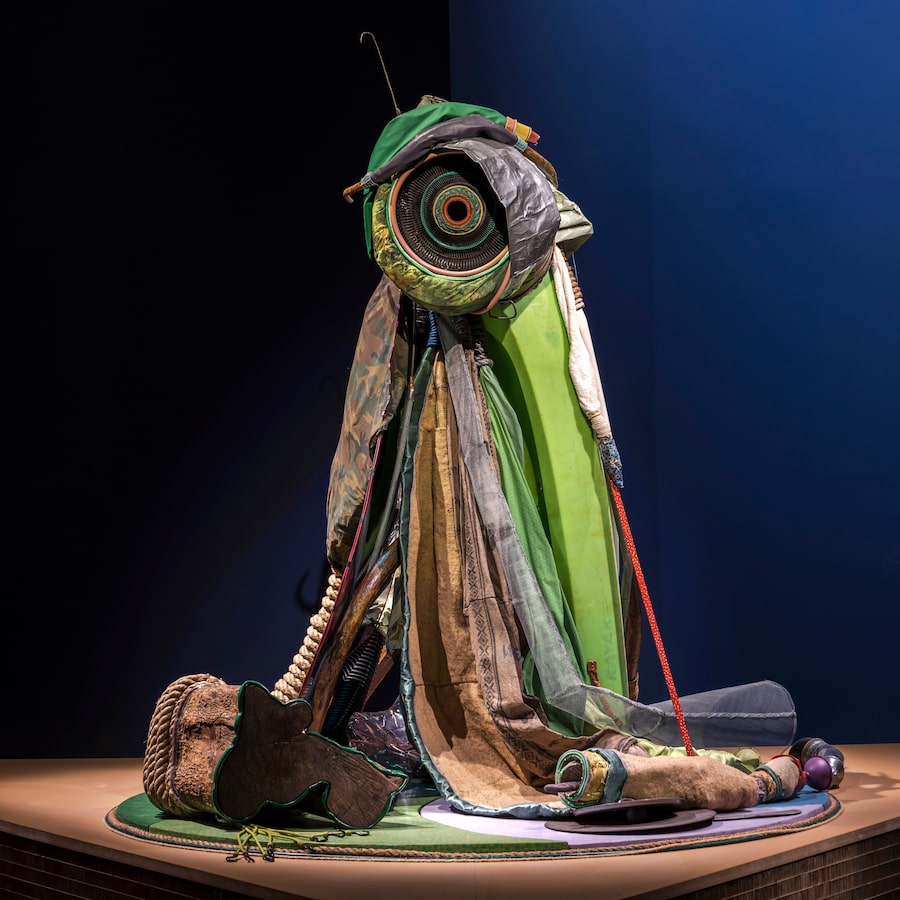
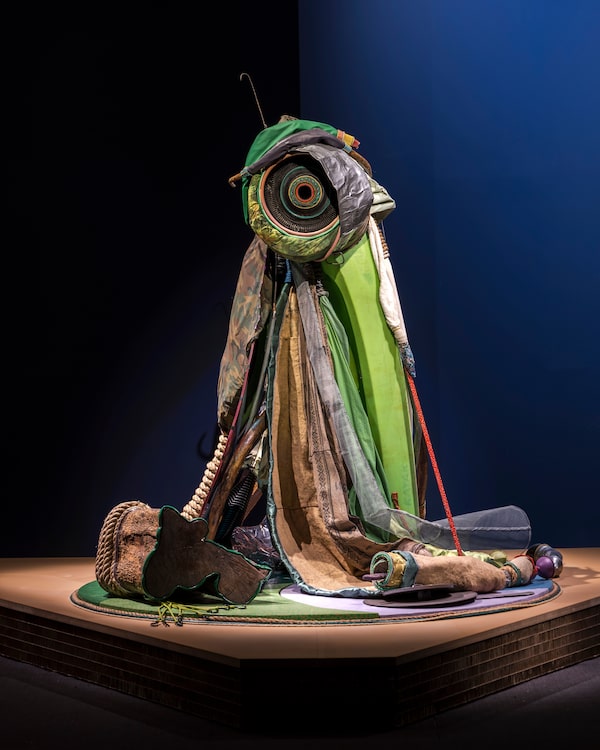
Lind-Ramos's Centinelas de la luna nueva (Sentinels of the New Moon) from 2022-23.Andrea Avezzù/La Biennale di Venezia/Supplied
When you walk into its first central room, you are greeted by half-human figures constructed with found materials by Puerto Rican artist Daniel Lind-Ramos, creatures both witty and unsettling, just like the nearby gathering of ceramic spirit animals by the Peruvian artist Celia Vásquez Yui. However, the power of these works overshadows smaller side areas devoted, for mysterious reasons, to the Dada artist Marcel Duchamp, and to a fascinating mini retrospective of drawings and little shacks by the late Beverly Buchanan, the American artist who considered questions of Black ownership and architecture in the South. This exhibition, supposedly about listening to poetry and gentle resonances, often produces cacophony.
7 pavilions to catch at the Venice Biennale
At the back of that room, serving as a giant altarpiece surrounded by over-sized glass flowers, there is a seven-panel painting by the Cuban-American artist María Magdalena Campos-Pons. It celebrates Toni Morrison, the first Black woman to win the Nobel Prize for Literature, and Kouoh, the first Black woman to have curated the international exhibit at the Venice Biennale.

In Anatomy of the Magnolia Tree for Koyo Kouoh and Toni Morrison, artist María Magdalena Campos-Pons elevates the 2026 Biennale's own curator.Andrea Avezzù/La Biennale di Venezia/Supplied
The big group show often includes too much and claims too much, but this year it is celebrating the apotheosis of its own curator. When Kouoh died of cancer in 2025, she had delivered the concept and text for a show – but not the final execution. Her team has completed her work and one could speculate they have not felt at liberty to cull.
Kouoh’s untimely death is rotten luck. But some of the Biennale’s troubles can be traced to the way it clings to an increasingly burdensome structure based on a competition among nation states, many of whose artists are committed to decolonization. The Netherlands has proved the country most willing to address this: In the genteel setting of the Giardini where national pavilions sit in friendly proximity, artist and performer Dries Verhoeven is locking audiences inside a shuttered Dutch pavilion as a metaphor for Europe’s increasing hostility to migrants. In 2024, the Dutch simply lent the building to a plantation workers’ art collective from the Democratic Republic of the Congo.
The Biennale administration lacks such resolve. Its weird compromise on the Russian pavilion – closed in 2022, lent to Bolivia in 2024, now reopened but only for preview week – and the way it has sidestepped the issue of Israeli participation have inevitably led to protests outside those pavilions. And the Biennale seems resigned to them, since it makes no attempt to search for banners, pamphlets or smoke bombs in the bags of the preview week passholders.
The demonstrations on the final day of previews culminated with symbolic strikes by some countries who chose to close their pavilions for a few hours, but a complete boycott or a full picket line at the gate were never in play. Critics, curators and collectors who have come to take the pulse of the art world were never inconvenienced, although the politics do further distract from slow looking at an event that is already an unseemly scramble toward the hot new thing.

Seaworld Venice, Florentina Holzinger’s ecological action-performance in the Austrian pavilion.Andrea Avezzù/La Biennale di Venezia/Supplied
This year, that hot new thing was Seaworld Venice, Florentina Holzinger’s ecological action-performance in the Austrian pavilion where a naked dancer swims in a tank fed by porta-potties that visitors are invited to use, in a miniature version of urban water filtration systems. Another performer in a larger tank circles endlessly on a personal water craft. Just outside the pavilion, patient visitors in the hours-long queue to see this work were treated to an appetizer, the alarming spectacle of a naked woman hanging upside down in a giant bell, as though functioning as its clapper. No, these are not pleasant times.
Meet the Canadian artists at the Venice Biennale
And there isn’t much escape from either noise or politics when visiting In Minor Keys. At the Giardini, you couldn’t get a good read on Tammy Nguyen’s intriguing multimedia panels featuring the American artist’s dense mix of allegorical and political iconography, nor fully appreciate the washi paper hangings by Canadian artist Alexa Kumiko Hatanaka; the view was blocked by a layered textile installation by the Jamaican artist Ebony G. Patterson featuring dozens of stuffed red gloves, suggesting both natural abundance and consumerism’s detritus. Montreal artist Manuel Mathieu was represented by several fierce canvases, clustered in a corner, that detracted from his calmer, more reflective ceramics. He was one of many artists represented by too many pieces. Toronto Anishinaabe artist Bonnie Devine fared better with a mural of the Great Lakes over which she had painted pictographic animals, another example of her evocative layering of Indigenous and settler histories.
One specific theme that interested Kouoh was procession, especially as an element of Afro-Caribbean carnival culture: The show opened with a performance by Big Chief Demond Melancon, a central figure in New Orleans’ Black Masking culture whose costume created for the occasion is now on display. It’s dynamic stuff, but hardly a minor key.

The South African artist Senzeni Marasela is showing seven large-scale textile works at the In Minor Keys exhibition at the Venice Biennale, each one representing a mining disaster.Luca Zambelli Bais/La Biennale di Venezia/Supplied
Thankfully, over at the Arsenale, the renovated shipyard that provides the Biennale’s spacious secondary site, there was more breathing room for the second half of the exhibition. Here, bold gestures, such as Senzeni Marasela’s huge red wool hangings marking South African mining disasters, had space to hit their mark.
Some discoveries – or confirmations – finally emerged. The exiled Burmese artist Sawangwongse Yawnghwe, who now lives in Thailand and the Netherlands, covers a tabletop with tiny clay standing figures, dozens of them interspersed with the occasional prone body in a bed, boat or bier. His specific concern is the treatment of the Rohingya but the piece could be an indictment of any genocide. In a complete stylistic contrast, his bold stencilled paintings both encode and decry human rights abuses around the world.

In his Disease Throwers at the 2026 Venice Biennale, Guadalupe Maravilla creates assemblages that are part chemotherapy chair, part magical throne.Marco Zorzanello/La Biennale di Venezia/Supplied
Guadalupe Maravilla contributes wild assemblages of natural fibres and plastic detritus. They could be the thrones of a carnival king, but are actually part chemotherapy chairs and part magic healers: He calls them Disease Throwers, and traces his own cancer to the stress of his childhood journey from El Salvador to the U.S. The Filipino London-based artist Pio Abad contributes finely detailed ink drawings that juxtapose images of the looted Benin bronzes in museum collections with domestic displays of books or mundane decorative objects, a knowing commentary on context and collectability in the art world.
One recurring theme in all this busyness (which also appeared when curator Adriano Pedrosa included outsider art in the 2024 show) is that of horror vacui, the fear of any empty space in art, a term that describes the all-over surfaces of much folk and outsider art. You could observe it in many paintings by African artists, including those of the Nairobi Contemporary Art Institute. The style might suggest depth and richness but also a desperate surfeit, a peculiar tension in a show that supposedly set out to rebalance an art event previously devoted to the overdeveloped West and its own anxious hunt for the new.
There are many such tensions at the 2026 Biennale, an art show that can’t figure out if it wants to welcome protest or ignore it, an elite event that preaches decolonization, and a global gathering that excludes Venetians from one of the few green spaces in their dense city. The Biennale is in need of a rethink before 2028.

Pio Abad's drawings, titled 1897.76.36.18.6, juxtapose the looted Benin bronzes from the British Museum with more mundate domestic displays.Andrea Avezzù/La Biennale di Venezia/Supplied