Objectivity has long been a defining metric in journalism. But for Parisa Azadi, an Iranian-Canadian photojournalist whose work explores Iran’s treatment of women and girls, maintaining emotional distance from her subjects is impossible. She knows intimately their feelings of rage, grief and despair, and she channels them into her work.
“I don’t think I can be fully objective,” she says over Zoom. “Oftentimes, white journalists parachute into foreign places for their stories. That’s not what I’m doing. I’ve been in anti-government protests in Iran. I know what it feels like and sounds like – the fear, the bravery.”
Azadi, whose work has been published by The New York Times, The Guardian and the BBC, among others, moved to Canada with her family in the 1990s, and now splits her time between Iran and Dubai. Her Yadegari photo series – Farsi for “remembrance” or “souvenir” – presents a portrait of what it means to exist in a woman’s body in Iran.
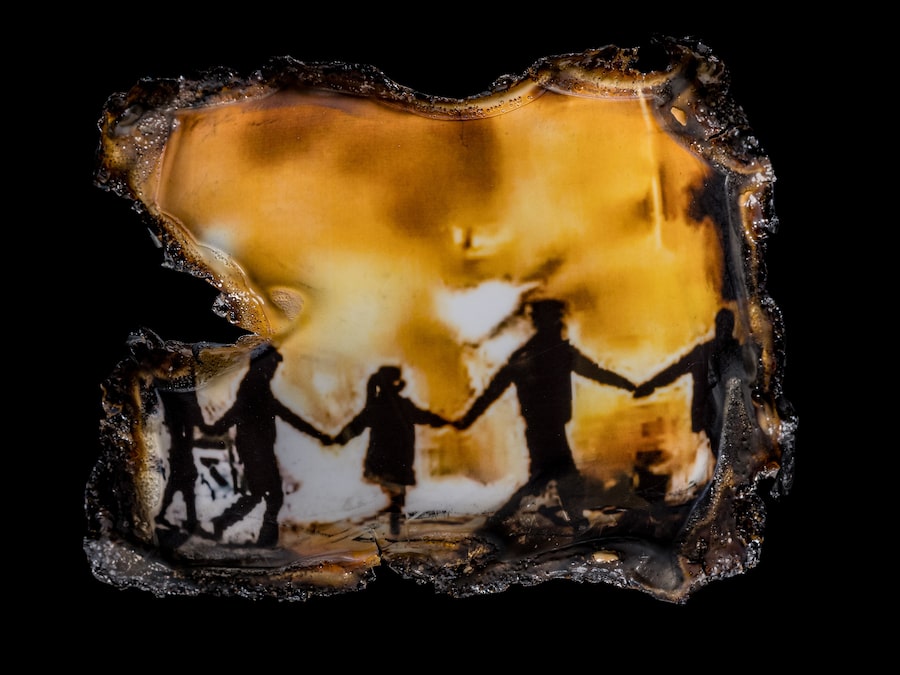
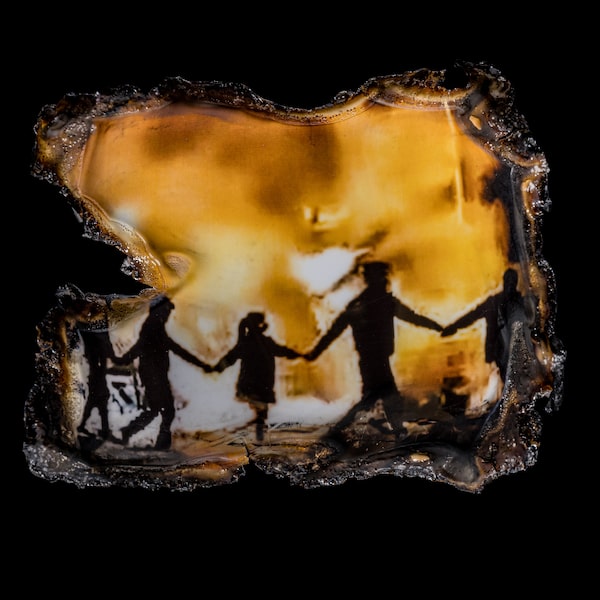
Since the beginning of the Woman, Life, Freedom movement in 2022, Azadi has used a Fujifilm Instax camera, similar to an instant Polaroid device, to take photos of social-media videos, adding a digital wall between her and her subjects. For added impact, she burns the edges of the Instax prints, and sometimes cuts into them or adds ink to obscure faces. Over the years, she’s collected a considerable number of plastic lighters – experiments with matches and lit Q-tips were short-lived, she says.
The Globe spoke with Azadi over Zoom to discuss her process as a photojournalist, from sourcing protest videos to altering the images she takes from them.

Azadi’s process unfolds in multiple stages. First, she collects and archives videos from social media. Then comes the task – a daunting one, she says – of verifying and geolocating the footage. She does not ask families for permission to use their videos in her work, but does reach out to them to help verify identities and context: “These videos have been made available to amplify their voices, to make a record of what has happened to them,” she explains. “I try to be respectful and really tell the story as it is, without trying to sensationalize or manipulate it.”
Once she’s confirmed that a given video isn’t AI-generated or out of date, she isolates specific frames on her computer screen, which she then photographs with her Instax camera.
“For a while, I stopped there,” she says. “But something was missing. They felt static, and I wanted to test different methods to break the white frame around the images.” In January, during protests against the Iranian government that led to violent state retaliation and thousands of deaths, she began to burn the photographs. “My act of mourning,” she says. “I wanted the fire to destroy the image, in a way, to echo the violence of this year’s uprising and its aftermath,” says Azadi. “I wanted to push against the limits of the image, that frame around each print. I wanted to break that stillness.”

Publishing her photographs in a mainstream Western news outlet such as The Globe and Mail comes with risks for the photojournalist, whose previous exhibitions, shown under a pseudonym, have mostly flown under the radar of Iranian authorities. “When you work in Iran for as long as I have, you kind of learn to navigate the censorship,” she says. “But the government will know about my work now. And I feel like I can’t worry about that any more. I don’t want that to hold me back, the fear.”
As a set, the three photographs below show an Iran whose women and girls have reached a breaking point. One print shows a young student in a school uniform, her face obscured by a hijab and face mask as she jumps on a framed portrait of the late Ayatollah Khamenei. Others show women spraypainting slogans on Iranian buildings, with the one below saying, “the fight continues.” Still others, burnt nearly to crisps, show protestors silhouetted by fire.
“I’m not destroying these images,” she says of the charred prints. “I’m responding to them. The burning, the fire, echoes what’s already in the frame.”


Violence is a common motif in the Yadegari series. But even the less graphic shots are affecting: One shows a mother banging on the door of the detention centre where her daughter is being held. “In the video, she’s screaming that she will remove the door,” says Azadi.
What makes the image stand out is its burn pattern. While most of Azadi’s prints are burnt around their borders, this one has a large, scorched hole in its middle.
“That was a happy mistake,” says Azadi, explaining that she accidentally pierced a hole in the print while working with it. “Instead of throwing the image away, I wanted to work with it. She’s trying to break the door, so I made a tear in the door. I ripped it more, actually, and made it more prominent. … I take this role very seriously, being able to contribute to the story myself while amplifying these voices and visualizing this struggle.”

After Azadi burns the prints – usually with a tray of water nearby, just in case the flames spread too quickly – she lays them on a plain black surface to photograph them. “You can’t run them through a scanner,” she says. “The material becomes too crispy – a scanner crushes them.” For in-person exhibitions, she enlarges the prints on fabric.
“When the uprising began, I felt like I was failing as a journalist, having been in Iran for as long as I had been but not being able to be there during this very important moment in time,” she says. “Ordinary citizens have had the burden of documenting these brutal crackdowns. It is almost impossible at the moment for journalists to do their jobs. For me, I’m slowing down time in these frames. These photographs are my way of staying connected to what’s happening, to continue my reporting and not just be here feeling hopeless.”


Source photos by Vahid Online; From Iran; Sarkhatism; 1500 Tasvir; Middle East Images; BBC Persian; Hengaw Organization for Human Rights