

Water pours into John Felice Ceprano’s rubber boots as he fishes a glossy, football-shaped rock from the Ottawa River.
The 79-year-old carries the stone past a flock of swimming geese, gets down on one knee and perches one of its narrow tips atop three more grey slabs already stacked into a metre-high pillar.
The resulting formation – known as a cairn – is one sculpture among dozens Ceprano has erected in lines and semi-circles this summer at Remic Rapids.

This year marks 40 years since Ceprano began building cairns at the river’s outcrop. What started as a spontaneous creative impulse in 1986 has evolved into an annual attraction, with his rock sculptures drawing international media attention and turning the site into a beloved tourist attraction that invites crowds from the world over.
But Ceprano isn’t thinking about any of this history as he works through the July heat. He’s fully focused on his art.
“That’s just a distraction from being in the moment, right?” he says. “The whole point of what I do is that we’re in the now.”

Ceprano's sculptures are created without the use of bonding materials, relying instead on achieving perfect balance.
He spends hours collecting stones from the river and finding the optimal spot along the rocky ridge, wading out into the water with his rainboots if the tide is high enough to flood it. He uses makeshift rock hammers to secure small stones, called wedges or shims, into place under larger rocks.
Unless he’s moving something heavy, Ceprano works without gloves to “feel what the rock wants,” until it “finds its place where it is balanced.”
Ceprano, who moved to Aylmer, Que., in 1998, drives to the site – it’s nine kilometres from his home – and restarts the installation every June after the previous year’s stacks have been swept away by the wind, snow and rain of the changing seasons.
By early July, the project dominates the Remic Rapids landscape, with some of Ceprano’s sculptures reaching higher than 2.5 metres. The breeze and waves inevitably knock over his creations, forcing him to constantly restart and reinvent the installation.

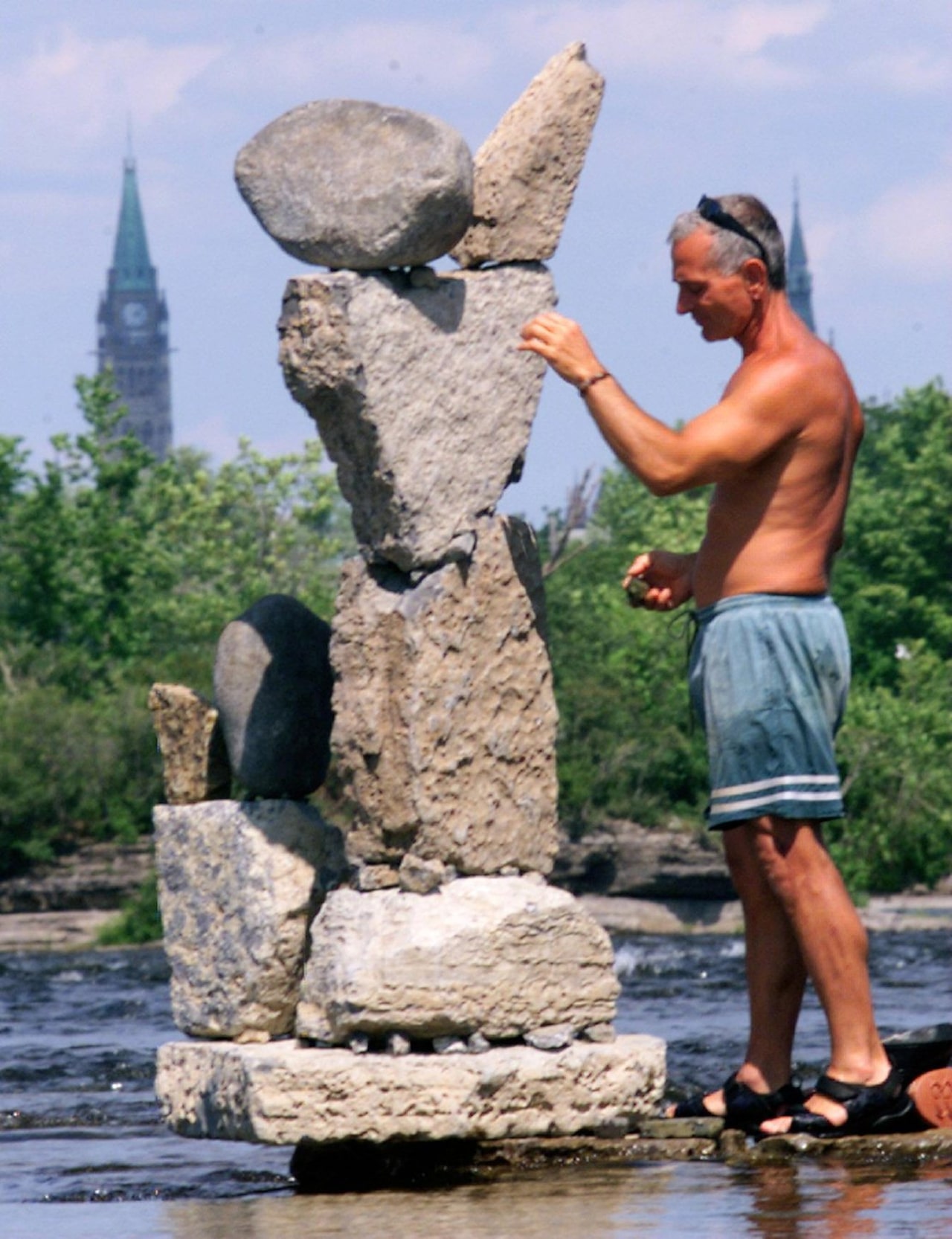

He says he never tires from the work, physically or emotionally. The art is a testament to his lifetime commitment to mindfulness, and to balance.
Ceprano was born July 6, 1947, into a tight-knit Italian family living in Providence, R.I. He earned an associate degree in physics from the Community College of Rhode Island and planned to pursue a career in meteorology, but on the advice of a professor who watched him struggle with calculus, Ceprano instead enrolled in fine arts at the University of Rhode Island.
While building up his skills in abstract expressionist painting and joining a campus commune to protest the Vietnam War, he built on his long-standing love for the concept of balance by learning about Taoism, the ancient Chinese philosophy that teaches about yin and yang. Ceprano would later be inspired by the 1991 philosophy and quantum physics book The Holographic Universe, especially its view that everything is interconnected – another important idea in his creative practice.
Ceprano also became more in tune with nature thanks to his studies on Indigenous beliefs that promote “equilibrium between man and Earth,” as he puts it, and experiments with drugs such as mescaline and LSD during his university years. Rhode Island’s cityscapes made it hard to appreciate the environment, he says, so he and a friend went on a road trip along the south coast of New Brunswick, where he fell in love with Canada’s natural landscapes.
“Once we got to the Bay of Fundy national park, I just said, ‘I’m going to live here. This is home,’” he says. “Environmental stewardship is essential in how you live in harmony with the world around you. I find it far more accessible in Canada because of the abundant amount of nature.”

Ceprano moved to Ottawa in 1973, where he completed his fine arts degree through an exchange program at the University of Ottawa and took courses to become a part-time registered nurse at Élisabeth-Bruyère Hospital. Between officially immigrating in 1978 and becoming a Canadian citizen by 1991, Ceprano found his now-cherished spot at Remic Rapids.
In June, 1986, right before his 39th birthday, Ceprano left his apartment in the Byward Market and biked along the Ottawa River in search of a peaceful place to meditate on the future. He followed the sound of the rushing rapids through some bushes and towards the water, where he found what he felt was a “healing place.”
Days later, he returned to the spot. The river had receded, exposing limestone rocks whose unique shapes and textures sparked a creative impulse. At first, Ceprano says, he was inspired to build a dam. Stacking rocks was a natural next step. Over the next few years, he honed his technique through trial and error.

Ceprano uses makeshift rock hammers to secure small stones, called wedges or shims, into place under larger rocks.
“There are people today who still think those gosh darn rocks are glued together,” Ceprano says.
His sculptures fit into a “land art” tradition that emerged during the mid-20th century, involving works that draw materials from the artist’s surroundings. His chosen medium dates back even further to practices from Indigenous cultures, though rock sculptures such as inuksuit are not artistic expressions. They have historically been used by Inuit communities for navigation and communication.
Painter Sarah Bradfield noticed the sculptures’ similarity to inuksuit in 2017 when she moved to Ottawa from the Northwest Territories and stumbled upon Remic Rapids.
She painted Ceprano’s site in 2024 for her book Ottawa ABC Landscapes, which depicts the city through a series of landscape paintings, each tied to a letter of the alphabet. Remic Rapids became the painting for the letter “I” – for “inspiration.”

Ottawa-based artist Sarah Bradfield's painting Remic Rapids celebrates Ceprano’s rock art.Courtesy of Sarah Bradfield
The painting, which earlier this year hung in the building that houses The Globe and Mail’s offices in Ottawa, was most recently displayed at Galerie Old Chelsea in May and June.
“I’m at peace when I’m painting rocks,” Bradfield says. “Maybe it’s the same for him?”
Though Ceprano describes this part of the shoreline as healing, running the project for 40 years hasn’t always been easygoing. In his first year, he hurt his back owing to poor form and had to cut his season of rock balancing short. He restarted the next summer, and that’s when Ceprano says an on-camera interview with a CBC reporter brought the site popularity.
In 1989, Ceprano got a Canada Council for the Arts grant worth $5,000 to bring the project to life as a full-time summer job. He still worked as a part-time nurse the rest of the year. Following years of steady routine, he paused the project in 1997 after his mother died. After he returned to work at Remic Rapids in 1998, Ceprano says he arrived one day to find that someone had coated the installation in yellow paint overnight. This alerted the National Capital Commission to the site’s need for conservation and support.
They struck up a contract by 2000 to officially protect the site with insurance coverage; install signs and plaques describing the installation; erect a shed where Ceprano stores his dolly and gloves; and hire conservation staff who monitor Remic Rapids to ensure members of the public do not disturb Ceprano or his installation.
Since the contract was signed, the NCC has paid Ceprano around $8,000 annually to start stacking rocks on June 15 and wrap up when the river rises in late fall. They added a barricade in the late 2010s for liability reasons.
Ceprano retired from his nursing job in 2012 to focus on the installation, and he says the ensuing decade was comfortable thanks to the NCC’s support.


Local artists, including handpan drummers, Inuit throat singers, stilt walkers and fire dancers, began entertaining visitors at the site in 2005. Ceprano also hosted three festivals from 2012-14, during which a dozen rock balancing artists from around the world created a collaborative installation at Remic Rapids.
Michael Muir, an NCC land manager and Ceprano’s long-time liaison with the organization, says the NCC was already looking for ways to help Ottawa residents access the waterfront when they found out about Ceprano’s work. The installation was a natural fit for their mission. Muir says it “creates a bit of an attractive node that people love to stop at and see” and “gives a lovely backdrop to the Ottawa River.”
Muir says Ceprano’s passion has turned a visit to Remic Rapids into an experience for locals and international travellers alike. It was “really telling,” he says, “when we started getting full tour buses of people coming in.”
Art historian and curator Judith Parker, who was an education officer at the National Gallery of Canada for 20 years, often visits Remic Rapids, which is within walking distance from her home. She says the “space has a magic” because of its natural beauty and Ceprano’s “incredible doggedness” to make the site meaningful. It inspired her to write an application that helped Ceprano win Ottawa’s 2015 Award of Excellence for urban design in public places.
“There’s also the intrigue of figuring out and looking at his sculpture,” she says. “Sculpture is meant to be seen not from one angle, but from many angles.”

Ceprano works on a cairn in October, 2021. That year, his installation commemorated the discovery of unmarked graves at the site of the former Kamloops Indian Residential School.Sean Kilpatrick/The Canadian Press
Each year’s installation has a theme. In 2021, Ceprano recreated a packed classroom to commemorate the announcement that unmarked graves had been discovered at the site of the former Kamloops Indian Residential School using ground-penetrating radar. And in 2025, he aligned rocks in parallel lines to leave empty spaces between the sculptures for his “allies of balance” theme, which lined up naturally with the strained relationship between Canada and the U.S. thanks to American tariffs and threats of annexation.
This year’s theme is still yet to be discovered. Ceprano says the acoustics of the space, or how all its elements come together and harmonize, could play a large part in helping him decide.
“If you go up close to it, you hear the water going through the openings, but much more so that sound, constantly, of the rapids in the background. That is a form of balance, that sound,” he says.
The idea rings true for Attef Bouras, a photographer who immigrated to Canada from Algeria in June.
Bouras says the installation offers a calm space to reflect on life as he searches for work in an unfamiliar city. He learned about Remic Rapids after looking at an online map and decided to walk over. Bouras found the sculptures, the surrounding landscape and the crowd of onlookers seated in nearby lawn chairs inspiring.
“I’ve visited other sites, but I find a particularity to this space,” Bouras says in French. “The people here are mostly older. These are people who want to appreciate the view, and the view is exceptional.”


Other visitors, including long-time Ottawa resident Carol Shipley, have known about the site for decades and visited repeatedly. In the middle of a semi-circle of towers, Shipley sees what she calls a “primary figure” welcoming the others. It speaks to her belief in the power of human connection.
“Life almost boils down to being connected with each other, caring about each other, and God knows there’s not enough of it these days with all the nasty news we get,” she says. “There’s something about a circle or semicircle that lends itself to connection.”

At 79, Ceprano is starting to slow down, but the core principles of his work – balance and harmony – remain as strong as when he first found his “healing place.”
While he’s working, Ceprano likes to talk with visitors about the nature of creativity and the installation’s annual theme. He recalls that when an Israeli woman in her 80s visited the site on a warm Oct. 7 last year, the sculptures connected with her so deeply that she started crying. She asked for permission to walk through the rock lanes and towards the water.
“When she got to the end, she literally just raised her arms up into the sky and stood there for quite a while. She didn’t move. So when I can see that the work that I do – the work that happens, is a better way to put it – can touch another human being in that way, that’s my reward,” he says.
Muir says the NCC will support the site as long as Ceprano wants, though Ceprano is starting to slow down and ask people for help when lifting heavier rocks. He never expected to work on the installation past 70, he says, so he feels lucky to have the same enthusiasm as when he began.
“The principle of what I do has pretty much remained the same from the start,” he says. “It was already there before I started: balance. Harmony.”