For Daniela Elstner, it feels like the dawn of a new era.
The French film executive, head of the venerable Paris-based trade organization Unifrance, has come to the Cannes Film Festival to promote her country’s artists, but to also spread a message. Namely: that the days in which the global film industry revolved around the United States are over. And Elstner’s not just saying this because she’s currently situated in the most ostentatiously European surroundings imaginable.
Holding court on a sunny rooftop terrace a stone’s throw from the French Riviera, while Parisian star Gilles Lellouche takes a drag of a cigarette behind her and lightly accented producers flit around sipping cups of espresso, Elstner paints a stark picture of the new cultural world order.
“It’s complicated to make conclusions too quickly, but what definitely has happened is that the American market that shaped the cinema worldwide with big blockbusters, that’s pretty much gone. So now, we have to reinvent,” says Elstner. “You can either say that’s a disaster for Europe or a chance for Europe. But I tend to say it’s a chance.”
She isn’t the only one. For the past two weeks in Cannes, the most powerful players in the international screen sector have come to participate in the Olympics of show business.

Festival-goers walk the streets of Cannes during the 79th edition of the event on Monday.BLANCA CRUZ/AFP/Getty Images
They are here to buy and sell films, and debut their very best work on the grand screens of the majestic Palais theatre. But they are also in town to lay the groundwork for a radical shift in soft-power primacy – one that, if the metaphorical and marquee-level stars align, could reorient Canada on the cultural-sovereignty map.
Last year, Cannes operated under the shadow of U.S. President Donald Trump’s plan to slap a 100-per-cent tariff on “any and all movies coming into our country that are produced by foreign lands.” While that still-unrealized threat has since been dismissed by the rest of the world, its sentiments and intentions have not been forgotten.
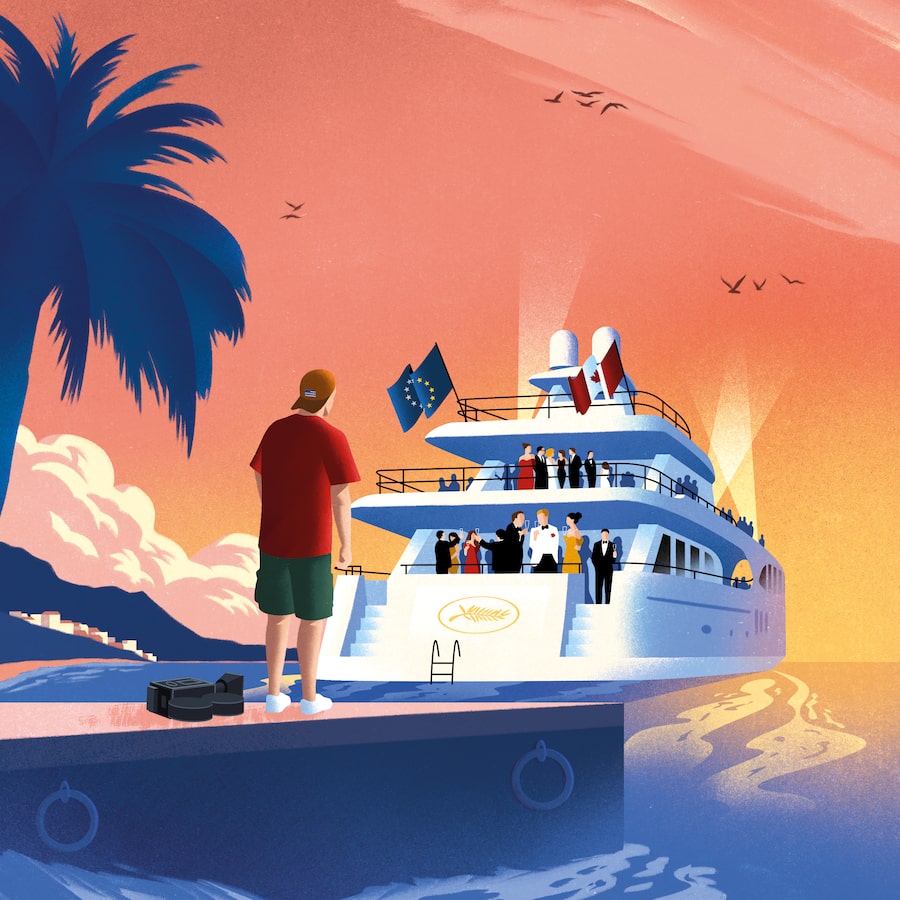
As the United States isolates itself politically and culturally, Europe is responding with a plan to beat America at its own game – to become the new world leader in the production and exportation of the easiest, sexiest, most profitable form of global influence: movies. And Canadians want a piece of that action.
In Cannes, you didn’t have to look too hard to see the bigger picture forming.
Who are the big winners and losers at the Cannes Film Festival? Ask us your questions
Cannes jury president Park Chan-wook is ready for anything, including political debate
This year’s festival programming featured just two U.S. titles, both arriving via independent production houses and not the major Hollywood studios that have regularly stolen the spotlight in the past.
The countless panel discussions in and around the Marché du Film – a warren of pavilions and networking spaces where the business of buying and selling movies goes down – featured such blunt conversation starters as “An Era of European Collaboration” and “Invest in What Matters: Support to European Film.”
Often, the only time that people were even talking about Hollywood was in the incredulous tone of a concerned parent, with the Paramount/Warner Bros. merger regarded as an inevitable but sure-to-be-embarrassing blunder.
But you could feel the shift in priorities and power most in the many cocktail-hour, beach-party and postpremiere conversations, during which anyone with a stake in the industry sensed the tide turning.
“There’s a wake-up call in general in Europe,” says Dietmar Güntsche, co-head of Weltkino, Germany’s leading independent film distributor, who added that countries need to co-operate and collaborate more than they used to. “We have to rely on each other.”

Oscar winner Rami Malek walks the red carpet at the world premiere of 'The Man I Love' at Cannes on Wednesday.Sarah Meyssonnier/Reuters
And just a few weeks after Prime Minister Mark Carney travelled to Armenia to join a high-profile summit of European leaders – underlining how dedicated Ottawa is to proving we are closer in sensibilities to our trans-Atlantic cousins than to our southern neighbours – the feeling in Cannes is there is unprecedented potential for Canadian culture to travel farther and wider than ever before.
“I’ve been working with Canada for the past decade, and I can see now there is an appetite to work more with the country internationally for funding, especially when talking about Europe. Canada is on the map for that,” says Constance Richard, founder of the Paris-based film consultancy group Citizen Kino. “There used to be a kind of shyness in the Canadian industry because it was so linked to the U.S. and so dependent on it. The willingness was there, but not so much the need. But that’s changing.”
Richard was in Cannes consulting with the Directors Guild of Canada, which this year launched a new initiative to send a delegation of eight filmmakers to the Marché, where they pitched projects to global financiers.
“This really started with the U.S. actors’ and writers’ strikes, when it became so apparent that we had to not rely on that one-way relationship with the U.S.,” says Hans Engel, director of the guild’s national directors division. “What has happened to us is what is happening to everyone else in the world. Everybody is looking around more. So this is the moment for us to lean in. We’re not at Cannes to beg the world to take our stories. We’re there because they want them.”
Standing ovations have long been a hallmark of the Cannes Film Festival, running May 12 to 23 this year. The Globe's film editor, Barry Hertz, explains how the length of a movie's applause can signal its success.
Toronto-based director Yung Chang, who is at Cannes with the guild shopping his crime drama Eggplant, notes that it was once standard for Canadian filmmakers to submit budget proposals in U.S. dollars when pitching at markets abroad. Heading into Cannes this year, though, Chang was encouraged to convert everything to Euros and Canadian currency.
“Those were the numbers that everyone needed to look at, which was quite telling,” Chang says, adding that he’s also seen his fellow Canadians stop referring to themselves as “North American” filmmakers. “Just call yourself Canadian. We’re leaving the U.S. out of it.”
Already, Europe is moving full-speed ahead with jettisoning its reliance on the U.S. system. A few days before Cannes kicked off, the French media giant Pathé announced it was partnering with Vendôme Pictures to launch a new production and finance company specializing in commercial, English-language films that would appeal to audiences in Europe and around the world.
Meanwhile, the leading European producer and distributor StudioCanal, which operates in such key markets as France, Italy and Germany, was at the festival shopping a slate of big-budget English-language movies while also touting plans to invest in larger franchises with global appeal.

British-French actress Emma Mackey attends the Cannes screening of 'Full Phil' on May 16.THIBAUD MORITZ/AFP/Getty Images
The Americans are keenly aware of the ground shifting underneath their feet.
During the back half of the festival, U.S. production and management company Anonymous Content pledged to double the number of European features that it develops. Bill Kramer, president of the Academy of Motion Picture Arts and Sciences, was busy taking meetings across town to highlight new and long-awaited changes to the eligibility rules for the Best International Feature Film Oscar. And chat with enough sales agents and producers, and they’ll privately admit it isn’t that fun to travel around the world with an American passport these days.
“It’s inarguable that at the moment, America’s long-standing cultural strength is at something of a low, and that affinity with the U.S. business sector has been damaged over the past couple of years largely due to broader geopolitical activities,” says Stuart Ford, the British-born and L.A.-based chief executive of the sales and financing giant AGC Studios. “So it’s no surprise that the European sector is moving to fill that void that American cinema has so powerfully filled on and off for many decades. That’s not to say that it’s a permanent sea change.”
But before those waves readjust, Canada’s industry players feel that there is no better time than now to triple down on aligning themselves with Europe.
‘Doors are opening’ for Canadian filmmakers carrying the flag at Cannes
Those who scoffed at Carney’s 2025 federal budget for setting aside money to explore participation in Eurovision might, for example, be surprised to learn that Canada has been a member of the Council of Europe’s cultural fund Eurimages for almost a decade. The organization, which distributes millions annually for the co-production, distribution and exhibition of cinema, counts Canada as its first and so far only non-European member.
“That’s quite prestigious when you look at the films they support,” says Julie Roy, chief executive of the federal funding agency Telefilm. She also notes that Canada has more co-production treaties – 57 of them – than any other country. “This is something we’re talking about in Cannes, trying to see if we can find other ways to join the European community to be stronger together.”
Dozens of movies are screening this year at the famed Cannes Film Festival in the French Riviera, with more than 20 competing for the top prize of the Palmes d'Or. Globe film editor Barry Hertz watched 25 movies over nine days – here are his top three picks.
Of course, the Quebec market has long helped stitch together those connections – and underscores how long this shift has been looming in the background.
“Being from Montreal, I was born with this sense of urgency and survival, which I now see in English-Canadian cinema,” says producer Sylvain Corbeil, who is at Cannes with the drama Marie Madeleine, a co-production between Haiti, France, Belgium, Luxembourg and Canada. “Canadian film has been rooted in trying to mimic the United States for so long. But Quebeckers, we’ve internalized for a long time that it’s not about making it to Hollywood, it’s about making it everywhere else. The rest of Canada is now catching on.”
This isn’t to say that everything is going smoothly in Europe at the moment.

French actress Juliette Binoche arrives at Tuesday's screening of 'Amarga Navidad' (Bitter Christmas).SAMEER AL-DOUMY/AFP/Getty Images
On the eve of Cannes, more than 600 French film professionals, including such major names as Juliette Binoche and Adèle Haenel, signed an open letter decrying media mogul Vincent Bolloré’s plans to take control of the country’s third-largest cinema chain, equating it to a “fascist takeover of the collective imagination.” Days later, Maxime Saada, the head of Canal+, France’s largest film production company – which is owned by Bolloré – responded that he would “no longer wish Canal to work with the people who signed this petition.” (Crowds booed the Canal+ logo when it appeared during festival screenings.)
Many European markets are also in the midst of contentious fights with U.S.-owned streaming services, similar to the Online Streaming Act battle currently being waged in Canada, where the Canadian Radio-television and Telecommunications Commission has ordered outfits such as Netflix and Disney+ to contribute a portion of their revenues to the production of homegrown content and news. Germany, for instance, recently announced that it would compel foreign-owned streamers such as Netflix to invest eight per cent of their revenues in the country toward local European content.
Back on the sunny Unifrance terrace, Elstner, whose organization supported 17 films playing this year’s festival, noted that the global ambitions among French filmmakers is high. They just need everyone else – governments, industry players and audiences – to come together and seize the energy of the moment.
“I see that many people in the industry in France speak with one voice, and they’re willing to give a lot of time to these discussions. It might sound a little naive, but that’s the first key to success,” Estner says. “To have film professionals and artists stand together with the Ministry of Culture, that will make the difference.”

Illustration by Lorenzo Sainati