3 Key Reasons Investors May Want to Avoid MercadoLibre Stock Right Now

MercadoLibre MELI presents a concerning investment picture that should give potential investors serious pause. While the Latin American e-commerce giant reported revenue growth of 49% year over year to $8.85 billion in the first quarter of 2026, a deeper dive into the company's financial health reveals troubling trends that suggest investors would be wise to steer clear of this stock for now.
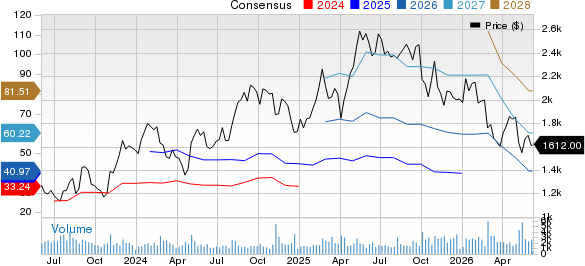
The Zacks Consensus Estimate for 2026 earnings has been revised downward by 14.4% over the past 30 days to $40.97 per share. The market appears increasingly pessimistic about MELI's near-term growth trajectory.
MercadoLibre, Inc. Price and Consensus
MercadoLibre, Inc. price-consensus-chart | MercadoLibre, Inc. Quote
Operational Margin Erosion Threatens MELI’s Growth Outlook
MELI's margin erosion appears structural rather than temporary. The company is pursuing an aggressive growth strategy centered on expanding logistics infrastructure, increasing fulfillment capacity, scaling first-party inventory operations and enhancing cross-border commerce capabilities across Latin America. While these initiatives have supported strong revenue growth and market share gains, they require substantial capital and operating investments that are weighing on profitability.
The pressure is unlikely to ease anytime soon. MELI recently implemented targeted take rate reductions for competitively priced sellers in Brazil, with the financial impact expected to begin flowing through results from the second quarter of 2026. Combined with continued free shipping expansion and investments aimed at driving buyer engagement, these actions are poised to create additional margin headwinds over the coming quarters.
The first-quarter 2026 operating margin declined 600 basis points to 6.9%, reflecting the growing cost of supporting MELI's expansion strategy. Management has indicated that investment intensity is likely to remain elevated as opportunities continue to emerge across both commerce and fintech. The company continues to prioritize ecosystem expansion and market share gains over near-term profitability, meaning top-line momentum is not translating into proportional earnings growth. However, peers such as AmazonAMZN and Sea Limited SE have managed to sustain comparable growth trajectories while maintaining more credible paths to margin improvement, a balance MELI has yet to strike.
MELI's Expanding Credit Book Hurts Profitability
MELI's rapidly expanding credit portfolio is emerging as a growing drag on profitability as the company pushes deeper into financial services. The credit book nearly doubled year over year to $14.6 billion in the first quarter of 2026, driven by aggressive credit card issuance, expanding consumer lending and broader credit penetration across Latin America. While lending has become an important growth engine for Mercado Pago, the strategy is simultaneously increasing exposure to provisioning costs and credit losses. MELI has been extending average personal loan durations in Brazil from five months to eight months and broadening credit access to newer, less tested borrower segments, which is expected to increase risk exposure over time and require higher upfront provisioning.
The broader backdrop adds another layer of concern. Latin American economies remain susceptible to inflation, currency volatility and shifts in consumer spending patterns, any of which could pressure repayment trends and push provisioning costs higher. Intensifying competition from Nu HoldingsNU may further compel MELI to stay aggressive on credit origination and customer acquisition, limiting its flexibility to moderate growth if credit conditions weaken. With the credit book growing nearly twice as fast as overall revenues, the provisioning drag on margins is unlikely to abate until the portfolio matures.
MELI's Premium Valuation Offers Limited Upside
MELI trades at a premium price-to-earnings multiple of 32.63X, well above the Zacks Internet Commerce industry average of 21.88X and the Retail-Wholesale sector average of 23.04X. The stock's Zacks Value Score of D further suggests that the valuation is stretched relative to fundamentals. Unlike Amazon, which has demonstrated operating leverage in its e-commerce model, Nu Holdings, which is scaling fintech operations profitably, or Sea Limited, which has been steadily improving unit economics across its commerce and digital financial services segments, MELI's profitability trajectory remains uneven, which makes the premium difficult to justify.
MELI Stock’s Valuation

Image Source: Zacks Investment Research
On a year-to-date basis, MELI’s shares have declined 19.9%, underperforming the broader sector's gain of 0.2% and the industry's decline of 1%. Amazon’s shares have returned 6.3% over the same period. While Nu Holdings and Sea Limited’s shares have declined 30.7% and 33.7%, respectively, amid broader emerging market pressures, MELI's losses reflect company-specific concerns around profitability rather than purely macro headwinds.
MELI’s Share Price Performance
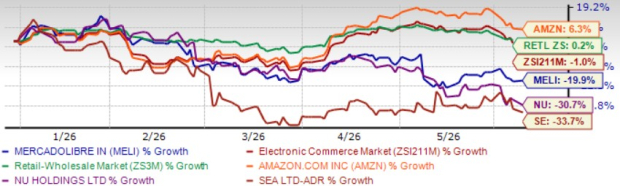
Image Source: Zacks Investment Research
Conclusion
MercadoLibre faces a confluence of challenges that make it an unattractive investment proposition at current levels. Structural margin erosion, a rapidly expanding credit book and regional macroeconomic uncertainty collectively paint a difficult near-term picture. With earnings estimates revised sharply downward, the stock underperforming peers on a year-to-date basis and no credible path to margin recovery in sight, downside risks remain elevated.
MELI carries a Zacks Rank #5 (Strong Sell), suggesting that it would be prudent for investors to stay away from the stock until meaningful operating leverage and valuation support reappear.
You can see the complete list of today’s Zacks #1 Rank (Strong Buy) stocks here.
Radical New Technology Could Hand Investors Huge Gains
Quantum Computing is the next technological revolution, and it could be even more advanced than AI.
While some believed the technology was years away, it is already present and moving fast. Large hyperscalers, such as Microsoft, Google, Amazon, Oracle, and even Meta and Tesla, are scrambling to integrate quantum computing into their infrastructure.
Senior Stock Strategist Kevin Cook reveals 7 carefully selected stocks poised to dominate the quantum computing landscape in his report, Beyond AI: The Quantum Leap in Computing Power.
Kevin was among the early experts who recognized NVIDIA's enormous potential back in 2016. Now, he has keyed in on what could be "the next big thing" in quantum computing supremacy. Today, you have a rare chance to position your portfolio at the forefront of this opportunity.
See Top Quantum Stocks Now >>This article originally published on Zacks Investment Research (zacks.com).
