Oracle Bottoms: A Multi-Cloud Future Is Ahead—and Undervalued
Oracle (NYSE: ORCL) was among the hardest hit during the SaaS AI-disruption fear sell-off, but its bottom is in, and a robust rebound lies ahead. While Oracle is a Software-as-a-Service (SaaS) stock, it is not an SaaS play, having invested heavily in the cloud and AI. Today, Oracle is a hybrid SaaS/IaaS (Infrastructure-as-a-Service) company, with services spanning sectors and verticals. Among the critical details is its multicloud capability, including deals with all major hyperscalers, which opens them as revenue streams even while Oracle competes directly with them.
A key component of the strategy is portability. With Oracle in place, operators can easily move data from one cloud to the next, accessing it when and where they like, without the cumbersome duplication that underpins costs and ties up CPU and GPU capacity. For regular folks, Oracle’s database and accompanying services are ubiquitous and can be used natively, on one of Oracle’s own clouds, or at the cloud of choice.
Oracle Expands Deal With AWS: Strengthens Cloud Position
A recently expanded deal with Amazon's (NASDAQ: AMZN) AWS highlights Oracle’s position in the AI and data center ecosystem. The expanded deal enables multicloud users to interface with Oracle Cloud Infrastructure (OCI) in a native-like setting, accelerating AI development and deployments.
Other deals highlighting Oracle’s positioning and the strength of its strategy are an expanded deal with Bloom Energy (NYSE: BE). Bloom Energy’s fuel cells provide numerous benefits, including a short deployment timeline, low operating costs, and low emissions, making them ideal for data centers. The deal more than doubles the existing one, derisking Oracle’s outlook, as power needs can be met.
Among the risks are debt and dilution. The surge in demand, as reflected in Oracle’s remaining performance obligation (RPO), has led to a surge in debt. The company needs to build dozens of data centers and is on track to more than double its count relative to 2025 figures, and it is using debt and share sales to do it.
Activity in 2026 is expected to bring debt to well above $150 billion, and the total is expected to continue rising through the year’s end. The risk is twofold: the near-term hurdle is negative cash flow, and the long-term risks are execution and demand.
The offsetting factor is the RPO. RPO is a measure of contracted but unearned revenue, and it is growing at a triple-digit pace, up 325% to $553 billion as of the fiscal Q3 2026 earnings report. The backlog is underpinned by large, multi-year contracts with major hyperscalers and AI labs, with approximately 35% expected to be recognized within the subsequent fiscal year. The critical takeaway is that these contracts more than cover the cost of data center expansion and will generate additional revenue down the road. To this end, the company has begun moving to more evergreen pricing models.
Analysts and Institutions Provide Floor With Catalyst Ahead
Analysts and institutional activity aided Oracle’s stock price correction, with analysts lowering targets in Q1 2025, and institutional activity is iffy but otherwise bullish for the market.
The sentiment reduction was driven by fears, but the impact was less than bearish, with 40 analysts rating it a consensus Moderate Buy, with a 75% Buy-side bias. The price target reductions put the market at the low end of the range, but consensus forecasts about a 50% upside, and there is a trigger for higher price points ahead.
The trigger is the upcoming earnings release. Analysts didn’t just lower price targets; they also reduced revenue and earnings targets, despite the company’s solid fiscal Q3 performance and a guidance boost. The likely outcome is that Oracle outperforms the expectation for 20% revenue growth, margin contraction and issues another favorable guide. In this scenario, the high-end target will come back into play, pegged at $400, which would be sufficient for a fresh all-time high.
Oracle Sets Up for Robust Rebound
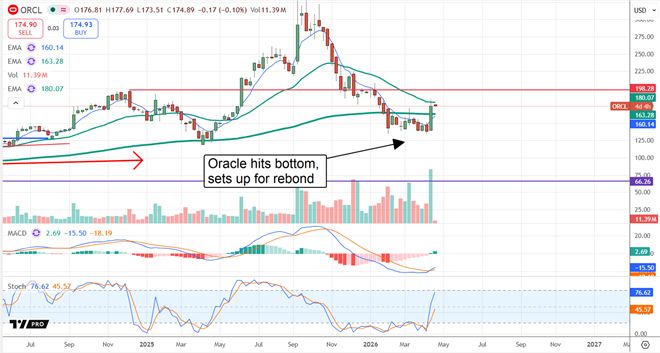
Technical action is promising. Oracle’s market bought into the AWS news, rising by more than 25% in a single week. The move put ORCL stock above its short and long-term EMA’s, leaving only the 150-day EMA to act as resistance. This indicator of mid- to long-term buying sentiment reflects institutional and buy-and-hold investors and may cap gains until the Q4 report is released in early June. Assuming this market advances and moves above the EMA, the next resistance targets are near $200 and $220.
Catalysts for Oracle include its push into agentic AI. Not only is the company enmeshing itself into the cloud fabric, but it is advancing AI adoption with the launch of agentic tools. A new suite of tools across verticals, including financial, health, supply chain, human resources, and customer relationship management, is expected to drive gains over the long-term, helping sustain high-level growth long after the data center build-out is completed.
Where Should You Invest $1,000 Right Now?
Before you make your next trade, you'll want to hear this.
MarketBeat keeps track of Wall Street's top-rated and best performing research analysts and the stocks they recommend to their clients on a daily basis.
Our team has identified the five stocks that top analysts are quietly whispering to their clients to buy now before the broader market catches on... and none of the big name stocks were on the list.
They believe these five stocks are the five best companies for investors to buy now...
The article "Oracle Bottoms: A Multi-Cloud Future Is Ahead—and Undervalued" first appeared on MarketBeat.
