Will Keytruda Continue to Aid Merck's Top Line in Q3 Earnings?

Merck’s MRK revenues are primarily derived from the oncology portfolio, led by its blockbuster PD-L1 inhibitor, Keytruda. The drug accounts for more than 55% of the company’s pharmaceutical sales.
Keytruda generated $16.40 billion in sales in the first six months of 2026, increasing 4.2% year over year. Keytruda Qlex, the subcutaneous formulation of Keytruda, contributed $590 million during this period. Keytruda Qlex can offer substantially quicker administration time than the intravenous infusion of Keytruda.
Building on this growing momentum, we expect investors to keep a close eye on Keytruda's sales performance when Merck reports its third-quarter 2026 results on Oct. 29.
Keytruda sales are likely to have gained from continued strong momentum in metastatic indications and rapid uptake across earlier-stage launches during the third quarter. Recent label expansions, including Keytruda’s use in combination with Pfizer’s Padcev in muscle-invasive bladder cancer, have broadened its patient base and should also support sales growth.
The Zacks Consensus Estimate for Keytruda’s third-quarter sales stands at $7.45 billion.
Importantly, the company expects Keytruda’s strong growth to continue until the drug loses patent exclusivity in 2028. Management expects the drug to achieve peak sales of $35 billion by 2028 before it loses exclusivity.
However, Keytruda is expected to face significant biosimilar competition around 2028-2029. Once biosimilars enter, Keytruda’s sales are likely to decline sharply.
PD-L1 Inhibitors Competing With MRK's Keytruda
Keytruda faces competition from other PD-L1 inhibitors, including Bristol Myers’ BMY Opdivo, Roche’s RHHBY Tecentriq and AstraZeneca’s AZN Imfinzi.
BMY’s Opdivo, like Keytruda, is approved across multiple cancer types, including lung, melanoma and kidney cancers. Bristol Myers recorded $4.63 billion in Opdivo sales in the first half of 2026, down 3.9% year over year.
Tecentriq is Roche’s leading immuno-oncology drug approved for multiple cancer indications. RHHBY recorded CHF 1.70 billion in Tecentriq sales in the first half of 2026, up 6% year over year.
AZN’s Imfinzi generated sales of $3.55 billion in the first half of 2026, up 29%, driven by strong demand growth across all regions from established indications and new launches. Imfinzi has strategically expanded its use across multiple cancer indications, strengthening AstraZeneca’s oncology portfolio.
MRK's Price Performance, Valuation and Estimates
Year to date, shares of Merck have rallied 37.7% compared with the industry’s 15.1% rise. The stock has also outperformed the sector and the S&P 500 during the same time frame, as seen in the chart below.
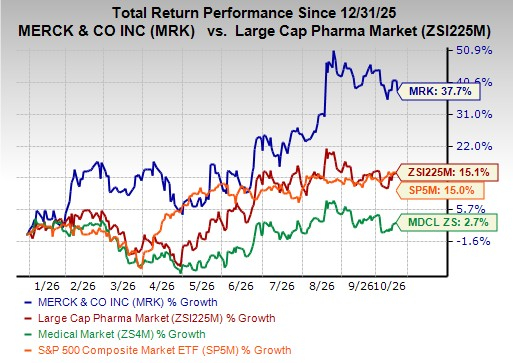
Image Source: Zacks Investment Research
From a valuation standpoint, Merck appears to be trading at a discount compared to the industry. Going by the price/earnings ratio, MRK’s shares currently trade at 17.94 forward earnings, lower than 18.33 for the industry. The stock is trading above its 5-year mean of 13.04.
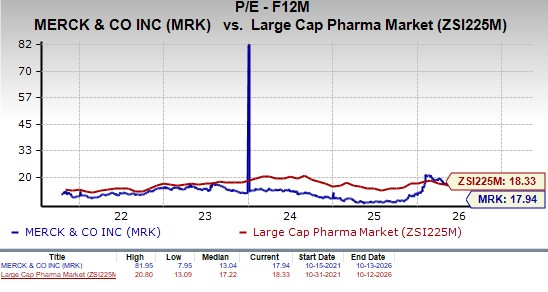
Image Source: Zacks Investment Research
The Zacks Consensus Estimate for 2026 earnings per share has declined from $2.78 to $2.66, while the same for 2027 has declined from $9.67 to $9.27 over the past 60 days.
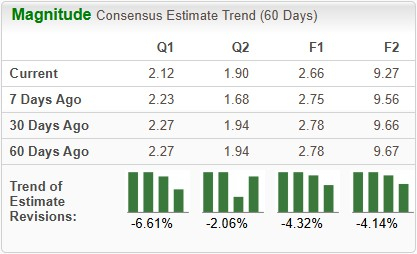
Image Source: Zacks Investment Research
MRK's Zacks Rank
Merck currently has a Zacks Rank #4 (Sell).
You can see the complete list of today’s Zacks #1 Rank (Strong Buy) stocks here.
Radical New Technology Could Hand Investors Huge Gains
Quantum Computing is the next technological revolution, and it could be even more advanced than AI.
While some believed the technology was years away, it is already present and moving fast. Large hyperscalers, such as Microsoft, Google, Amazon, Oracle, and even Meta and Tesla, are scrambling to integrate quantum computing into their infrastructure.
Senior Stock Strategist Kevin Cook reveals 7 carefully selected stocks poised to dominate the quantum computing landscape in his report, Beyond AI: The Quantum Leap in Computing Power.
Kevin was among the early experts who recognized NVIDIA's enormous potential back in 2016. Now, he has keyed in on what could be "the next big thing" in quantum computing supremacy. Today, you have a rare chance to position your portfolio at the forefront of this opportunity.
See Top Quantum Stocks Now >>This article originally published on Zacks Investment Research (zacks.com).
