Key Points
Chevron is a diversified industry giant that has long focused on being resilient.
Devon Energy is a highly focused oil and natural gas producer that will benefit materially from high energy prices.
The geopolitical conflict in the Middle East has the world watching oil and natural gas prices. The daily flow of news can drive energy prices higher or lower, depending on how fast-changing events are perceived by financial markets. This geopolitical conflict is unique, but this dynamic is not new.
If you are looking to invest in the energy sector because oil and natural gas prices are rising, you need to think beyond the current geopolitical events. Which is why most long-term investors will prefer a business like Chevron(NYSE: CVX). And why a stock like DevonEnergy(NYSE: DVN) could be higher risk than you may think.
Will AI create the world's first trillionaire? Our team just released a report on the one little-known company, called an "Indispensable Monopoly" providing the critical technology Nvidia and Intel both need. Continue »
Chevron and Devon both drill for oil
Chevron and Devon are both well-respected energy companies. However, they have vastly different production profiles. Devon is focused on the onshore U.S. market, with exposure to five energy-producing regions. The recently announced plan to acquire Coterra Energy(NYSE: CTRA) will eventually extend that to six. The direction of U.S. energy prices is what drives Devon Energy's business, not Brent Crude, the global energy benchmark.

Image source: Getty Images.
Chevron has material U.S. energy production assets, but its reach is global. And it has onshore and offshore production capabilities. This is notable because offshore production assets tend to have longer production lives than onshore U.S. assets. Given Chevron's more diverse production portfolio, it is far more impacted by Brent Crude prices. Brent and West Texas Intermediate (WTI), the key U.S. oil benchmark, generally move in the same direction, but given the location of the current conflict, Brent is currently trading above WTI.
Chevron's business is more diverse
Devon Energy's business basically starts and stops with production. For the most part, the rise and fall of energy prices will dictate its financial performance. Chevron's business expands beyond production, including energy transportation, chemicals, and refining operations. This adds even more diversification to Chevron's business, noting that production, transportation, chemicals, and refining assets perform differently through the energy cycle.
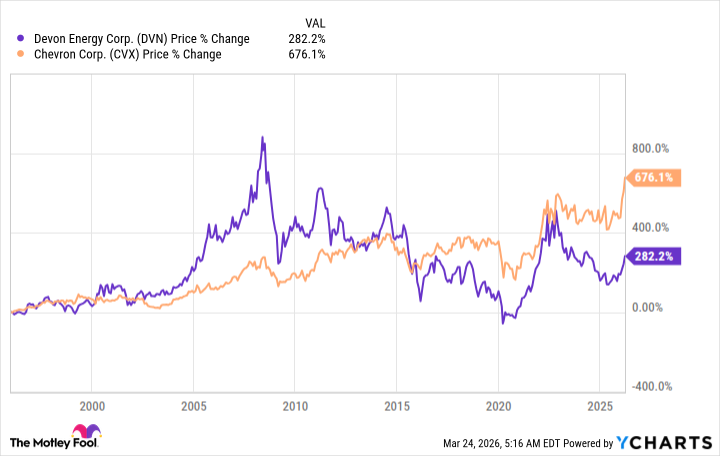
The end result of these business differences is that Devon's stock tends to be more volatile, with higher highs and lower lows driven by WTI's price moves. Chevron's stock price rises and falls with energy prices, too, but the peaks and valleys tend to be more muted. This has important implications for long-term investors, particularly those with an income focus.
Most investors should err on the side of caution with energy stocks
Chevron has a 3.4% dividend yield and has increased its dividend annually for decades. Devon Energy has a 2% yield, and its dividend has been highly volatile over time. If you are a long-term investor, sticking with a reliable dividend stock like Chevron is probably the best choice. Even after oil prices fall, history suggests you should continue collecting Chevron's dividend without fail.
That said, investors looking to play the swings in oil prices will likely find Devon Energy more to their liking. There is an important difference with such an investment approach. If you make a buy-and-hold investment in Chevron, you will need to monitor whether the business continues to operate at a high level, regardless of oil prices. If you make a short-term investment in Devon because you believe it will benefit from rising oil prices, you will likely want to get out before oil prices start to fall.
Nothing unusual is taking place in the energy sector
The real problem that has to be addressed is big-picture in nature. Volatility is actually quite normal in the energy patch. If you want to take an aggressive position and play the volatility, a stock like Devon Energy is a way to do so, but you'll have to constantly monitor your investment and the energy market. Chevron is built to survive through the entirely normal and often dramatic swings oil prices go through, so you don't have to worry as much about tracking energy prices. You can, instead, monitor your dividend checks. For most investors, that will make Chevron the better oil stock.
Should you buy stock in Chevron right now?
Before you buy stock in Chevron, consider this:
The Motley Fool Stock Advisor analyst team just identified what they believe are the 10 best stocks for investors to buy now… and Chevron wasn’t one of them. The 10 stocks that made the cut could produce monster returns in the coming years.
Consider when Netflix made this list on December 17, 2004... if you invested $1,000 at the time of our recommendation, you’d have $497,659!* Or when Nvidia made this list on April 15, 2005... if you invested $1,000 at the time of our recommendation, you’d have $1,095,404!*
Now, it’s worth noting Stock Advisor’s total average return is 912% — a market-crushing outperformance compared to 185% for the S&P 500. Don't miss the latest top 10 list, available with Stock Advisor, and join an investing community built by individual investors for individual investors.
*Stock Advisor returns as of March 26, 2026.
Reuben Gregg Brewer has no position in any of the stocks mentioned. The Motley Fool has positions in and recommends Chevron. The Motley Fool has a disclosure policy.
