UnitedHealth vs. Humana: Which Healthcare Leader Is a Better Bet Now?

UnitedHealth Group Incorporated UNH and Humana Inc. HUM are leading U.S. managed-care and health insurance companies operating in an industry that is navigating higher medical-cost trends, evolving reimbursement policies and changing regulatory requirements. Both companies have significant exposure to the Medicare Advantage market, making them key participants in one of the fastest-growing segments of the healthcare insurance landscape.
While UNH and HUM compete within the same sector and face many of the same industry dynamics, their business models and strategic priorities differ. UnitedHealth benefits from a diversified healthcare platform that spans insurance, health services and care delivery, whereas Humana maintains a greater focus on government-sponsored healthcare programs, particularly Medicare-related offerings. These distinctions influence their growth profiles, profitability trends and overall market positioning.
Let’s dive deep and closely compare the fundamentals of the two stocks to determine which one is a better bet now.
The Case for UNH
UnitedHealth's growth is supported by the breadth of its healthcare ecosystem, which combines insurance, pharmacy services, care delivery and healthcare technology under one platform. The company generated total revenues of $111.7 billion, which grew 2% year over year in the first quarter of 2026, benefiting from pricing actions, a favorable member mix and improving operational execution across its businesses.
UnitedHealthcare unit remains a key earnings driver for the company, supported by its leading positions in Medicare Advantage, commercial insurance and government-sponsored programs. Recent pricing actions have improved alignment between premiums and healthcare costs, while a greater focus on affordability initiatives and cost management is helping stabilize margins. The business is also expanding digital engagement, with nearly half of its members now using its digital platform and digital interactions becoming the primary channel for customer service. In the first quarter of 2026, the unit’s revenues rose 1.9% year over year.
Another major contributor to future growth is Optum Health, where the company continues to strengthen its value-based care models. The segment served around 93 million people in first-quarter 2026. Greater care coordination, improved patient navigation and enhanced clinical oversight are helping reduce unnecessary hospital and post-acute care utilization, supporting better health outcomes while improving operating performance.
Technology is becoming another key pillar of UnitedHealth's strategy. The company plans to invest nearly $1.5 billion in AI-related initiatives in 2026 to streamline administrative processes, improve customer experiences and increase productivity across its operations. Meanwhile, Optum Insight is expanding AI-driven solutions for healthcare providers and payers, creating an additional avenue for growth beyond traditional insurance operations.
Alongside these efforts, investments in provider connectivity, automation and streamlined authorization processes are helping improve member experiences, drive operational efficiencies and strengthen the long-term competitiveness of the insurance segment. The company benefits from significant scale and diversification, although persistent medical-cost inflation and regulatory changes could weigh on earnings growth in the near term. UNH beat earnings estimates in three of the past four quarters and missed once, with an average surprise of 0.8%.
UnitedHealth Group Incorporated Price, Consensus and EPS Surprise
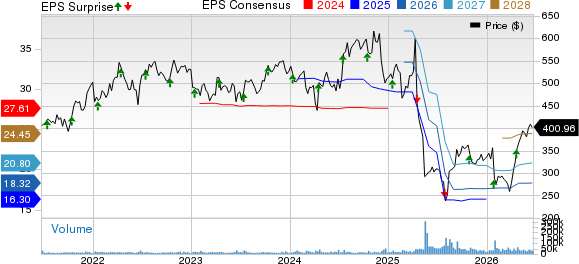
UnitedHealth Group Incorporated price-consensus-eps-surprise-chart | UnitedHealth Group Incorporated Quote
Financially, UNH is in a solid position. It ended the first quarter of 2026 with $31.2 billion in cash and short-term investments, sufficient to cover its short-term borrowings and current maturities of long-term debt, which stands at $6.5 billion. Its total debt-to-capital of 40.75% is below HUM’s 42.9% and the industry’s 42.9%. In the first quarter of 2026, it paid dividends worth $2 billion.
The Case for HUM
Humana's growth is being driven by continued expansion in its Medicare-focused businesses and the increasing scale of CenterWell, its healthcare services platform. In the first quarter of 2026, total revenues rose 23.5% year over year, supported by strong growth in Medicare Advantage and Medicare Part D membership. Total Medicare membership increased to nearly 11 million members, while Medicare Advantage membership climbed 23% year over year to 7.1 million in the quarter.
CenterWell remains a key strategic growth engine for Humana as the company continues to deepen its presence across primary care, home health and pharmacy services. The segment generated $6.1 billion in revenues in the first quarter of 2026, up nearly 20% from the prior-year period. By strengthening the integration between healthcare services and insurance operations, CenterWell supports member engagement, care coordination and long-term growth opportunities beyond the company's core insurance business.
The company is emphasizing disciplined pricing, benefit optimization and cost-management initiatives to improve Medicare Advantage margins following a period of elevated healthcare utilization. This approach is designed to strengthen earnings quality and support a more sustainable long-term growth profile while maintaining competitiveness in its core markets. It beat earnings estimates in three of the past four quarters and missed once, with an average surprise of 3.8%.
Humana Inc. Price, Consensus and EPS Surprise
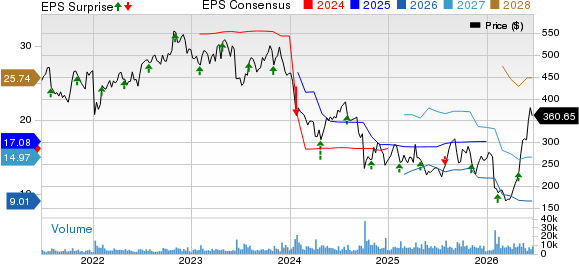
Humana Inc. price-consensus-eps-surprise-chart | Humana Inc. Quote
HUM is also investing in data interoperability, digital capabilities and quality-improvement initiatives that support its integrated care model. These efforts are intended to enhance healthcare outcomes, improve operational efficiency and strengthen Star Ratings performance over time, which remains a key driver of reimbursement levels, member retention and long-term profitability. However, competitive pressures and ongoing cost trends remain key factors that could influence earnings and margin recovery in the years ahead.
Nevertheless, as of March 31, 2026, the company had cash and cash equivalents of $5 billion, with short-term debt of $1.7 billion only, which implies a solid capital position. Humana has been returning excess capital to its shareholders in the past several years. It repurchased common shares in connection with employee stock plans for $107 million in the first quarter of 2026. The company also paid dividends of $107 million during the quarter. However, its dividend yield of 1% is below UNH’s 2.3%.
Price Performance Comparison
In the year-to-date period, HUM shares have outperformed UNH, the industry and the S&P 500.
Price Performance – UNH, HUM, Industry & S&P 500
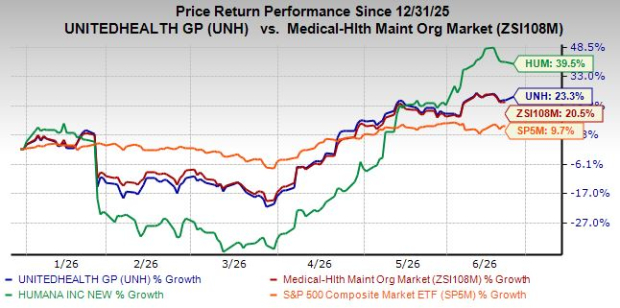
Image Source: Zacks Investment Research
How Do Estimates Compare for UNH & HUM?
The Zacks Consensus Estimate favors UNH at this stage. The consensus estimate for UNH’s 2026 earnings indicates a 12.1% increase from a year ago. Over the past 60 days, the estimate has witnessed 14 upward revisions with no downward adjustments. Meanwhile, the consensus estimate for revenues suggests a 0.9% decline.
On the other hand, the Zacks Consensus Estimate for HUM’s 2026 revenues indicates 25.3% year-over-year growth, but the same for EPS signals a massive 47.4% decline. Over the past 60 days, the estimate has seen three upward revisions with two downward adjustments.
Valuation: UNH vs. HUM
From a valuation standpoint, UnitedHealth may appear slightly more expensive than the industry at first glance, but it represents its size, operational consistency and business diversification. Humana’s stock currently trades at a higher multiple than UNH. UnitedHealth is currently priced at 20.57X forward 12-month earnings, compared to Humana’s 30.47X, both above the industry average of 17.46X.
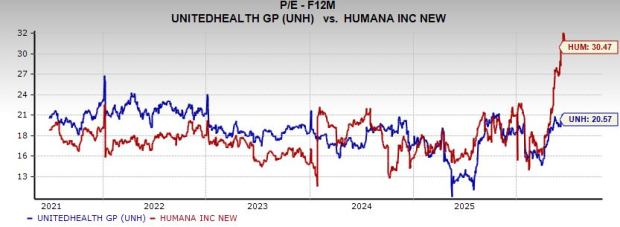
Image Source: Zacks Investment Research
UNH currently trades below its average analyst price target of $412.56, implying a 2.9% potential upside from current levels. Meanwhile, HUM trades above its average analyst price target of $300.26, implying a 16.7% potential downside from current levels.
Conclusion
Both UnitedHealth and Humana are leading managed-care companies with strong positions in the Medicare Advantage market. Humana is benefiting from robust membership growth and the expansion of CenterWell, but its earnings recovery remains dependent on improving Medicare Advantage margins and reimbursement dynamics.
UnitedHealth, however, appears to have the edge due to its diversified business model, stronger financial position and broader growth opportunities across insurance, healthcare services and technology. Despite ongoing regulatory and cost-related pressures, its superior earnings growth outlook, attractive valuation and higher dividend yield make UNH the stronger healthcare stock at present, even though both companies currently carry a Zacks Rank #3 (Hold).
You can see the complete list of today’s Zacks #1 Rank (Strong Buy) stocks here.
Radical New Technology Could Hand Investors Huge Gains
Quantum Computing is the next technological revolution, and it could be even more advanced than AI.
While some believed the technology was years away, it is already present and moving fast. Large hyperscalers, such as Microsoft, Google, Amazon, Oracle, and even Meta and Tesla, are scrambling to integrate quantum computing into their infrastructure.
Senior Stock Strategist Kevin Cook reveals 7 carefully selected stocks poised to dominate the quantum computing landscape in his report, Beyond AI: The Quantum Leap in Computing Power.
Kevin was among the early experts who recognized NVIDIA's enormous potential back in 2016. Now, he has keyed in on what could be "the next big thing" in quantum computing supremacy. Today, you have a rare chance to position your portfolio at the forefront of this opportunity.
See Top Quantum Stocks Now >>This article originally published on Zacks Investment Research (zacks.com).
