AMZN Intensifies AI Push With Latest Warehouse Robots: What's Ahead?

AmazonAMZN is doubling down on artificial intelligence within its fulfillment operations, unveiling a new generation of AI-powered warehouse robots that signal a significant shift in how the company manages logistics — and where it is directing capital next.
Amazon recently introduced the next-generation Proteus robot, which can now operate anywhere items need to be moved across fulfillment sites, responding to plain conversational text-based prompts without the need for technical programming. The robot is currently being piloted in Amazon's labs, with deployment in Europe planned for the first half of 2027. Alongside Proteus, Vulcan, Amazon's first robot with a sense of touch, and STARK, a collaborative robotic tote-handling system, are also expanding to more European sites as part of a broader operational buildout.
The robotics push is underpinned by AI at the fleet level. Amazon has deployed its one millionth robot and introduced DeepFleet, a generative AI foundation model designed to coordinate robot movement across its fulfillment network, improving robot fleet travel time by 10%. Built on the company's proprietary data sets and leveraging AWS tools, including Amazon SageMaker, DeepFleet is designed to continue learning and improving over time.
The financial backdrop supports this ambition.
In the first quarter of 2026, Amazon reported net sales of $181.5 billion, up 17% year over year, while AWS segment sales surged 28% to $37.6 billion. AWS reached a $150 billion annual revenue run rate, with second-quarter 2026 guidance calling for net sales of $194-$199 billion and operating income of $20-$24 billion.
Yet the scale of investment raises questions about near-term cost pressures. Amazon has committed more than €10 billion to expand and modernize European fulfillment centers with next-generation robotics, while also pledging to grow its European workforce by 25,000. Additionally, Amazon is committing $1 billion to its Career Choice employee upskilling program by 2030 — outlays that will weigh on margins even as efficiency gains from AI robotics gradually materialize. How quickly DeepFleet and the next-generation robot fleet translate capital expenditure into operating leverage remains the central question for AMZN investors watching this space.
Rivals in the Race: Alphabet and Microsoft Ramp Up Physical AI
Amazon is not alone in its AI-robotics push. AlphabetGOOGL and Microsoft MSFT are making parallel moves, though with different strategic architectures. Alphabet's robotics software unit Intrinsic has now joined Google to make AI-enabled robotics applications easier to build, deploy and manage for industrial automation. Alphabet's approach positions Google as an enabler of physical AI across manufacturing and logistics sectors, rather than an operator of robotic fleets. Microsoft, meanwhile, is pursuing physical AI through its cloud infrastructure. Microsoft has introduced an Azure Physical AI Toolchain, enabling developers to build, train and operate physical AI and robotics workflows that connect physical assets, simulation and cloud training environments into repeatable, enterprise-grade pipelines. While Amazon deploys AI robotics directly within its own fulfillment operations at scale, both Alphabet and Microsoft are competing as platform and infrastructure providers powering third-party robotics deployments — a differentiated and potentially broader, commercial surface area that bears watching.
AMZN’s Share Price Performance, Valuation & Estimates
Amazon shares have jumped 7.6% in the past six-month period compared with the Zacks Internet – Commerce industry and the Zacks Retail-Wholesale sector’s decline of 1.6% and 0.6%, respectively.
AMZN’s 6-Month Price Performance
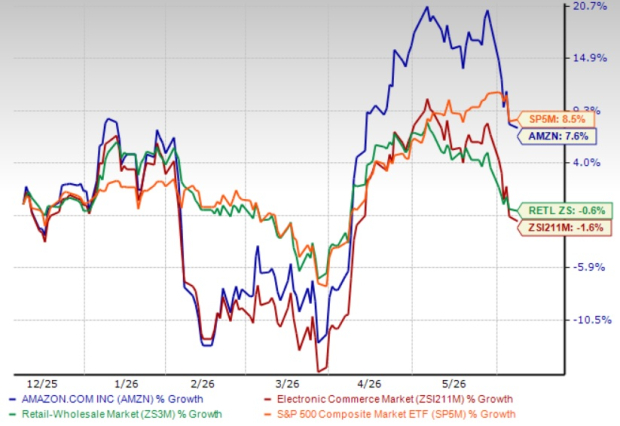
Image Source: Zacks Investment Research
From a valuation standpoint, AMZN stock appears overvalued, trading at a forward 12-month price/earnings ratio of 26.2X, higher than the industry’s 22X. Amazon has a Value Score of D.
AMZN’s Valuation
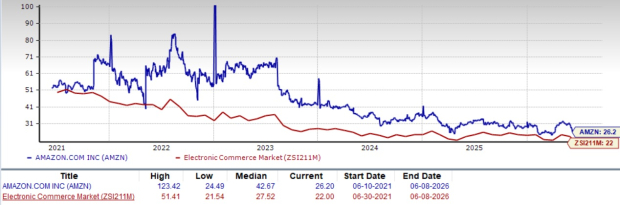
Image Source: Zacks Investment Research
The Zacks Consensus Estimate for AMZN’s 2026 earnings is pegged at $8.85 per share, indicating a 23.43% increase from the figure reported in the year-ago quarter.
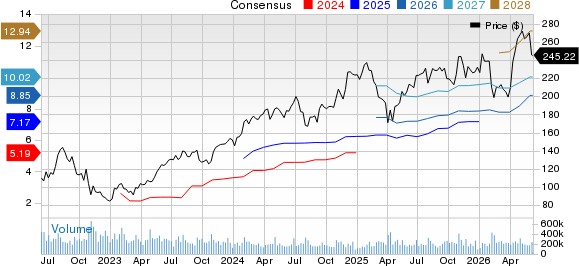
Amazon currently carries a Zacks Rank #3 (Hold). You can see the complete list of today’s Zacks #1 Rank (Strong Buy) stocks here.
Radical New Technology Could Hand Investors Huge Gains
Quantum Computing is the next technological revolution, and it could be even more advanced than AI.
While some believed the technology was years away, it is already present and moving fast. Large hyperscalers, such as Microsoft, Google, Amazon, Oracle, and even Meta and Tesla, are scrambling to integrate quantum computing into their infrastructure.
Senior Stock Strategist Kevin Cook reveals 7 carefully selected stocks poised to dominate the quantum computing landscape in his report, Beyond AI: The Quantum Leap in Computing Power.
Kevin was among the early experts who recognized NVIDIA's enormous potential back in 2016. Now, he has keyed in on what could be "the next big thing" in quantum computing supremacy. Today, you have a rare chance to position your portfolio at the forefront of this opportunity.
See Top Quantum Stocks Now >>This article originally published on Zacks Investment Research (zacks.com).
