BROS Growth Drivers: Loyalty, Food and New Stores in 2026

Dutch Bros Inc.BROS has kept momentum intact by leaning into what the brand does best: fast, friendly service built for convenience. The model is producing traffic-led growth, while digital tools and menu expansion are widening the reasons to visit.
With 2026 guidance now framing the near-term scorecard, investors have clear markers to watch: transactions, new-shop productivity, and the operating levers that can protect margins while the footprint expands.
BROS Traffic Is Rising on Transactions, Not Price
Dutch Bros’ same-shop sales growth has been led by traffic rather than pricing. System same-shop sales rose 7.7% in fourth-quarter 2025, driven primarily by 5.4% growth in transactions. For the full-year 2025, comps increased 5.6%.
That mix matters because it points to underlying demand. The brand’s convenience-focused, drive-thru model, paired with a high-energy service culture, is increasingly embedding Dutch Bros into customers’ daily routines. Consistent engagement is translating into steady traffic gains.
Dutch Bros Loyalty and Digital Add Frequency and Speed
Loyalty is doing heavy lifting in retention and visit frequency. Dutch Rewards surpassed 15 million members, and about 72% of transactions were tied to the platform in 2025.
Digital convenience is also scaling. Order Ahead contributed roughly 14% of the sales mix in fourth-quarter 2025, supporting throughput and making the experience easier for repeat customers. Over time, that combination can reinforce a habit loop: discover, customize, reorder, and come back faster.
BROS Food Rollout Creates Incremental Occasions
Dutch Bros is expanding food as an additive growth layer, not a replacement for beverage-led demand. By the end of 2025, the food program had expanded to more than 300 shops. Early results indicated around a 4% comparable sales lift in participating locations.
The mechanism is straightforward. Food creates incremental occasions and can raise both transactions and ticket size. That works alongside beverage innovation, seasonal offerings, and customization, which help keep customer interest high and broaden revenue opportunities across dayparts.
Dutch Bros Inc. Price, Consensus and EPS Surprise
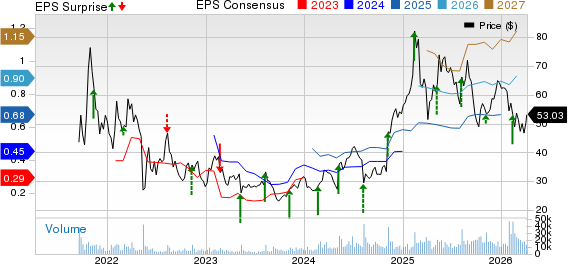
Dutch Bros Inc. price-consensus-eps-surprise-chart | Dutch Bros Inc. Quote
Dutch Bros Expansion Plan and Store Economics Matter Most
Unit growth remains a core driver, supported by improved site selection, operational readiness, and a scalable development model. In 2025, Dutch Bros opened 154 new shops, reflecting 16% unit growth, and ended the year with 1,136 systemwide locations.
Productivity has stayed strong during that buildout. Record system average unit volumes reached $2.1 million, highlighting robust unit economics and ramp strength as the company expands across both existing and newer markets.
BROS 2026 Outlook Sets the Near-Term Scorecard
Management’s 2026 framework lays out the key milestones for the year. Dutch Bros expects total revenues of $2.0-$2.03 billion and same-shop sales growth of 3%-5%. Adjusted EBITDA is projected at $355-$365 million, with capital expenditures of $270-$290 million.
The development pipeline is also accelerating. The company raised its 2026 opening outlook to at least 181 system shops, including 20 Clutch conversions targeted for the second and third quarters of 2026. Openings are expected to be about 30 in the first quarter, with a step-up thereafter.
Dutch Bros Margin Algorithm and the Operating Levers
The margin algorithm hinges on leverage and build economics. In 2026, management expects nearly 70 basis points of selling, general and administrative leverage with relatively flat overhead, an approach designed to support long-term profitability even amid commodity volatility.
Capital efficiency is improving at the same time. Average capital expenditures per shop fell to $1.3 million in fourth-quarter 2025, down from $1.8 million in the prior-year period. That decline improves returns on expansion and helps fund growth more efficiently.
Liquidity adds flexibility. Dutch Bros ended 2025 with $705 million in liquidity, including $269 million in cash, and generated free cash flow for the second consecutive year.
BROS currently carries a Zacks Rank #3 (Hold). Investors looking across the broader restaurant universe may also monitor peers such as CAVA Group, Inc.CAVA and Shake Shack, Inc. SHAK, both with a Zacks Rank #3, as additional read-throughs on demand trends and traffic durability in the category. You can see the complete list of today’s Zacks #1 Rank (Strong Buy) stocks here.
Research Chief Names "Single Best Pick to Double"
From thousands of stocks, 5 Zacks experts each have chosen their favorite to skyrocket +100% or more in months to come. From those 5, Director of Research Sheraz Mian hand-picks one to have the most explosive upside of all.
This company targets millennial and Gen Z audiences, generating nearly $1 billion in revenue last quarter alone. A recent pullback makes now an ideal time to jump aboard. Of course, all our elite picks aren’t winners but this one could far surpass earlier Zacks’ Stocks Set to Double like Nano-X Imaging which shot up +129.6% in little more than 9 months.
Free: See Our Top Stock And 4 Runners UpThis article originally published on Zacks Investment Research (zacks.com).
