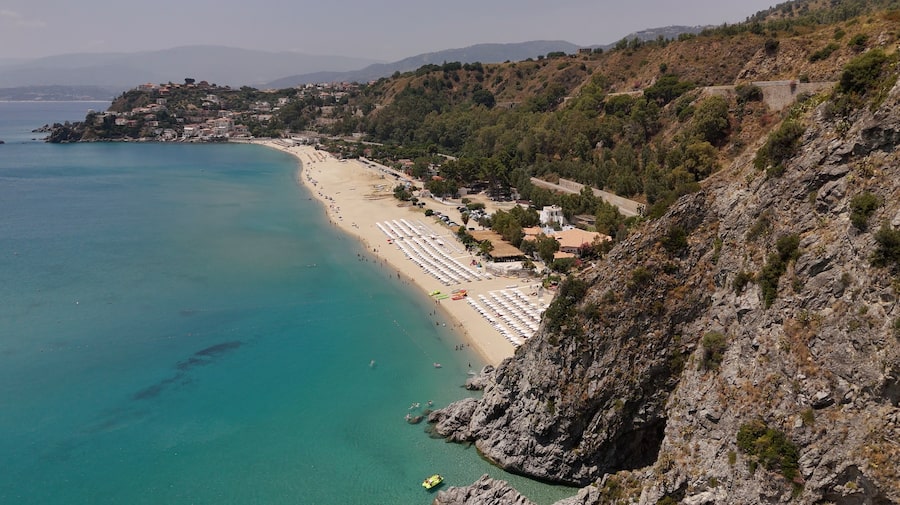
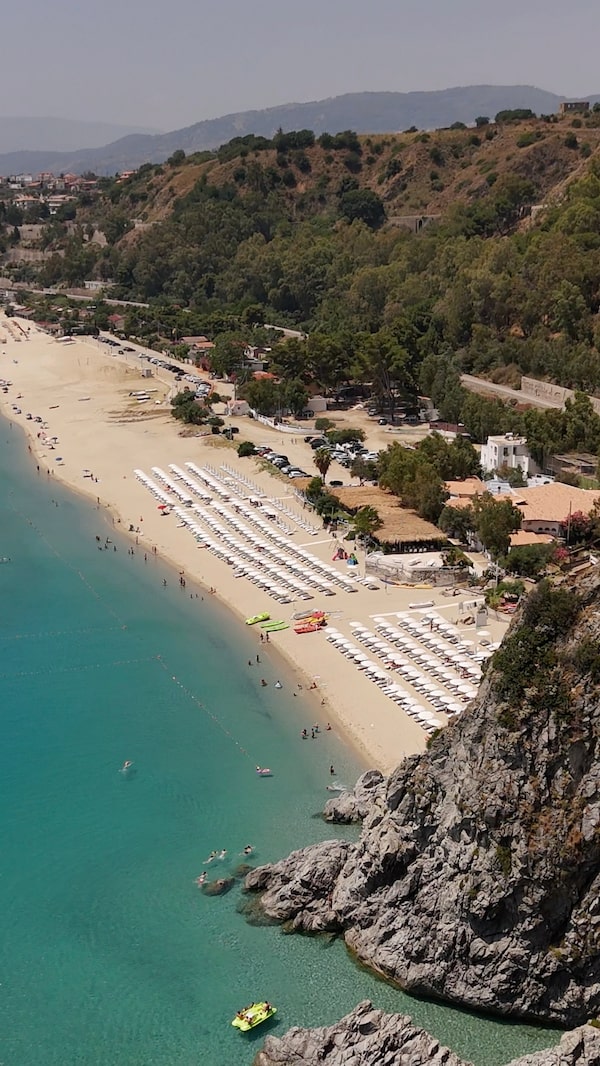
That first swim at Caminia Beach was like diving into a glorious secret, nothing short of paradise.
Despite visiting Calabria’s Ionian coastline countless times, a recent return to my roots after a decade away felt more intimate, more revealing somehow. The Ionian’s translucent waters shimmered under the same sun that warms Calabria’s better-known Tyrrhenian towns, yet the energy was entirely different.
All aboard Rome’s new hotel inspired by the Orient Express
While the Tyrrhenian coast draws crowds with its dramatic cliffs and medieval hill towns, the Ionian tells an older, quieter story. Once part of Magna Grecia, colonized by the Greeks between the eighth and fifth centuries BC, it still bears their imprint in vineyards, olive groves and a slower rhythm of life. Wide sandy beaches and unspoiled fishing villages offer a glimpse of an Italy both ancient and refreshingly undiscovered.

Le Castella in Calabria.THE REGION OF CALABRIA/supplied
That balance between past and promise is the sweet spot for Anthony Macri, the creative director of Calabria Food Fest, a weeklong culinary tour that blends music, dining, cooking classes and cultural experiences across the region’s beaches, mountains and timeless hill towns. He returned to his native region in 2020 after 15 years in Toronto, encouraged by his Canadian partner, who had fallen in love with Calabria on his first visit.
Together they traded North American hustle for what Macri calls “the luxury of the essentials: a life where the sea, the land and community aren’t luxuries, but daily life.” From his base in Soverato, a lively beach town on the Ionian coast, Macri has become one of the region’s most eloquent advocates for sustainable, soulful tourism.
“The Ionian coast remains one of Italy’s best-kept secrets, even to Italians,” he told me. “Compared to Tropea [on the Tyrrhenian coast] or even Scilla [on the Strait of Messina] now, the Ionian has seen little investment in promotion and infrastructure. But this underexposure is its greatest strength – it’s kept the coastline raw, unspoiled and deeply authentic.”

Roccella Ionica is a little city near the blue Mediterranean sea.THE REGION OF CALABRIA/supplied
Up until recently, the coast was visited mainly by Calabrian expats returning from abroad. But the global search for places with real soul is changing that. “International visitors, especially from North America, are looking beyond the Instagram-famous Amalfi coastlines,” Macri said. “They’re seeking something truer, something undiscovered, and the Ionian is exactly that.”
Sounds like a recipe for the dreaded “O” word: overtourism. I can’t help but feel a pang of anxiety at the thought of such an outcome in a land so dear to me.
For Macri, the lesson from surrounding southern regions is clear: “Rapid development can bring opportunity, but it can also price out locals and dilute authenticity. This isn’t about becoming ‘the next Amalfi’ or ‘the next Puglia.’ Calabria must remain Calabria – a place where authenticity is not a curated product but a lived reality.”
He added that the Ionian coast naturally lends itself to slow travel. “This isn’t a place of rushed checklists or tour buses. Travellers are invited to stay longer, rent a home in a small town, join a summer festa or simply linger on a beach until sunset.”

Locals craft juices, jams and bergamot spritzes.RAFFO PRODUCTION/COURTESY OF CALABRIA FOOD FEST/supplied
It’s a rhythm tour operator Cherrye Moore knows well. The founder of My Bella Vita Tours, Moore moved from Texas to Calabria in 2006. “Amore! That’s what brought me to Calabria,” she declared. While living abroad, she met her future husband, Peppe, who grew up in Catanzaro. What began as a love story evolved into a calling: helping travellers discover Calabria’s hidden charms.
“People are often surprised by what they find here,” Moore explained. “The coast is dramatic, the villages unspoiled, the food fresh and rooted in tradition. There’s no overproduction or pretense – what you see is what you get.”
Some of her favourite stops capture Calabria’s blend of history and heart. Inland, the village of San Giorgio Morgeto transforms each August with a two-day medieval festival. On the northern Ionian, Cirò produces world-class wines from the ancient Gaglioppo grape, once poured in Athens during the first Olympic Games.

Capo Rizzuto.THE REGION OF CALABRIA/supplied
And toward the tip near Reggio Calabria, where the Ionian and Tyrrhenian seas meet, a microclimate yields bergamot, the fragrant citrus prized by the perfume industry. Calabria supplies about 90 per cent of the world’s bergamot. Locals now craft juices, jams and, as I discovered this summer, a bright, tangy bergamot spritz by the sea. Soooo refreshing!
Few regions compress beauty and drama into such a compact space. It is a land of contrasts, rugged and wild yet deeply human. “Visitors leave not just with photographs of landscapes,” Macri said, “but with memories of people, traditions and a feeling of connection that’s rare in today’s world.”
Having visited this stretch since my late teens, I can confirm that the beaches, from Capo Rizzuto to Caminia and Copanello, offer a sense of discovery few Italian destinations can match. For a true Calabrian escape, the bookends of summer – June and September – are ideal. The sea is warm, the villages are lively but not crowded, and you can savour the Ionian’s raw beauty as if it were your own private show.
If you go

The Artist's Room Praia at the Praia Art Resort.Gaetano De Girolamo Del Mauro/Praia Art Resort/supplied
Praia Art Resort, in Praialonga near Capo Rizzuto, is an SLH, five-star hideaway that embodies understated Ionian elegance. Open from May to October, with rates from €342 ($559) a night, the resort combines refined luxury with Calabrian craftsmanship. Within the rooms, corridors and grounds, the clay tiles – hand-painted with ancestral and marine symbols – become an emotional alphabet of Calabria, silently narrating the region’s cultural roots, the owner told me.
I spent two days here in June, long enough to understand why guests find it hard to leave. A typical day begins with the hum of cicadas and breakfast under a sun-dappled pergola, followed by a 20-metre stroll to a private beach and your own gazebo.

Private gazebos on the beach are just one of many luxuries at the resort.Praia Art Resort/supplied
From my gazebo, white flowing drapes filtered the sunlight and framed the sweeping views of Praialonga Beach. Afternoons are for drifting lazily between reading, siestas and light seafood lunches. Later, opt for an aperitivo right from your gazebo as Ibiza-style music from the beach bar adds unintrusive ambience.
Evenings invite a sunset boat ride to Le Castella, the striking 16th-century Aragonese fortress rising from the sea, followed by dinner built around the day’s fresh catch and local citrus.
Beyond the resort, curated excursions reveal Calabria’s charm: wine tours in Cirò, visits to the hilltop medieval castle of Santa Severina and boat trips through the Capo Rizzuto Marine Protected Area.

The spaghetti mussels at Praia Art Resort.Praia Art Resort/supplied
Four-star stays along the Ionian coast include Hotel Rada Siri in Montepaone, offering contemporary comfort a short walk from the beach, with rooms from about €120 ($195) a night. In Catanzaro Lido, Park Hotel le Dune sits right on the seafront promenade and makes an ideal base for exploring nearby villages, with rooms starting around €110 ($180).
International flights arrive at Calabria’s Lamezia Terme Airport. Within Europe, it’s possible to fly directly into the regional airport in Crotone. Trains and buses are limited, so rent a car for maximum flexibility.
The writer was a guest of Praia Art Resort. It did not review or approve the story before publication.
Special to The Globe and Mail