Bob Paulson is a retired police officer who, between 2011 and 2017, served as the 23rd commissioner of the Royal Canadian Mounted Police.
There’s something going on in Canada’s courtrooms.
It can take a staggering amount of effort and an awfully long time to get a case to a courtroom in this country. And even once a case makes it to trial, the doors often close while lengthy, confusing and resource-consuming examinations of the evidence and the way the police conducted themselves is undertaken. Ever since the Supreme Court’s ruling in R. v Jordan set out time limits to avoid “unreasonable delay” in getting cases from charge to conclusion, roughly 10,000 cases each year have been stayed because they took too long.
Why this is happening is not well understood by Canadians who are not touched by crime. And for those who are, it can be a rough awakening.
But it’s very hard these days to have a consequential conversation about the effectiveness of our court system. Lawyers and judges often cry foul when anyone – least of all a former police officer – publicly questions whether court processes are undermining respect for our independent judiciary, a foundational pillar of our constitutional democracy.
Why can’t we discuss the culture of our court system at a macro level? Why can’t we wonder if it’s still an effective public institution serving the needs of Canadians? Shouldn’t we earnestly question whether “judicial independence” is a barrier to public oversight into the way justice is administered? Do citizens get a say in how the courts operate, and how efficient they should be? And what is the modern-day value proposition for the public purse in pursuing convictions of the criminally culpable?
Opinion: In fighting organized crime, Canada is losing its way
These questions have been central to me in the context of my career. “It is better to let 10 guilty men go free than to convict one innocent man,” the legal maxim goes, and that hit home for me when I heard it as a young police officer coming to terms with the profession. I understood that Canadians are blessed to have the presumption of innocence as the bedrock of our justice system. But it is also true that the safety, security and prosperity of our communities – indeed, the freedoms we all cherish – rely on securing convictions of the guilty. The state’s ability to collect and present reliable evidence to an independent, impartial and competent court is how that is accomplished.
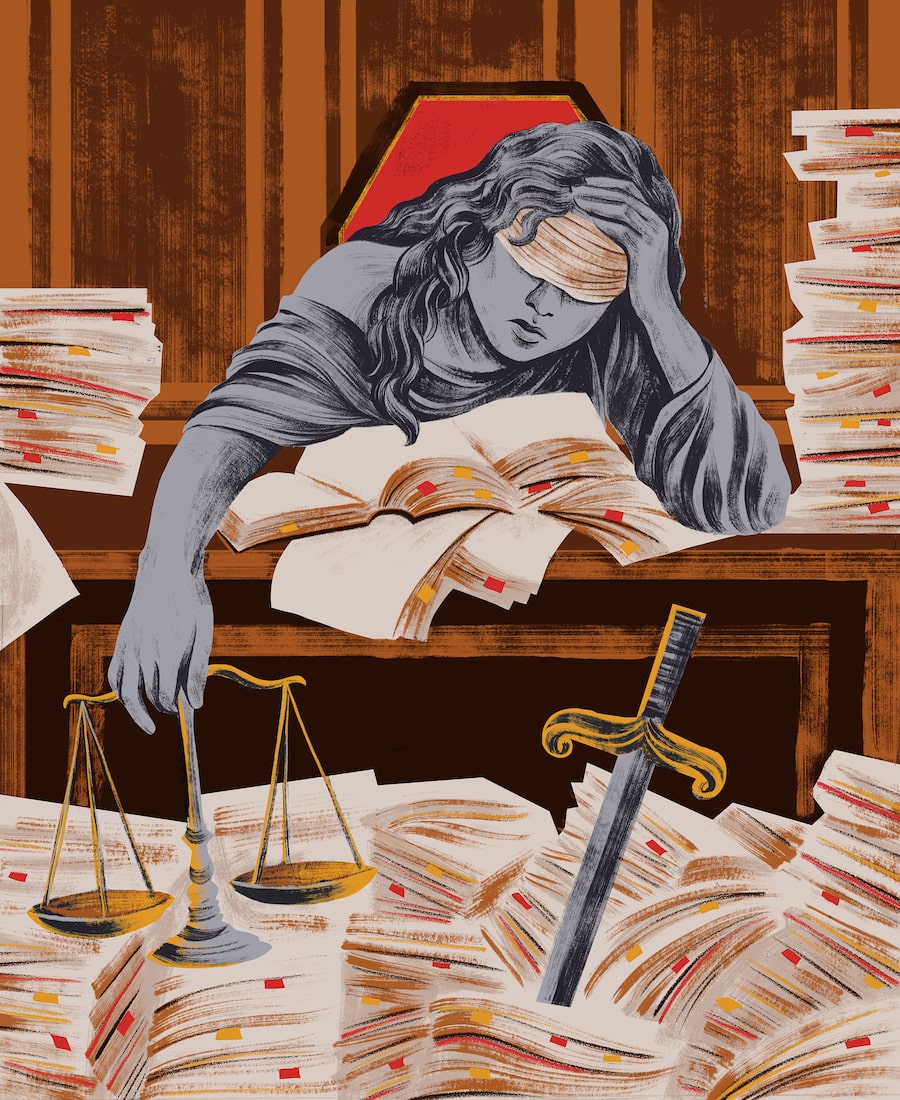
It is absolutely crucial that we do not convict the innocent – but surely, the principle of convicting the guilty must keep some footing on the climb toward justice. After all, while Lady Justice is blindfolded and holding a set of scales, she’s got a sword in her other hand: balance, objective reason, and authority.
What’s more, while the number of people going free these days may be climbing, it has almost nothing to do with ensuring the innocent stay free. The justice system has developed a kind of unchecked esoteric bubble within the legal profession as intellectual one-upmanship extends the reach of our Charter of Rights and Freedoms such that determinative evidence becomes inadmissible or sometimes even impossible to collect. Trials of the accused are increasingly becoming trials of the police, with the focus shifting from proving the elements of the offence to assessing the conduct of the police with microscopic intensity.
The Charter has been with us for more than 40 years, yet there is not a significant prosecution these days that doesn’t face a veritable cluster bomb of time- and resource-devouring Charter-related pretrial motions seeking to exclude evidence. By taking away justice’s sword, reason and balance have been lost, too.
As a result of these efforts, direct lines between crime, accountability and punishment have been confounded in Canada’s justice system. Yet the rest of us look on, like cows in a pasture staring at a passing train, because too few Canadians understand what it takes to deliver justice.
A story: in 1995, as a journeyman major crime investigator, I was assigned to the case of the murder of a woman in northern British Columbia. I determined that the accused, David Mostyn Pritchard, was a violent career criminal suspected of other murders. But I had to charge him with the theft of the victim’s husband’s marijuana to keep him in custody as the murder investigation developed. Then, once he was actually charged with murder, it took almost four years to secure a conviction. Seemingly endless pre-trial motions by the defence sought to derail the prosecution, and very nearly did. An enormous amount of public resources went into sustaining the prosecution – and the defence, for that matter.
I started the investigation as a corporal, and by the time the jury finally issued its verdict – guilty, of first-degree murder – it was 2002, and I had been promoted twice and transferred three times. By then, basically no one was watching this trial except me. I was in the lobby of the courthouse in Prince George, B.C., when jurors delivered the verdict, and I remember that they emerged from sequester and descended the spiral staircase to come and shake my hand. The foreman told me: “We had no idea it took this kind of effort to get these guys.”
Yet by 2008, when the Supreme Court of Canada ultimately confirmed Mr. Pritchard’s conviction after a series of appeals, I had been transferred and promoted twice more. At that point, even I had taken my eye off the case.
Canada’s civil courts are a mess. What will it take to ensure justice is done faster?
That was then. This is now: In 2017, a man named Brandon Teixeira committed a contract killing in Surrey, B.C., and then evaded arrest and fled Canada. Eventually he was extradited back here to stand trial, which is when, as presiding BC Supreme Court Justice Jennifer Duncan noted in a decision, a staggering 117 pre-trial applications and numerous applications for disclosure were brought – most of them by the defence to challenge the evidence. Just this past January, after dragging the process on for more than seven years, Mr. Teixeira somehow felt emboldened enough to ask the BC Supreme Court to toss out his murder conviction after what he claimed was an unreasonable delay.
This all took a mindboggling number of days in court – from when he was charged in September, 2018, to when he was convicted in February, 2025 – requiring hundreds of thousands of hours of work by public employees such as the police, Crown counsel, court staff and the judge just to get him to face a jury.
Justice Duncan rightly described his defence counsel’s strategy as leaving “no stone unturned, then [scouring] the earth to ensure no lingering scrap of evidence with any possible use, no matter how remote, remained on the ground.” She concluded, however, that it was a valid choice for Mr. Teixeira to proceed that way: “Mr. Teixeira was entitled to instruct his counsel to follow that approach. He has a constitutional right to full answer and defence.”
Justice Duncan did not toss out his conviction for “unreasonable delay,” likely because she had lived that case for years and saw that his own style of defence created the length of time it took to get him to his verdict. But this is exactly one of the points Canadians need to know: that neither Mr. Teixeira nor his counsel will be meaningfully impugned or chastised for running his case this way. The courts effectively encourage this; they create these conditions.

ILLUSTRATION BY CHLOE CUSHMAN
Mr. Teixeira’s case is not extraordinary – and his defence strategy is now very ordinary. This is the unique cultural characteristic that has emerged in our Canadian brand of common law.
And there are many more examples where the accused wasn’t even ultimately convicted. In a recent report entitled “Unlawful Enforcers,” professors Scot Wortley and Sunil Gurmukh documented more than 1,000 reports of Charter violations in a 10-year period from police services in Toronto, Ottawa, Peel, York, and Durham handling criminal cases. In 15 of these cases, the authors found officers conducted unlawful investigations into alleged child pornography resulting in the exclusion of reliable evidence at trial.
Investigations must of course be done properly. But more than 65 per cent of these violations relate to instances where an accused’s Charter right to be free from unreasonable search and seizure or the right to be told, without delay, of their right to consult a lawyer upon arrest. While important, these issues are more procedural in nature, yet they have led to hundreds of mistrials in cases where the accused was alleged to have represented a real threat to public safety. Complicated cases around the sexual exploitation of children, guns and drugs are collapsing at trials that have become less about the findings of guilt or innocence than they are about the process.
Perhaps more concerning is that most of these pretrial deliberations now happen under court-imposed publication bans. This virtual public-accountability cloak is now regularly deployed out of a contorted anxiety for fair trial rights, premised on a fear that potential jurors will be contaminated into bias by reading or hearing about these cases as they unfold in real time. A 2023 Supreme Court of Canada decision even suggested that these bans make justice more efficacious: “By shielding information from publication, s.648(1) gives courts the confidence, flexibility, and ability to hold hearings earlier in time, which can be expected to reduce delays and may also allow the parties to gain certainty about contested matters, leading to earlier resolution.” But in what world is that actually happening?
The principle of court openness, which was established as a feature of our criminal justice system well before the Charter, is being abandoned. When Canadians don’t know what is going on in their courtrooms, especially in criminal courtrooms, who will try the triers and keep the court system aligned with society’s values and expectations?
Many blame the Charter of Rights and Freedoms itself, but that just doesn’t wash with me. It just cannot be that these beautifully simple and incontrovertible principles of freedom are the problem. No, the problem is the litigious and relentless pursuit of what it all actually means – the incessant pulling on the string of refined interpretation and efforts to apply the Charter, with no regard for the consequences to society’s broader and equally fundamental right to safety and security. The problem is lawyers and judges who, unrestrained by any stewardship of the public purse, peacock in effectively closed courtrooms with overly pedantic legal arguments.
Editorial: Ottawa can’t throw up its hands in the fight for timely justice
Former Supreme Court chief justice Beverley McLachlin often spoke of the need for judges to consider the practical implications of their decisions on the lives of Canadians. This is the essential principle that demands the public’s attention, because it is simply not happening.
Section 24(2) of the Charter creates a catch-22 in pursuit of that goal: “Where, in proceedings under subsection (1), a court concludes that evidence was obtained in a manner that infringed or denied any rights or freedoms guaranteed by this Charter, the evidence shall be excluded if it is established that, having regard to all the circumstances, the admission of it in the proceedings would bring the administration of justice into disrepute.” The Supreme Court has repeatedly weighed in on the application of section 24 (2); the Court even provided a veritable road map in its 2009 ruling on R. v. Grant for how to assess the various factors giving rise to a denial or infringement of a Charter right to determine whether “disrepute” hangs in the balance. There may ultimately be some irony there, but it seems reasonable enough, even to a simple country cop like me. What the Supreme Court hasn’t contemplated is the practical implications of giving a map like this to the lower courts, because disrepute is in the eye of the beholder.
Consequently, significant criminal investigations and prosecutions have become administrative and logistical behemoths. Increasingly, the go-to defence strategy is to accumulate and often even invent new infringements or denials of increasingly obscure and minute expressions of a Charter right. Prosecutors now devote large chunks of their lives to defending against these motions, and as a result police are stifled in their ability to investigate crimes without potentially birthing new ones.
These decisions have imposed a level of complexity and logistical burden upon criminal investigations and prosecutions such that with a little forethought, persistence and care, the dark-hearted and well-represented among us are virtually free to do as they please.
Another story: When I investigated outlaw motorcycle gangs in Vancouver in the early 2000s, the bikers held a symposium at a local hotel. There, lawyers briefed attendees on the latest jurisprudence around search and seizure, such as wiretaps and search warrants, arrests, and interrogation. Were these civic-minded motorcycle enthusiasts, or was this just prudent business practice?
There has been a palpable erosion of trust and confidence in the police and justice system to swiftly and meaningfully bring consequence to those who commit crime. I say the question is more accurately posed as such: Can the Canadian court system be a reliable – or even viable – means of regulating safety and security in this country. If we hope to answer that fundamental question, we need to start talking openly and honestly about what goes on in our courtrooms. We need to know not just whether somebody was convicted of a sensational crime or not, but what it took – or what was missing – to get there.
One last story. In my occasional lectures about major case management over the course of my career, I would show a quote, attributed to Sir Winston Churchill, that in many ways guided my career: “The soul of a nation can be determined by the methods its police use to investigate crime.” I was a little embarrassed one day when, after one such lecture, a senior prosecutor pulled me aside to tell me Churchill had, in fact, said no such thing. So given that it was a fabrication, allow me to edit it to something that now feels even truer: The soul of a nation can be determined by the manner in which its courts decide and deliver criminal justice.