Andrea Pitzer is a journalist and author of One Long Night: A Global History of Concentration Camps.
Immigrants held at the Bluebonnet Detention Facility in Anson, Tex., spelled out SOS with their bodies on a field of dirt to catch the attention of the outside world.

An Iranian woman in transit to a remote detention camp in Panama wrote “HELP” in lipstick on a pane of glass to press waiting outside.

Rows of half-naked men jailed without trial stood facing the bars of their cell in El Salvador while the U.S. Secretary of Homeland Security posed in front of them for publicity shots.

Donald Trump ran in 2024 promising “Mass Deportations Now,” a rallying cry that his base responded to enthusiastically. Since his second inauguration, he has made immigration policy the centrepiece of his administration. As a result, the U.S. is acting outside the existing legal process to arbitrarily deport U.S. residents to places like Panama and El Salvador, where they face severe conditions and from which there may be no release. Reports of plans for similar deportations to Rwanda and Libya raise the question of what exactly is happening and where these detention policies might lead.
Based on the words coming out of Mr. Trump’s mouth and my research into the history of mass civilian detention around the world, what he and those who help shape his policies want is unlimited power. If they can establish rendition and arbitrary overseas detention for one group – for example, those who are declared to be Tren de Aragua or MS-13 gang members – history shows that they will likely expand the categories of people they can subject to the same treatment. The administration has already declared its interest in subjecting U.S. citizens to detention in El Salvador.
Immigration actions in Mr. Trump’s second administration are not a seamless operation. Their messiness is a response to the failure of the administration’s attempts to do what they promised to during the 2024 campaign. But they currently lack the personnel, the facilities, and the networks to be able to deport the tens of millions of immigrants they promised to remove. As a result, we‘ve seen a mad scramble to send people to Guantanamo and foreign countries famous for their mistreatment of detainees – and now there‘s even talk of reopening Alcatraz.
These operations may be sloppy, but they aren’t harmless. Consciously or not, the administration is creating an international concentration-camp system.

In light of the millions murdered in the Holocaust, “concentration camp” might seem over the top as a descriptor. Yet many other monstrous concentration-camp systems have existed around the world that didn’t descend to the scope of mass killing seen at Auschwitz. Even the Nazi camp system itself evolved over nearly a decade before the addition of extermination camps that carried out genocides aimed at Jews, Roma and Sinti.
The camps that came before were bad enough; what came after was unimaginable. Paying attention to what laid the path for those death camps is critical to keeping this history from repeating.
Concentration camps involve the mass detention of civilians without any real trial outside the existing legal system, usually on the basis of race, religion, or political affiliation. This kind of detention typically results from who the detainees are rather than any criminal action they’ve taken. Detainees belong to a group scapegoated for the country’s ills by a party or government that seeks to expand power, often by declaring a national emergency. Detention may begin with some official sentence, but it tends toward the indefinite, with the government having arbitrary control over the whole process.
These modern camps for civilians began as part of military strategy in imperial wars at the end of the 19th century. Their death toll horrified the world and led the tactic to become disreputable. During the First World War, governments revived and implemented what were then known as concentration camps, ones we now refer to as internment camps. This stage of camps was less lethal than the prior one, but still involved years of detention with no definite release date for hundreds of thousands of people who’d committed no crime.
Canada has its own history in this realm. Leon Trotsky was interned in Nova Scotia. The detention of thousands of Ukrainian-Canadian civilians, some of them held a year or more past the end of the First World War, remained an open wound for the nation well into this century. These cruelties were inflicted again against Japanese Canadians and even against Jewish refugees from Germany during the Second World War.
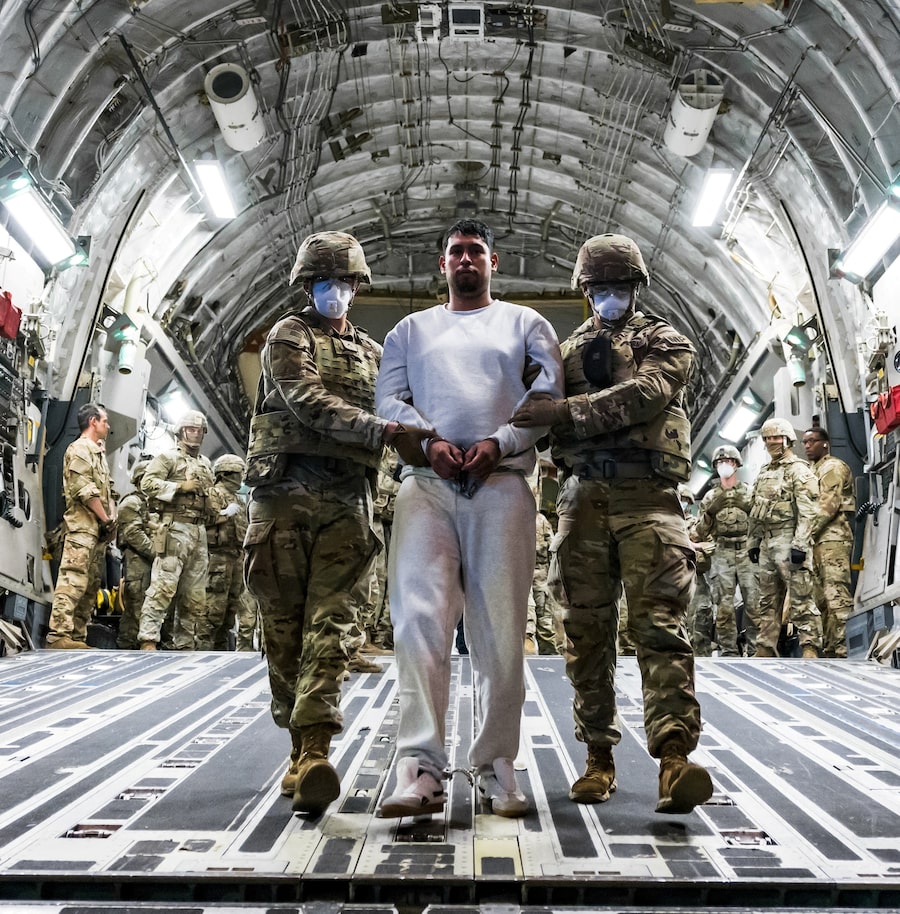
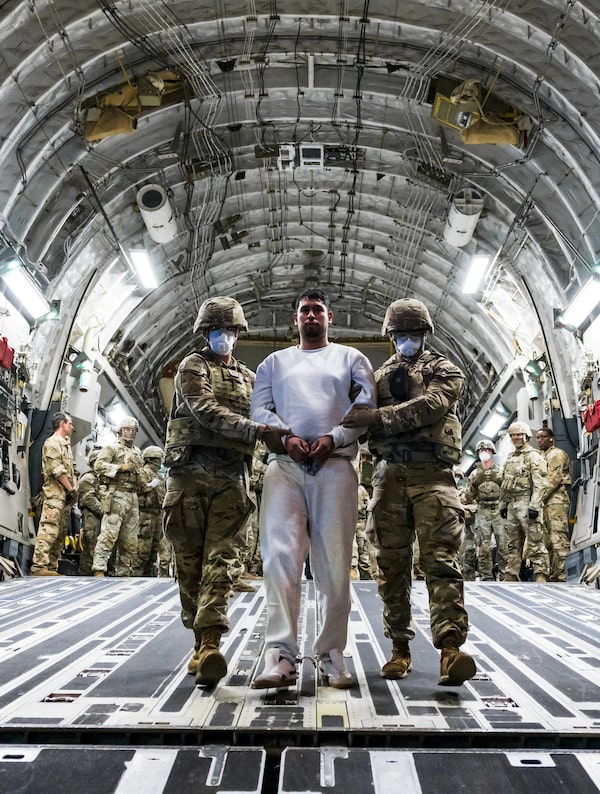
The kind of detention we‘re seeing the U.S. embrace in El Salvador is more openly brutal than the examples from Canada‘s past. But like wartime internment, it meets the concentration-camp definition in multiple ways. The hundreds of men sent from the U.S. to CECOT, the Terrorism Confinement Center in El Salvador, are said to be violent criminals, but the vast majority of them have no criminal record. Some seem to be undocumented, while others had legal status or were in the middle of the asylum process when they were detained. Nearly all of them appear to have been rounded up on the basis of national identity – being Venezuelan. Their deportations were conducted outside the normal legal process in ways that even U.S. courts are declaring unlawful. There is no end date to their sentence. In fact, the justice minister in El Salvador has said before that CECOT is for those whom the government does not intend to release.
This kind of detention can only be done in El Salvador right now because the country is in a state of emergency, one renewed regularly since 2022. The U.S., however, has not declared martial law. It should not currently be possible to carry out this kind of operation.
This kind of overreach and haste are a bad sign, as is the administration’s apparent disregard of court edicts to co-operate in returning Kilmar Abrego Garcia, a Salvadoran man deported to CECOT.

Jennifer Vasquez Sura, the wife of Kilmar Abrego Garcia, speaks during a news conference in Hyattsville, Md. on April 4 after her husband was mistakenly deported to El Salvador.Jose Luis Magana/The Associated Press
The administration is moving more aggressively and more quickly to reinforce illegal detention than several countries that eventually established large concentration-camp systems.
But the pattern is similar, and history shows how this arc has been traced before, over and over: in Nazi Germany, in Soviet Russia, in Brazil and Argentina. All over the globe, mass detention of civilians has been a political weapon of authoritarians for more than a century.

Most people don’t start out in favour of camps; the demonization of vulnerable groups takes years. But with enough propaganda and enough time, it‘s almost inevitable. In this way, the seeds for what is happening now were planted in Mr. Trump’s first administration with the help of right-wing news organizations, allies in Congress, and even political foes who failed to draw the line against dehumanizing immigrants.
Mr. Trump’s actions bring to mind Myanmar, where I sneaked into detention camps holding Rohingya Muslims in 2015. The same kind of malignant rhetoric prevailed in cities and towns I visited. People who had been lifelong neighbours of the Rohingya just three years before came to see them as illegal aliens, depraved and dangerous. More than one person talked to me about why it was good that whole families had been rounded up and forced into camps outside town.
At that point, Mr. Trump had just begun using the same language on the campaign trail. In the decade since, he‘s shaped the conversation on immigration in the country, and his rhetoric has only gotten worse over time. But he may be moving too quickly for the American people, with popular opinion shifting in the face of such extreme methods. We‘re currently in a race to see whether sanity or fear will prevail.
On one side are the courts, which are emphasizing the illegal nature of nearly every aspect of Mr. Trump’s detention policies, from the lack of due process to the misapplication of the Alien Enemies Act, and the weak arguments being made again and again where the law is clear. On the other side is the administration, which appears to be trying to move as quickly as it can to create inevitabilities on the ground that will be hard to undo. Meanwhile, the Secretary of Defense is purging Pentagon leadership in what looks like an attempt to remove everyone but those most loyal to Mr. Trump.

With any kind of arbitrary detention, it‘s critical to hold the line on due process and not to buy into debates over whether a given detainee is “bad” or not. Determining whether a crime has been committed and what the punishment should be is the whole point of establishing a legal system.
Abandoning due process for any group is the quickest way a country can set itself on the road to concentration camps. And after doing that for one vulnerable group, countries rarely stop there.
The U.S. is currently setting up a capacity for arbitrary detention to be used both at home and abroad for civilians. Combining the obliteration of due process with rendition to foreign detention is especially heinous, with the potential to expand the horrors of how 21st-century camps might evolve.
This goal is why they can’t bend on Mr. Abrego Garcia, even though the U.S. government admitted his deportation was a procedural mistake. Their goal is not to identify actual criminals or dangerous threats – it‘s to be able to detain anyone they want in the long run.
Mr. Trump aims to be the one who gets to decide innocence and guilt independent of any system of laws. It‘s critical that Canada and its allies collaborate on ways to actively oppose American use of overseas detention, as well as pressing the U.S. to respect the human rights of immigrants on American soil.