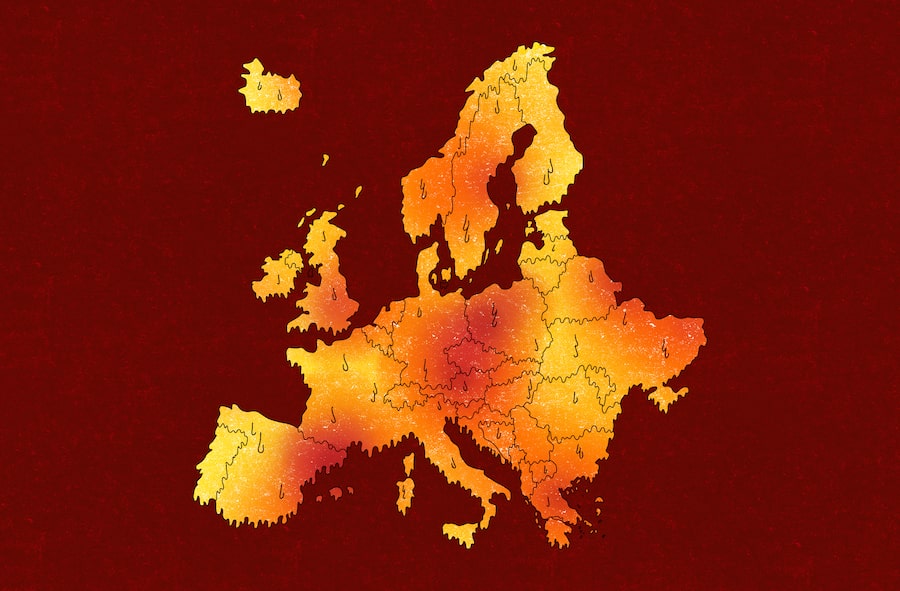
Springtime in Paris, that romantic interval when the City of Light comes back to life, l’amour is in the air, the trees blossom, the birds tweet … and the butter you left on the counter is reduced to a puddle because it’s 35 Celsius inside your apartment?
Paris, the rest of France and much of western Europe are re-examining their vernal certainties this summer after being struck by two deadly heatwaves that arrived before the summer solstice, and then a third one after that.
The first, during the last 10 days of May, produced the hottest average temperature in France ever recorded in May (24.8 C on May 26) and the single highest temperature ever for the month (37.9 C in Angoulême-La Couronne).

French Open spectators cool off at a misting station during the summer's first major heatwave in May.Benoit Tessier/Reuters
That was just a warmup, so to speak. After barely two weeks of relief, temperatures peaked even higher during a second heatwave that began June 17. By the time it was over two weeks later, Paris and the rest of France had hit their hottest daytimes temperatures since records started being kept in 1947.
Other western European countries, as well as Britain, suffered similarly tropical conditions. The current suspected death count for both heatwaves, measured in excess deaths compared to the norm, is said to be as many as 25,000 across the continent.
The third heatwave jolted Europe, France included, this week. It contributed to an unprecedented forest fire in Fontainebleau just outside Paris. And August lies ahead.

A firefighter works to extinguish the wildfire in France's Fontainebleau forest on July 13. The heatwave that settled over much of the country contributed to the massive blaze.Stephane Mahe/Reuters
North Americans watching from afar often ask one question: Don’t people have air conditioning over there?
The answer is, no, they don’t. In much of temperate Europe, air conditioning has long been seen as unnecessary, or worse: as a wasteful, ugly, environment-harming American affectation. In Paris, as few as 5 per cent of homes have air-conditioning; country-wide, the percentage is 25. Even more shocking to North Americans, most schools and hospitals in France lack central AC.
That gallic resistance to mechanical cooling is melting away this summer, and air-conditioning has become a new front in France’s culture wars. The debate is centred on a straightforward issue: is the state responsible for making sure that people’s homes are safe to live in as the climate heats up?
After all, in Canada and France, it is illegal in winter for a landlord or a utility to turn off the heating in homes where rent or bills go unpaid. If it is accepted wisdom that all people should have access to safe temperatures in the cold months, it doesn’t take a big leap to come to the same conclusion in summer. It’s a question many countries are grappling with, but nowhere is the issue better illustrated than in Paris.

Tourists shield themselves from the sun near the base of the Eiffel Tower, where a sign announces early closing due to the heatwave in Paris on July 11.DIMITAR DILKOFF/AFP/Getty Images
The (little) dog days of summer
In France, a heatwave is “une canicule,” which comes from the Latin word for “little dog”. Canicula was the Latin nickname for Sirius, the brightest star in the night sky. Sirius rises and sets with the sun in the hottest months, hence the English term “dog days of summer.”
Parisians were given a cruel lesson in the dangers of la canicule in 2003, when Europe was struck by a horrific heatwave in early August. Daytime temperatures in Paris were over 40 C for two weeks and barely fell to 25 C at night.
Paris and its suburbs saw nearly 5,000 deaths, the worst for a single département (an administrative region) in a country where 15,000 people died in total. The French government responded with a colour-coded warning system and measures to keep track of vulnerable people, such as the elderly and sick, living in apartments and seniors’ residences.

People cool off in the fountain at the Place de la Concorde in Paris, in August, 2003, during the deadly heatwave that swept across France.THOMAS COEX/AFP/Getty Images
Since then, Paris has been hit with heatwaves most summers, and the systems in place have helped limit the number of deaths. But never before has the city registered three heatwaves by mid-July.
Right-wing populist politicians have seized the moment and are promising the air-conditioning equivalent of a chicken in every pot. The Rassemblement National party, eyeing the French presidential election next April, says it will put AC in every school and hospital, and will also provide €20 billion euros ($32-billion) in interest-free loans that people can use to install AC in as many as 40-million households.
The left and centre are accusing the populist right, which has never supported efforts to reduce emissions of greenhouse gases, of naked opportunism.
Critics on the left say mechanical cooling increases the consumption of electricity, leaks refrigerant gases that contribute to the greenhouse effect, and pumps hot air into streets, exacerbating the heating that occurs in urban environments.


The potential proliferation of air-conditioning units conflicts with the desire to protect the aesthetic and architectural integrity of Paris. Politicians have said keeping shutters closed and improving building insulation are better ways to deal with extreme heat.MARTIN LELIEVRE/AFP/Getty Images
Paris’s left-wing mayor Emmanuel Grégoire went as far as saying in June that “individual air conditioning is a scourge” that contributes to global warming.
There is also a very French desire to preserve the architectural integrity of Paris by not marring it with the sight of air-conditioning units on every balcony or hanging off walls in courtyards.
Politicians on the left say it is far better to improve insulation in walls and windows, keep shutters closed and curtains drawn during the day to block the heat of the sun, and to open windows at night to let in the cool air.
Fair enough. That’s what just about everyone does now. But it makes for an uncomfortable existence. Paris’s older apartments retain heat; after seven days of daytime temperatures of 39 C and nighttime temperatures of 26 C, it’s not unusual to go to bed in an apartment with an interior temperature of 35 C.
Parisians take it in stride, because the heat wave always ends. Just drink gallons of water, buy an electric fan and wait it out. Why pay for air-conditioning that you might only need a few days a year, and that is environmentally harmful?
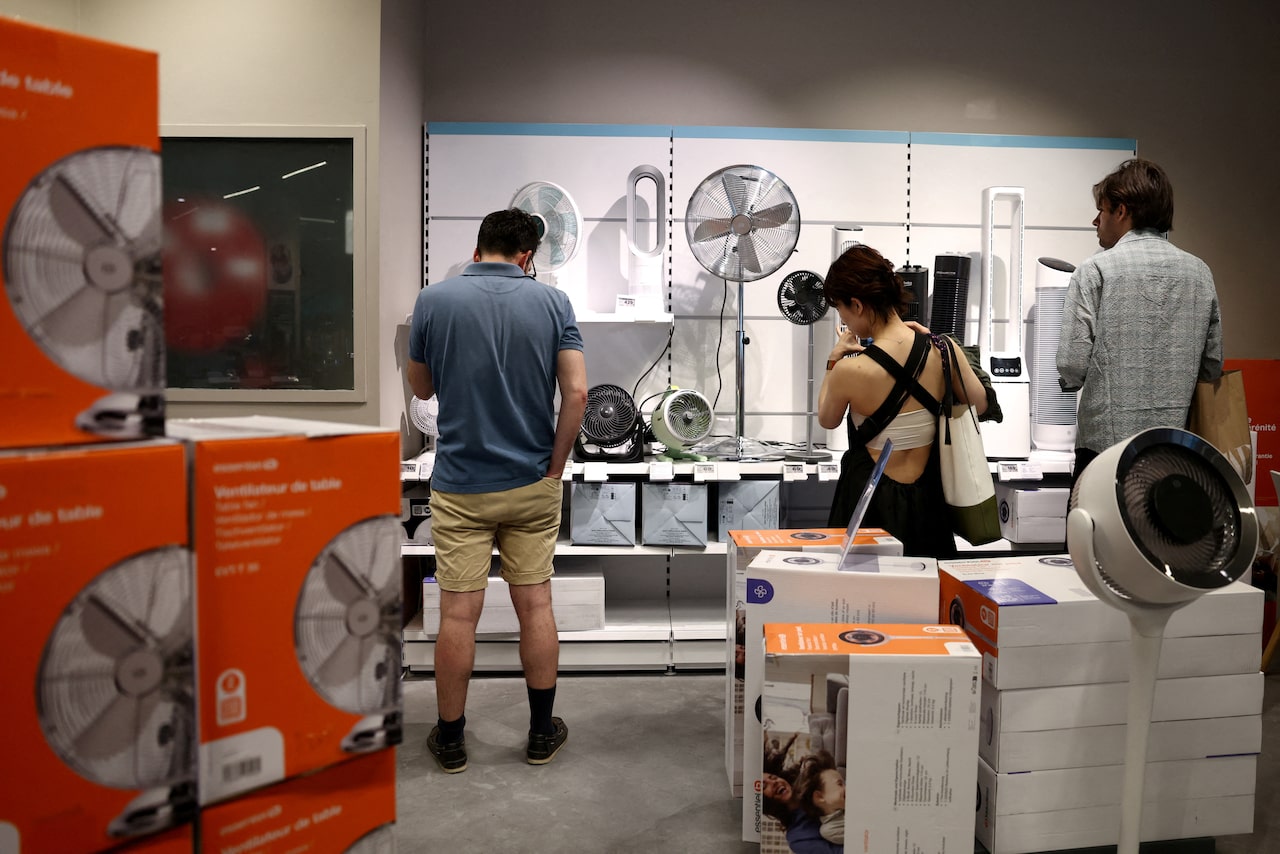

Still, the French government has begun to recognize that AC will have to be part of the solution to a warming planet. France announced it would deliver 30,000 mobile AC units to hospitals. It also slashed the sales tax on reversible heat pumps that meet European efficiency criteria, while maintaining the tax on the less expensive and easier to install mobile units that sell out instantly during the first heatwave of every summer.
Even the Green Party in France has dropped its dogmatic opposition to air-conditioning when it comes to hospitals. The next question, there and in other countries like Canada, will be: When does air-conditioning go from being a personal luxury to a necessity?
Cooling the rhetoric
AC is not, you will forgive the term, a polarizing issue in Canada. Installing it is uncontroversial. The far greater concern is heating. Governments offer rebates to owners and builders who install efficient systems that cut down on energy use.
Still, more and more Canadian households have air-conditioning or heat pumps to control the temperature in summer. According to Statistics Canada, 68.3 per cent of households had mechanical cooling in 2025, compared with 64 per cent in 2021.
There is an income divide, however. Only 55 per cent of households with annual incomes under $50,000 have AC, compared to 82 per cent for households earning $150,000 or more.
Couple this with the fact that, in the United States – where 90 per cent of households have mechanical cooling – there is overwhelming evidence that air-conditioning saves lives during heatwaves, and it becomes clear that governments cannot ignore the issue.
This became evermore apparent in British Columbia in 2021, when a prolonged heat dome led to the preventable deaths of 619 people – most of them from exposure to high indoor temperatures created by a lack of air-conditioning, according to a coroner’s report.

Air conditioning units are seen on an apartment building in Burnaby, B.C. According to Statistics Canada, the number of households with mechanical cooling has risen over the past few years.DARRYL DYCK/The Canadian Press

A woman enters a cooling centre during a heatwave in Vancouver in June, 2021. For those without adequate cooling, the increasingly frequent extreme heat conditions can be life-threatening.JENNIFER GAUTHIER/The Globe and Mail
Moving the dial
Governments in Canada are clearly going to have to ensure that low-income housing has adequate cooling in this era of extreme heat, just as it is required to provide heating in winter. Governments will either have to provide access to it, or oblige builders and landlords to install it.
That adaptation, as in Paris, will take time, and more heat waves are a certainty.
But unlike the U.S., where much of the population lives in the south, more temperate countries such as Canada and France still have time to adapt in ways that don’t make air-conditioning, with all of its environmental downsides, the stock solution.
Better construction and better practices, such as closing shutters during the day and opening windows at night, could lessen the dependence on mechanical cooling. Any vicious circle created by a loop of hotter temperatures and more AC can be avoided, or at least minimized.
The key to the success of it in Canada, though, will be to keep ideology out of it, and to focus instead on sound policies. France is concerned with protecting the vulnerable, but it is also wrestling with worries about culture and the Americanization of cities.
As this space said in May, every summer is another season of peril. Being elderly, sick or poor – or, as in France, overly resistant to change – should not be a death sentence.