Ontario and the federal government have joined forces to try to breathe life back into the province’s moribund residential construction market.
In the past two weeks, Premier Doug Ford and Prime Minister Mark Carney have announced a combination of tax cuts that they hope will shake homebuilding out of its torpor. First, they’ll each pitch in to rebate the 13 per cent harmonized sales tax for most buyers of new-construction homes.
Second, they’ve pledged to spend $8.8-billion on capital projects in cities that agree to slash their development charges, fees that developers must pay to cover the cost of municipal infrastructure such as sewer pipes and roads. Together, they project the two measures will shave up to $200,000 in taxes and fees off the price of a newly built home in Ontario.

Prime Minister Mark Carney, Toronto Mayor Olivia Chow, and Ontario Premier Doug Ford arrive at a new condo development in Toronto on March 30 to make an announcement about a combination of tax cuts and spending that they hope will stimulate homebuilding in the province.Nathan Denette/The Canadian Press
That may well help to create enough demand to absorb the province’s towering inventory of unsold condos and stimulate homebuilding. But the two policies come with short-term expiry dates. The beefed-up HST rebate will be around for a year. And cities only have to commit to lower development charges for three years.
It’s the equivalent of a shot of adrenaline in the arm for an ailing patient. But what Ontario – and Canada – needs is a proper, long-term remedy for a chronic affliction that has helped create the current housing crisis: the costs of building a home are simply too high.
It is telling that, so far, neither tumbling home prices nor falling interest rates have done much to restore housing affordability. In aggregate, prices have dropped 20 per cent from their peak in March, 2022.
Interest rates have also declined sharply in the past year and a half, partially undoing the Bank of Canada’s previous, aggressive rate-hiking cycle to battle inflation.

Neither falling home prices nor lower interest rates have done much towards housing affordability, as buying a home in 2026 is generally more expensive than it was before COVID.Christinne Muschi/The Canadian Press
But buying a home today remains, by and large, far more expensive than it was before COVID.
Combine that with an anemic economy battered by trade and geopolitical uncertainty, and it’s little wonder few people are in the mood to purchase a house. And if sales are lacklustre for existing homes, they have cratered completely in the market for new condominiums, which is swamped with tiny units no one wants to buy now that investors have deserted the space.
Yet, at the same time, today’s prices are already too low for many developers to be able to turn a profit on new construction. As CIBC economists Benjamin Tal and Katherine Judge put it in a recent report: “Prices are still too high to buy and not high enough to build.”

According to the Canada Mortgage and Housing Corporation (CMHC), housing starts are expected to decline over the next three years as developers face rising costs and weaker pre-construction sales.Sean Kilpatrick/The Canadian Press
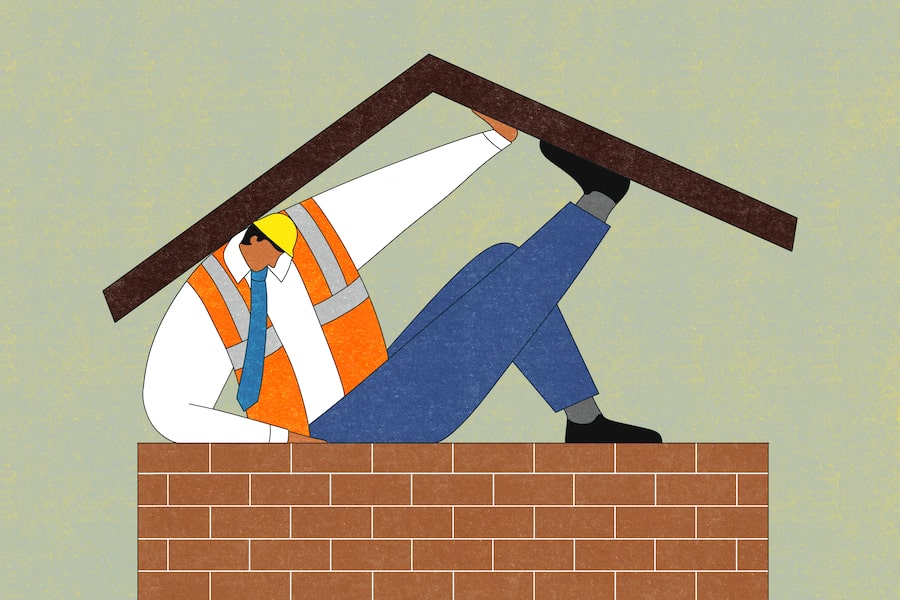
Caught between a price ceiling and a hard floor of costs
For homebuilders, profit is the space between a revenue ceiling set by market prices and a floor determined by construction costs. Right now, the ceiling has collapsed onto the floor. Housing starts are set to tumble over the next three years, the Canada Mortgage and Housing Corporation has warned.
This is a problem, because the pace of building was already well below what’s needed to meet projected demand, even accounting for Ottawa’s recent immigration curbs. The current drop-off in construction is a recipe for another spike in home prices when the economy rebounds and young Canadians dare to venture out of their parents’ basement or their roommates’ rentals to try to finally buy a place of their own.
The crux of the issue is that residential construction in many markets has become so expensive that it can’t be done profitably at prices that are affordable to middle-class households. To find a way out of the housing crisis, Canada must make homebuilding cheaper.
Taxes and development have played a significant role in driving up building costs. All levels of government across Canada should work together to lower them permanently.

One of the factors pushing up the cost of homebuilding is the price of materials such as lumber, which spiked during the pandemic.James MacDonald/The Globe and Mail
Why residential building in Canada is so expensive
Many factors have conspired to push up the cost of homebuilding. The price of materials from lumber to concrete spiked during the pandemic. Another hit came from the trade war, which caught imports of anything from steel to plywood in its crosshairs.
The industry has also long been hobbled by a shortage of skilled trade workers. Even in markets where construction has floundered, some developers are holding onto their key labourers for fear they would struggle to staff up again when the market recovers, especially now that construction workers are also in high demand in the fast-growing infrastructure sector, Mr. Tal and Ms. Judge wrote.
Statistics Canada’s gauge of residential building prices, which primarily reflects materials and labour, shows that costs increased by roughly 80 per cent between the end of 2017 and the end of 2025, rising several times faster than inflation.
But there’s another category of costs that have been pushing the price of new homes higher and higher: taxes.
The high rise of development charges

Mr. Carney tours a modular home under construction in Ottawa in September, 2025. In Ontario and B.C., construction and home sales will be weaker than their 10-year average, according to the CMHC's housing market outlook for this year.Justin Tang/The Canadian Press
The biggest source of government-made runaway costs is development charges.
These municipal fees were originally meant to pay for the expenses that municipalities often incur to support new housing. But in cities, primarily in Ontario and B.C., that rely on them to raise revenue they have ballooned. In Toronto, for example, they have risen by almost 600 per cent in a decade and now can add more than $100,000 to the price of a newly built home.
Taxing the supply of something, of course, is a recipe for getting less of it.
But for years, soaring real estate values fuelled by rock-bottom interest rates and strong population growth, helped mask the impact of development charges on new constructions. Prices were so high – and borrowing costs so low – that builders could still turn a profit.

The housing industry is facing a shortage of skilled tradespeople, especially now that these workers are also in high demand in the fast-growing infrastructure sector.Laura Proctor/The Globe and Mail
Now, with weak demand and higher interest rates, sky-high municipal fees are making a slew of residential projects financially unviable.
This space has long called on municipal governments to slash development charges. The present residential construction freeze only adds urgency to that argument.
Those who retort that cities can’t possibly afford lower fees should ponder the fact that no revenue from development charges will flow to municipal coffers if nothing gets built. Besides, there are several ways in which cities could replace revenue from fees on residential construction, as we have pointed out before.
Options include raising property taxes to charging user fees to cover the cost of new municipal infrastructure such as water and wastewater projects. Another avenue is for provincial and federal funds to make up the funding shortfall.
That’s exactly what Mr. Carney and Mr. Ford’s $8.8 billion money pot for municipal infrastructure projects does. It’s a good start.
And in an interview with The Globe and Mail, federal Housing Minister Gregor Robertson, said he’s hoping to make similar deals with other provinces. B.C., with its own high development charges and struggling condo market, likely tops the priority list.
But any such arrangements should be treated not as a one-off housing stimulus but as a pilot project aimed at finding permanent ways to cut down development charges.

Builders look on from a residential construction site in Ottawa as Mr. Carney and Minister of Housing and Infrastructure Gregor Robertson announce the launch of Build Canada Homes, a new federal agency created to accelerate affordable housing construction across the country, in September, 2025.Justin Tang/The Canadian Press
The problem with sales taxes on new homes
Ottawa and the provinces also have an important role to play in reducing the tax wedge that currently pushes up the cost of new homes. Unlike existing homes, newly built ones are generally subject to federal and provincial sales taxes.
These are taxes on homebuyers, rather than builders, but their impact is still to add tens of thousands of dollars to the price of a new property.
The longstanding GST/HST new housing rebate allows buyers to recover some of federal tax on a property they buy as a principal residence. But tax breaks only exist for homes valued at less than $450,000, a threshold that hasn’t been adjusted since 1991. For reference, the median national price of a newly-built detached home back then was $175,000. Today, it is $795,000.
If the rebate threshold had kept up with inflation, it would be worth around $910,000. If it had kept up with the prices of new homes, it would have grown to more than $2 million.
Last year, the Carney government announced a new rebate, valid until the end of 2030, that would cover the full cost of the 5 per cent federal portion of sales taxes on new homes valued up to $1-million, with the benefit phasing out at $1.5-million. Mr. Ford, for his part, pledged to cover the 8 per cent provincial share of the HST in Ontario on homes worth up to $1 million.
In his latest provincial budget, Mr. Ford went one step further, saying he would rebate up to $80,000 worth of provincial sales taxes for most buyers for one year. Ottawa has promised to match that, covering up to another $50,000 worth of federal sales taxes for eligible buyers.

Mr. Ford and Mr. Carney have pledged $8.8-billion to boost housing construction in cities that agree to slash their development charges.Laura Proctor/The Canadian Press
Such tax carveouts are usually a bad idea, because they complicate the tax system. Not only that, but some economists convincingly argue that Canada should shift its tax load away from income taxes, which reduce the returns from hard work and investing, and toward consumption taxes. These, while regressive, are easier to collect.
But given the current state of the housing market, the sensible thing to do is to make GST/HST rebates both bigger and longer-lasting. Ottawa and Ontario should scrap the distinction between rebates for first-time buyers and rebates for all buyers and make those tax cuts permanent, ideally with a commitment to revise home-price thresholds so they keep up with market values.
And other provinces should follow Ontario’s lead in scrapping their portion of sales taxes.
This would help even out the playing field between new and existing homes, which are not subject to sales taxes. Crucially, it would also boost demand for new housing, without also attracting buyers to the resale market.

With weaker demand and higher interest rates, steep municipal fees are making many residential projects financially unviable.Sean Kilpatrick/The Canadian Press
Canadians have become justifiably wary of demand-side housing measures that portend to improve affordability by making it easier to purchase a home. From looser mortgage rules to buyer incentives, the ultimate effect has been to boost demand without significantly increasing supply, which led home prices to rise.
Narrowly targeting the demand for new homes is fundamentally different because it channels capital to the construction of new homes without stimulating the demand for those that already exist, notes economist Mike Moffatt.
Critics of cutting taxes on new housing argue it’s a gift to developers, who’ll beef up their profits and charge prices as high as the market will bear.
That’s certainly plausible in a hot real estate market. But in a sluggish one, such as the one we’re in now, high taxes simply make it harder, and often impossible, for homebuilders to squeeze a profit.
Canada needs the home-price ceiling to continue to come down. But for housing to truly become affordable, the construction-costs floor must come down, too.