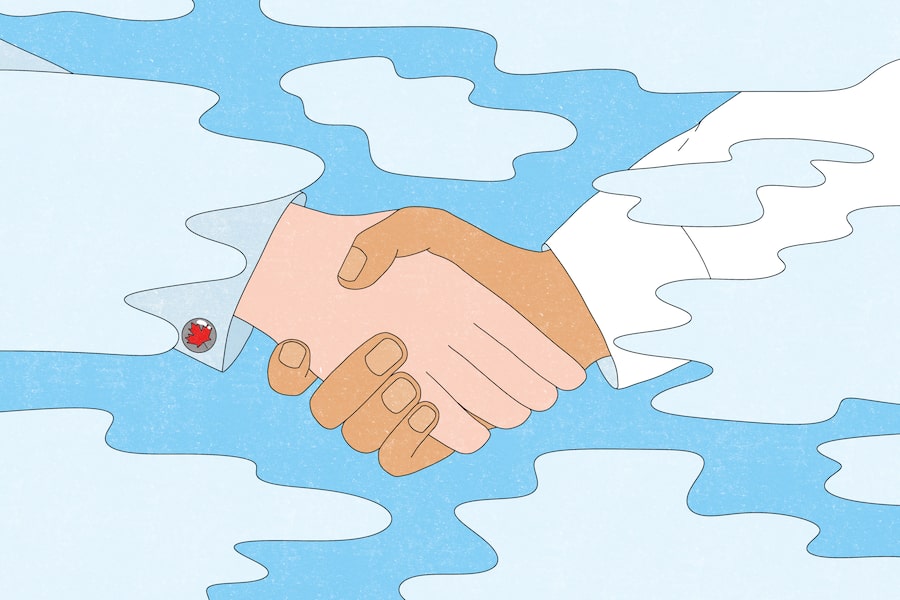
For two decades, Canada pursued a values-based foreign policy, although the values pursued by Liberal and Conservative governments were very different.
Today, Canada is pursuing a more hard-nosed foreign policy that puts Canada’s national interests front and centre. Putting Canada first, so to speak, has proved to be a far better approach.
Of course, values and interests have always comingled in the foreign policy of Canadian prime ministers. Brian Mulroney in the 1980s pursued free trade with the United States – interests – while staunchly opposing apartheid in South Africa – values.

Former prime minister Jean Chretien, right, shakes hands with former U.S. president Bill Clinton at the end of a three-day Summit of the Americas in 1994.Jacques Boissinot/The Canadian Press
Similarly, Jean Chrétien agreed to continental free trade with the United States and Mexico – interests – while co-operating with the United States to protect persecuted minorities in the Balkans but refusing to join the American coalition invading Iraq – values.
Conservative Prime Minister Stephen Harper arrived in office in 2006 having rarely travelled beyond Canada’s borders. He believed this country’s foreign policy should reflect democratic, Western values. He distanced Canada from the rising power of China, while offering stalwart support to Taiwan because, he said, Canadians embraced democratic values and “they don’t want us to sell that out to the almighty dollar.”
Mr. Harper worked closely with both Republican President George W. Bush and Democratic President Barack Obama in supporting the American-led mission in Afghanistan, while leading the charge to expel Russia from the G8, telling President Vladimir Putin at a summit in 2014, “I guess I’ll shake your hand but I have only one thing to say to you. You need to get out of Ukraine.”
But Mr. Harper’s foreign policy goals came to grief more than once. Facing complaints from Canadian businesses, who said they were losing contracts, Mr. Harper reversed himself on China, even submitting himself to a indignity-filled visit to the Middle Kingdom in 2009.

Former prime minister Stephen Harper walks past Russian President Vladimir Putin at the G20 Summit in St. Petersburg, Russia, in September, 2013. Harper would lead the charge to expel Russia from the G8 over the annexation of Crimea in 2014.Adrian Wyld/The Canadian Press
And his close alliance with Washington frayed when President Obama refused to approve the Keystone XL pipeline from Canada’s oil sands into the United States.
When he became prime minister in 2015, Justin Trudeau took a values-based foreign policy to new, and quite different, heights. On his watch, the Liberals proclaimed their leadership in the fight against global warming, while promoting the rights of women and labour.
Mr. Trudeau’s government, to its credit, successfully concluded the Canada-European Union trade agreement that the Conservatives had launched. But his demands to increase protections for Canadian automotive and cultural industries almost wrecked the Trans-Pacific Partnership agreement, and left lasting bitterness, especially among the Japanese and Australians, even after Canada eventually agreed to sign the deal.

Justin Trudeau's Liberal government took a strong values-based foreign policy approach, proclaiming its leadership in the fight against global warming, among other things.Ryan Remiorz/The Canadian Press
Efforts to launch free trade talks with China foundered on Canadian demands to include labour and women’s rights. And the prime minister’s Bollywood sartorial choices and the embarrassing invitation to a reception of a man previously convicted of attempting to assassinate an Indian state official turned Mr. Trudeau’s visit to India into a disaster.
On top of all that, preachiness on human rights in Saudi Arabia led that country to freeze ties with Canada.
The Liberal government did successfully protect Canada’s free-trade interests with the United States during the negotiations that led to the Canada-United States-Mexico (CUSMA) pact, after initial fumbling. Chrystia Freeland, then foreign affairs minister, headed into those negotiations with a mandate to negotiate a “progressive” trade pact that emphasized gender and Indigenous rights. Those are worthy goals – but the Trudeau government badly misread the moment and the fact that the existence of the continental trade pact was at risk. (The Carney government has not replicated that naivete.)

Canada, Mexico and the U.S. hold a signing ceremony for the Canada-United States-Mexico Agreement (CUSMA) in Buenos Aires, Argentina, in November, 2018. Despite initial fumbling, Mr. Trudeau's government did successfully protect Canada’s free-trade interests during negotiations.Sean Kilpatrick/The Canadian Press
By the end of Mr. Trudeau’s tenure, values had collided with reality. Relations with China were in a deep freeze over Canada’s arrest of Huawei executive Meng Wanzhou and China’s detention of Michael Kovrig and Michael Spavor in retaliation.
India and Canada both expelled officials after Mr. Trudeau’s assertion that New Delhi was involved in the assassination of a Sikh activist in Vancouver.
And relations with the United States in President Trump’s second term had reached rock bottom, with tariffs and threats of annexation.
In the end, values-based foreign policy foundered on the shoals of reality for both the Liberals and the Conservatives. And both governments struggled with foreign policy capability. Canada lost its bid for a seat on the UN Security Council in 2010 under Mr. Harper in part because of his suspicion of multilateral forums. Canada lost its bid for a seat on the UN Security Council in 2020 under Mr. Trudeau despite his enthusiasm for multilateral forums.
The Liberals won the 2025 election because a plurality of Canadians believed that Mark Carney, the former central banker in both Canada and Britain, was best equipped to meet Mr. Trump’s challenges and threats. Mr. Carney promised to protect Canada’s economy through trade diversification, while responding to the growing international anarchy by encouraging co-operation among like-minded countries.

Prime Minister Carney's lauded speech at the World Economic Forum in Davos, Switzerland, urged middle powers to cease pretending the rules-based international order is still functioning and instead focus on uniting against the economic coercion of "great powers."Denis Balibouse/Reuters
In his landmark speech in Davos, Mr. Carney summed up his version of realpolitik. “We actively take on the world as it is, not wait around for a world we wish to be.”
To his credit, Mr. Carney has turned those words into action. To wit:
- In the spirit of Davos, Mr. Carney signed trade and/or security agreements with a broad range of countries, including Australia, the European Union, Germany, France, Italy, Japan, Korea, Latvia, Malaysia, Mexico, the Philippines, Poland, Qatar, South Africa, the United Arab Emirates, the United Kingdom and others. Some of these agreements built on existing arrangement; others were little more than talks about talks. But all advanced trade and security beyond the status quo;
- Canada hopes to conclude a major trade agreement with the Association of Southeast Asian Nations within the year;
- Despite concerns that the Chinese government had interfered in Canadian elections, Mr. Carney travelled to Beijing, where Canada agreed to lift tariffs on a limited number of EVs, while China eased restrictions on Canadian canola seeds and other products, with both sides also agreeing to further increase two-way trade. (As we’ve previously said, the Carney government should not make the mistake of replacing economic dependence on the United States with overreliance on China);
- Putting aside ongoing tensions, Mr. Carney travelled to India, where the two sides signed a memorandum to advance trade and other interests;
- In Norway in March, Mr. Carney and Nordic leaders agreed to strengthen economic and security co-operation;
- Talks are under way with the Mercosur bloc of South American nations. An agreement is expected within a matter of months.
There is even nascent evidence of a Canadian effort to forge an Atlantic-Pacific trade area not centred on the United States.
After only one year, we see baby steps of progress. While exports to the United States declined by almost 6 per cent in 2025, exports to other countries rose by 17 per cent, according to Statistics Canada. The government’s goal is to double exports beyond the United States by 2035.

Prime Minister Carney tours a CC-130 Hercules aircraft at IMP Aerospace in Halifax in March. Under Mr. Carney's leadership, Canada’s military spending finally hit the NATO target of 2 per cent of GDP for the first time in roughly 35 years.Darren Calabrese/The Canadian Press
Mr. Carney has also replaced talk with action by rapidly increasing spending on national defence. Nothing lends credibility to global commitments like concrete evidence of the will to back words with deeds.
Not every step has been sure-footed. The Liberal government vacillated in its approach to the American and Israeli war on Iran, affirming support for the mission but with increasing reluctance, given widespread public concern over rising energy prices and regional instability.
And Mr. Carney needs to remember that if he is going to spend about a fifth of his time abroad, he must be candid with Canadians about what is happening on these trips and at home. This government already manifests a reluctance to speak with journalists and to communicate openly.
The biggest challenge still lies ahead. Because the United States will always be Canada’s most important trading partner, the first and greatest priority must be to protect the tariff exemptions by preserving – if necessary, by renegotiating – CUSMA. That said, it is not in Canada’s interest to rush into a deal. As Derek Burney, who as Mr. Mulroney’s chief of staff during the Canada-U.S. free trade negotiations in the 1980s was a key figure in those negotiations, recently observed, “time may be our best ally” in the CUSMA talks.
Still, the Prime Minister is starting to make good on his promises to diversify Canadian trade and to strengthen defence. And in this increasingly dangerous world, protecting Canadian workers and Canadian security is the most important value of all.