Briefing highlights
- Forecasts for wage, salary increases
- Economy creates 35,000 jobs
- But unemployment up to 6.3%
- Loonie pops above 78 cents
- U.S. churns out 261,000 jobs
- Markets at a glance
- Canada’s trade deficit unchanged
- Long queues for Apple iPhone X
Consumer math
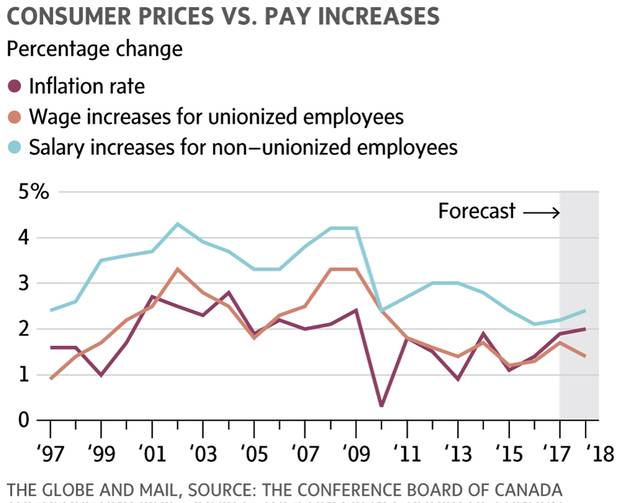
You do the math: The Conference Board of Canada projects average wage increases of just 1.4 per cent among unionized workers in 2018, while the Bank of Canada forecasts inflation of 2.1 per cent. Add to that the expected rise in borrowing costs, which has already started, and you get a picture of a consumer under the gun.
Salaried workers will do somewhat better, with the group's survey of 324 employers suggesting average increases of 2.4 per cent.
Of course, how much you get depends on several things, such as whether you're in the private or public sector, where you live and whether there's a boost to minimum wages, and the industry in which you work.
Salaried employees in the private sector, for example, are looking at an average 2.5 per cent, while their public sector counterparts can expect 2 per cent. It's much lower in the unionized work force, of course, with those in private industry looking at 1.7 per cent and those in the public service at 1.1 per cent.
The Bank of Canada, meanwhile, forecast in its latest monetary policy report that the cool inflation of late will rise next year, to 2.1 per cent, certainly not high by historical standards and, indeed, just about bang on the central bank's targets.
Of course, you may not much care if inflation is on target if your pay still lags.
One of the factors here is that "inflationary pressures coming from wages are muted," as the central bank put it in that recent report.
"The growth of compensation per hour worked and various measures of wage growth also remain below their historical averages," the Bank of Canada said.
"Based on estimates from a wage-equation regression model, past labour market slack appears to be the key factor weighing on wage growth since 2011, with the peak impact of labour market slack on wage inflation being felt after roughly one year," the report added.
"The drag from weak labour productivity in 2015 has now dissipated, owing to the rebound of labour productivity over the first half of 2017. But other factors could also be at play."
The central bank cited, as an example, the shift to lower-paying positions among those who lost their jobs during the oil shock.
"Bank staff estimate that the decline in commodity prices may have reduced wage growth by about 0.5 percentage points by mid-2016. However, these reallocation effects, and other factors holding down wage growth, appear to be fading."
That's welcome news to those trying to make a buck. As is the central bank's suggestion that "wage growth could potentially accelerate if labour shortages were to become more pervasive since, historically, strong wage growth has been associated with significant excess demand in the labour market."
The central bank believes that pay will perk up, in turn helping to push up inflation.
Today's jobs report, however, showed a pick-up in average hourly wages, to 2.4 per cent from a year earlier and "a long way from the extreme lows of below 1 per cent in the spring and finally well north of inflation," said Bank of Montreal chief economist Douglas Porter.
Economists and the Bank of Canada are looking at that number closely, particularly given that September also showed a perkier statistics.
"While one single jobs report will not sway the Bank of Canada, officials will no doubt be encouraged by the moderate wage uptick," Mr. Porter said.
Royal Bank of Canada economist Josh Nye agreed.
"Stronger wage growth is also consistent with their expectation that tighter labour market conditions will feed through to wages, albeit with some lag," he said.
Even at October's annual pace of 2.4 per cent, wage growth may be less than what policy makers are hoping for.
"Wage growth accelerated to 2.2 per cent year over year in September, a 17-month high, but that is still well below the 3 per cent plus the BoC would like to see, suggesting slack remains," Benjamin Reitzes, BMO's Canadian rates and macro strategist, said before today's report was released.
Read more
- Rachelle Younglai, Murat Yukselir: Who are Canada’s 1 per cent and highest paid workers?
- Rachelle Younglai: The missing middle
- Follow Globe Careers
Job creation surges
Canada's jobs market was on fire in October, creating tens of thousands of full-time positions.
The net increase to employment was 35,300, with a gain of 89,000 full-time jobs and the loss of 53,000 part-time positions, Statistics Canada said today. The loonie popped above 78 cents (U.S.) in response.
Having said that, the jobless rate inched up to 6.3 per cent from September's 6.2 per cent.
Over the past 12 months, employment is now up 1.7 per cent, or almost 310,000 jobs. Again, that's led by full-time positions, which are up 2.7 per cent or almost 400,000.
Quebec led October's surge, with a gain of 18,000.
In Alberta, employment also climbed, by 12,000, and all of them full-time jobs. Of course, unemployment is still at 7.8 per cent in the heart of the energy industry.
Notable, too, is that young people aged 15 to 24 gained the most.
"Growth indicators for Canada have been decelerating, but you wouldn't know it looking at the labour market, where employers are still beefing up their work force," said CIBC World Markets chief economist Avery Shenfeld.
"A 35,000 net addition to employment in October topped consensus expectations, and the 'quality' indicators this month were all on the side of angels. The growth was in full-time, private sector paid (not self-employed) positions, and led by cyclical goods industries (construction and manufacturing)."
The U.S. jobs report, in turn, showed an October gain of 261,000, with unemployment easing to 4.1 per cent.
Read more
- Economy blows past expectations, creates 35,000 jobs in October
- U.S. job growth speeds up, unemployment rate falls; wages flat
Markets at a glance
Read more
More news
- Apple’s iPhone X hits spot as queues return from Sydney to Shanghai
- Canada trade deficit unchanged; exports and imports both drop