Briefing highlights
- What to expect in Poloz speech
- Household debt burden tops 171%
- Cenovus to cut work force by 15%
- Bombardier sees higher revenue
- Canadian home sales climb
- Disney to buy Fox film, TV businesses
- Markets at a glance
Tossing and turning
The exceptionally low level of core inflation may not keep most of us awake, but it may well be one of the things that go bump in the night for the governor of the Bank of Canada.
(Or slump, as the case may be.)
So, too, might be lack of any bounce in Canadian exports, the lingering uncertainty over NAFTA, and the swollen levels of debt of households across the country.
So many issues, in fact, that it wouldn't be surprising if Stephen Poloz has ongoing insomnia.
Mr. Poloz will shed light on such issues in a midday speech in Toronto, the topic being "issues keeping the governor awake at night."
Which we take to mean the nightmares, rather than those dreams that make you want to stay asleep.
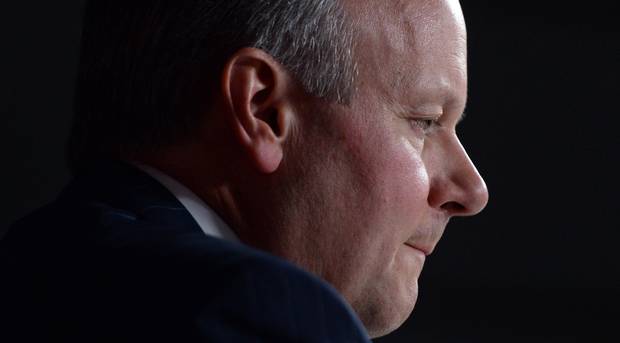
Bank of Canada governor Stephen Poloz
SEAN KILPATRICK/THE CANADIAN PRESS
Markets will be watching Mr. Poloz closely because, among other things, it's an opportunity for the central bank chief to expand on last week's decision and policy statement, which signalled ongoing caution and a pause after rate hikes earlier this year. It will be a look at some key issues as markets prepare for next year.
"The BoC already took a pause to reflect on the weak inflation outlook after hiking in back-to-back policy decisions last summer, said Laurentian Bank chief economist Sébastien Lavoie.
"Some of the 'issues keeping the governor awake at night' could be resolved in 2018. Yet others could come up, as well. This makes it a challenging time to make monetary policy decisions for the economic well-being of Canadians."
Here's what Mr. Lavoie and Bank of Montreal chief economist Douglas Porter believe are the issues keeping Mr. Poloz tossing and turning:
Exports
Mr. Lavoie: "For one thing, would he need to, the current murky trade outlook is currently preventing Governor Poloz from expressing a stronger preference for higher interest rates."
Mr. Porter: "Where is growth going to come from in Canada over the next few years? With the consumer all but topped out, the big hope is for exports. But exports have struggled to gain any traction in recent years (even with a strong global economy and a competitive Canadian dollar)."
Inflation
Mr. Lavoie: "For a central banker pursuing a 2-per-cent inflation target, one of these issues in our view is the low inflation environment still in place despite the accelerating, and synchronized, global economic cycle. The Canadian economic recovery has been very strong this year. Yet, core inflation figures registered in recent months are the same as a year ago."
Mr. Porter: "He may be concerned about the persistence of very low core inflation this deep into an economic cycle."
Mr. Lavoie: "Another issue is the absence of a broad-based improvement in labour market conditions, which, in turn, is restraining inflationary pressures. Granted, full-time employment is booming (up 3 per cent year over year), the unemployment rate plunged to a 10-year low (5.9 per cent in November) and the hourly wage of employees has been accelerating (2.7 per cent year over year in November). However, the total number of hours worked by Canadians only increased by 1 per cent year over year, unit labour costs are up only 1 per cent, and long-term unemployment remains high (about 20 per cent of the total unemployed)."
Household debt
Okay, this one may in fact be keeping many of us up at night. And, according to Statistics Canada today, it's up again.
This one's been going on for a while, and was an issue for Mr. Poloz's predecessor, Mark Carney, and various governments through the years.
Mr. Porter: "There's the ever-present concern over high household debt, and how that may complicate efforts by the bank to eventually bring rates back to neutral."
Consumer debts and inflated housing markets go hand in hand, of course, and the federal and provincial governments, along with the commercial bank regulator, have moved to bring things into line.
Mr. Lavoie: "The trouble resulting from lower interest rates is high indebtedness and inflated asset prices, particularly in the housing sector … [Various] targeted measures imply that next year, the BoC can focus on the inflation dynamics within the borader economic cycle - rather than on removing monetary stimulus to prevent excessive financial leverage."
NAFTA
Given President Donald Trump's love of pre-dawn tweets, and the fact that Mr. Poloz may be up at that hour, anyway, it should come as no surprise that the U.S. administration's repeated threats to kill the North American free-trade agreement are weighing on the Bank of Canada governor's mind.
Mr. Porter: "And if the export backdrop already wasn't difficult enough … there's the uncertainty over NAFTA."
Mr. Lavoie: "NAFTA termination still remains a non-neglible possibility … Under such a potential scenario, the course of adjustment for the Canadian export sector could depend, among other things, on the BoC's monetary response, the federal government's fiscal policies and the magnitude of the [Canadian dollar] depreciation."
Hockey?
Mr. Porter: "And, finally, he must be getting concerned about the deepening struggles of the Ottawa Senators."
Read more
- Canadian home sales rise for fourth consecutive month
- Barrie McKenna: Bank of Canada keeps rate hike options open
- Why the world is agog over Canadian home prices and debt: A special report
- Janet McFarland: Inventory glut pushes down Toronto area home prices
- Ugh, it’s getting tougher to be debt-free, particularly for seniors
- Janet McFarland: Tougher mortgage rules could shut out 50,000 potential home buyers a year: report
- Rob Carrick: Canada has a strong foundation for financial happiness. So why is the mood so dark?
- Threat of Canadian financial crisis eases (but don’t take that to the bank)
- Mortgage sticker shock: Get ready to pay more on renewal, possibly through the nose
- Housing affordability: It’ll be far nastier in Toronto and Vancouver as rates rise this time
- 2018 consumer math: 2% inflation + 1.4% pay raise = you’re screwed
Debt burden climbs
Canadians now owe $1.71 for every dollar they have to spend.
The key ratio of household debt to disposable income climbed in the third quarter to 171.1 per cent, up from a revised 170.1 per cent in the second three months of the year, Statistics Canada said today.
This came as total household credit rose to more than $2.1-trillion, largely on a 1.5-per-cent increase in mortgage debt, the agency said. But consumer credit also rose, by 1.2 per cent.
Compared to a year earlier, consumer credit is now up by 4.8 per cent.
The debt-service ratio, or what it takes for us to juggle our principal and interest obligations, was fairly flat at just shy of 14 per cent.
As for how wealthy we are, net worth was also flat in the third quarter, at $10.6-trillion.
Read more
Bombardier sees higher revenue
Bombardier Inc. hopes to boost revenue by about $1-billion next year.
The Canadian plane and train manufacturer's goal is for revenue of between $17-billion and $17-billion, it said today. That would mark a gain of about $1-billion over its guidance for 2017, but Reuters reports, it would be below what analysts estimate. So watch the stock today.
Bombardier cast even further out, with a revenue goal of $20-billion for 2020.
"As we approach the half-way point of our five-year turnaround plan, we continue to meet our commitments and build a strong foundation for generating sustainable profit growth," chief executive officer Alain Bellemare said in a statement.
Read more
Cenovus to cut more
Canada's Cenovus Energy Inc. plans to cut further as it pumps money into its oil sands business.
The company will cut a further 15 per cent of its work force next year, and "expects to achieve further cost efficiencies through continued improvements in areas such as drilling performance, development planning and optimized scheduling of oil sands well start-ups," it said today in a statement.
It also plans to spend up to $1.7-billion next year, with most of the investment earmarked for the oil sands.
"Our priorities for 2018 are to reduce costs and deleverage our balance sheet while maintaining capital discipline," said chief executive officer Alex Pourbaix.
"The sooner we can achieve our long-term debt ratio goal, the sooner we can move to balance returning cash to shareholders with disciplined investments in high-return growth."
Cenovus added that it expects to cut its oil sands operating costs by 8 per cent on a per-barrel basis.
Read more
Markets at a glance
Read more