How to watch the game
The Canada-England rugby game starts at 11 a.m. ET (8 a.m. PT) on Saturday. Check our viewer guide for more information.
Many Canadians may be late to the rugby party, but between working out the differences in scoring a try and a drop goal – the former is worth five points and the second just three – it’s important to know that the Canadian women’s rugby team didn’t become elite overnight.
The squad that will take on host team England in the Women’s Rugby World Cup final on Saturday has been building to this point over the past three years, ever since England vanquished it in the semi-finals of the last World Cup in New Zealand by just seven points.
That amount is the equivalent to the points gained from a converted try – when the kicker gets to add on two more points after the ball is touched, like an extra point in football – and were it not for that, this year’s squad would have been looking to make it consecutive World Cup wins.
But that was then and this is now, and Canada has used the past three seasons wisely, climbing the world rankings to reach second behind England, a position it has occupied since October of last year.
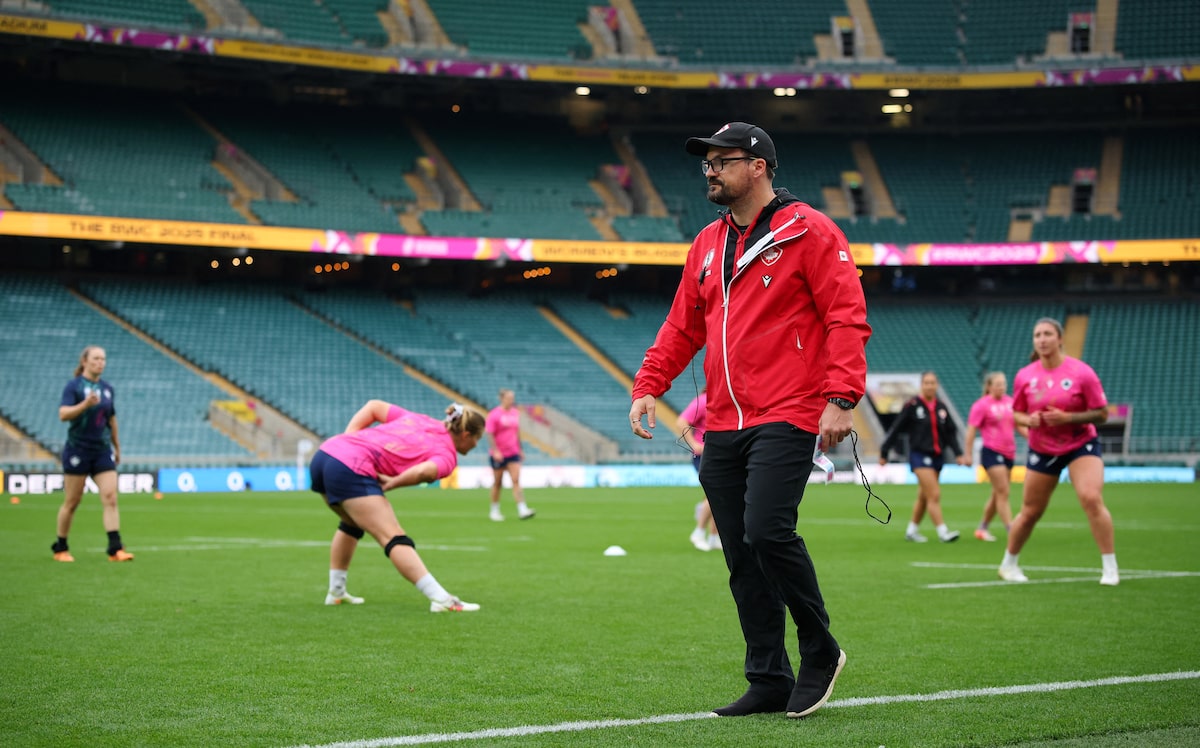
In defeating the New Zealand Black Ferns in last Friday’s semi-final so comprehensively – handing the six-time champions their first defeat in a knockout round since 1991 – Canada put on a display that can easily be considered the defining game of head coach Kévin Rouet’s tenure.
The Frenchman took over the job just months before the last World Cup, and while that didn’t give him time to fully implement the expansive game that his team currently plays, the players seem to have his philosophy down to a tee now.


Total Rugby
Like the player Johan Cruyff and coach Rinus Michels of the famous Dutch soccer team that reached the 1974 World Cup final – the pair often credited with creating a “positionless” system of soccer that’s now called Total Football – Rouet has empowered his players to be fluid and always thinking.
No matter if it’s a prop – traditionally a slower, heavier player that brings muscle to bear in the scrum – or a lithe winger, Canada’s head coach has encouraged all his players to be playmakers, able to run with the ball and offload it to teammates while in the tackle, creating player overload and hitting holes in the opposition defence.
The players have certainly appreciated being handed ownership of their on-field direction.
“It’s the most fun rugby I’ve ever had to play, because there’s so much freedom,” says second rower Sophie de Goede. “And we make mistakes in the way that we play, because it’s not preplanned. We’re constantly reacting to each other, and so mistakes happen.”

A fast style of play paid off for Sophie de Goede, right, and her teammates in the semifinal match against New Zealand.Andrew Matthews/PA via AP
Canadian players account for four of the top eight offloaders in the tournament – led by de Goede with 11 offload passes – attesting to the commitment to fast, running rugby.
And for those looking for stylistic differences between Canada and England, there are 12 Canadians with more offloads in the tournament than that of the leading English player, Meg Jones, who has three, with Canada leading England 77-29 as a team in that department.
Former player-turned-rugby-analyst Gareth Rees, who is also Rugby Canada’s director of partnerships, thinks the “Total Rugby” moniker is apt.
“I think it’s getting the best out of the athletes,” he says. “It’s allowing them all to be decision makers. And that’s something that a lot of coaches talk about, but they genuinely are.”
Rees credits that ethos for Canada’s quick ruck speed, which is a measure of how fast Canada is able to recover the ball after being tackled to the ground.
“The reason we have such quick ruck speed, which is a big aspect of how we play, like one, two seconds, is because when a player arrives, they’re not in doubt as to what they’re trying to do. They know that my options are this or that, and they execute really, really well.”

In a ruck, players pile on to compete for a ball on the ground. Risi Pouri-Lane of New Zealand is passing the ball out of one during semifinal play against Canada.David Rogers/Getty Images
Fast ball
That ruck speed has been vital to Canada’s relentless drive toward the opposition tryline, which is the goal line the attacking team must cross to score. When a player gets taken down in a tackle, a teammate is there to recycle the ball quickly, keeping the move going. Just as important, it prevents the defence from getting a chance to reset.
In its semi-final win, Canada completed 45 per cent of its rucks in under two seconds, winning all 106 of its attacking rucks with its average ruck speed of 2.45 seconds, the fastest in the tournament. As Rugby World Cup tournament director Yvonne Nolan told the Rugbypass website about Canada’s ruck speed: “That is rapid. That is quicker than the average men’s test rugby speed. It is a massive jump in standards and that is what we are seeing across this whole tournament. Back [in 2022], 11 per cent of Canada’s rucks were that quick and 21 per cent of England’s were.”

Upper body strength is a key part of the physical fitness needed for rugby. Picking up teammates is a useful way to gain possession of the ball when play restarts, as the Canadians are doing in this quarterfinal with Australia.David Rogers/Getty Images
Conditioned to win
One of the key requirements for Canada’s game is high-level fitness. Former England head coach Simon Middleton – who coached the Red Roses to the past two World Cup finals – considers Canada to be “the fittest and most physical team in the World Cup.”
Rouet admits that operating his system requires some high-level conditioning from all 23 players – the 15 starters and eight substitutes – but adds that he’s lucky to have a squad full of real athletes. “We have athletic people who can play a fast-tempo game for 80 minutes,” he says. “So that’s very important in Canada, because playing the game like that is not easy for them.”
Rees adds that it’s not normal to have so many high-functioning athletes across multiple positions. He points to de Goede, arguably the world’s best No. 8 who is playing in the second row for the good of the team; loose forward Caroline Crossley, who was part of the Olympics sevens squad; or prop DaLeaka Menin, who is “just a freak [physically] … but she’s fantastic on the ball.”
He draws the comparison with the South African men’s squad, who have won back-to-back World Cups on the strength of using a 6-2 or even 7-1 forward-back split amongst their eight substitutes to physically dominate the latter stages of games. “They can have six forwards on the bench, because a couple of them are legitimate international backs, right?” Rees says of the Springboks team. “So that’s how they can do seven and one. And that’s how I’d stack [up] our women right now, there’s that kind of athleticism in that group.”

Depth and discipline
Another string to Canada’s bow heading into Saturday’s final is the new-found depth among the squad compared to three years ago. The success of the women’s sevens program – winning Olympic silver in Paris a year ago – has helped in that regard, with seven of that team currently a part of Canada’s World Cup squad. The team’s experience – 21 of the roster has previously appeared in World Cup games – makes for a very savvy combination.
“We have a squad of 32 players, and honestly, a wider squad of way more than that could easily be playing in a World Cup final tomorrow and do a great job for us,” de Goede says. “So I think to be able to trust in that many players based off the experiences that we’ve had over the last three, four years has been huge.”
The team has also been able to show its discipline at key times, with last week’s semi-final win a great example of that. Canada conceded just six penalties to New Zealand’s 10, and the first of those didn’t occur until after the 60th minute, by which time Rouet’s team was already up 31-14.
“Sixty minutes and no penalties is a remarkable stat,” Rees said. “It’s remarkable in international rugby. So it’s a credit to Kevin and the team. If that happens again on Saturday, we’re in good shape. That’s pretty rare to see that number.”

Lysbeth Arthur of Winnipeg, right, and her sister Stephanie are among the Canadians who've travelled to Britain to see how Canada fares on Saturday. The match starts at 11 a.m. ET; check back at globeandmail.com to follow the action.Anna Liminowicz/The Globe and Mail