
Speed skater Ivanie Blondin, right, celebrates with Valérie Maltais on Feb. 15 after winning gold in team pursuit. Blondin's signature event is the mass start, which is on Feb. 19 in Beijing.Susana Vera/Reuters
More below • How does Olympic speed skating work? A visual guide
Four years ago, long-track speed skater Ivanie Blondin entered the Pyeongchang Olympics as a serious medal contender. But in the semi-finals of her signature event – the mass start, a jumble of skaters vying to be the first to finish 16 laps – she slipped midrace, wiping out two others in a chaotic crash.
On Saturday, Blondin will return to the mass start at the Olympic level, hoping for a different outcome this time.
“It was hard, mentally, going in as one of the favourites for so many distances, and then coming home empty-handed,” said Blondin, now 31, in a phone interview before leaving for China. “I felt like I had failed not only myself, but my entire team and the country.”
In Beijing, Blondin is part of a strong Canadian long-track team. Earlier this week, she celebrated a gold in the team pursuit event with Valérie Maltais and Isabelle Weidemann, who has also earned bronze and silver medals in individual races. Soon, Blondin will get her opportunity to shine.
She’s currently one of the world’s top-ranked women in the mass start event, and Metadata company Nielsen Gracenote, a well-known Olympic medal prognosticator, named Blondin as one of the country’s must-watch athletes in its pre-Games projections.

Blondin at the Olympic Oval in Calgary in 2019.Jeff McIntosh/The Canadian Press
Blondin earned silver at the world all-round speed skating championships in 2020, she’s an eight-time medallist at the world single distance championships (including two golds in the mass start) and she seized two gold medals at a December, 2021, World Cup stop in Salt Lake City.
Her strong finishing skills were on display there when she broke free from the crowd in the final lap of the mass start, edging past Dutch skater Marijke Groenewoud right at the finish line.
The mass start Blondin excels at typically lasts just over eight minutes. The skaters leave the start line in a pack, and then jockey in close proximity right up until the exhilarating sprint finish. The race is both physical and tactical, with plenty of pushing, jostling and crashing, so skaters need patience and strategy.
“She has no fear,” said her coach Remmelt Eldering, who joined the Canadian women’s long track team from the Dutch program. “She’s very fast, probably one of the best skilled athletes in the women’s peloton, and that is to her advantage.” Lots of skaters battle to skate right behind Blondin, he said, because they know what a good eye she has for positioning. He once saw her nearly spin out, but rescue herself back on her feet after dropping to one knee, and she still finished second.
“You wait for seven minutes, and then we’ll really see what’s gonna happen,” he said.

Blondin, Maltais and Isabelle Weidemann in action at the team pursuit final in Beijing.Susana Vera/Reuters
In addition to Eldering, the group supporting Blondin during these Olympics has changed since Pyeongchang – her team now includes sport psychologist Dave Pescovitz and physiotherapist Lauren Vickery, who has worked closely with Blondin for four years.
She credits Blondin’s life outside the oval – and her love of nature and animals – as one of the keys to her recovery following disappointment in Pyeongchang.
Since 2018, Blondin, who’s from Ottawa but lives in Calgary, has fostered countless animals – many sick or badly wounded.
There’s Gizmo, the African grey parrot she and her husband keep in their living room, and Brooke, the lively young Saint Bernard-Pyrenees mix who tags along to team training camps and keeps pace with Blondin during long runs in the mountains.
She also helped retrain a temperamental aging Saint Bernard so he could be adopted; she rehabilitated a Cane Corso puppy with severe mobility problems due to hydrocephalus. And the dogs have befriended the many cats they’ve fostered, including an amputee they cared for until it could get around again.
“I often joke with her that she could be a Disney character – birds will literally flock to her hand in a public park, just to say hello,” Vickery said.
Blondin is something of a professional – she also holds a diploma from the veterinary assistant program at Robertson College. All of this animal caretaking was part of her efforts to move on from what happened in Pyeongchang.
“After the 2018 Games, I went through a phase where I just couldn’t function. I wasn’t happy,” Blondin said. She was having terrible migraines. She was anxious and couldn’t sleep.
She recalls a day when video of the team’s Olympic season was playing inside the Calgary Oval during a training camp, and her emotions hit her like a freight train. She left the ice in tears.
It wasn’t until she saw a doctor for the chronic headaches that she realized she was suffering from depression, and went on antidepressants.
While nursing her menagerie of animals back to health, Blondin slowly began to heal, too.
“I was helping them, but it was actually helping me, too, because I felt like I had a purpose,” she said. “I didn’t realize it at the time – until after I was over my depression – what that experience has done for me.”
The companionship from her animals has also helped with isolation during the pandemic, when her husband, the Hungarian speed skater Konrad Nagy, has had to be abroad for large periods of time with his own national team. Whenever she’s disappointed in one of her races or workouts, Blondin turns to long hikes with her dogs to help free her mind.
“We see a huge shift in her whole mindset when she comes home from those little adventures in the mountains,” Vickery said.
Blondin’s nurturing and playful sides co-exist with her “fierce exterior,” Vickery added. “She is super, uber-competitive and always expects the best out of herself. But to those of us who know her really well, she is extremely caring, sensitive and a real mama bear, making sure everyone around her is doing okay. You see that with the animals, but it’s the same with her teammates and team staff – everyone else around her.”
With fellow skaters Maltais and Weidemann, Blondin is the jokester. They make fun TikTok dance videos and reels together, but they also push each other in the gym and on the ice. The three women – who must skate in a line together around the track as one unit – are very close.
Blondin has had to be resilient during this Olympic quadrennial. The long-track team navigated plenty of pandemic cancellations, and got creative with other ways to stay in shape when a mechanical failure left the Calgary Oval without ice for eight months. Blondin and her husband made a slide board so they could train at home, and fashioned weight-training workouts using heavy milk jugs. They also chose to go to Europe for a while, bringing just one dog along, to train there with the Hungarian team.
Blondin has said she felt more at ease going into Beijing than she did before Pyeongchang, with the weight of big expectations on her shoulders. All that time spent on the trails, with her dogs racing ahead, has been freeing. “It clears my head to be up in the mountains with a dog,” Blondin said. “I’m always searching for that better feeling.”
How does Olympic speed skating work? A visual guide

SPEED SKATING
BEIJING 2022
SCHEDULE
Qualification
Medal
FEBRUARY
3
4
5
6
7
8
9
10
11
12
13
14
15
16
17
18
19
20
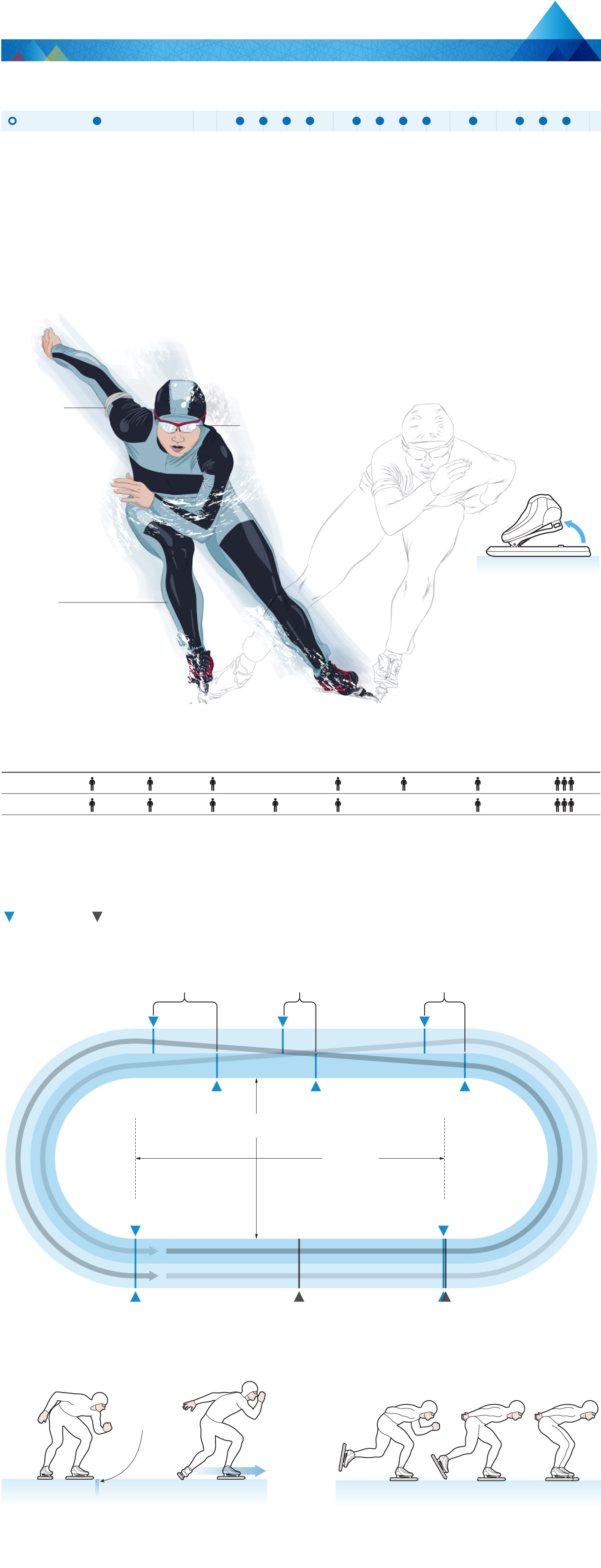
Speed skating began as a rapid form of transportation across frozen lakes and rivers in the Netherlands, before spreading across the channel to England. Passionate skaters included several kings of England, Marie Antoinette, Napoleon III and German writer Johann Wolfgang von Goethe.
Speed skating made its Olympic debut at Chamonix 1924 with men’s events. Women’s speed skating made its Olympic debut as a demonstration sport at Lake Placid Games 1932 before inclusion in the offical program at Squaw Valley 1960.
Skaters, who can reach speeds up to 65 km/h, compete for the fastest times as individuals or as a team
1
2
3
3
Armband
Skater starting in inner lane wears white, skater starting in outer lane wears red
1
Eyewear
Enhances visibility and protects eyes from wind
2
Skin suit
With aerodynamic hood made of low-friction fabric at the underarm and inner thigh areas while low-drag fabric covers the body
3
Clap skates
Hinged blade remains in contact with the ice longer to produce a more efficient stride. The blade springs back to the boot when lifted and makes a “clap” which gave rise to its name
4
THE RINK
Skaters race in pairs, counterclockwise, on two lanes of a 400-metre track and switch lanes every lap to ensure they travel the same distance.
Start line
Finish line
500 m
Start lines for the 3,000 m and 5,000 m races
Finish line for the 1,000 m race
1,000 m
10,000 m
1,500 m
500 m; 1,500 m; 3,000 m; 5,000 m; 10,000 m
TECHNIQUE
Starting
line
Back foot is angled 45° to the
line for a powerful initial push
Crouched position reduces air
resistance, maximizes force
SOURCE: REUTERS

SPEED SKATING
BEIJING 2022
SCHEDULE
Qualification
Medal
FEBRUARY
3
4
5
6
7
8
9
10
11
12
13
14
15
16
17
18
19
20
Speed skating began as a rapid form of transportation across frozen lakes and rivers in the Netherlands, before spreading across the channel to England. Passionate skaters included several kings of England, Marie Antoinette, Napoleon III and German writer Johann Wolfgang von Goethe.
Speed skating made its Olympic debut at Chamonix 1924 with men’s events. Women’s speed skating made its Olympic debut as a demonstration sport at Lake Placid Games 1932 before inclusion in the offical program at Squaw Valley 1960.
Skaters, who can reach speeds up to 65 km/h, compete for the fastest times as individuals or as a team
1
2
3
3
Armband
Skater starting in inner lane wears white, skater starting in outer lane wears red
1
Eyewear
Enhances visibility and protects eyes from wind
2
Skin suit
With aerodynamic hood made of low-friction fabric at the underarm and inner thigh areas while low-drag fabric covers the body
3
Clap skates
Hinged blade remains in contact with the ice longer to produce a more efficient stride. The blade springs back to the boot when lifted and makes a “clap” which gave rise to its name
4
THE RINK
Skaters race in pairs, counterclockwise, on two lanes of a 400-metre track and switch lanes every lap to ensure they travel the same distance.
Start line
Finish line
500 m
Start lines for the 3,000 m and 5,000 m races
Finish line for the 1,000 m race
1,000 m
10,000 m
500 m; 1,500 m; 3,000 m; 5,000 m; 10,000 m
1,500 m
TECHNIQUE
Starting
line
Back foot is angled 45° to the
line for a powerful initial push
Crouched position reduces air
resistance, maximizes force
SOURCE: REUTERS
SPEED SKATING
BEIJING 2022
FEBRUARY
SCHEDULE
3
4
5
6
7
8
9
10
11
12
13
14
15
16
17
18
19
20
Qualification
Medal
Speed skating began as a rapid form of transportation across frozen lakes and rivers in the Netherlands, before spreading across the channel to England. Passionate skaters included several kings of England, Marie Antoinette, Napoleon III and German writer Johann Wolfgang von Goethe.
Speed skating made its Olympic debut at Chamonix 1924 with men’s events. Women’s speed skating made its Olympic debut as a demonstration sport at Lake Placid Games 1932 before inclusion in the offical program at Squaw Valley 1960.
Skaters, who can reach speeds up to 65 km/h, compete for the fastest times as individuals or as a team
Armband
Skater starting in inner lane wears white, skater starting in outer lane wears red
Eyewear
Enhances visibility and protects eyes from wind
Clap skates
Hinged blade remains in contact with the ice longer to produce a more efficient stride. The blade springs back to the boot when lifted and makes a “clap” which gave rise to its name
Skin suit
With aerodynamic hood made of low-friction fabric at the underarm and inner thigh areas while low-drag fabric covers the body
EVENTS
500 m
1,000 m
1,500 m
3,000 m
5,000 m
10,000 m
Mass Start
Team Pursuit
Men
Women
THE RINK
Skaters race in pairs, counterclockwise, on two lanes of a 400-metre track and switch lanes every lap to ensure they travel the same distance.
Start line
Finish line
Start lines for the
3,000 m and 5,000 m races
1,500 m
1,000 m
52 m
100 m
500 m
10,000 m
500 m; 1,500 m; 3,000 m; 5,000 m; 10,000 m
Finish line for the 1,000 m race
TECHNIQUE
Starting
line
Back foot is angled 45° to the
line for a powerful initial push
Crouched position reduces air
resistance, maximizes force
SOURCE: REUTERS