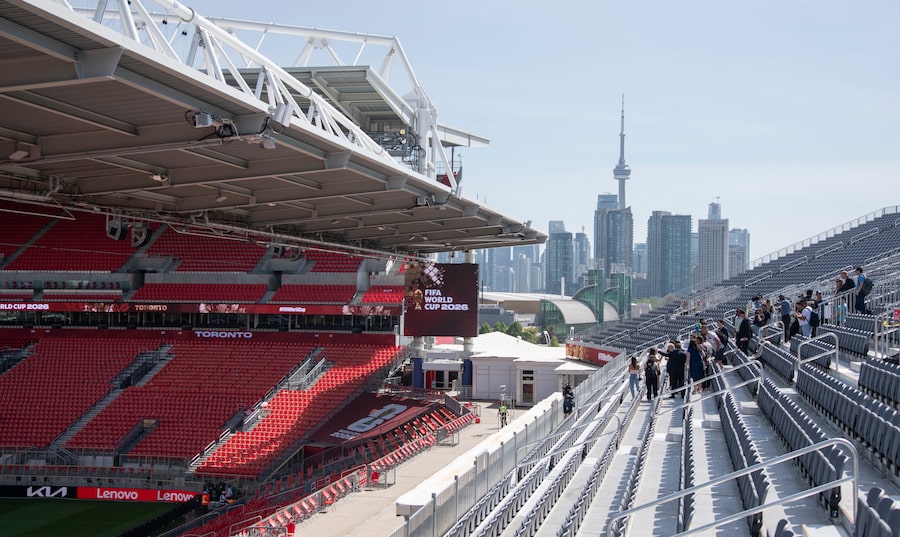

The biggest FIFA World Cup ever is sweeping into Toronto and Vancouver as Canada co-hosts the tournament with the United States and Mexico.
And with more teams and host countries than ever before, new rules, political tensions with the U.S. and the war in Iran weighing on the competition, the beautiful game has never been more complicated.
Before the historic soccer spectacle kicks off on Thursday, here’s everything you need to know on and off the pitch.
Schedule and logistics
When does the World Cup start and what is the full schedule?

The first match of the World Cup is in Mexico City Stadium, officially named Estadio Banorte or better known by its former name, Estadio Azteca.Hector Vivas/Getty Images
The World Cup kicks off on June 11 with Mexico playing South Africa in Mexico City, and Canada will play its first match on June 12 in Toronto against Bosnia-Herzegovina.
The group stage runs from June 11 to 27, followed by the new round of 32, the round of 16, quarter-finals, semi-finals and the final, which will be played on July 19 at MetLife Stadium in East Rutherford, New Jersey.
Find the full match schedule here.
What time is the World Cup opening ceremony and who is performing?
The tournament will begin with a star-studded opening ceremony at Mexico City’s Estadio Azteca on Thursday, June 11. The show begins at 1:30 p.m. ET, 90 minutes before the opening match between Mexico and South Africa kicks off.
Global pop icon Shakira will headline with Nigerian singer Burna Boy, and the two are set to perform their official tournament single “Dai Dai” live for the first time. FIFA has said the show will highlight Mexican pride and culture, and will also feature performances by Alejandro Fernández, Belinda, Danny Ocean and others.
And at Canada’s official opening ceremony on June 12 at 1:30 p.m. ET, some of this country’s most beloved musicians and rising global stars will take the stage.
Alanis Morrisette and Michael Bublé are both set to perform at BMO Field, with Alessia Cara, Jessi Reyez, Nora Fatehi and William Prince also representing Canada. French singer Vegedream, Bangladeshi-American DJ Sanjoy and Palestinian pop singer Elyanna will round out the show.
Where can I watch the games in Canada?
You can watch all 104 matches on television on TSN, or subscribe to stream them on TSN.ca or the TSN+ app. Check your cable package to see if you have TSN included, and find the full broadcast schedule here.
Thirty matches, including all three Canada group-stage games, will be available to watch on CTV or to stream through the CTV channel via the Crave app.
And The Globe and Mail will have live coverage of all Team Canada matches, as well as news and analysis throughout the tournament.

Far below Grouse Mountain, where this giant Canadian flag was set up to celebrate the World Cup, fans in Vancouver will be able to see the first match on June 13.Darryl Dyck/The Canadian Press
Which games are Toronto and Vancouver hosting?
Canada will host 13 games in total between Toronto’s BMO Field and Vancouver’s BC Place, including all three Team Canada group stage matches.
Toronto:
- June 12: Canada vs. Bosnia-Herzegovina (Group B)
- June 17: Ghana vs. Panama (Group L)
- June 20: Germany vs. Ivory Coast (Group E)
- June 23: Panama vs. Croatia (Group L)
- June 26: Senegal vs. FIFA playoff 2 winners (Group I)
- July 2: Round of 32 match (Group K second place vs. Group L second place)
Vancouver:
- June 13: Australia vs. Turkey (Group D)
- June 18: Canada vs. Qatar (Group B)
- June 21: New Zealand vs. Egypt (Group G)
- June 24: Canada vs. Switzerland (Group B)
- June 26: New Zealand vs. Belgium (Group G)
- July 2: Round of 32 match (Group B winners vs. highest-ranked third place of Group E/F/G/I/J)
- July 7: Round of 16 match
Can I still get tickets?
Demand for tickets to all 104 matches has been massive, especially for Canadians trying to take advantage of games happening at home. While the vast majority of tickets were snapped up in official releases months ago, there will still be opportunities to snag tickets to games in Toronto, Vancouver or elsewhere.
FIFA previously said whatever tickets remain will be released “closer to the tournament … on a first-come, first-served basis,” and has been periodically releasing small numbers of tickets on the ticketing platform. Find more information at FIFA.com/tickets.
What are the FIFA Fan Festivals?

The Zocalo plaza will be Mexico City's main fan festival zone. Other hosts across North America are setting aside spaces for people to cheer on the teams.Hector Vivas/Getty Images
The FIFA Fan Festivals are located in Toronto, Vancouver and the other host cities across the U.S. and Mexico. The festivals are public viewing parties, which broadcast the World Cup games live. They’ll also feature concerts and have local dishes for sale.
The events run for the duration of the World Cup and are free. However, patrons must still hold a free general admission ticket, which can be claimed online.
The Toronto Fan Festival is at 250 Fort York Blvd, and the Vancouver Fan Festival is at Hastings Park.

Team Canada, which arrived at Toronto's Billy Bishop airport on June 7, plays its first match on home turf against Bosnia and Herzegovina.Cole Burston/Getty Images
Team Canada
When and where does Canada play?
Canada will play three matches in the group stage between June 12 and 24, against Bosnia-Herzegovina, Qatar and Switzerland.
Here is Canada’s group-stage match schedule:
- June 12 at 3 p.m. ET in Toronto: Canada’s opening match will be at BMO Field against against Bosnia-Herzegovina
- June 18 at 6 p.m. ET in Vancouver: Canada will play Qatar at BC Place
- June 24 at 3 p.m. ET in Vancouver: Canada will play Switzerland at BC Place
Who is on Canada’s World Cup roster?
Canada’s 26-man World Cup roster skews young and puts a lot of faith in injured players, including superstar captain Alphonso Davies, to heal-up before kick-off.
Coach Jesse Marsch selected four forwards, ten midfielders, nine defenders and three goalkeepers, including starting goalie Maxime Crepeau. The side’s average age is 25, with 20-year-old defender Luc de Fougerolles being the youngest and veteran midfielder and Toronto FC captain Jonathan Osorio the oldest at 33.
However days before the tournament, Jayden Nelson replaced midfielder Marcelo Flores, whose recent ACL injury forced him out of the roster.
Here is the full Canada roster for the 2026 FIFA World Cup:
Goalkeepers: Maxime Crepeau, Orlando City SC (MLS); Owen Goodman, Crystal Palace (England); Dayne St. Clair, Inter Miami FC (MLS)
Defenders: Moïse Bombito, OGC Nice (France); Derek Cornelius, Olympique de Marseille (France); Alphonso Davies (capt.), Bayern Munich (Germany); Luc de Fougerolles, Fulham (England); Alistair Johnston, Glasgow Celtic (Scotland); Alfie Jones, Middlesbrough (England); Richie Laryea, Toronto FC (MLS); Niko Sigur, Hajduk Split (Croatia); Joel Waterman, Chicago Fire (MLS)
Midfielders: Ali Ahmed, Norwich City (England); Tajon Buchanan, Villarreal CF (Spain); Mathieu Choiniere, Los Angeles FC (MLS); Stephen Eustaquio, FC Porto (Portugal); Ismaël Koné, U.S. Sassuolo Calcio (Italy); Liam Millar, Hull City (England); Jayden Nelson, Austin FC (MLS); Jonathan Osorio, Toronto FC (MLS); Nathan Saliba, Anderlecht (Belgium); Jacob Shaffelburg, Los Angeles FC (MLS)
Forwards: Jonathan David, Juventus (Italy); Promise David, Royale Union Saint-Gilloise (Belgium); Cyle Larin, RCD Mallorca (Spain); Tani Oluwaseyi, Villarreal CF (Spain)
Who are the Canadian players to watch?

Canada's captain, Alphonso Davies, is a veteran of the last World Cup in Qatar.Charlie Riedel/The Associated Press
Team Canada is talented up and down the lineup, but this World Cup could turn stars into hometown heroes and up-and-comers into household names.
All eyes will be on captain Alphonso Davies, a world-class fullback and the best men’s player this country has ever seen. His game-breaking speed and power were on full display when he scored Canada’s first men’s World Cup goal in 2022, and fans are hoping the 25-year-old can recover from injury to help Canada reach the tournament’s knockout stage for the first time.
Also, watch out for clinical finishes from star forward Jonathan David, Canada’s all-time top male goal-scorer, and for a potential breakout performance from Ismaël Koné, a promising young midfielder whose six-goal haul for Serie A’s Sassuolo has Canadians wondering what he can do for this country.
Read about five Canadian players to watch here before the tournament begins.

The World Cup teams come from nations big and small: The smallest is Curaçao, an island in the Dutch Caribbean where Brenton Balentien, known as Blue Face, is a leader of soccer fans for the national team.Matias Delacroix/The Associated Press
The tournament
What are the groups?
There are 48 teams in the tournament, separated into 12 groups. Each group - lettered A to L - has four teams. All four countries will face each other in the group stage, earning three points for a win, one point for a tie and no points for a loss.
The groups were drawn randomly in December. Each team was placed into a seeded pot based on their FIFA rankings as of Nov. 19, 2025. Canada, the United States and Mexico were automatically placed in the first pot, along with the other nine highest-seeded teams.
Six of the 48 teams had not qualified for the World Cup at the time of the draw. Those teams were Czechia (Group A), Bosnia-Herzegovina (Group B), Turkey (Group D), Sweden (Group F), Iraq (Group I), and Democratic Republic of the Congo (Group K).
What is the World Cup’s format?
Each team that participate in the World Cup is guaranteed three games, where they face off against the other teams in their group. The group stage does not go to extra time, and tied games by the end of regulation time would finish in a draw.
Teams get three points for a win, one point for a draw and no points for a loss. Based on how many points a team earns from those three games, they may advance to the knockout stages.
Every team that finishes first or second in their group automatically qualify for the first knockout stage, the round of 32. The next-best eight teams, regardless of group, will fill the remaining spots.
If teams have the same record, the first tie-breaker is the team’s goal differential — how many goals were scored by a team minus the goals the team let in. If that is tied, then the tie-breaker is determined by how many goals were scored by the team, and, if that number is the same, is then determined by the team that got the least yellow and red cards over the three games.
There are five rounds of knockout stages: the round of 32, the round of 16, quarterfinals, semifinals and the finals. There’s also a game for third place, with the losers of the semi-finals facing off.
Knockout stages will go to extra time if a game is tied after regulation. The extra time consists of two 15-minute halves with added stoppage time. If necessary, the game would then go to a best-of-five penalty shootout if the tie was not broken after the extra time.
Are there any new rules in effect?

The process for issuing penalty cards will be somewhat different at this World Cup than previous ones.Julio Cesar AGUILAR / AFP via Getty Images
There are a couple of new rules for the World Cup, but none that fundamental change the sport.
One of the biggest changes is that any player who is injured and treated by the medical staff during the game must leave the pitch for one minute. After that one minute, the players can be allowed back on by the referees. Serious injuries or goalkeeper injuries are the exception to this rule.
Virtual assistant replay (VAR) has added capabilities, including reviewing red cards issued after a second yellow card, reviewing corner kicks that may have been incorrectly given and yellow or red cards given to the wrong player.
Players will also be automatically issued a red card if they cover their mouth during a confrontation with another player, or for leaving the pitch in protest.
The penalization for covering your mouth comes after an incident involving Benfica’s Gianluca Prestianni, who was accused of making discriminatory slurs to Vinícius Junior in a UEFA Champions League match in February.
Prestianni, who denied the accusation, was handed a six-match suspension by UEFA for discriminatory conduct that was deemed homophobic. He was also left off of Argentina’s World Cup roster.
The sanctioning for protesting comes after this year’s Africa Cup of Nations final saw Senegal’s players walked off the pitch when a potentially decisive penalty was awarded to Morocco. Senegal returned to win the game, but were eventually stripped of the title after Morocco protested the win.
Key teams and players to watch
Which countries are the most likely to win?

The powerhouses of the World Cup include Argentina and France, who fought each other at the final in the last tournament in 2022.Franck Fife/AFP via Getty Images
It’s hard not to bet against the current top three teams in the FIFA world rankings: France, Spain and Argentina. France and Argentina fought tooth and nail in the final of the 2022 World Cup in Qatar, with Lionel Messi and co. coming out on top.
The Argentina squad of today is mostly unchanged from the team that won in 2022 - but importantly without Ángel Di María, who scored in the final and retired in 2024. The addition of Messi to this year’s team will mark a record sixth World Cup appearance.
France has played in three straight World Cup finals under boss Didier Deschamps, who will retire from international soccer after the World Cup. Les bleus will be captained by superstar Mbappé, and add Désiré Doué, who helped Paris Saint-Germain win the UEFA Champions League in 2025. Twenty-one-year-old Doué was named the UEFA Champions League Young Player of the Season in 2025.
Spain won the 2024 UEFA European Championship, and has a powerhouse roster with the likes of Pedri, Rodri, Nico Williams and Lamine Yamal. Spain is hopeful to replicate the success of 2024, after losing to Morocco in the round of 16 in 2022.
Five-time champion Brazil and four-time champion Germany can also never be counted out, and Harry Kane’s England squad will hope to make its first World Cup final since the team’s only trophy in 1966.
Who are the players to watch?

Many soccer fans are keeping an eye on Spain's Lamine Yamal, in action at a World Cup qualifying match with Turkey.Khalil Hamra/The Associated Press
England’s Jude Bellingham is a metronomic midfield force, and an incredibly dependable player. Were he to lead England to a win in North America, he’s David Beckham, but less needy and more reliable.
At 16, Spain’s Lamine Yamal showed up at the 2024 European championship and assumed control of the eventual winners. While the now-18-year-old is adjusting to worldwide fame, the potential for a great World Cup with everybody’s pre-tournament favourites makes him one to watch.
Most top footballing nations bring stars to the World Cup. The Germans have a knack for bringing the World Cup to its stars. Germany’s current next big thing is Lennart Karl, who just finished his rookie season at Bayern Munich. If the 18-year-old can score, Germany might just make it out of the World Cup group stage for the first time in 12 years.
Read the seven other players to watch in this year’s tournament here.
Which group-stage matches should I watch?

England's Harry Kane, playing Iran at the 2022 World Cup, will have a critical game to watch against Croatia on June 17.Abbie Parr/The Associated Press
Brazil vs. Morocco on June 13 at 6 p.m. ET will find Brazil facing a team that owned a dominant storyline at the last World Cup, before it bowed out in the semi-final.
England vs. Croatia on June 17 at 4 p.m. ET is a rematch of the 2018 World Cup semifinal, which Croatia won before losing out in the final to France.
France vs. Norway on June 26 at 3 p.m. ET has the 2022 World Cup runners-up facing Erling Haaland, the Norwegian striker who scores goals like he’s playing a free slot machine.
Spain vs. Uruguay on June 26 at 8 p.m. ET has Spain, a heavy-favourite to win the tournament, facing off against Uruguay, where winning as the underdog is in the South American country’s DNA.
Portugal vs. Colombia on June 27 at 7:30 p.m. ET may feature Cristiano Ronaldo in his final World Cup contest ever, and is a return to the tournament for Colombia.

Toronto's City Hall has pulled out all the stops for the World Cup, whose games in town are estimated to cost $380-million to various levels of government.Fred Lum/The Globe and Mail
The big picture
How much is Canada paying to co-host the World Cup?
Canada’s two host cities are spending more than $1-billion to host 13 games, a price that has given some taxpayers sticker shock. Toronto’s six games are estimated to cost around $380-million of combined municipal, provincial and federal funds, while in Vancouver, the total for seven games could top $700-million.
But not all host cities have the public footing virtually the whole bill. In the U.S., several organizing committees are relying heavily on private and corporate sponsors to cover the cost, while some cities have structured their agreements to shield their coffers from some of the financial risks Toronto and Vancouver have taken on. Here’s a deep dive into what Toronto and Vancouver promised FIFA, and what they’re on the hook for at the World Cup.
How is the war in the Middle East affecting the tournament?


When Tehran said farewell to the Iranian soccer team in May, some brought posters of Ayatollah Mojtaba Khamenei, who took power during the current war with Israel and the United States.ATTA KENARE / AFP via Getty Images
This is the first time in FIFA history that a host nation has been at war with a participating nation, and the United States’ war in Iran is still shaping the tournament despite a fragile ceasefire.
After President Donald Trump in March discouraged Iran from participating, worries about obtaining U.S. visas spurred the team to move its training camp from Arizona to Tijuana, Mexico. U.S. Secretary of State Marco Rubio had also stated that any players or staff with ties to Iran’s Islamic Revolutionary Guard Corps – which both Canada and the U.S. designate as a terrorist organization – would face enhanced visa screening and potential bans.
In a last-minute agreement, Iran’s soccer team was allowed to enter the U.S. for its three games, but more than a dozen of its coaches, trainers and other support staff have been barred, according to news reports this week.
Iran’s ticket allocation has also been revoked, making it much more difficult for Iranian fans to attend the team’s games, the country’s football federation said Tuesday.
Iran’s retaliatory strikes against the U.S. and some Gulf states also targeted several military bases, embassies and consulates in the region, complicating visas for World Cup teams from Iraq and Qatar.
Is ICE going to be at the World Cup?

Critics of U.S. Immigration and Customs Enforcement have been vocally opposing its potential presence at the World Cup.Mike Blake/Reuters
U.S. President Donald Trump’s mass deportation campaign is casting a shadow over what should be a season of celebration for soccer-loving Latin American, African and Caribbean communities.
While the Trump administration has given no indication whether it will target any of the 11 American host stadiums, the possibility that Immigration and Customs Enforcement agents could set up perimetres around the venues or target fan celebrations has many immigrant fans fearful.
The President’s strict border controls, meanwhile, exclude citizens of 19 countries from entering the U.S., impose tight restrictions on citizens of 20 others and are expected to curb international tourism related to the tournament. A Somali referee was also denied entry in Miami over the weekend before the tournament, adding more fuel to the growing worldwide furor over U.S. restrictions on fans, journalists and officials.
Somali World Cup referee being denied entry to U.S. sparks global uproar
Many fans from African countries have been denied U.S. visas after they purchased high-priced tickets and some Congolese fans are seeking refunds after the Trump administration imposed a ban on visitors from the Democratic Republic of Congo amid the latest Ebola outbreak.
Canada has also temporarily suspended visas for people from the Democratic Republic of Congo, Uganda and South Sudan in response to the Ebola outbreak, which has heightened public health concerns at the World Cup.
With reports from Paul Attfield, Cathal Kelly, Greg Mercer, Adrian Morrow, Geoffrey York, The Canadian Press and Reuters