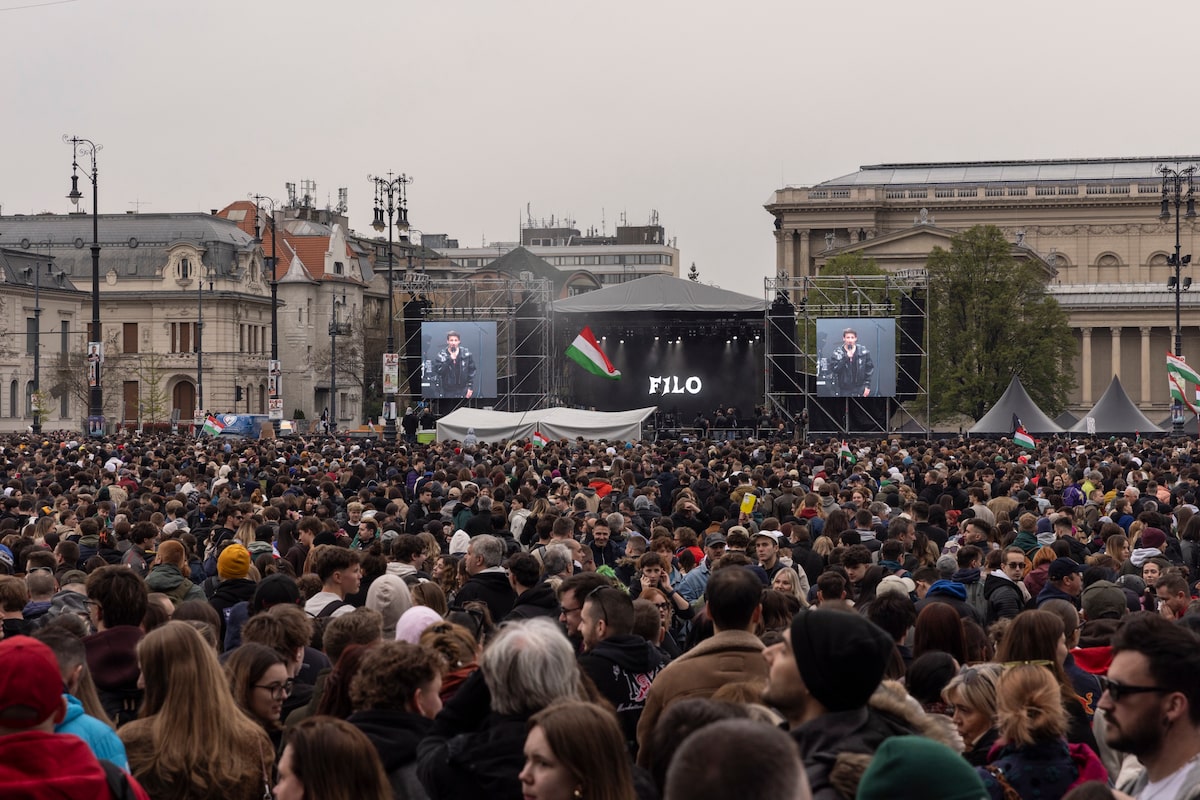
Peter Magyar bounded on to a stage set up near a playground in Mosonmagyaróvár and waved a large Hungarian flag as music boomed and the crowd roared.
Several hundred people from this small town in western Hungary had come to catch a glimpse of the 45-year-old novice politician who has gained rock star status. Dressed in black jeans, grey running shoes and a blue windbreaker, Mr. Magyar pumped his fists to the beat and led the cheers.
This was his second of three campaign stops Thursday and his third visit to Mosonmagyaróvár in the past few months.

Peter Magyar has been busy stumping for his Tisza party in hopes of unseating Viktor Orbán.Denes Erdos/The Associated Press
“Are you ready for victory?” he shouted. “We won’t have another chance.”
At the end of his half-hour stump speech − made entirely off the cuff − he asked everyone to hold hands and recite a patriotic poem by Sándor Petőfi: “The time is here, now or never. Shall we be slaves or free?”
Hungary has never seen a political leader quite like Mr. Magyar.
His Tisza movement has taken the country by storm since he launched it two years ago, and he’s mobbed wherever he goes by selfie-seeking fans who wave signs and chant, “Tisza is overflowing,” a play on the party’s name, which is a tributary of the Danube.
He has galvanized Hungary’s fractious opposition and presented the first real challenge to Prime Minister Viktor Orbán, 62, whose Fidesz party has ruled the country with increasing authoritarianism for 16 years.
“He’s a very powerful speaker,” said Judit Kzppolka, a dentist in Mosonmagyaróvár which is considered a Fidesz stronghold. When Mr. Magyar first came to the town in 2024, she said, just five people showed up to hear him.
“Now we are many hundreds. … We have a good chance of winning here. People have had enough.”
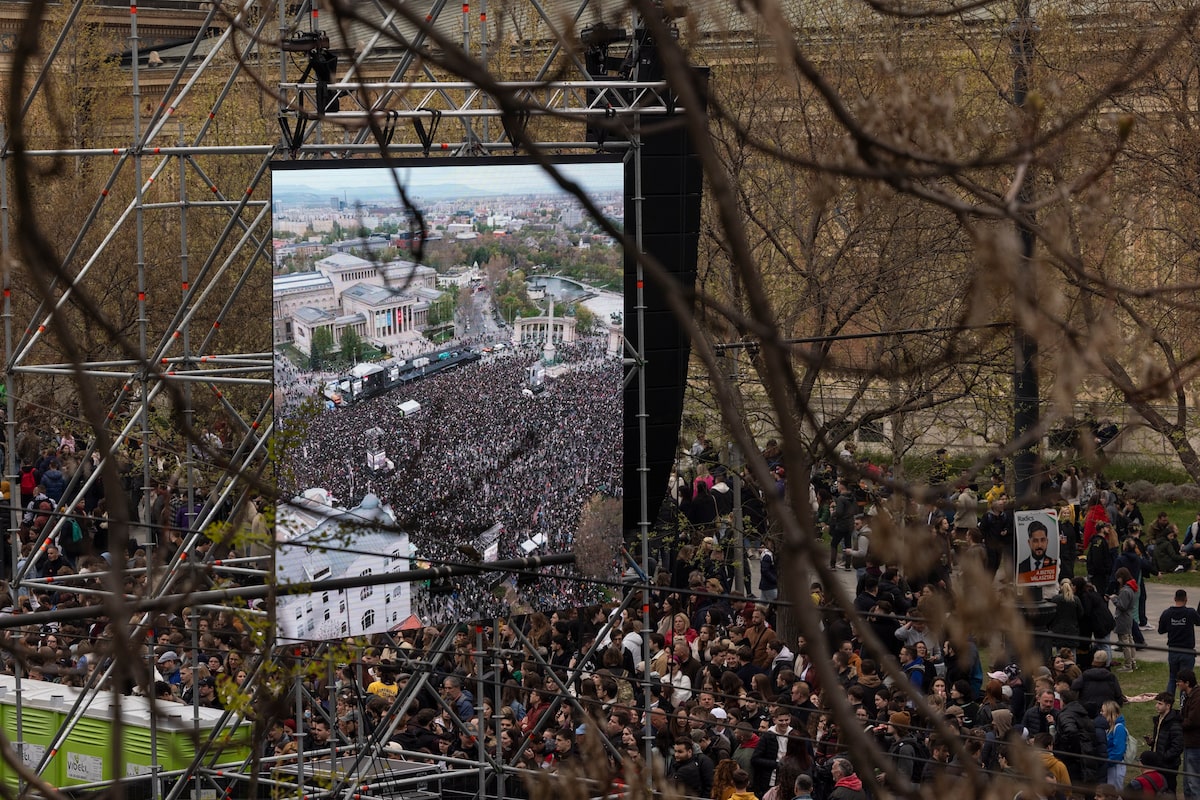
Polls show Tisza is poised for a sweeping victory in Sunday’s election, with some forecasting the party could win as much as two-thirds of the seats in the 199-seat parliament.
The election results will reverberate far beyond Hungary. Mr. Orbán has become a vanguard for populist movements across Europe, and the vote will be watched closely in Washington, Moscow and Brussels. U.S. President Donald Trump has been a vocal supporter of Mr. Orbán, and Vice-President JD Vance spent three days in Hungary last week campaigning for the Prime Minister. Russian President Vladimir Putin is also a firm backer and sees Mr. Orbán as a key ally in keeping the European Union off balance.
Brussels, meanwhile, will be desperately hoping Mr. Orbán loses so the EU will finally be rid of the biggest roadblock to the bloc’s many initiatives, including support for Ukraine.

Mr. Orbán feted the U.S. Vice-President at a ‘Day of Friendship’ in Budapest on Tuesday.Jonathan Ernst/Reuters
No one is counting out Mr. Orbán, though. He has spent years reshaping the government, the media and the judiciary into instruments of Fidesz.
Few Hungarians dismiss the possibility of rampant vote rigging on Sunday. The country’s complicated electoral system − 106 directly elected MPs and another 93 seats determined by the proportion of votes each party receives − also leaves plenty of room for manipulation.
Mr. Orbán has aimed his campaign squarely at Ukrainian President Volodymyr Zelensky, blaming Kyiv for almost every economic woe and claiming the EU wants to drag Hungary into Ukraine’s war with Russia. Streets are lined with Fidesz posters featuring mug shots of Mr. Magyar and Mr. Zelensky that read: “They are dangerous.”

A billboard in Budapest brands Volodymyr Zelensky and Mr. Magyar as ‘dangerous’ men.
Mr. Orbán has also railed against the EU for freezing nearly €20-billion ($32-billion) in funding over accusations that he has undermined democratic institutions. “We are under daily attack because we follow the rules of common sense,” he told supporters at a rally last week.
His message has been getting through to some voters. “No, it’s not close,” said George Redman as he lined up for a Fidesz rally last week. “Fidesz will win a majority.”
But polls show most voters are more concerned about their pocketbooks than Ukraine.
For years Hungarians were willing to overlook Mr. Orbán’s increasing power grabs and payoffs to friends and family because the economy was strong. That’s no longer the case. The economy has stagnated for the past four years, and the prices of food and other goods have skyrocketed. Mr. Orbán’s big bet on Chinese investment − China has surpassed Germany as Hungary’s biggest source of foreign investment − has also failed to pay off.

Simon Kocsis, a Hungarian living in Britain, came home for Easter and extended his stay to vote for Tisza on Sunday.
The government has neglected public services such as health care, education and infrastructure, and young people are leaving in droves. “They stole the opportunity for us to have a future,” said Simon Kocsis, 26, who left Hungary for Britain six years ago to study aerospace engineering and now works for a British airline. Mr. Kocsis said roughly a third of his high school graduating class has moved abroad. He’s so determined to vote for Tisza that he flew to Budapest last week so he could cast his ballot on Sunday.
Eniko Tibold, 28, drives 70 kilometres to Austria every day from her home in western Hungary to work in a warehouse because it’s better than any job she could get at home. Mr. Orbán “already stole everything he could,” she said. “He should just go to hell.”


Mr. Orbán owns a country house about 30 yards from the arena’s front gates, and a bigger estate outside of town.
Many Hungarians have also lost patience with the country’s widespread corruption. Nowhere is that more evident than in Mr. Orbán’s hometown of Felcsút.
The village has a new soccer stadium, a sports academy, a golf course, a luxury hotel and a small train that takes visitors to an arboretum − all courtesy of Mr. Orbán’s government and all owned by his relatives or friends.
There’s also a sprawling estate outside Felcsút called Hatvanpuszta. It includes a 2,000-square-metre main house, several spacious guesthouses and acres of manicured gardens. There have been reports that zebras and other exotic animals roam the grounds.
Mr. Orbán has insisted that the estate belongs to his father and that he has a more modest home in Felcsút.

Hatvanpuszta was a more simple estate in the days of the Austro-Hungarian Empire. Its lavish renovations under Orbán family ownership have made it a magnet for criticism of the Prime Minister.
Ákos Hadházy, an independent MP who has campaigned against corruption, said Felcsút has become a symbol of Mr. Orbán’s excess. Mr. Hadházy organizes regular protests outside Hatvanpuszta and brings ladders so visitors can look over the wall.
“Corruption is everywhere in the world,” Mr. Hadházy said in an interview Friday. “But I think that our level of corruption can’t be imagined in any other country.”
He was blunt about what’s at stake Sunday. “The fact is that if we don’t stop them now, this country will go on the road of dictatorship.”

Ákos Hadházy, an anti-corruption activist, is running for a seat in one of Budapest's constituencies this Sunday.
Mr. Magyar has built his campaign around fighting corruption, investing in public services and unlocking the frozen EU funds.
But even opponents of Mr. Orbán have reservations about Mr. Magyar.
The Tisza leader was a former Fidesz insider and a diplomat before he split from the party in 2024. He’s kept silent during the campaign on social issues such as LGBTQ rights, immigration and support for Ukraine.
It’s far from certain he can come close to fulfilling his many promises given the state of Hungary’s public finances. Most pundits say Tisza needs to win a super majority − two-thirds of the seats − to be able to effect any real reform.
“I really hope that they change things, but I’m skeptical,” said Adam Zalsko, 23, who is backing the leftist Pirate party instead. “He’s from the same corrupt party.”

Balázs Lucza has lived in California through the Orbán years, and says he and his Fidesz-supporting mother are at odds over the direction Hungary has taken.
Whatever the outcome Sunday, the campaign has already taken a toll on many Hungarians. Families are split, tension is high, and many people fear the government could call off the election at the last minute.
Balazs Lucza has stopped speaking with his mother about politics or Mr. Orbán. He’s 45 and moved to Los Angeles 16 years ago to work in film. When he told his mother in 2014 that he is gay, she accepted him and was thrilled when he got married. But she’s become a devout Fidesz supporter over the years and now views her son as diseased.
“She loves me because her religion tells her that you need to love your son even if he’s sick,” Mr. Lucza said. “There’s no way I can reach my mom any more, and it’s all because of this propaganda. I just felt like she betrayed me or abandoned me.”
He’s been in Budapest on a visit and plans to vote for Tisza on Sunday. He’s wary of Mr. Magyar but hopes the people around him will keep him in line. “And also that society is going to maybe be more proactive about keeping things in check.”

Polls in the Hungarian election close at 7 p.m. local time on Sunday, or 1 p.m. ET. Follow globeandmail.com for updates on the results.
Eyes on Europe: More from The Globe and Mail
The Decibel podcast
Hungary’s partners in the European Union, increasingly wary of Washington, have been working more closely with Ottawa on defence recently. In December, they announced a deal to bring Canada into the EU’s military purchasing fund. Reporter Steven Chase spoke with The Decibel about what that could mean. Subscribe for more episodes.
From our correspondents
In Finland, preparing for war is a way of life
Canada, Nordic countries vow closer collaboration as middle-power bloc