
Smoke billows from a Syrian naval ship destroyed in an overnight Israeli attack on the port city of Latakia on Dec. 10.AAREF WATAD/AFP/Getty Images
Syria’s new interim leader announced on Tuesday he was taking charge of the country as caretaker prime minister with the backing of the former rebels who toppled President Bashar al-Assad three days ago.
In a brief address on state television, Mohammed al-Bashir, a figure little known across most of Syria who previously ran an administration in a pocket of the northwest controlled by rebels, said he would lead the interim authority until March 1.
“Today we held a cabinet meeting that included a team from the Salvation government that was working in Idlib and its vicinity, and the government of the ousted regime,” he said.
“The meeting was under the headline of transferring the files and institutions to caretake the government.”
Behind him were two flags – the green, black and white flag flown by opponents of Assad throughout the civil war, and a white flag with the Islamic oath of faith in black writing, typically flown in Syria by Sunni Islamist fighters.
In the Syrian capital, banks reopened for the first time since Assad’s overthrow. Shops were also opening up again, traffic returned to the roads, and cleaners were out sweeping the streets and there were fewer armed men about.
Two sources close to the rebels said their command had ordered fighters to withdraw from cities, and for police and internal security forces affiliated with the main rebel group Hayat Tahrir al-Shams (HTS) to deploy there.
U.S. Secretary of State Antony Blinken said Washington fully supports Syria’s political transition process and wants it to lead to inclusive and non-sectarian governance.
The process must prevent Syria being used as a base for terrorism and ensure any chemical or biological weapons stocks are safely destroyed, he said.
Israeli air strikes hit bases of the Syrian army, whose forces had melted away in the face of the rebel advance that ousted Assad. The Israeli military later said it had struck most of the strategic weapons stockpiles in the past 48 hours.
Israel, which has sent forces across the border into a demilitarized zone inside Syria, acknowledged on Tuesday that troops had also taken up some positions beyond the buffer zone, though it denied they were advancing towards Damascus.
In a sign foreigners are ready to work with HTS, the former al Qaeda affiliate that led the anti-Assad revolt and has lately emphasized its break with its jihadist roots, the U.N. envoy to Syria played down its designation as a terrorist organization.
“The reality is so far that HTS and also the other armed groups have been sending good messages to the Syrian people … of unity, of inclusiveness,” Geir Pedersen told a briefing in Geneva.
The United States is still working out how it will engage with the rebel groups, U.S. Deputy National Security Adviser Jon Finer told Reuters, adding that as yet there had been no formal change of policy and that actions were what counted.
Syria’s new interim leader has little political profile beyond Idlib province, a mainly rural northwest region where rebels had maintained an administration during the long years that Syria’s civil war front lines were frozen.
A Facebook page of the rebel administration says he was trained as an electrical engineer, later received a degree in sharia and law, and had held posts in areas including education.
Israel’s incursion in the southwest and its air strikes create an additional security problem for the new administration, although Israel says its intervention is temporary.
After Assad’s flight on Sunday ended more than five decades of his family’s rule, Israeli troops moved into the buffer zone inside Syria established following the 1973 Middle East war.
Three security sources said on Tuesday the Israelis had advanced beyond the demilitarized zone. One Syrian source said they had reached the town of Qatana, several km (miles) to the east of the buffer zone and a short drive from Damascus airport.
Israel’s Defence Minister Israel Katz said he had ordered a “sterile defensive zone” to be created in southern Syria to protect Israel from terrorism.
Military spokesperson Lieutenant Colonel Nadav Shoshani said troops were in the buffer zone and “a few additional points” in the vicinity, the first apparent official Israeli acknowledgment that they had moved beyond it. He said, however, that there had been no significant push into Syria.
Katz also said Israel’s navy had destroyed Syria’s fleet.
Regional security sources and officers within the defunct Syrian army said Tuesday’s Israeli air strikes had hit military installations and air bases across Syria and destroyed dozens of helicopters and jets.
Turkey, Egypt, Qatar and Saudi Arabia condemned the Israeli incursion.
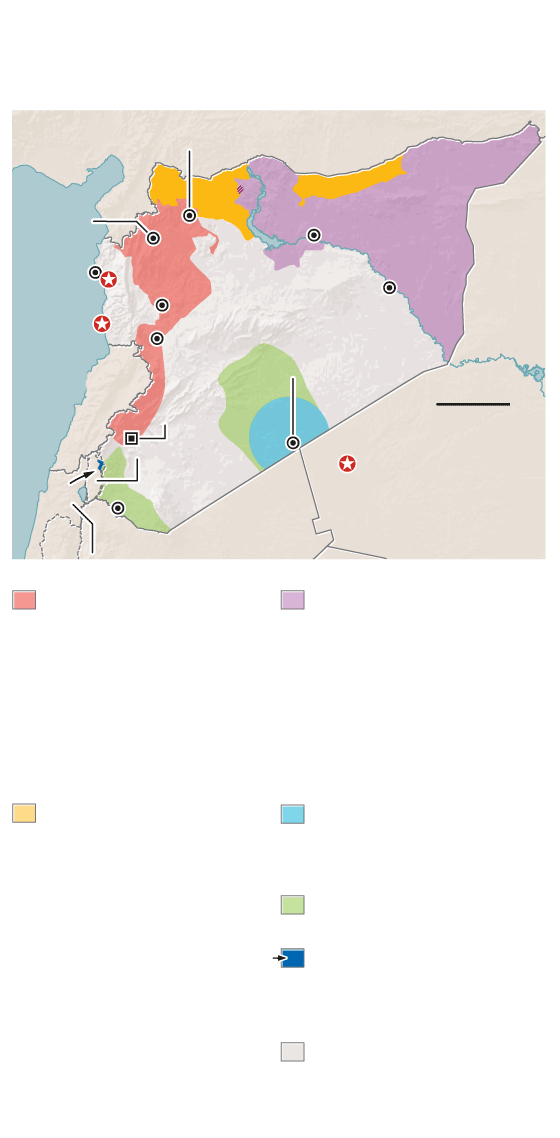
Key Syrian rebel groups
Syrian rebels who ousted Bashar al-Assad and seized
Damascus include fighters from different factions, while other
groups hold territory elsewhere in the country
TURKEY
Aleppo
Idlib
Raqqa
Deir
al-Zour
Latakia
Hama
IRAQ
SYRIA
Tartus
Homs
Al-Tanf
LEBANON
100km
Damascus
Golan
Heights
Russian bases
Future of Russia’s
military presence in
Syria in doubt
Daraa
ISRAEL
JORDAN
HAYAT TAHRIR AL-SHAM (HTS)
Main rebel group behind Assad’s
ouster, first emerged as al-Qaeda
affiliate at start of Syria’s 2011
uprising, but broke ranks with
jihadist group in 2016. Despite
trying to shed extremist roots,
the U.S. and others still consider
HTS a terrorist group.
SYRIAN DEMOCRATIC FORCES
(SDF) Alliance of Kurdish-led militias,
backed by U.S. Formed to hold back
the advance of the Islamic State
in Syria in 2014, it now controls some
of the country’s biggest oil fields.
Turkey regards SDF as a terrorist
group linked to Ankara’s proscribed
PKK movement.
SYRIAN NATIONAL ARMY (SNA)
Umbrella alliance of Turkish-backed
militias believed to have given tacit
approval to HTS’ recent offensive.
Turkey first sent troops into Syria
from 2016 to push Kurdish
militants and Islamic State
away from the border .
AL-TANF DECONFLICTION ZONE
55km area around U.S. military
base in Al-Tanf
UNIDENTIFIED OPPOSITION GROUPS
ISRAEL DEFENSE FORCES (IDF)
Entered buffer zone in Golan Heights
for “defensive purposes” on Dec. 8
LOST SYRIAN REGIME TERRITORY
Source: graphic news; reuters; BBC; Institute for the Study of War
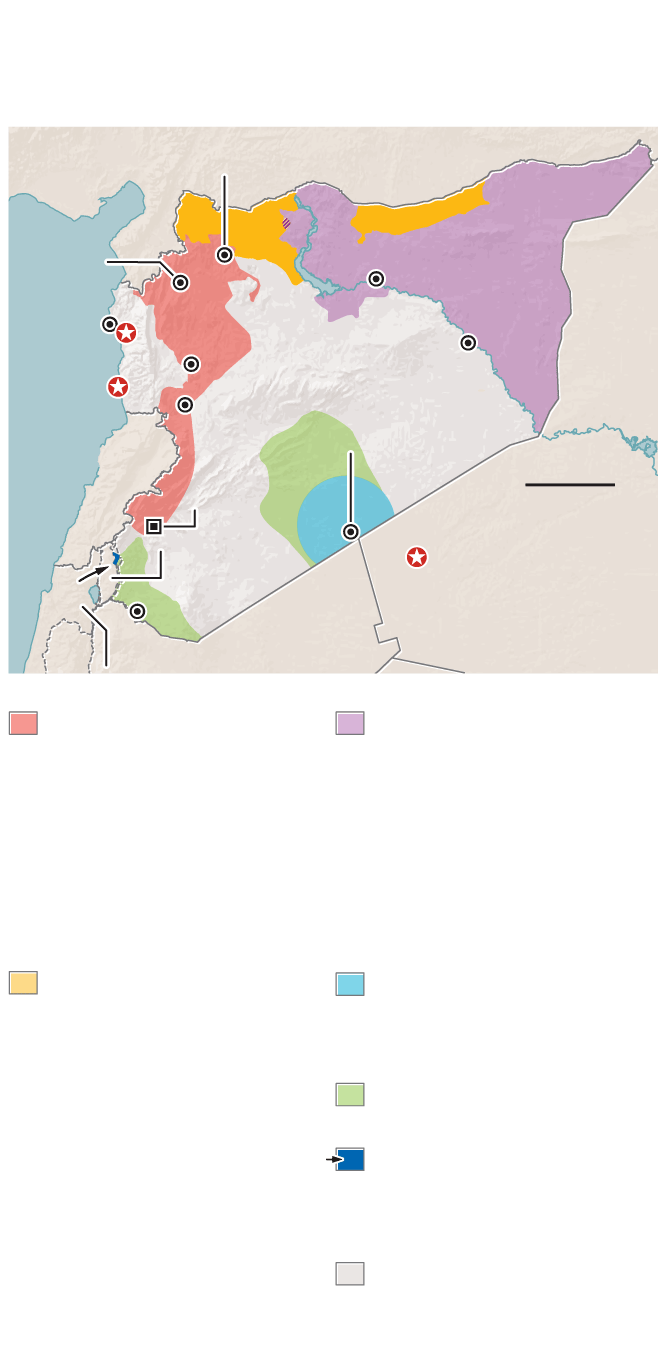
Key Syrian rebel groups
Syrian rebels who ousted Bashar al-Assad and seized
Damascus include fighters from different factions, while other
groups hold territory elsewhere in the country
TURKEY
Aleppo
Idlib
Raqqa
Deir
al-Zour
Latakia
Hama
IRAQ
SYRIA
Tartus
Homs
Al-Tanf
LEBANON
100km
Damascus
Golan
Heights
Russian bases
Future of Russia’s
military presence in
Syria in doubt
Daraa
ISRAEL
JORDAN
HAYAT TAHRIR AL-SHAM (HTS)
Main rebel group behind Assad’s
ouster, first emerged as al-Qaeda
affiliate at start of Syria’s 2011
uprising, but broke ranks with
jihadist group in 2016. Despite
trying to shed extremist roots,
the U.S. and others still consider
HTS a terrorist group.
SYRIAN DEMOCRATIC FORCES
(SDF) Alliance of Kurdish-led militias,
backed by U.S. Formed to hold back
the advance of the Islamic State
in Syria in 2014, it now controls some
of the country’s biggest oil fields.
Turkey regards SDF as a terrorist
group linked to Ankara’s proscribed
PKK movement.
AL-TANF DECONFLICTION ZONE
SYRIAN NATIONAL ARMY (SNA)
Umbrella alliance of Turkish-backed
militias believed to have given tacit
approval to HTS’ recent offensive.
Turkey first sent troops into Syria
from 2016 to push Kurdish
militants and Islamic State
away from the border .
55km area around U.S. military
base in Al-Tanf
UNIDENTIFIED OPPOSITION GROUPS
ISRAEL DEFENSE FORCES (IDF)
Entered buffer zone in Golan Heights
for “defensive purposes” on Dec. 8
LOST SYRIAN REGIME TERRITORY
Source: graphic news; reuters; BBC; Institute for the Study of War
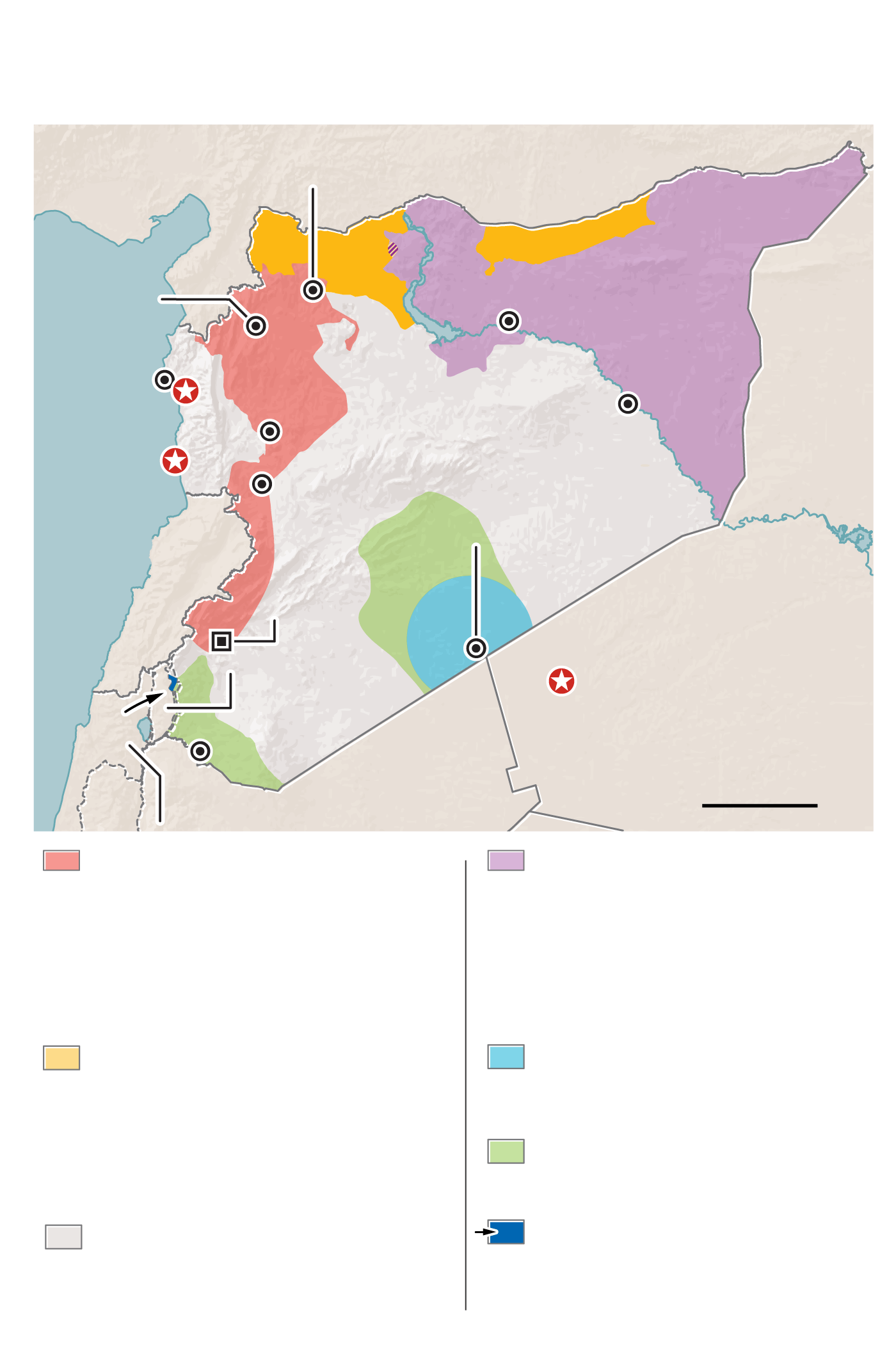
Key Syrian rebel groups
Syrian rebels who ousted Bashar al-Assad and seized Damascus include fighters
from different factions, while other groups hold territory elsewhere in the country
TURKEY
Aleppo
Idlib
Raqqa
Deir
al-Zour
Latakia
Hama
IRAQ
SYRIA
Tartus
Homs
Al-Tanf
LEBANON
Damascus
Golan
Heights
Russian bases
Future of Russia’s military
presence in Syria in doubt
Daraa
100km
ISRAEL
JORDAN
HAYAT TAHRIR AL-SHAM (HTS)
Main rebel group behind Assad’s ouster, first
emerged as al-Qaeda affiliate at start of Syria’s
2011 uprising, but broke ranks with jihadist group
in 2016. Despite trying to shed extremist roots,
the U.S. and others still consider HTS a terrorist
group.
SYRIAN DEMOCRATIC FORCES (SDF)
Alliance of Kurdish-led militias, backed by U.S.
Formed to hold back the advance of the Islamic
State in Syria in 2014, it now controls some
of the country’s biggest oil fields. Turkey regards
SDF as a terrorist group linked to Ankara’s
proscribed PKK movement.
AL-TANF DECONFLICTION ZONE
SYRIAN NATIONAL ARMY (SNA)
Umbrella alliance of Turkish-backed militias
believed to have given tacitapproval to HTS’
recent offensive. Turkey first sent troops into
Syria from 2016 to push Kurdish militants and
Islamic State away from the border .
55km area around U.S. military base in Al-Tanf
UNIDENTIFIED OPPOSITION GROUPS
ISRAEL DEFENSE FORCES (IDF)
Entered buffer zone in Golan Heights
for “defensive purposes” on Dec. 8
LOST SYRIAN REGIME TERRITORY
Source: graphic news; reuters; BBC; Institute for the Study of War
Rebuilding Syria will be a colossal task following 13 years of civil war that killed hundreds of thousands of people. Cities have been bombed to ruin, swathes of countryside are depopulated, the economy has been gutted by international sanctions and millions of refugees still live in camps after one of the biggest displacements of modern times.
But the mood in Damascus remained celebratory, with refugees beginning to return to a homeland they had not seen in years.
Anas Idrees, 42, a refugee since early in the war, raced from Lebanon to Syria to cheer Assad’s fall.
He ventured into the Hamidiyeh Souk in old Damascus to the renowned Bakdash ice cream parlour, where he ordered a large scoop of their signature Arabic gelato, served coated in pistachios.
“I swear to God, it tastes different now,” he said after eating a spoonful. “It was good before, but it’s changed because now we are happy inside.”