
Expatriate Syrians gather with flags to celebrate the fall of the Assad regime in Syria on Dec. 8 in Berlin, Germany. Germany took in hundreds of thousands of Syrians following the outbreak of the civil war, with flows of refugees intensifying in and after 2015.Omer Messinger/Getty Images
The latest on Syria
Syria's civil war seems to have come to an end as rebel forces, known as the HTS, overthrew Bashar al-Assad's government. This is what we know of the events so far:
The situation in Syria is rapidly evolving after a shock insurgency overthrew president Bashar al-Assad’s government, bringing an end to a 13-year civil war. In less than two weeks, rebel forces took over major cities such as Aleppo and Hama and by Sunday laid claim to the capital, Damascus. The opposition fighters’ speedy advance forced Mr. al-Assad to flee the country to Moscow.
Here is everything we know so far about what is happening in Syria.
How did the Syrian Civil War start?
The civil war began March, 2011, as a wave of pro-democracy protests, known as the Arab Spring, swept over many countries in the Middle East. In Syria, Mr. al-Assad unleashed police, military and paramilitary forces to violently suppress protesters who called for the end of the dynastic Assad regime, which began in 1971 with his father, Hafez al-Assad.
Mr. al-Assad received support from allies Iran and Russia as the uprising hemorrhaged into an outright civil war. International rights groups and prosecutors alleged widespread use of torture and extrajudicial killings in Syria’s government-run detention centres. The war has killed nearly half a million people and displaced half the country’s prewar population of 23 million.
The conflict appeared to be frozen in recent years, with Mr. al-Assad’s government regaining control of most of Syria’s territory while the northwest remained under the control of opposition groups and the northeast under Kurdish control.
Although Damascus remained under crippling Western sanctions, neighbouring countries had begun to resign themselves to Mr. al-Assad’s continued hold on power. The Arab League reinstated Syria’s membership last year, and in May Saudi Arabia announced the appointment of its first ambassador since severing ties with Damascus 12 years ago.
Why did the war in Syria suddenly intensify?
The geopolitical tide turned quickly when opposition groups in northwestern Syria launched a surprise offensive in late November. Government forces quickly collapsed, while Mr. al-Assad’s allies, preoccupied by other conflicts – Russia’s war in Ukraine and the year-long wars between Israel and the Iran-backed militant groups Hezbollah and Hamas – appeared reluctant to forcefully intervene.
What happened in Syria this week?
On Sunday, insurgents toppled the government after they took the capital. Prime Minister Mohammad Ghazi al-Jalali said the government was ready to “extend its hand” to the opposition and hand over its functions to a transitional government.
Videos emerged online a day earlier showing members of Mr. al-Assad’s army deserting their posts and changing into civilian clothes.
As the rebels’ victory became clear, residents of the capital poured into the streets to tear down a statue of Mr. al-Assad’s father, then loot the presidential palace, which had been the seat of the Assad dynasty for much of its 54-year rule.
The next target for some was the Iranian embassy, where Syrians smashed windows and tore down posters of former Hezbollah leader Hassan Nasrallah and former Iranian military commander Qassem Soleimani, two key allies of Mr. al-Assad. Mr. Nasrallah was killed in an Israeli air strike on Beirut in September, while General Soleimani was assassinated by the U.S. in 2020.
Residents of the capital reported hearing gunfire and explosions. Footage broadcast on opposition-linked media showed a tank in one of the city’s central squares while a small group of people gathered in celebration. The pro-government Sham FM radio reported that Damascus airport had been evacuated and all flights halted.
It was the first time opposition forces had reached the capital since 2018, when Syrian troops recaptured areas on the outskirts of the city after a years-long siege. The insurgents also announced they had entered the notorious Saydnaya military prison north of the capital and “liberated” the prisoners there.
Who are the HTS, the opposition forces that brought down the Assad regime?
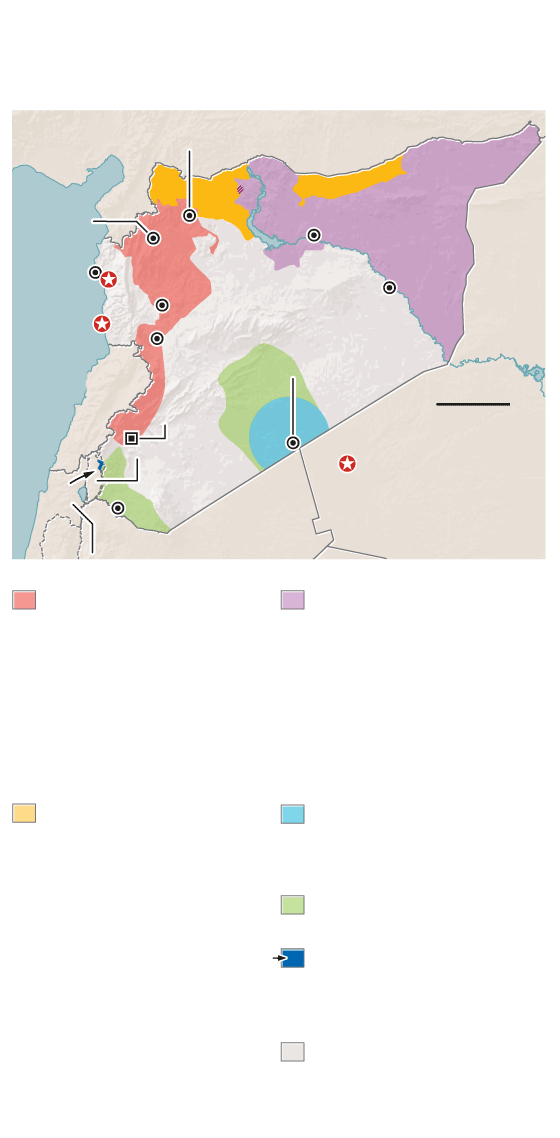
Key Syrian rebel groups
Syrian rebels who ousted Bashar al-Assad and seized
Damascus include fighters from different factions, while other
groups hold territory elsewhere in the country
TURKEY
Aleppo
Idlib
Raqqa
Deir
al-Zour
Latakia
Hama
IRAQ
SYRIA
Tartus
Homs
Al-Tanf
LEBANON
100km
Damascus
Golan
Heights
Russian bases
Future of Russia’s
military presence in
Syria in doubt
Daraa
ISRAEL
JORDAN
HAYAT TAHRIR AL-SHAM (HTS)
Main rebel group behind Assad’s
ouster, first emerged as al-Qaeda
affiliate at start of Syria’s 2011
uprising, but broke ranks with
jihadist group in 2016. Despite
trying to shed extremist roots,
the U.S. and others still consider
HTS a terrorist group.
SYRIAN DEMOCRATIC FORCES
(SDF) Alliance of Kurdish-led militias,
backed by U.S. Formed to hold back
the advance of the Islamic State
in Syria in 2014, it now controls some
of the country’s biggest oil fields.
Turkey regards SDF as a terrorist
group linked to Ankara’s proscribed
PKK movement.
SYRIAN NATIONAL ARMY (SNA)
Umbrella alliance of Turkish-backed
militias believed to have given tacit
approval to HTS’ recent offensive.
Turkey first sent troops into Syria
from 2016 to push Kurdish
militants and Islamic State
away from the border .
AL-TANF DECONFLICTION ZONE
55km area around U.S. military
base in Al-Tanf
UNIDENTIFIED OPPOSITION GROUPS
ISRAEL DEFENSE FORCES (IDF)
Entered buffer zone in Golan Heights
for “defensive purposes” on Dec. 8
LOST SYRIAN REGIME TERRITORY
Source: graphic news; reuters; BBC; Institute for the Study of War
Key Syrian rebel groups
Syrian rebels who ousted Bashar al-Assad and seized
Damascus include fighters from different factions, while other
groups hold territory elsewhere in the country
TURKEY
Aleppo
Idlib
Raqqa
Deir
al-Zour
Latakia
Hama
IRAQ
SYRIA
Tartus
Homs
Al-Tanf
LEBANON
100km
Damascus
Golan
Heights
Russian bases
Future of Russia’s
military presence in
Syria in doubt
Daraa
ISRAEL
JORDAN
HAYAT TAHRIR AL-SHAM (HTS)
Main rebel group behind Assad’s
ouster, first emerged as al-Qaeda
affiliate at start of Syria’s 2011
uprising, but broke ranks with
jihadist group in 2016. Despite
trying to shed extremist roots,
the U.S. and others still consider
HTS a terrorist group.
SYRIAN DEMOCRATIC FORCES
(SDF) Alliance of Kurdish-led militias,
backed by U.S. Formed to hold back
the advance of the Islamic State
in Syria in 2014, it now controls some
of the country’s biggest oil fields.
Turkey regards SDF as a terrorist
group linked to Ankara’s proscribed
PKK movement.
AL-TANF DECONFLICTION ZONE
SYRIAN NATIONAL ARMY (SNA)
Umbrella alliance of Turkish-backed
militias believed to have given tacit
approval to HTS’ recent offensive.
Turkey first sent troops into Syria
from 2016 to push Kurdish
militants and Islamic State
away from the border .
55km area around U.S. military
base in Al-Tanf
UNIDENTIFIED OPPOSITION GROUPS
ISRAEL DEFENSE FORCES (IDF)
Entered buffer zone in Golan Heights
for “defensive purposes” on Dec. 8
LOST SYRIAN REGIME TERRITORY
Source: graphic news; reuters; BBC; Institute for the Study of War
Key Syrian rebel groups
Syrian rebels who ousted Bashar al-Assad and seized Damascus include fighters
from different factions, while other groups hold territory elsewhere in the country
TURKEY
Aleppo
Idlib
Raqqa
Deir
al-Zour
Latakia
Hama
IRAQ
SYRIA
Tartus
Homs
Al-Tanf
LEBANON
Damascus
Golan
Heights
Russian bases
Future of Russia’s military
presence in Syria in doubt
Daraa
100km
ISRAEL
JORDAN
HAYAT TAHRIR AL-SHAM (HTS)
Main rebel group behind Assad’s ouster, first
emerged as al-Qaeda affiliate at start of Syria’s
2011 uprising, but broke ranks with jihadist group
in 2016. Despite trying to shed extremist roots,
the U.S. and others still consider HTS a terrorist
group.
SYRIAN DEMOCRATIC FORCES (SDF)
Alliance of Kurdish-led militias, backed by U.S.
Formed to hold back the advance of the Islamic
State in Syria in 2014, it now controls some
of the country’s biggest oil fields. Turkey regards
SDF as a terrorist group linked to Ankara’s
proscribed PKK movement.
AL-TANF DECONFLICTION ZONE
SYRIAN NATIONAL ARMY (SNA)
Umbrella alliance of Turkish-backed militias
believed to have given tacitapproval to HTS’
recent offensive. Turkey first sent troops into
Syria from 2016 to push Kurdish militants and
Islamic State away from the border .
55km area around U.S. military base in Al-Tanf
UNIDENTIFIED OPPOSITION GROUPS
ISRAEL DEFENSE FORCES (IDF)
Entered buffer zone in Golan Heights
for “defensive purposes” on Dec. 8
LOST SYRIAN REGIME TERRITORY
Source: graphic news; reuters; BBC; Institute for the Study of War
The group that toppled Mr. al-Assad’s government is the Hayat Tahrir al-Sham, known as HTS. Its leader is Abu Mohammed al-Golani, who is now going by his real name, Ahmed al-Sharaa. HTS controls much of northwestern Syria and in 2017 set up a “salvation government” to run day-to-day affairs in the region. In recent years, the group has sought to remake its image, cutting ties with al-Qaeda, ditching hardline officials and vowing to embrace pluralism and religious tolerance.
Before it was rebranded, HTS was known as the Nusra Front and designated a terrorist group by much of the world, including Canada. It emerged as the most powerful of the many rebel factions that sprang up in the early days of the insurgency more than a decade ago.

Abu Mohammed al-Golani speaks at the Umayyad Mosque in Damascus Dec. 8.Omar Albam/The Associated Press
Before founding the Nusra Front, Mr. al-Golani had fought for al-Qaeda in Iraq, where he spent five years in a U.S. prison. He returned to Syria once the uprising began, sent by the leader of the Islamic State group in Iraq at the time, Abu Omar al-Baghdadi, to build up al-Qaeda’s presence. Mr. al-Golani fought a bloody war against Mr. al-Baghdadi after Islamic State sought to unilaterally subsume the Nusra Front in 2013. Despite its al-Qaeda ties, the Nusra Front was regarded as more tolerant and less heavy-handed than Islamic State in dealings with civilians and other rebel groups.
Seeking to assure Syrian religious minorities who have long feared jihadist rule, Mr. al-Golani issued a steady stream of messages promising them protection as insurgents began their lightning advance less than two weeks ago.
How al-Assad’s allies and enemies abroad have reacted
Iran
- Iran’s Foreign Affairs Ministry said in a statement that Iran respects Syria’s unity and national sovereignty and called for “the swift end of military conflicts, the prevention of terrorist actions, and the commencement of national dialog” with all sectors of Syrian society. Tehran said it would continue to support international mechanisms for pursuing the political process, adding that long-standing and friendly relations between Iran and Syria are expected to continue.
Russia
- The Kremlin is reported to have offered Mr. al-Assad and his family asylum in Moscow on Sunday after the rebels’ stunning advance, according to Russian media reports. Syrians will have to cope with a full-scale civil war alone, said Konstantin Kosachyov, the deputy chairman of Russia’s upper house of parliament, as reported by the Interfax news agency.
Israeli Prime Minister Benjamin Netanyahu
- The fall of Mr. al-Assad, a major link in the Iranian axis, is a historic day and a direct result of blows dealt to Hezbollah and Iran by Israel, Mr. Netanyahu said. “We will not allow any hostile force to establish itself on our border,” he added.
Prime Minister Justin Trudeau
- Mr. Trudeau said a new chapter for Syria that is free of terrorism and suffering for its people can begin. In a social media post on X Sunday, Mr. Trudeau said the fall of the Assad dictatorship “ends decades of brutal oppression.” He added that Canada is monitoring the transition of power closely and he urged “order, stability, and respect for human rights.”
U.S. President Joe Biden
- “President Biden and his team are closely monitoring the extraordinary events in Syria and staying in constant touch with regional partners,” the White House said in a statement.
The broader international community
U.S. president-elect Donald Trump, Iraq, Saudi Arabia, European leaders and many other international figures issued statements after the rebels seized the country.
What are the impacts on Iran and Russia?
The fall of Mr. al-Assad’s regime completes a year of defeat for Ayatollah Ali Khamenei’s policy of “forward defence” – confronting Iran’s enemies beyond its own borders via a network of allies and proxy militias such as Hamas and Hezbollah. He is due to give a speech Wednesday.
Russia was also caught off guard by the rebel offensive – and too distracted by its war in Ukraine to commit many resources to Mr. al-Assad’s defence. But Moscow was quick to make the best of the new situation, even as it offered political asylum to Mr. al-Assad and his family.
The rebels who have taken power in Syria have yet to approach Russia’s naval base in the port city of Tartus, nor its airbase further up the Mediterranean coast at Khmeimim, indicating that some understanding may have been reached to let the Russians remain. “The opposition’s armed forces did not and have no plans to penetrate the Russian military bases, which continue to operate normally,” the Kremlin-run TASS news wire reported Monday.
Globe and Mail reporters Mark MacKinnon and Geoffrey York have full analyses on what this means for Iran and Russia and Russia’s influence in Africa.
What comes next for Syria and its pursuit of democracy
It is not yet clear what will happen to Syria, how its government will take shape or whether there will be democratic elections.
Prime Minister al-Jalali, who remained in his post after Mr. al-Assad and most of his top officials vanished over the weekend, has sought to project normalcy.
“We are working so that the transitional period is quick and smooth,” he told Sky News Arabia TV on Monday, saying the security situation had already improved from the day before. He said the government is co-ordinating with the insurgents and that he is ready to meet the HTS leader.
Meanwhile, streams of refugees crossed back into Syria from neighbouring countries, hoping for a more peaceful future and looking for friends and relatives who disappeared during Mr. al-Assad’s brutal rule.
The rebel command said Monday they would not tell women how to dress.
Britain and the U.S. are both considering removing HTS from their lists of designated terrorist organizations.
Why is Israel carrying out air strikes in Syria?
Israel said it carried out air strikes on suspected chemical weapons sites and long-range rockets in Syria to keep them from falling into the hands of extremists. It also seized a buffer zone after Syrian troops withdrew.
“The only interest we have is the security of Israel and its citizens,” Israeli Foreign Minister Gideon Saar told reporters Monday. “That’s why we attacked strategic weapons systems, like, for example, remaining chemical weapons, or long-range missiles and rockets, in order that they will not fall in the hands of extremists.”
Air strikes were reported in the area of the Mezzeh military airport, southwest of the capital, on Sunday. The airport has previously been targeted in Israeli air strikes. Strikes were also heard in the capital Monday.
Israel has carried out hundreds of air strikes in Syria in recent years, targeting what it says are military sites related to Iran and Hezbollah. Israeli officials rarely comment on individual strikes.
Syria agreed to give up its chemical weapons stockpile in 2013, after the government was accused of launching an attack near Damascus that killed hundreds of people. But it is widely believed to have kept some of the weapons and was accused of using them again in subsequent years.
The new Syrian flag

Members of the Syrian diaspora wave while flying the Syrian opposition flag at the Syrian Embassy, in Moscow, Russia, on Dec. 9.Alexander Zemlianichenko/The Associated Press
Hours after Mr. al-Assad arrived in Moscow, the Syrian embassy there took down the Assad-era flag hanging outside the building and replaced it with the green-white-and-black banner of the Syrian uprising.
How are Syrian-Canadians reacting?
Since the civil war broke out more than a decade ago, approximately 60,000 Syrian refugees have settled in Canada.
In Calgary, what had been planned as a rally to demand a free Syria quickly pivoted to a celebration, with hundreds of Syrians gathered outside City Hall, bundled against the cold, cheering and dancing. Some wrapped themselves in flags, some were crying, others singing. A local Middle Eastern sweet shop offered free treats.

A protest-turned-celebration for the freedom of Syria from Dictator Al-Assad and his family’s 50-year rule at City Hall in Calgary on Dec. 8.Jude Brocke/The Globe and Mail
Khadija Alsaeid, 18, fled the Syrian city of Aleppo with her family about 10 years ago. “It’s amazing, you don’t know the joy we feel,” she said at the rally. She hopes she can return to her hometown. “As much as I love Canada, as much as I love the mountains, I would love to go back one day there. It’s my city,” she said.
Bassam Al Rashed Abazed came to Canada in 2017 with his wife and three children. Since then, they’ve had another child. When it’s safe, he plans to visit Syria, where one of his sisters and many of his aunts, uncles and cousins still live. But he’s unlikely to move back permanently.
“I want to help build our country again,” said the 44-year-old. “But my eldest daughter is in Grade 10. Her first language is English now. I think it’s better for her to study here in Canada, and the other kids too.”
Ahmad Habboub became a Canadian citizen in October. The Calgary resident said he would like to go back to Syria, but his family home in the city of Homs has been destroyed. He also wants to complete his postsecondary studies here first. But one day? “I hope so.”
With reports from Mark MacKinnon, the Associated Press and Reuters