

The morning tour group is nearing the end of a two-hour visit to Zealandia, the pioneering eco-sanctuary in the hills of Wellington, New Zealand’s capital.
They have glimpsed many of the birds on their list, from a chunky parrot called the kaka to the petite North Island robin. But there is one they haven’t seen.
Suddenly, they hear a splashing sound from a trailside stream. “There,” says their excited guide, pointing into the bush. It’s a saddleback, a striking black bird with an orange “mustache” below its beak and a rusty patch on its back. Oohing and aahing, the group snaps pictures as the bird takes a bath, beating its wings in the water.
This glimpse of unspoiled New Zealand is the product of an extraordinary nationwide campaign to save the remnants of the country’s unique bird life. New Zealand has vowed to rid itself of bird-killing predators such as rats and weasels by 2050, a wildly ambitious goal. “No other country has ever attempted a multi-species eradication across its entire landmass,” said a report issued by the country’s Department of Conservation last year.
After decades of methodical effort involving thousands of citizen volunteers, millions of animal traps and a network of high-tech, pest-proof fences that would put the Berlin Wall to shame, the campaign is starting to show results.
The saddleback, which disappeared from Wellington in the 1880s, and the rest of the mainland not long after, is thriving at Zealandia. Its “cheet te-te-te-te” song reverberates through the forest all day. It is even confident enough to bathe in public.


Thanks in part to Zealandia, nearby Wellington has had a revival of native birds.
To understand what an accomplishment that is, you need to go back about 80 million years. It was then that what was to become New Zealand began to drift away from an ancient supercontinent, Australis, that also included Australia, Antarctica and South America.
Alone like a raft in the vastness of the South Pacific, New Zealand developed its own peculiar life forms. Grasshopper-like bugs, called weta, as big as small rodents. Carnivorous snails the size of your palm that slurp up native earthworms. A bat that hunts on the ground instead of in the air, scrambling around on folded wings.
Birds took an especially unusual course. New Zealand floated away from the rest of the world before the evolution of land mammals, so it never had any of its own. No rodents. No primates. No hyenas, raccoons, foxes or bears. No snakes, either.
So its birds did not have to contend with creatures that would attack their eggs or young. They evolved accordingly. Some lost the power of flight and became entirely terrestrial. The most famous, the kiwi, New Zealand’s national symbol, has fur-like plumage and nostrils on the end of its long bill for sniffing out spiders and worms on the forest floor.

Kiwis come in five species: This is a North Island brown, the most common. The birds are ratites, related to emus and ostriches.David Gray/Reuters
Many species learned to nest on the ground or in tree hollows. That made them especially vulnerable when mammals finally did arrive. The first were humans, who came late to New Zealand, the world’s most isolated major habitable landmass. “This was truly a land apart; not a lost world but one that had never been found,” says a 2019 book about the Wellington sanctuary, Zealandia: The Valley that Changed a Nation.
The ancestors of today’s Maori people arrived from Polynesia only in the 1300s, thousands of years after the Indigenous peoples of Australia or North America. The effect on plants and animals was devastating. The newcomers burned the forests to plant crops and flush out game. Almost a third of New Zealand’s forestlands disappeared before Europeans arrived. All nine species of the ostrich-like moa were hunted to extinction, including some that weighed as much as 250 kilograms and stood twice the height of a human.
Just as destructive as the settlers was humankind’s constant companion, the rat. New Zealand’s birds had evolved to defend themselves against predators such as owls and eagles by feeding at night or developing camouflage plumage. Against four-legged hunters with a keen sense of smell and the ability to climb or dig, they were defenceless.


The European settlers who started arriving in the 1800s were many times more destructive than the Maori. They cut down vast numbers of native trees for timber, from the giant kauri − which can grow as tall as 60 metres and make safe homes for nesting parrots such as the kaka − to the rata, whose vivid red flowers provide nectar for species such as the bellbird. They killed an estimated 150,000 keas, bold alpine parrots with a bounty on their heads because some farmers suspected the omnivorous birds of attacking their sheep.
Worse, they brought a whole Noah’s ark of ravenous animals. Ship rats and Norway rats, which learned to prey on nesting female birds and devour their eggs and young. Deer, goats and rabbits, which gobbled up local plants. Cats, famously adept bird killers, many of which quickly went feral.
Brushtail possums brought over from Australia to start a fur trade started raiding bird nests. Stoats, weasels and ferrets introduced to control the explosive populations of escaped rabbits soon became among the deadliest predators of bird life. Even that cute English import, the hedgehog, established itself by feasting on eggs and chicks.


The populations of korimako (bellbird), hihi (stitchbird) and pateke (brown teal) all fell dramatically due to introduced predators and habitat loss.
By the 1980s, more than 50 New Zealand bird species had died off, one of the highest rates of extinction anywhere. The embattled survivors hung on in pest-free island refuges such as Tiritiri Matangi, near Auckland. Those refuges had managed to control or wipe out predatory animals. Bird populations bounced back.
Could that success be repeated on the mainland, without stretches of water to keep predators at bay? A Wellington conservationist thought so. Jim Lynch and his wife, Eve, imagined a land sanctuary surrounded by a fence so the birds inside would have a chance. They found the perfect place for it in a local valley that had been used as a reservoir to provide the city with fresh water.
The organizers tested some existing predator-control fences and found they were not up to the job. So they decided to design one of their own.
They needed something high enough to thwart both champion jumpers like cats and superb climbers like possums. To see what they were up against, they watched as the invaders tried to scale model fences. Some possums were so determined they would climb over each other’s backs to get in or even fling fellow possums over the top.
The result was a masterpiece of Kiwi ingenuity, with a curved cap on top to block the acrobatic possums, mesh tight enough to keep out even the smallest mouse and an L-shaped skirt underneath to keep burrowing animals such as rabbits from going under. It took three years to develop and five months to construct.
Once it was in place – 8.6 kilometres long, 2.2 metres high – workers started trapping and poisoning the invasive creatures inside, all 13 species, from hares to hedgehogs. They caught 1,000 possums in two months. By 2000, the job was complete. Zealandia had become the “world’s first mammalian-predator-free zone in an urban environment.” Only a manageable population of mice remained (they are nearly impossible to get rid of).


Birds are not the only animals sheltered inside. There are tuataras, which look like lizards but belong to a much older family of reptiles.
A quarter-century later, Zealandia teems with native birds. About 130,000 people a year come to see them in their glory.
On the day I visited in February, I saw not just a saddleback but a brilliant red-crowned parakeet perching on a branch and a half-dozen stitchbirds shuttling in and out of a feeding station − not to mention a sleepy tuatara, a species of long-lived nocturnal reptile that is the only surviving member of a family that flourished in the age of the dinosaurs.
Even more encouraging, some of these species have begun to thrive outside the perimeter. Consider the kaka, that chunky parrot. Fourteen of the highly intelligent birds were brought to Zealandia in 2002 from the zoo in Auckland. Now they are a common sight all over Wellington, even around the Parliament buildings.

The kaka in Zealandia descend from 14 parrots bred in captivity.
Zealandia concedes that it has a long, long way to go. What it has accomplished so far is only the start of what it calls a 500-year journey. That is how long it will take for some of the native trees it has planted in the valley to reach their full, gigantic height, recreating the lush, dark forest of a millennium ago, before humans reached New Zealand’s shores.
Outside the 225-hectare sanctuary, the challenge is far greater. Human settlement has transformed the country’s landscape, leaving parts of it looking more like Scotland or Southern Ontario than the New Zealand of old. About 70 per cent has next-to-no native trees or plants. Most of the birds seen in cities are introduced foreign species such as the myna, starling and blackbird.
The imported mammals that are the enemies of native birds are clever and resilient. Listing all the species of predator it must wipe out, the Department of Conservation admits that for all but a few, eradication is “beyond current capability.”
One of the hardiest is the feral cat. Conservation Minister Tama Potaka added the felines to the hit list in November, calling them “stone cold killers.”
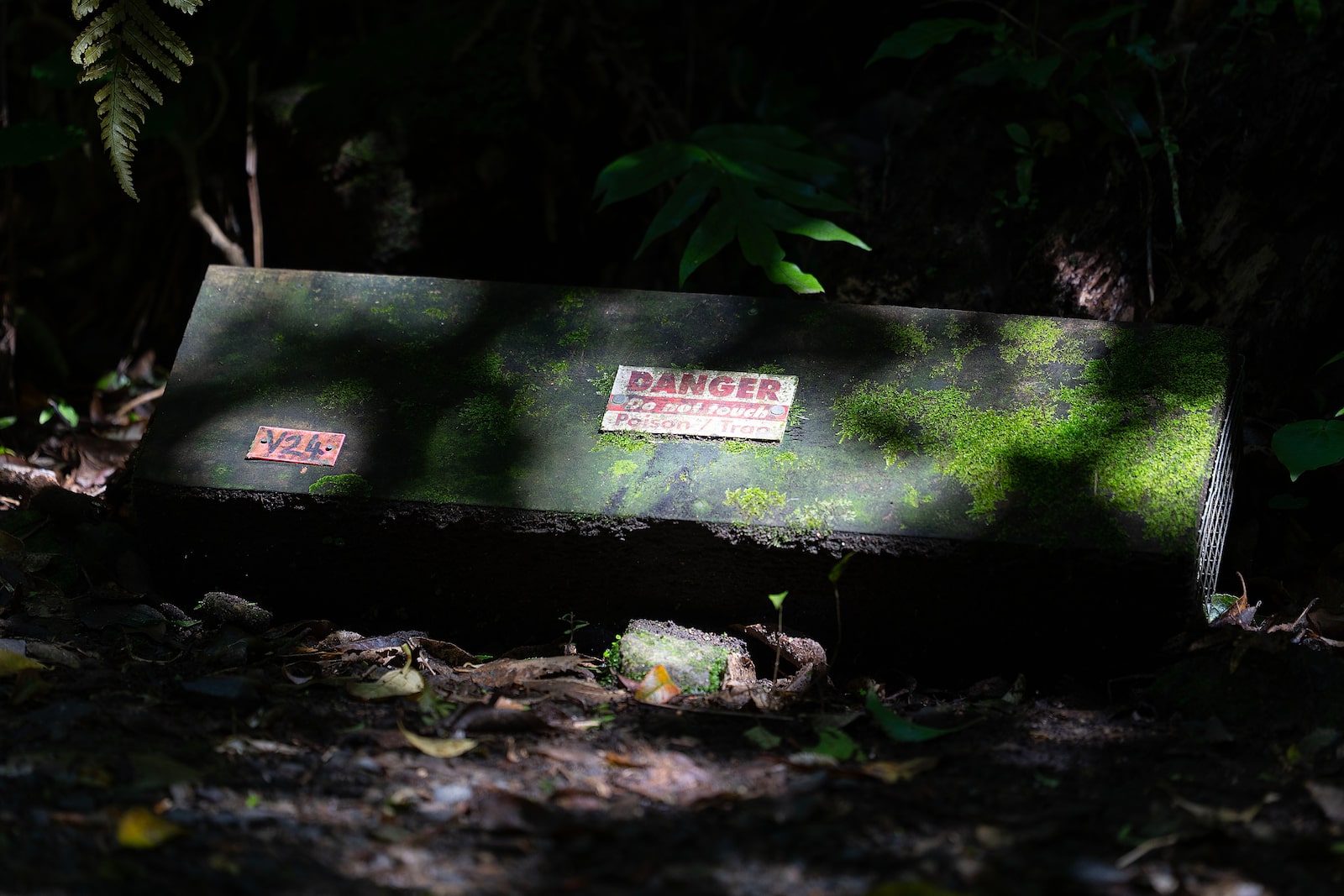


Recent advances could turn the tide of battle: thermal cameras carried by drones to detect predators; traps that can tell one species from another; DNA tests of waterways to tell which animals are nearby. In the meantime, the conservation report says, predators kill an estimated 25 million native birds a year.
Saddlebacks are among them. Though hundreds thrive inside Zealandia’s fence, those that fly outside are vulnerable. The birds like to feed on the ground, using their pointed bills to root around in fallen leaves or chip away at rotten wood like a woodpecker. They often nest in tree cavities or rock crevices, where stoats can reach them with ease.
When they venture beyond the fence, said Zealandia guide Scott Langdale, “I sadly say goodbye to them, because I know they won’t survive.”

Scott Langdale, a guide at Zealandia, knows that birds face many dangers leaving the sanctuary.
Still, what the sanctuary and others like it have achieved is remarkable. The species of saddleback seen in Zealandia was once down to about 500 birds, found only on a small island in New Zealand’s far north.
Another bird, the kakapo, the world’s only flightless (and only nocturnal) parrot, was down to just 51. Thanks to decades of careful fostering on remote southern islands, there are now 235 adults. This winter (New Zealand’s summer), the kakapo had been enjoying a baby boom, with 100 hatched as of late March. A recent nest-cam video shows a plump mother in bright green plumage feeding two fluffy white chicks.
Inspired by such comebacks, New Zealanders have joined together to help save native birds. The Department of Conservation says more than 8,000 volunteer groups are involved in this great national movement, doing everything from checking traps to counting birds.
Wellington alone has 163 groups. One of their triumphs was clearing the city’s Miramar Peninsula of rats, weasels and stoats, an enterprise that, according to the DOC, included “almost every business, school and kindergarten” in the area. With that collective success in mind, officials announced in March that they are aiming to make Wellington the country’s first predator-free city.
“People of all walks of life in New Zealand have gone, ‘Hey, this is cool, I want to be part of it. I will willingly give my time and energy to help make this happen,’” says Jacqueline Beggs, an expert in conservation biology at the University of Auckland. “That’s been a game changer.”
The way New Zealanders have rallied to protect their country’s unique natural heritage carries a hopeful message for other countries: Yes, human greed and ignorance have done awful damage, but human ingenuity and compassion can help repair it.
The day after I joined a tour of Zealandia, I went back for a hike through the upper reaches of the valley. As I was making my way back down, I heard splashes from a little creek beside the trail. A look through my binoculars revealed a flash of burnt orange through the foliage: Just another saddleback taking a bath.

Follow that bird: More from The Globe and Mail
The Decibel podcast
Birds in Canada have had to adapt their habits to climate change and human activity. The spring migration in Ontario’s Point Pelee National Park is an ideal time to see that. Two years ago, a team from The Decibel went to Point Pelee to hear as many kinds of birdsong as they could. Subscribe for more episodes.
A birdwatcher’s view
Julia Zarankin: To my surprise, I learned that birding can be an adrenaline-fuelled extreme sport
Sophie Mercer: A search for the scarlet tanager brought me closer to Dad