Stepping into Boulaq Al Dakrour on the edge of central Cairo, just west of the Nile, is to enter another world. The streets are narrow, crowded and chaotic. Horses, mules, cars, motorcycles and tuk-tuks, the three-wheeled motorized rickshaws that act as taxis, fill every available space. The shop owners shape metal into kitchen pots, make flatbreads, sell live poultry and fish, and iron and sew clothing.
But what makes Boulaq truly different from most other areas of this megacity is the amazing diversity of its residents. Yemeni men in white robes and turbans, Sudanese men in black and Iraqi women in colourful abayas ply the streets. Most are refugees. The newest arrivals are virtually indistinguishable from Egyptians. They are the Palestinians who escaped Gaza – thousands of them.

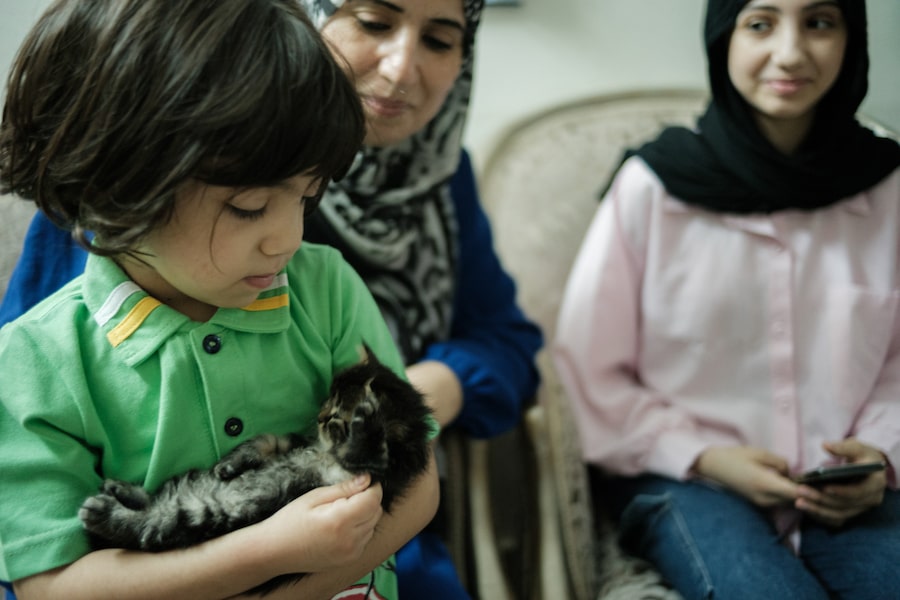
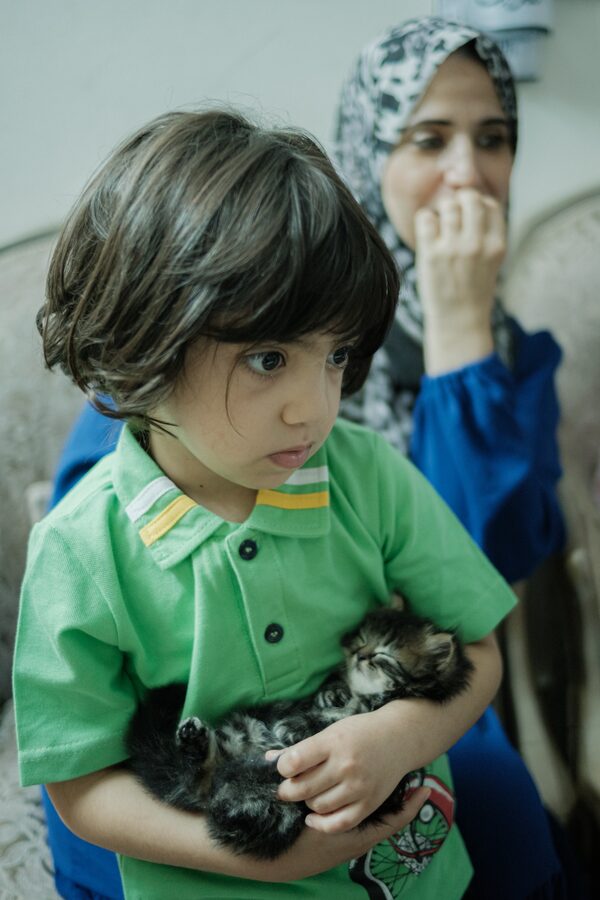
Nama Soliman fled Khan Younis in 2023 with her children. In 2024, they joined her husband Maher in Egypt, where he had gone before the war to study.Aly Hazzaa/The Globe and Mail
The number of Palestinians in Egypt has exploded as the Hamas-Israel war finishes its second year. Even though the Egyptians, for the most part, have welcomed them, the new arrivals are struggling to rebuild their lives in a country that is not their own. They are unsure whether they will ever see their homeland again or whether it will be liveable if they do, given the destruction of the 41-kilometre-long strip.
In a sandy-brown, six-storey walk-up building, 11 members of the Soliman family – Maher and Nama and their nine children, ages 5 to 22 – are stuffed into a three-room apartment. They have one bathroom and a small kitchen and the rent is the equivalent of US$200 a month, or almost exactly what Maher makes as an administrator at a Palestinian TV channel. “We are struggling, but the Egyptians have treated us well,” Nama says. “When I took my children to the doctor, he handed me back my fee when he learned we were from Gaza. He felt so sorry for us.”
The Solimans have formed a co-operative with about 20 other Palestinian families who contribute a few dollars a month to a fund. The pooled money can be used for the bulk buying of food or act as an informal bank. If one family runs low on cash, they can borrow from the fund to make ends meet. Families with fridges store food for those without. Teenage babysitters are shared.
Egypt, mostly Cairo, with a population of 23 million, or more than half of Canada’s, is thought to have absorbed between 100,000 and 200,000 Palestinians from Gaza since the war started on Oct. 7, 2023, when Hamas militants attacked Israel, killing 1,200 people (there is no official figure for the number of Gazans who have entered Egypt since that date). Palestinian health authorities say that more than 66,000 Gazans have been killed in the conflict.

Boulaq Al Dakrour, on the edge of central Cairo, is home to a diverse group of residents, including thousands of Palestinians escaping the war in Gaza.Eric Reguly/The Globe and Mail
Many of the Palestinians who entered Egypt were wounded and granted emergency medical visas. Others were allowed to reunite with family members who were working or going to school in Egypt, or had Egyptian passports. Still others were wealthy enough to afford the US$5,000 exit visas issued by Hala Consulting and Tourism, a private business with widely reported links to the Egyptian government of President Abdel Fattah El-Sisi.
Stay up to date on Gaza and the Israel-Hamas war, including the ground offensive, ceasefire talks and the continuing famine.
What almost all the Gazans have in common is the new realization that Egypt may be their home-away-from-home for some time, perhaps for a few years – or much longer. They fear that Israel, backed by U.S. President Donald Trump, will empty Gaza of Palestinians so the strip can be rebuilt as a “Gaza Riviera,” to use Mr. Trump’s own words. The Trump-inspired peace plan announced this week says no Gazans will be sent abroad against their will, but many Palestinians are wary of this claim.
This realization has filled the community with deep sadness, but also deep anxiety, since few Palestinians have legal residency or working rights in Egypt. They are a people without a country.
“We don’t have a vision of what the future holds for us,” says Ghada Safy, 47, a mother of five who could only get her three youngest children out of Gaza last year and has found work in Cairo as an English-language teacher. “For us, we live day by day. We don’t sleep well, we are always worried. I’m depressed all the time. My life of nearly 50 years was destroyed in one second.”

Mahmoud, of Egyptian-Palestinian background, and his wife Ghada Safy, right of centre. Mahmoud secured Egyptian citizenship for their daughter, who is studying medicine at Mansoura University, while Ghada teaches English to Palestinian refugees in Cairo.Aly Hazzaa/The Globe and Mail
At least they are marooned in a country that will not deny them medical care and tends to look the other way when they find illegal work.
“Egyptians are welcoming,” says Basem Kamel, a member of the Egyptian Senate who is Secretary-General of the small Social Democratic Party. “But Egypt will not give citizenship to Palestinian people. Doing so would help Israel, which wants them out of Gaza. Egypt wants the Palestinians to go back to Gaza.”
The Palestinians in Egypt gravitate to the suburbs of Cairo, where the rents are far lower than those in the centre. Even in the poorest areas, no one goes hungry, thanks to the government-subsidized bakeries, where aish baladi, a whole-wheat flatbread that resembles a slightly inflated pita, can be had for as little as one U.S. cent. Their kids are getting educations since some schools have developed a novel method to accommodate Palestinian children. In the morning, the schools are Egyptian. In the midafternoon, they are turned over to the Palestinians, using Palestinian teachers. Private donations pay electricity bills and teachers’ wages.

Maher Soliman looks at images of bombing in the Gaza Strip.Aly Hazzaa/The Globe and Mail
The Palestinians form communities. The Palestine Hospital in northeast Cairo has a split personality – part medical centre, part cultural centre. The hospital is owned by the Palestine Red Crescent, which was formed by the Fathi Arafat, the brother of Yasser Arafat, who was chairman of the Palestine Liberation Organization until his death in 2004. The hospital, with 93 beds, opened in 1982 and built a cultural centre on the sixth floor, complete with cinema, dance studio and heritage room, where the art of Palestinian weaving, among other crafts, was kept alive.
In recent years, the flow of Palestinians out of Gaza had slowed and the cultural centre languished. The surge in arrivals since the Oct. 7 war has filled the beds but also triggered the revival of the cultural centre. “After the war started, we had to renew the hospital, even the cultural centre,” says physician Nabeel Rushdi Alshawa, 72, the hospital chairman who fled Gaza last year to save his life and that of his family. “I want to go back to Gaza, but there is nothing to go back to. We were not refugees in Gaza. Now we are refugees in Egypt. We are trying to rebuild our lives here, but we are here under pressure.”
While many of the Egyptians in Cairo say they feel no discrimination, there are signs that the Egyptian government is losing patience with the inflow of Gazans. According to the International Organization for Migration, the country has some nine million refugees, asylum seekers, economic migrants and evacuees, mostly from Sudan, Syria, Yemen and Libya. Egypt is not keen for more as housing and infrastructure come under pressure in a poor, overpopulated country. (There are no refugee camps in Egypt.)
Egypt builds its military presence in the Sinai as Israel threatens to empty Gaza of Palestinians
The Gaza-Egypt border at Rafah has all but closed in recent months, with only severe medical cases allowed into Egyptian hospitals. Some of the recovering medical evacuees are no longer allowed to settle wherever they can find inexpensive housing. A recent investigation by Jewish Currents magazine said that 1,500 medical evacuees from Gaza were sent to seven-storey buildings in the “Tadamoun” complex on the outskirts of Obour City, northeast of Cairo.
The report said that Tadamoun was first built to help absorb Cairo’s burgeoning population but has quietly emerged as a sort of hidden, gated community for Gazans on the mend. The tenants, who pay no rent, must sign ledgers to leave or enter their buildings. Ditto visitors. They have no working or residency rights and are effectively cut off from society. The Globe and Mail drove through Tadamoun in late September and found the streets eerily empty, though the cluttered balconies suggested that most of the apartments were occupied.
The Palestinians in Cairo are not only struggling to find work to feed themselves, they are dealing with the aftermath of journeys from Gaza that were filled with death and destruction, leaving some of them in psychological torment.

Palestinians flee from parts of Khan Younis in July, 2024, following an evacuation order by the Israeli army.Abdel Kareem Hana/The Associated Press
In November, 2023, Israel dropped leaflets over the Solimans’ neighbourhood in the city of Khan Younis, in southern Gaza, instructing them to evacuate. “I got scared, started to pack clothing and food and my sister told me to write the names of the children on their arms in case they got killed, so they could be identified,” Nama said.
They fled. Their house was severely damaged that December, then obliterated six months later. In Rafah, they were stuffed into a relative’s house with more than 90 other people and waited five months to enter Egypt to join Maher, who had gone to Egypt before the war to study business administration. “My mother, two sisters and one brother are still in Gaza and they are very, very hungry,” Nama says. “I am sick with worry for them.” Dr. Alshawa, of the Palestine Hospital, said he “saw dogs eating the bodies of the dead” after his house was bombed in October, 2023.
Ms. Safy, the English teacher, lost her nephew shortly after the war started. “I have lost friends, family, neighbours, students,” she says. “I am exhausted and work endlessly to avoid thinking of war. Yes, we are safe in Egypt, but it is not my homeland and we have no stability here.”
Editor’s note: A previous version of this article incorrectly stated the Palestine Hospital is in northwest Cairo. It is in northeast Cairo.