
Syrians sit outside the building of the Iranian embassy which was ransacked after anti-government fighters took Damascus the previous day, with a portrait of Iran's slain Revolutionary Guards commander Qasem Soleimani.LOUAI BESHARA/AFP/Getty Images
It’s rare to see nervousness in a state-run propaganda outlet, but Monday’s edition of the Tehran Times gave away the anxiety that must be rippling through Iran’s ruling class. “Assad gone, Syria in twilight,” read the main headline across the top of both the print and online editions of the long-time English-language voice of the Islamic Republic.
“In twilight” would be a fitting description for Iran’s treasured aim of being a military and diplomatic force to be reckoned with across the Middle East. The fall of Bashar al-Assad’s regime over the weekend completes a year of utter defeat for Ayatollah Ali Khamenei’s policy of “forward defence” – confronting Iran’s enemies far beyond its own borders via a network of allies and proxy militias around the region.
Suddenly, Iran looks weaker than at any time since the 2003 U.S. invasion of Iraq, which Iran exploited to make itself into a regional power.
Fourteen months ago, the network of pro-Iranian forces known as the “axis of resistance” was formidable. Ayatollah Khamenei’s Shia Muslim theocracy effectively controlled politics in an arc stretching from Tehran to the Mediterranean Sea, via predominantly Shia Iraq, through a Syria dominated by Mr. al-Assad’s regime – many of the key figures in which were followers of the Alawite sect of Shiism – to Lebanon, where the Shia militia Hezbollah dominated the country militarily and politically. Iran was also a major player in the Gaza Strip, where it was the main backer of Hamas, and Yemen, where it stood behind the Houthi militia, which controls half the country.
All that began to unravel with the Oct. 7, 2023, surprise attack that Hamas launched on Israel. The attack, which Iran claimed to have no foreknowledge of, set off a whirlwind of war that has seen Hamas battered in Gaza and Hezbollah badly weakened after joining the conflict in an effort to aid Hamas.
The extent of the damage done to Hezbollah – which saw its long-time leader, Hassan Nasrallah, assassinated in an Israeli air strike, and thousands of fighters lost during a seven-week Israeli invasion of southern Lebanon – was on display over the past two weeks in Syria. Whereas Hezbollah, along with Iranian military advisers dispatched to the country, played a key role in preserving Mr. al-Assad’s wobbly regime early in Syria’s 13-year civil war, they proved powerless to help as Syria’s rebels launched a fast-moving offensive on Nov. 27 that reached Damascus on Sunday, forcing Mr. al-Assad and his family to flee.
Despite its fragility, Mr. al-Assad’s regime rivalled Hezbollah as Iran’s most important asset in the region. Having an ally in control of the Damascus airport allowed Iran to smuggle weapons, including tens of thousands of missiles and rockets, to southern Lebanon. The Assad regime also played a key role in the lucrative regional drug trade – an important source of cash for the entire axis – as well as in smuggling weapons to Palestinian fighters in the West Bank.
Russia, anxious to keep its Cold War-era naval base in Syria, entered the fray in 2015, and within a year the front lines of the civil war had stabilized. Mr. al-Assad’s forces were unable to completely vanquish the rebels, who held on to the northwestern Idlib province near the border with Turkey, the main backer of the predominantly Sunni Muslim rebels. But the idea of the insurgents toppling the regime seemed even more remote.
Who is Abu Mohammed al-Golani, the leader of the insurgency that toppled the Syrian regime?
From 2016 onward, Tehran, Moscow and Ankara managed the conflict from afar, while the rebels – particularly Hayat Tahrir al-Shams, a former offshoot of al-Qaeda – built up their military strength, while at the same time gaining experience as the de facto government of Idlib.
The entente between Iran, Russia and Turkey appeared to collapse with the start of the rebel offensive on Nov. 27, the same day a battered Hezbollah agreed to a ceasefire with Israel.
Four days later, Ayatollah Khamenei made plain his fury over the offensive with a social-media post accusing the Syrian rebels of distracting the Muslim world’s focus from the Israel-Palestinian conflict – there’s still no ceasefire in Gaza – by restarting the war for Syria. Emphasizing that his anger was aimed at Turkish President Recep Tayyip Erdogan, Ayatollah Khamenei posted his message on X in both English and Turkish.
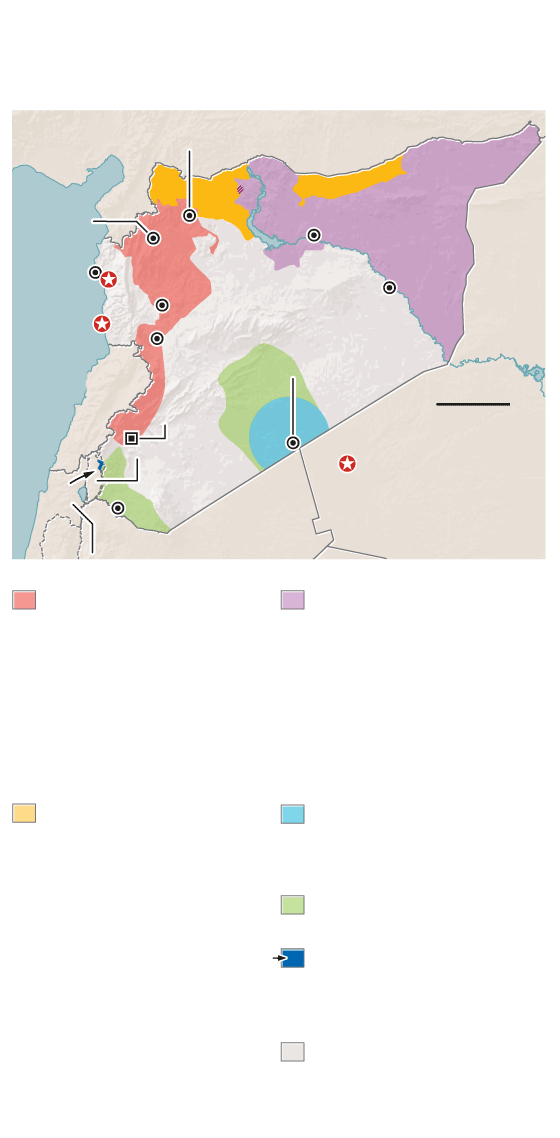
Key Syrian rebel groups
Syrian rebels who ousted Bashar al-Assad and seized
Damascus include fighters from different factions, while other
groups hold territory elsewhere in the country
TURKEY
Aleppo
Idlib
Raqqa
Deir
al-Zour
Latakia
Hama
IRAQ
SYRIA
Tartus
Homs
Al-Tanf
LEBANON
100km
Damascus
Golan
Heights
Russian bases
Future of Russia’s
military presence in
Syria in doubt
Daraa
ISRAEL
JORDAN
HAYAT TAHRIR AL-SHAM (HTS)
Main rebel group behind Assad’s
ouster, first emerged as al-Qaeda
affiliate at start of Syria’s 2011
uprising, but broke ranks with
jihadist group in 2016. Despite
trying to shed extremist roots,
the U.S. and others still consider
HTS a terrorist group.
SYRIAN DEMOCRATIC FORCES
(SDF) Alliance of Kurdish-led militias,
backed by U.S. Formed to hold back
the advance of the Islamic State
in Syria in 2014, it now controls some
of the country’s biggest oil fields.
Turkey regards SDF as a terrorist
group linked to Ankara’s proscribed
PKK movement.
SYRIAN NATIONAL ARMY (SNA)
Umbrella alliance of Turkish-backed
militias believed to have given tacit
approval to HTS’ recent offensive.
Turkey first sent troops into Syria
from 2016 to push Kurdish
militants and Islamic State
away from the border .
AL-TANF DECONFLICTION ZONE
55km area around U.S. military
base in Al-Tanf
UNIDENTIFIED OPPOSITION GROUPS
ISRAEL DEFENSE FORCES (IDF)
Entered buffer zone in Golan Heights
for “defensive purposes” on Dec. 8
LOST SYRIAN REGIME TERRITORY
Source: graphic news; reuters; BBC; Institute for the Study of War
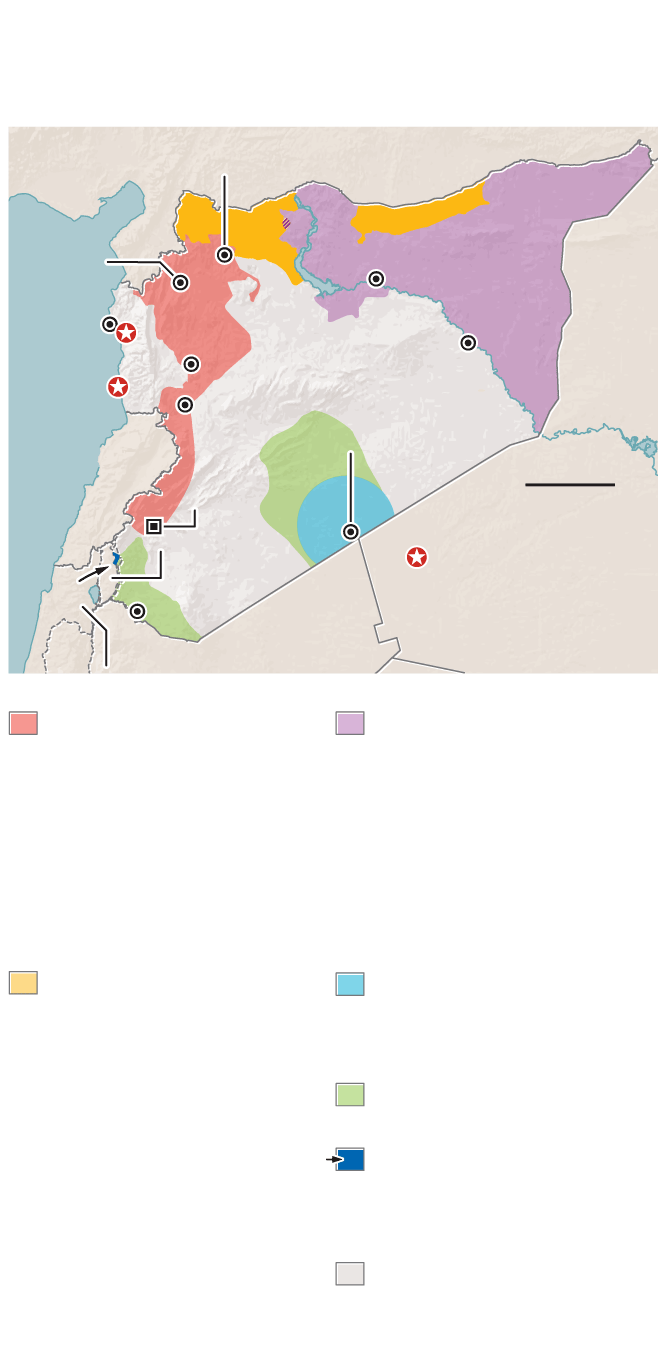
Key Syrian rebel groups
Syrian rebels who ousted Bashar al-Assad and seized
Damascus include fighters from different factions, while other
groups hold territory elsewhere in the country
TURKEY
Aleppo
Idlib
Raqqa
Deir
al-Zour
Latakia
Hama
IRAQ
SYRIA
Tartus
Homs
Al-Tanf
LEBANON
100km
Damascus
Golan
Heights
Russian bases
Future of Russia’s
military presence in
Syria in doubt
Daraa
ISRAEL
JORDAN
HAYAT TAHRIR AL-SHAM (HTS)
Main rebel group behind Assad’s
ouster, first emerged as al-Qaeda
affiliate at start of Syria’s 2011
uprising, but broke ranks with
jihadist group in 2016. Despite
trying to shed extremist roots,
the U.S. and others still consider
HTS a terrorist group.
SYRIAN DEMOCRATIC FORCES
(SDF) Alliance of Kurdish-led militias,
backed by U.S. Formed to hold back
the advance of the Islamic State
in Syria in 2014, it now controls some
of the country’s biggest oil fields.
Turkey regards SDF as a terrorist
group linked to Ankara’s proscribed
PKK movement.
AL-TANF DECONFLICTION ZONE
SYRIAN NATIONAL ARMY (SNA)
Umbrella alliance of Turkish-backed
militias believed to have given tacit
approval to HTS’ recent offensive.
Turkey first sent troops into Syria
from 2016 to push Kurdish
militants and Islamic State
away from the border .
55km area around U.S. military
base in Al-Tanf
UNIDENTIFIED OPPOSITION GROUPS
ISRAEL DEFENSE FORCES (IDF)
Entered buffer zone in Golan Heights
for “defensive purposes” on Dec. 8
LOST SYRIAN REGIME TERRITORY
Source: graphic news; reuters; BBC; Institute for the Study of War
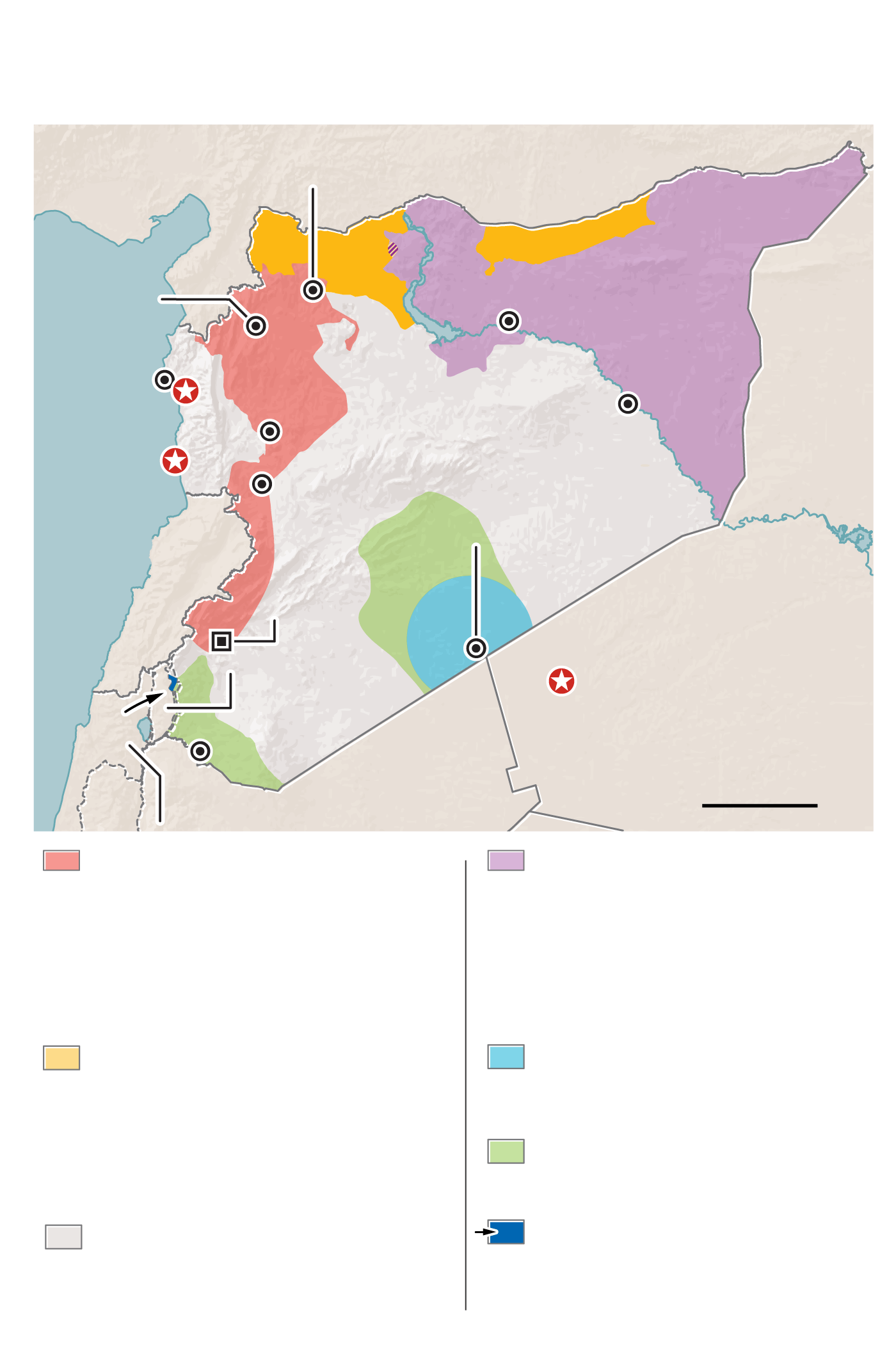
Key Syrian rebel groups
Syrian rebels who ousted Bashar al-Assad and seized Damascus include fighters
from different factions, while other groups hold territory elsewhere in the country
TURKEY
Aleppo
Idlib
Raqqa
Deir
al-Zour
Latakia
Hama
IRAQ
SYRIA
Tartus
Homs
Al-Tanf
LEBANON
Damascus
Golan
Heights
Russian bases
Future of Russia’s military
presence in Syria in doubt
Daraa
100km
ISRAEL
JORDAN
HAYAT TAHRIR AL-SHAM (HTS)
Main rebel group behind Assad’s ouster, first
emerged as al-Qaeda affiliate at start of Syria’s
2011 uprising, but broke ranks with jihadist group
in 2016. Despite trying to shed extremist roots,
the U.S. and others still consider HTS a terrorist
group.
SYRIAN DEMOCRATIC FORCES (SDF)
Alliance of Kurdish-led militias, backed by U.S.
Formed to hold back the advance of the Islamic
State in Syria in 2014, it now controls some
of the country’s biggest oil fields. Turkey regards
SDF as a terrorist group linked to Ankara’s
proscribed PKK movement.
AL-TANF DECONFLICTION ZONE
SYRIAN NATIONAL ARMY (SNA)
Umbrella alliance of Turkish-backed militias
believed to have given tacitapproval to HTS’
recent offensive. Turkey first sent troops into
Syria from 2016 to push Kurdish militants and
Islamic State away from the border .
55km area around U.S. military base in Al-Tanf
UNIDENTIFIED OPPOSITION GROUPS
ISRAEL DEFENSE FORCES (IDF)
Entered buffer zone in Golan Heights
for “defensive purposes” on Dec. 8
LOST SYRIAN REGIME TERRITORY
Source: graphic news; reuters; BBC; Institute for the Study of War
In contrast with the mournful tone taken by the Tehran Times, Monday’s edition of Turkey’s Daily Sabah newspaper – which is seen as a propaganda arm for Mr. Erdogan’s Justice and Development Party – hailed the fall of Mr. al-Assad as marking the start of a “new era” for Syria, one that Foreign Minister Hakan Fidan said Turkey would support. Mr. Erdogan’s government is particularly anxious to see the return of the three million Syrian refugees Turkey has been hosting since early in the civil war.
Russia was also caught off guard by the rebel offensive, and too distracted by its war in Ukraine to rush again to Mr. al-Assad’s defence. But Moscow was quick to try to make the best of the new situation, even as it offered political asylum to Mr. al-Assad and his family.
Opinion: When Obama backed down on his ‘red line’ in Syria, it set the stage for today’s Mideast
The rebels that have taken power in Syria have yet to try to approach Russia’s naval base in the port city of Tartus, nor its air base further up the Mediterranean coast at Khmeimim, indicating that some understanding may have been reached to let the Russians remain. “The opposition’s armed forces did not and have no plans to penetrate the Russian military bases, which continue to operate normally,” the Kremlin-run TASS news wire reported on Monday.
Hours after Mr. al-Assad arrived in Moscow, the Syrian embassy in the Russian capital took down the Assad-era flag hanging outside the building and replaced it with the green-white-and-black banner of the Syrian uprising.
In addition to the losses suffered by Hamas and Hezbollah, and now the defeat of a key ally in Mr. al-Assad, Iran is also still reeling from the death of President Ebrahim Raisi – heir apparent to the 85-year-old ayatollah – in a May helicopter accident. His successor, Masoud Pezeshkian, who is seen as a moderate interested in rebuilding ties with the West, has struggled to make an impact in a time of war.
Iran is also bracing for the return of U.S. president-elect Donald Trump to the White House. During his initial term, Mr. Trump tore up a 2015 deal under which the Islamic Republic agreed to abandon its pursuit of a nuclear program in exchange for the lifting of some decades-old sanctions on its economy. Mr. Trump also ordered the 2020 assassination of Qassem Soleimani, commander of the elite Islamic Revolutionary Guards Corps.
Mr. Trump has vowed to resume his policy of applying “maximum pressure” on Tehran, and his nominee for secretary of state, Marco Rubio, is fiercely pro-Israel and loudly critical of Iran. In November, U.S. prosecutors said Mr. Soleimani’s old unit, the IRGC, had hired an assassin, Farhad Shakeri, and assigned him to kill Mr. Trump.
Mr. Shakeri told investigators that the plot (which is unrelated to the assassination attempt carried out by a U.S. citizen in July, when Mr. Trump’s ear was grazed by a bullet) never got past the discussion phase. But no U.S. president in memory has ever come to office with such a specific reason to hold a grudge against a foreign power.
Ayatollah Khamenei is due to give a speech on Wednesday. While the world will be listening for his reaction to events in Syria, Iranians will likely want to hear if he has any plan to lead Iran out of the perilous corner his strategy of “forward defence” has led the country into.