

On a recent Tuesday morning, Johanna Rivera was working at La Perlita, her family’s Ecuadorean food store in northeast Minneapolis, when a man came in to pick up provisions for a goodbye party. One of his relatives had decided to return to Ecuador amid Donald Trump’s immigration crackdown, he told her.
That sparked a conversation about the roving squads of federal agents who have flooded into Minnesota since December in the largest single operation of the U.S. President’s mass roundup and deportation program.
“I told him that we could deliver to his house so he wouldn’t have to go out. It’s dangerous,” Ms. Rivera, 29, recounted in an interview.
Mere moments after the man left the shop and got into his car, federal officers surrounded it.
Video recorded by observers tracking the agents shows what happened next. While the officers’ two unmarked black SUVs blocked the parking lot, one agent hammered on the window of the Ecuadorean man’s car with what appears to be a glass-breaker.
The agents, wearing tactical vests over plain clothes and with their faces covered by masks, handcuffed the man and led him to one of their vehicles. They discovered three more occupants in the car: a woman who identified herself as the man’s wife, their toddler daughter, and another man whom the woman said is her cousin. The officers took the cousin into custody. “Leave her,” one agent said of the woman. “She’s got the baby.”
The woman got out of the car, carrying the toddler – dressed in a pink winter coat and white tuque, holding an ice-cream cone – and followed her husband to the officers’ SUV. “I’m going with my husband,” she cried, falling to her knees in front of an agent. “Sir, why? Why?”
Then, the woman’s cousin, his hands still cuffed behind his back, bolted from the back of one of the officers’ vehicles. He made it across the street before slipping on a snowbank and being grabbed by two agents chasing him.
In the end, the officers left with the husband and the cousin, while the woman and her toddler were taken in by La Perlita until her family could come to get her.
“The immigration authorities are doing a very bad job right now, because they should actually be catching criminals,” Ms. Rivera said. “Not innocent people who have come here to fight for a better, more stable life for their families.”
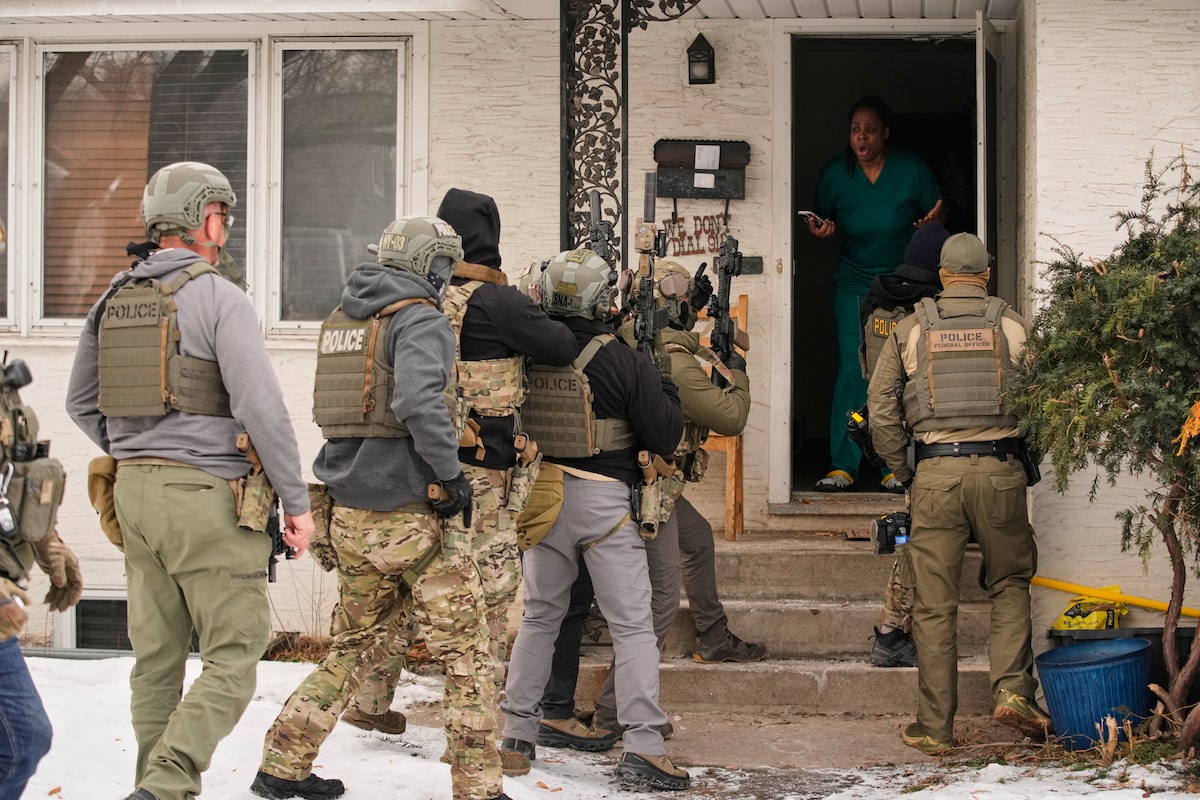


This scene was emblematic of the thousands of immigration arrests made in Operation Metro Surge, as 3,000 federal agents have descended on the state.
Officers from a wide range of agencies – Immigration and Customs Enforcement (ICE) most prominently, but also Border Patrol, the Bureau of Prisons and others – usually with faces covered and no visible identification, trawl the streets in unmarked vehicles to conduct immigration raids and arrests that often look like kidnappings.
Their tactics have included ramming and smashing up cars, racially profiling as they search for people to arrest, and pushing residents to inform on their neighbours. Agents have also clamped down on protests, frequently opening fire with pepper balls, deploying tear gas and arresting demonstrators.
After federal officers fatally shot U.S. citizens Renee Nicole Macklin Good and Alex Pretti last month, the White House promised to wind down the operation.
But it is pressing ahead with its plan to deport all of the country’s undocumented immigrants, as well as many who entered the country with legal status. And there is no guarantee Mr. Trump won’t soon target another city or state.
ICE, U.S. Customs and Border Protection and their parent organization, the Department of Homeland Security, did not respond to requests for comment on this story.

Alex Pretti, 37, was an ICU nurse that federal agents shot as he helped someone at an anti-ICE protest.Octavio JONES/AFP via Getty Images
Clayton Kelly, a mechanic in his 20s, said he did nothing more than verbally criticize federal agents before they violently arrested him. On the morning of Saturday, Jan. 24, shortly after Mr. Pretti was shot in South Minneapolis, Mr. Kelly went to the area with his wife.
“Your families are disappointed in you,” Mr. Kelly told The Globe and Mail he said to officers. “You’re a disgrace, and you should quit.”
Mr. Kelly had begun walking away when he heard one agent say, “That’s him, get him.” Officers body-slammed Mr. Kelly into the window of a tattoo parlour, tackled him to the ground and put him in a headlock, he said. Several agents held him down, kneeing him in the spine and smothering him. “I was trying to yell out that I couldn’t breathe, and they were telling me to shut up,” he recalled.
As he lay pinned, Mr. Kelly said, an officer put the nozzle of a can of pepper spray behind his glasses and shot it directly into his left eye. He was bundled into a vehicle and driven to the Whipple Federal Building near the airport, which agents are using as a detention centre.


Many of those detained in Minneapolis end up at the Whipple complex, the nerve centre of Operation Metro Surge.Scott Olson/Getty Images; Roberto Schmidt/AFP via Getty Images
For the next 10 hours, he was held in a roughly 12-foot-by-10-foot cell with a concrete bench and no sink or toilet. This section of the building was reserved for U.S. citizens, Mr. Kelly said, and he was eventually joined by several others. He said officers never identified themselves to him or read him his Miranda rights.
In the hallway outside the cell, Mr. Kelly could hear officers searching people’s belongings and taking their mobile phones. At one point, an agent had Mr. Kelly confirm which phone was his. When he was released without charges that night, Mr. Kelly said officers refused to give him back the device and said they planned to go through it.
Ten days before his arrest, Mr. Kelly had witnessed part of a police chase that ended with an ICE agent shooting Julio Cesar Sosa-Celis, a Venezuelan migrant, in the leg. Mr. Kelly recorded the aftermath and described what he saw to a reporter. His images of the scene are on the phone that he said agents confiscated.

Activists across Minneapolis continue to risk arrest for following ICE vehicles, as these people were doing.Ryan Murphy/The Associated Press
Brandon Sigüenza was arrested while observing federal agents in South Minneapolis on Sunday, Jan. 11. The 32-year-old special education teacher is one of thousands of people in the city who have followed officers while honking car horns and blowing whistles to alert neighbours to the agents’ presence.
That day, Mr. Sigüenza and a friend, Patty O’Keefe, were in her car tailing agents in unmarked vehicles down a residential street.
The first time officers stopped them, an ICE agent doused the car’s air intake with pepper spray, Mr. Sigüenza said. The second time, officers smashed the windows with their batons – even though the doors were unlocked, and Mr. Sigüenza put his hands up to show he wasn’t resisting arrest – and hauled them out.
At Whipple, Mr. Sigüenza, like Mr. Kelly, was in a cell designated for U.S. citizens. The sounds of people detained elsewhere in the building were audible. “When I closed my eyes, I could hear screaming every time. Screaming, crying, begging,” he said.
He saw cells holding 15 people – too many for anyone to lie down – staring at the walls and ceiling. The bathrooms had two-way glass with just a knee-high wall for privacy in front of the toilet. In one of these rooms, he said, a woman wearing a hijab was crying while ICE officers outside watched through the glass and laughed.
Three times that day, agents interrogated Mr. Sigüenza, the son of a Mexican immigrant father. In the final interrogation, one agent asked him for the names of protest organizers and pressed him for information on any undocumented people he knew, he said. The officer offered him money and to help if he wanted to get any family members into the United States.
Mr. Sigüenza said he turned down the officer’s requests. He and Ms. O’Keefe were released without charge after eight hours in detention.


East Africans in Minneapolis have been wary of racial profiling for months, hence these warning signs at the Karmel Mall and the slow business at Somali-owned shops within.Tim Evans/Reuters
In court documents, ICE has openly argued in favour of racial profiling, and its use of the practice is readily apparent to non-white Minnesotans. As the agency struggles to fulfill a White House edict to deport one million people every year, officers have cast a wide net.
Samrawit Yadetie, a 51-year-old Ethiopian immigrant, said she was stopped by ICE agents while shopping at Macy’s in the Mall of America in early January. They asked her whether she was a U.S. citizen and whether she was “legal.” Ms. Yadetie said she replied: “Do I have to be a U.S. citizen to live in America?” Ultimately, she had to show her U.S. passport for them to let her go.
She was also harassed at her workplace, the front desk of the Embassy Suites near the Minneapolis airport, by ICE agents staying at the hotel, she said. The officers would ask her and other hotel employees: “How did you get here? Where is your accent from?” she recalled. It got so bad that she quit her job.
Ms. Yadetie, who came to the U.S. as a refugee in the early 1990s after her family was imprisoned in Ethiopia for opposing the government, said the experience reminds her of the authoritarian regime that she fled.
“We gave up our original citizenship to be Americans. We love America. But these days, they’re trying to change America into a third-world country,” she said as she marched with tens of thousands in the streets of downtown Minneapolis last Friday.
Yubi Hassan, 24, who came from Somalia as a refugee, said he was stopped by agents outside a grocery store in Hopkins, a Minneapolis suburb, while making a delivery for the tea company he owns. Like Ms. Yadetie, he had to show his U.S. passport for them to let him go.
“Everybody’s scared. My mum calls me every four hours to check in,” he said.

Groceries delivered by volunteers help stay-at-home immigrant households to cope when they are too afraid to go out themselves.Evelyn Hockstein/Reuters
In many immigrant families, parents aren’t going to work and children are staying home from school to avoid getting grabbed off the street.
At La Perlita, the owners and staff are working to help those who are stuck in their houses.
The store offers free grocery deliveries, doing about 15 to 20 a day. One Sunday last month, they held a fundraiser at which people could purchase boxes of food for families that can’t work. After assembling more than 250 such boxes, the store is planning another such event this Saturday.
“It’s such a difficult story, especially seeing how they are separating families now,” said Tania Sigua, 26, a clerk at the store and immigrant from Ecuador. “I’ve lived six years in this country, and I’ve never seen anything as ugly as what’s happening now.”

Stephen Lam/San Francisco Chronicle via AP
The battle beyond Minneapolis: More from The Globe and Mail
The Decibel podcast
Minnesota’s fight against ICE goes beyond street protests; the state is suing the federal government, alleging the President has gone too far. Reporter Joe Friesen spoke with The Decibel about how the standoff could evolve. Subscribe for more episodes.
From our correspondents
In Texas’s Rio Grande Valley, Trump’s immigration crackdown reshapes daily life
In Berkeley, America’s first sanctuary city, anti-ICE sentiment is revitalizing the movement
Italy plays down role of ICE agents at Olympics after public outcry