
Bill Lomax came back to Canada at a turning point.
First Nations, Métis and Inuit are making meaningful strides within the national economy, and they’re clamouring for financial services and expertise to help improve conditions and bolster independence for their communities. First Nations Bank of Canada (FNBC) was a pioneer in the space, having helped Indigenous peoples gain their financial footing for nearly three decades. But in 2023, as this specialized financial segment was taking off, FNBC was struggling to make a name for itself outside its home base of Saskatchewan.
It was time for change. The bank’s founding CEO, Keith Martell, was retiring, and the board wanted to catapult FNBC onto the national stage. It went looking for a new leader who could build on its unique position and boost its profile as opportunities grew. It gave its executive search firm a wish list that included a rare combination of hard-core financial expertise and a deep understanding of the culture. It pinpointed its top candidate in the United States.
A member of the Gitxsan Nation in northern British Columbia with years of experience at Wall Street investment houses Smith Barney, Merrill Lynch and Goldman Sachs, Lomax understood the assignment. “When I first started, we would get people all the time saying, ‘Oh, are you guys new? We haven’t heard of you before,’” says Lomax. “Some people would call us the best-kept secret, and when you’re trying to run a business like banking, you don’t want to be the best-kept secret. You want to be well known.”
Lomax was immersed in the market, having managed numerous large investment portfolios for U.S. tribal nations—which, he reasoned, have many similarities to Canada’s First Nations. Lomax had also run across members of the FNBC board throughout his career. “So I thought I could help a lot with the marketing side and the sales side of things, and help build up the bank.”
Now, as CEO, Lomax is focused on expanding the Saskatoon-based institution into more locations to provide retail banking to its Indigenous clients, and fast-tracking growth in its commercial lending and trust businesses. His first mission: Get the name out there. He designed a co-ordinated sales, marketing and media blitz that included spending his first 18 months on the speaking circuit and telling the FNBC story to reporters. He also hired a chief marketing officer and another marketing staffer, who both report directly to him.
His efforts have generated results, notably a couple of multimillion-dollar partnerships to provide a suite of new financing options to Nations and their entrepreneurs, and a big expansion of FNBC’s trust arm—all aimed at lifting more Indigenous people into Canada’s broader economy.
“One of our taglines is that we do the economic part of reconciliation, the financial part of nation-building. And that is a critical part. It’s not the only part; it’s one piece of the puzzle. But if you don’t have finances, you don’t have money. You can’t pay for language revitalization. You can’t pay for drug and alcohol programs. You can’t pay for scholarships. You can’t provide jobs that keep people in the community,” says Lomax during an interview in Vancouver, where the 57-year-old and his family are now based. “Those things all cost money, and without having an understanding of finance and investments, you’re not going to do any of that stuff.”
That would leave First Nations, Métis and Inuit communities reliant on government, and for generations that record has been dismal, contributing to long-standing inequality, poverty and social ills.
FNBC was an early entrant in what’s now a fast-growing ecosystem of financial institutions, venture capital firms and asset managers that offer expertise and sophistication to Indigenous peoples as they confront energy and mining proposals on their territories, establish businesses, beef up local infrastructure and acquire equity stakes in companies.

Now, Canada’s big banks see the opportunity, too, and they’re competing for the business as capital flows into Indigenous communities across the country from legal and treaty settlements, commercial deals and equity stakes in large industrial projects. All the institutions have senior bankers and growing teams devoted to the client base.
First Nations and their development corporations have been busy buying interests in large-scale infrastructure like pipelines, power networks and liquefied natural gas projects, and are starting to take advantage of a new $10-billion federal loan guarantee program geared to Indigenous investors.
These big-ticket buys are important, Lomax says, but it’s not FNBC’s market. Instead, the bank targets what he calls “the missing middle”—offering financing to help entrepreneurs buy businesses or assist communities in building community halls, water treatment plants and housing. It also offers lending services to retail clients.
All that comes with challenges. When the bank was established, Indigenous peoples found it difficult to get loans; there was little interest from established banks to provide them, Lomax says. The risk calculation differs from what major chartered banks employ for non-Indigenous Canadians, because people who live on reserve don’t own their own land and houses.
This was one of many restrictions placed on Indigenous people by the long-lamented Indian Act. So FNBC looks at other metrics, including own-source or government revenues, when running the numbers on loans.
“Having access to capital was always one of the hurdles that First Nations people had to get through, because land is not held in fee-simple title on reserves, so they didn’t have a lot of access to collateral. You had to find new initiatives and new means to get around that hurdle,” says Perry Bellegarde, FNBC’s chair and former Grand Chief of the Assembly of First Nations. “Our team at the bank and Bill know that you have to work around the Indian Act. You have to look at the First Nations Land Management Act. You have to look at all these pieces of legislation in order to make a deal work.”
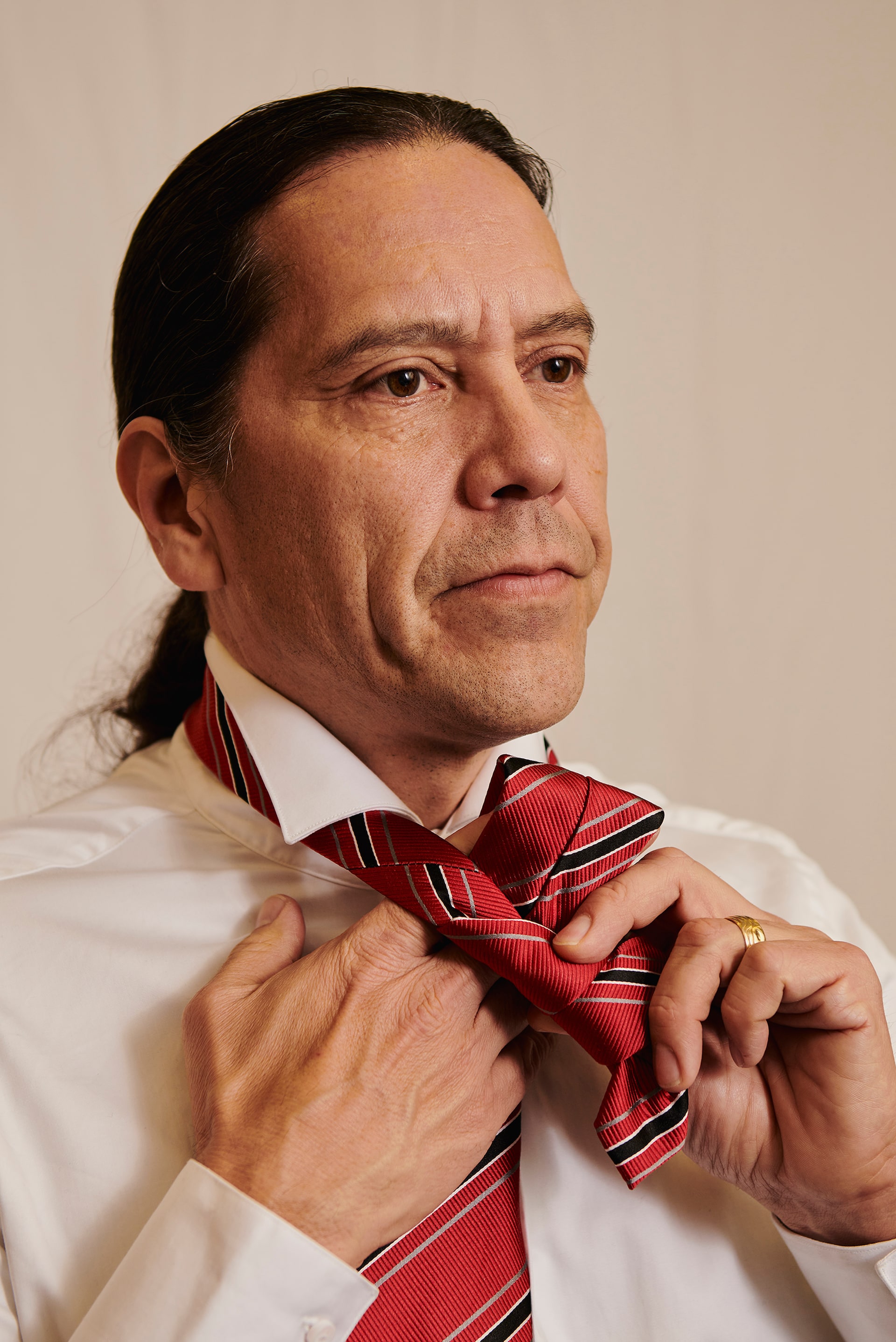
Despite Lomax’s Wall Street pedigree, and two decades working in New York, Los Angeles, San Francisco and Seattle, he’s far from a buttoned-down, high-finance exec from central casting. He maintains strong links to his own Indigenous roots, wearing his long hair tied back and occasionally sporting a necktie adorned with traditional West Coast iconography.
He speaks thoughtfully and frankly of his varied experiences in the financial big leagues and how they play into the sense of purpose he harbours in contributing to the financial success of First Nations. When he was first offered the CEO position, he demurred, thinking it wasn’t the right fit—he’d built up a solid franchise within Goldman Sachs, where he and his team managed US$2.2 billion in assets on behalf of U.S. tribal nations. He didn’t know much about the bank, which then had 130 employees. But the more he learned about the operation, its “quiet success” under Martell and its potential, the more enticing it became. “I thought, well, this is a natural extension of what I’ve been doing.”
Lomax spent his childhood in Terrace, B.C., just outside the lands of the Gitxsan. The First Nation has a large traditional territory of 33,000 square kilometres, but it’s not considered as wealthy as many that have, as Lomax puts it, “won the geographic lottery”—those with deepwater port sites or other natural economic advantages. A matrilineal society, the Gitxsan have hereditary chiefs who work in co-operation with the elected chief system set up by the federal government.
His mother worked at BC Tel and owned a café where, starting at age 7, Lomax washed dishes. His father owned a corner store and rented out mobile homes, which gave Lomax an early understanding of how money was made. At 15, he left Terrace and moved in with his sisters in Vancouver, taking on restaurant jobs as he got older and went to university. There, he studied economics and Japanese (in preparation for a move to Japan that didn’t happen) before entering law school.
He kept close connections with his northern community, however, especially with Ray Jones, a hereditary chief and residential school survivor whom Lomax considers an uncle. Jones was influential in Lomax’s teenage years and, at age 80, still regularly offers counsel. He made a deep impression on Lomax by venturing into activities others in the community weren’t taking on, like running a radio station and listening to jazz. He also instilled a sense of curiosity, especially in other people.
“I didn’t know what Wall Street was, and I didn’t have an understanding of banking beyond my savings accounts,” says Lomax. “But Ray helped me realize that there was much more out in the world and that I should dream big. We talked a lot about education, and he inspired me to focus on working with the Indigenous community.”
“If you don’t have finances, you don’t have money. You can’t pay for language revitalization. You can’t pay for drug and alcohol programs. You can’t pay for scholarships. You can’t provide jobs that keep people in the community.”
– Bill Lomax, CEO of the First Nations Bank of Canada
Lomax still seeks Jones’s guidance on traditions and culture, including for his sons, who are learning the language in preparation for joining his house, a grouping that occupies a sub-territory within Gitxsan lands.
For his part, Jones says Lomax exemplifies the wide impact Indigenous leaders can have when they venture beyond their communities. “Aboriginal people work just as hard as main society, and they get far from their hard work and support from families,” he says.
After law school, Lomax signed on with the federal government and B.C. Treaty Commission, with a goal to help Indigenous people get the rights and compensation owed to them in long-fought land-claim settlements. He quickly discovered there were already plenty of lawyers doing that. The missing piece was the financial know-how needed to help communities invest that money to create economic opportunities. “I just thought, well, the worst thing would be if they got these large settlements, and then they just gave them all out to their community members or lost them in inappropriate investments,” he says. “So I thought I could probably be a decent player.”
Lomax worked hard to be accepted into the MBA program at Columbia University in New York, taking a full week off work to write his entrance application. After graduation, he landed roles at Smith Barney and then Merrill Lynch. At each firm, his superiors gave him a year and a half to prove himself as he went about seeking to manage the savings of U.S. tribal nations, many of which were seeing gambling revenues soar. It was a tough sell, he says, despite the growing sums flowing into nations that operated casinos near large cities.
“All the banks were sort of interested, but it was more like, let’s roll the dice on this. Let’s see what happens,” Lomax says. As he did that, he contacted several Canadian banks to gauge their interest in establishing a similar business in his home country. Their reaction? “Crickets. Never heard from them, whereas a number of the banks were certainly interested down in the States.”
When the financial crisis consumed Wall Street in 2008, Lomax became senior portfolio manager for the Yuhaaviatam of San Manuel Nation in California, one of the most financially successful tribes in the U.S. Two years later, he moved into institutional sales for Capital Dynamics, a Swiss-based investment fund.
He took a big step in the U.S. finance world in 2015, when he joined Goldman. Lomax was impressed by the culture at the Wall Street firm, where such notables as Prime Minister Mark Carney, former Italian PM and European Central Bank president Mario Draghi, and former U.S. Securities and Exchange Commission chair Gary Gensler spent parts of their careers. “It was definitely a step up—just to see the calibre of folks and collaboration that they would do to win business.”
At Goldman, he worked closely with vice-president Izu Akamiro, who was the more senior exec when they started on the file together. But Akamiro, who has built up that business further since Lomax moved on, credits his former associate with impressing upon him the values necessary to work with this population—realizing that financial sovereignty is a part of sovereignty writ large. “One thing he always said to me was, ‘Understand that the client is the hero of their story, and we’re here to help them achieve goals that will last, in many ways, seven generations down the line,’” Akamiro says. “And that’s one thing I really carry with me.”
By 2023, Lomax was based in Seattle and getting used to the idea of staying put in the U.S. with his family, perhaps until retirement. Plus, he says he felt supported by Goldman, even if future promotions weren’t assured. That’s when he fielded the call from FNBC.
As a chartered bank, FNBC is at once typical and unique. Established in 1996 by the Saskatchewan Indian Equity Foundation and Federation of Saskatchewan Indian Nations (now known as the Saskatchewan Indigenous Enterprise Foundation and Federation of Sovereign Indigenous Nations), along with TD Bank, its initial aim was to provide the financial services that Saskatchewan chiefs lamented weren’t available to them.
It’s now 88% Indigenous-owned and remains busy attracting First Nations into its roster of investors—in August, it raised $9 million from five Indigenous-led organizations and communities from the Yukon, B.C., Alberta and Saskatchewan. That same month, B.C.’s Lheidli T’enneh First Nation and Tano T’enneh Enterprises invested $10 million to gain an 8.6% equity stake. The investments help position FNBC to meet its goal of raising $50 million over the next year. The bank’s staff now numbers 162, and 60% of them are Indigenous, as are half the leadership and board members. (It provides services to non-Indigenous clients, as well.)
FNBC offers bread-and-butter banking—savings and chequing accounts, credit cards, mortgages, personal loans and investing services, along with a mobile app. It has 21 branches across the country, some in big cities but most in underserved Indigenous communities. The network spans five provinces and three territories—as far north as Pond Inlet, Nunavut. This is one instance where cultural know-how kicks in—in many cases, front-line staff can communicate with clients in their own languages, providing comfort to those who are wary of banking.
The wariness is understandable. Lomax cites the notorious incident in Vancouver in 2019, when Heiltsuk Nation artist Maxwell Johnson and his granddaughter were wrongly detained and handcuffed by police after visiting a branch of a major bank to open an account for the girl. A bank employee called police on the suspicion that they were using fake status cards.
Retail banking isn’t a big revenue driver for FNBC. But it sees the segment as part of its social responsibility for communities, many of which remain cash driven, Lomax says. “At some point, that’s going to change, and it’s changing already. But if I owe you $50 and we’re here, chances are I’m reaching for my phone. If I’m out in the community, I’m probably reaching for my wallet.”
Part of the mission, then, is building up familiarity with banking and investing among the bank’s clients. This, he says, offers a far better proposition than other options, such as cheque-cashing shops, which can charge exorbitant fees.
FNBC’s longtime focus has been in the centre of the country, but it’s now beefing up its presence in B.C. and Alberta. It also aims to expand in Ontario and Quebec, and is considering opportunities in Atlantic Canada.
The big growth area, of course, is in commercial lending, and Lomax has inked partnerships with federal Crown corporations to reduce lending risks and accelerate investments in infrastructure and real estate, as well as operating businesses. The loans are nowhere as large as those used to invest in major projects, but they can help entrepreneurs serve those developments by buying firms in construction, trucking and environmental services, and even worker housing and catering.
This year, FNBC and Business Development Bank of Canada launched a program to make $100 million in financing available for Indigenous communities and economic development agencies looking to buy operating businesses. FNBC provides loans, in the range of $5 million, and BDC guarantees 85% of the debt. The initiative is a response to projections that the number of First Nations, Métis and Inuit entrepreneurs could increase by 23% in the next decade—more than double the rate in the rest of Canada—as demand for Indigenous-led procurement for all kinds of projects grows. “All these businesses that are locally focused provide job opportunities for the communities,” says Lomax. “That’s a win for the Nation if they have that kind of business.”
The other major initiative is a loan agreement with the Canada Infrastructure Bank (CIB) to make it easier for communities to fund construction of homes, water treatment plants and other local projects. If a Nation wants to build a hotel on its land, for instance, CIB would fund site infrastructure like roads and parking, at a 1% financing rate; FNBC would finance the building at market rates, allowing a much lower blended cost for the communities. “That has been driving a significant amount of new business for us,” he says. “We initially agreed to $100 million with them. We’ll blow through that within the next year.”
In May, CIB and FNBC announced a package worth more than $9 million for Castle Rock Enterprises—wholly owned by Dakwakada Capital Investments, the economic arm of the Champagne and Aishihik First Nations—to build a new facility in Whitehorse.
The bank also has a trust arm that sets up and runs what are essentially sovereign wealth funds for Indigenous Nations. It specializes in institutional trusts of $10 million or more, acting as independent trustees for its clients’ long-term investments. Since Lomax took over, that segment has grown by a factor of five, to $5 billion.
It hasn’t all been smooth sailing. As it bolsters its sophistication, FNBC has had to shore up its compliance practices after a regulatory foul-up. In October, the federal anti-money-laundering watchdog, FinTRAC, fined the bank more than $600,000. It cited FNBC for failing to submit suspicious-transaction reports when there were reasonable grounds to suspect money laundering, and failing to apply up-to-date compliance policies and procedures, among other violations.
Those violations occurred in 2023, the year Lomax joined FNBC, and the bank says it has since taken measures to correct its deficiencies, including bolstering internal oversight, seeking help from external experts and, last March, hiring a chief compliance officer who’s also in charge of anti-money-laundering procedures.
Bellegarde says FNBC’s board has set out a clear goal to be the Indigenous financial institution of choice, as First Nations shift their roles in the economy from being largely consumers of goods and services to suppliers, using their growing wealth to generate returns on investment and employment opportunities. Lomax’s unusual combination of qualities should help achieve that vision, he says. “We’ve always said, as First Nations people, we walk in both worlds. There’s an economy we want to be participating in, but the old people used to say: ‘Know who you are and where you come from.’ Bill exudes that. He’s very proud to be Gitxsan, but he’s also a very proud and productive member of the finance industry who worked down in the States.”
When Lomax took the job, he set a goal to double the size of FNBC’s commercial banking business within three to five years, and he says the bank is making good progress—it grew 26% in fiscal 2025. He speaks of being innovative with capital, and that could mean new partnerships with institutions that have deep pockets.
“Even if we didn’t have any of those partnerships, we continue to grow, because the demand is there,” he says, “and we understand the way Nations work—and better than other banks, because this is what we do.”
CEOs of the Year 2025
Strategist of the Year and overall winner: Gord Johnston, Stantec
Corporate Citizen of the Year: Mike Garcia, Algoma
Innovator of the Year: Neil Cawse, Geotab
Each year, Report on Business magazine celebrates exceptional corporate leaders across Canada. Come behind the scenes as photographer Duane Cole photographs the CEOs of the Year for 2025 in Sault Ste. Marie, Oakville, Edmonton and Vancouver.