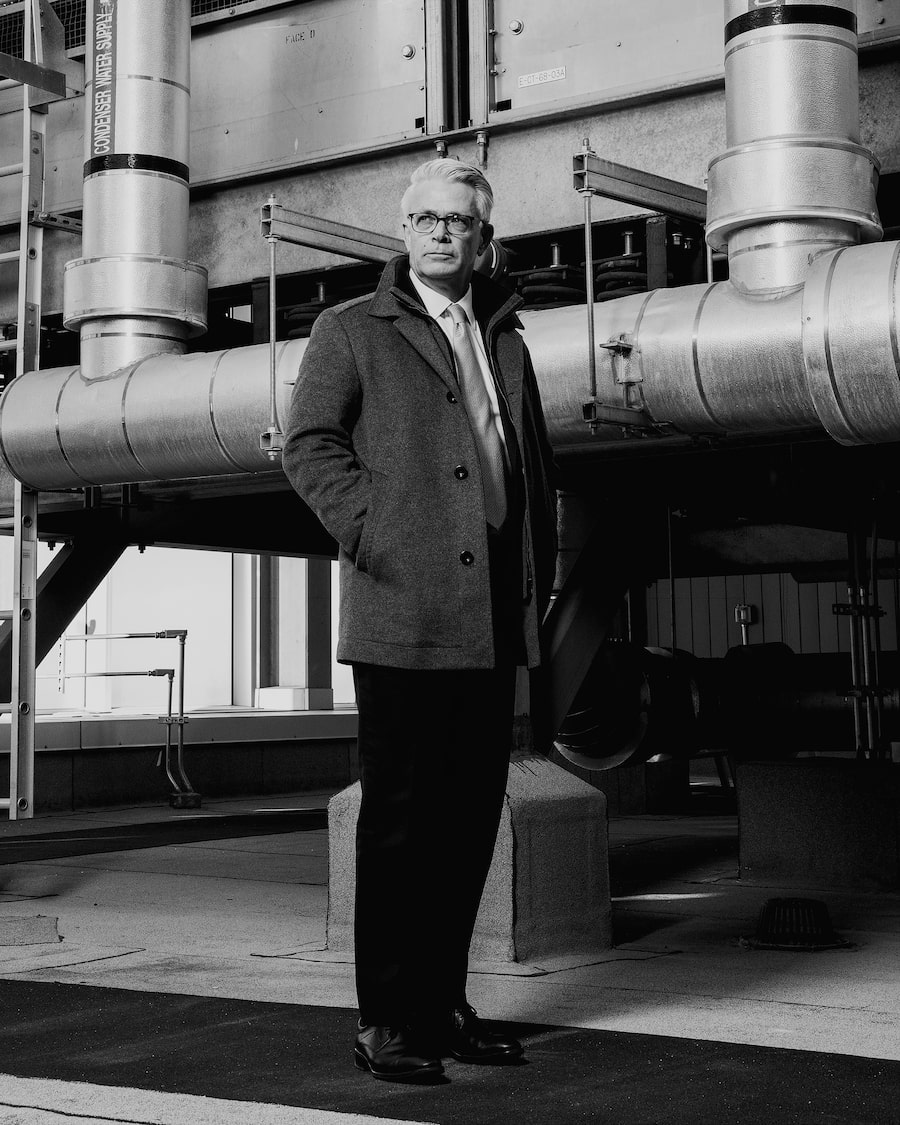
Right now, somewhere near you, Stantec is starting on something big. The numbers alone make that likely—at any moment in time, the giant Edmonton-based engineering and design firm has about 60,000 projects underway around the world. That project down the street could be a building or a water filtration system or some piece of vital infrastructure. But here’s the thing: Until you’re staring at it, you probably won’t know about it. And you’re not meant to know, because it’s a secret.
The company that hired Stantec? Can’t say their name.
The trucks Stantec uses? The vests or jackets they wear? Can’t show their logo.
The project staff who need to be hired? Can’t come from the local community.
If people at dinner ask a Stantec employee what they’re up to in the area, they might say, “We’re just here doing some…environmental work.” Uh-huh.
These are non-government projects we’re talking about. Stantec does plenty of federal, state, provincial and city projects, and because they use public money, those are all out in the open. Some of their recent projects include Vancouver’s Broadway subway extension; the US$2.1-billion modernization of Chicago’s Red and Purple lines; a redesign around the U.K.’s Reading Station; a 9,000-panel solar farm in South Wales; and a spate of Metrolinx projects in Ontario, including the 15-station Ontario Line (though nothing connected to the ill-fated Crosstown Eglinton LRT). But when Stantec is working for the private sector, NDAs are signed, lips are sealed, and sometimes even people in other Stantec departments can’t know.
When a company is trying to get a jump on its competitors, says Gord Johnston, Stantec’s CEO, “that confidentiality piece is paramount.”
As any Stantec executive will tell you, this engineering and design business they’re in is a relationship business. Relationships are built on trust and reliability. Many of Stantec’s clients have been with the firm for decades, some since it was founded 70 years ago.
It’s rare to be able to say of a company as old as Stantec, and as big—with 34,000 employees in 450 offices flung across dozens of cities in the U.K. and Australia, along with Milan, Brussels, Lima, Taipei, Dubai and more—that it’s just now coming into its own. But how else would you put it? Since Gord Johnston took over as CEO at the beginning of 2018, Stantec’s market cap has risen from roughly $4 billion to nearly $18 billion. From a low of less than $28 in 2019, its share price has grown a staggering 450%. The company took about six decades to build its annual net revenue to $3.4 billion, and over Johnston’s term, that number has almost doubled, to about $6 billion in 2024, while its adjusted EBITDA has nearly tripled, to $980 million. RBC Dominion Securities analyst Sabahat Khan, who covers Stantec, says these years “have been the most transformative in that company’s long history.”
There are a lot of reasons for the recent success, but they boil down to two: the moment Stantec finds itself in and the man at the top. And it’s no secret to anyone familiar with the company’s rise that, for a while, it looked like it might go a whole other way.
We’ve entered a golden age of engineering and design.
In the United States, the 2021 Infrastructure Investment and Jobs Act alone is pushing over US$1.2 trillion of government funding into water, transportation, broadband and power-grid projects. Added to that are the billions being invested in data centres and new manufacturing facilities by companies coerced by the Trump administration into onshoring their operations.
In Canada, the Carney government is spending billions trying to will major projects into existence in an effort to resist America’s gravitational pull. And around the world, governments are having to replace or repair hundreds of thousands of aging bridges, water systems and other pieces of major infrastructure, while needing at the same time to respond to revolutionary forces like climate change, a growing demand for critical minerals and rising concerns about resource security.
Stantec happens to be expert in all of these things.
The company separates its efforts into five verticals: infrastructure (accounting for 28% of its business by revenue); buildings (22%); water (21%); environmental services (18%); and energy and resources (11%). And one of the truths of conjuring big things is that any one project—a mine, a bridge, a hospital, a flood control system, a data centre—might require the work of experts from any or all of those disciplines. So when a retail giant needs a new distribution centre, it could hire five different consulting firms to meet the various challenges, or it could hire one. Increasingly, that one is Stantec.
Gord Johnston has set a goal for the company: to be the world’s top integrated engineering, architecture and environment services firm. He admits even he’s not sure what “top” means. “Is that revenue? Is that headcount?” he says. “The answer is, I don’t know.”
What he’s sure of is that top does not mean bigger. “Some folks will say, ‘I want to be the biggest. I want to be as big as Accenture.’” Johnston gives a shrug. “Bigger is kind of hollow.” What he wants is to be one of the three firms, almost anywhere in the world, that a client will call to bid on a project. And he wants to be first on that list. (The others would include some combination from the rest of the “big six” in global engineering: rival Canadian firms WSP Global and AtkinsRéalis, along with major U.S. firms Jacobs, AECOM and Tetra Tech.)
One way to be there is to make sure the company has access to the best talent. As Stantec execs are fond of saying, its only assets are people, and you’ll find a broad range of them on the payroll. When a potential client asks if the company can do something, the rule of thumb is, “Just say yes, and then come in and we’ll figure it out.”
And we’re not talking just about thousands of architects and civil engineers. At any moment, a project might require the input of an expert on silverback gorillas or someone who knows about Galapagos Island turtles or deep underwater caves. Stantec has all these specialists in-house, along with someone who’s mapped the migration system of monarch butterflies and experts who figured out a more economical way of testing for the local presence of a rare amphibian.
The other way Johnston aims to put Stantec on every potential client’s top-three list is by expanding its geographical reach. M&A is one of the chief means of growth in this sector, and before Johnston was named CEO, the company had acquired other firms at a rate of about two a year. Under Johnston, the pace has increased to about three a year, and that’s despite the CEO’s extreme pickiness about which companies are a good fit.
Beyond whether the financials work, beyond whether the acquired firm helps strategically, beefing up Stantec’s presence in Australia or the U.K. or Germany, what matters most to Johnston is the company’s culture. “When we buy a firm,” he says, “it becomes Stantec forever. And so the cultural piece is so important.”
There are no sub-brands here, no subsidiaries. After a year of financial oversight and integration by the same team that acquired the company (they use a fishing analogy here: “You caught it, you clean it”), the acquired company ceases to exist. It is fully absorbed. And everybody who came aboard needs to contribute.
That’s why Johnston wants to know why any company Stantec might acquire is looking to sell. Do the owners want to retire? If so, will they take all their client relationships with them? How strong is the second string of leaders? Are they, in Johnston’s phrase, “Stantec-izable”?
What he’s trying to avoid is what he calls “baby-bird syndrome,” whereby employees arrive in the morning waiting to be fed work. He says, in as genial a way as possible— because Johnston is always genial—“If you want to be a baby bird, you should go somewhere else.” Stantec expects its employees, at all levels, to be engaged in their field, to be excited about generating contacts, happy to support and collaborate with each other.
The CEO learned a lesson from an acquisition he made in Texas earlier in his tenure. It was only after he’d bought out the owners that Johnston realized the second string wasn’t as strong as he’d thought. The dedication and loyalty pieces were missing. In the first year, he identified the employees with potential and told them, “We want you to stay. We need you to get on board and be part of the one-Stantec approach.” The rest, about half of the company, were released.
These days, as much as 40% of Johnston’s time is spent getting to know other companies in the sector, wherever they might be in the world—he’s looking closely at the Nordic countries at the moment. So when it comes time to decide whether or not to buy them, much of the most important research has already been done.
But when the subject is M&A and lessons learned, there’s no getting around Stantec’s 2016 acquisition of MWH Global. It’s the deal that nearly derailed the company. And it’s Stantec’s recovery from that debacle that forms the foundational story of Johnston’s leadership.
“When we buy a firm, it becomes Stantec forever. And so the cultural piece is so important.”
– Gord Johnston, CEO of Stantec
In the 71-year history of Stantec, there have been just five CEOs, starting with the founder, Don “Doc” Stanley, who passed up a chance to play for the Boston Bruins to start a one-man engineering firm in Edmonton. After almost 30 years of building the business, he handed the reins to Ron Triffo, who diversified it and took it public, a $30-million firm in 1994. Then it was Tony Franceschini, who set his sights on growth, pushing the company from 1,200 people to more than 10,000. Fourth came Bob Gomes, who got Stantec through the aftermath of the financial crisis and then, in 2015, with growth prospects in North America dimming, thought it was time to take a big leap.
Based in Colorado, MWH Global specialized in water infrastructure and natural resources. With 187 offices in 26 countries, and a particularly strong presence in the U.K., it would give Stantec immediate global reach, while its 6,800 employees would boost the company’s workforce by almost half.
On top of that, a major part of MWH’s business was construction, a vertical Stantec had never been able to offer. Alone, the construction segment would contribute about 15% of Stantec’s future revenue.
“We thought that aspect of it would be complementary,” says board chair Doug Ammerman, who as a director at the time supported Gomes’s decision. They announced the deal in March of 2016.
Things went sideways quickly. It turned out that construction revenue was lumpy. Much of the money for a project came up front, then nothing for months. Estimating costs was hard, and delays dragged on the bottom line. One of the beauties of the engineering and consulting business model—wherein the company designs a project and then oversees construction carried out by someone else—is that delays actually generate revenue. That bridge is going to take six months longer than you thought? That’s six more months of oversight and billable hours; the costs are someone else’s problem.
Amid the new uncertainty, Stantec started missing earnings targets. Margins fell. Its stock bumped along for a year while its relationship with the investment community deteriorated. Problems with the construction segment became the focus of quarterly calls with analysts. Some within the company began to treat the relationship with investors as hostile and adversarial.
In mid-2017, Stantec announced that it was searching for a new CEO. Says the chair, “It wasn’t automatic that person was going to be Gord.”
Johnston had had an on-and-off relationship with Stantec. Schooled in engineering, he started in the ’90s after working for the City of Edmonton and then the Province of Alberta. Water was his specialty—designing upgrades to wastewater treatment plants and the like. Not long after joining Stantec, he realized that he liked people more than his calculator and started working more with clients. Soon the company was sending him places, first to an office in Cambridge, Ont., then off to the Middle East to help run a project in Kuwait.
There in the desert, he saw first-hand the destructiveness of poor middle management. A supervisor in Kuwait wasn’t, in Johnston’s opinion, living up to Stantec’s values of collaboration and mutual support. “I thought my boss was a jerk,” he says. So he quit. Went to work for a competitor in an office in Mississauga.
Eventually, though, he and his wife felt the need to rejoin their families in Alberta. So he hooked up with Stantec again and rose quickly. In 2012, he was senior VP, water. Three years later, executive VP, infrastructure. That was the job he held when then board chair, Aram Keith, asked if he’d like to be considered for CEO.
A big part of his pitch to the board boiled down to: Sell construction. Beyond the trouble it was causing, it wasn’t a core asset, and owning it meant they were competing with construction companies they were better off partnering with. At his first board meeting as CEO, he launched the process to sell the construction piece. Then he set to work repairing the relationship with the investment community. He didn’t know much about that part of the job, but he was by nature inclusive and engaging, which helped. He also had the insight to convince Theresa Jang to join as CFO.
Based in Calgary, Jang had spent 25 years in the oil and gas sector, was essentially retired and had no inclination to move to Edmonton. She took the interview mostly out of politeness. But after two or three hours with Johnston and Ammerman, a voice in her head told her to reconsider. “A big part of that was Gord,” she says. “He came across as so genuine.” He told her he wanted her help in getting Stantec’s mojo back. So she agreed to a five-year term. That she ended up staying six, she says, “tells you how much I loved it.” (Jang retired for good in September 2024.)
Together they restored the company’s relationship with the investment community, changing the messaging to focus on its economic resilience and strengths in M&A. Then they looked for ways to grow organically. And Johnston learned how much difference a CEO who liked people more than his calculator could make.
Gord Johnston has a squishy foot—a foam one about the size of a big toe. Some truck-rental company that wanted more Stantec business gave it to him. We mention it because it’s a hallmark of Johnston’s approach to his job. When he travels, which he does almost constantly (this year, he spent 158 days on the road, including trips to Australia, Paris, Geneva, London, Lima and Santiago), he sometimes returns to his Edmonton headquarters, high up in Stantec Tower, to find a to-do item on his calendar: Where is the foot? Someone in his office, perhaps Stantec VP Lana Bertsch, will have hidden it.
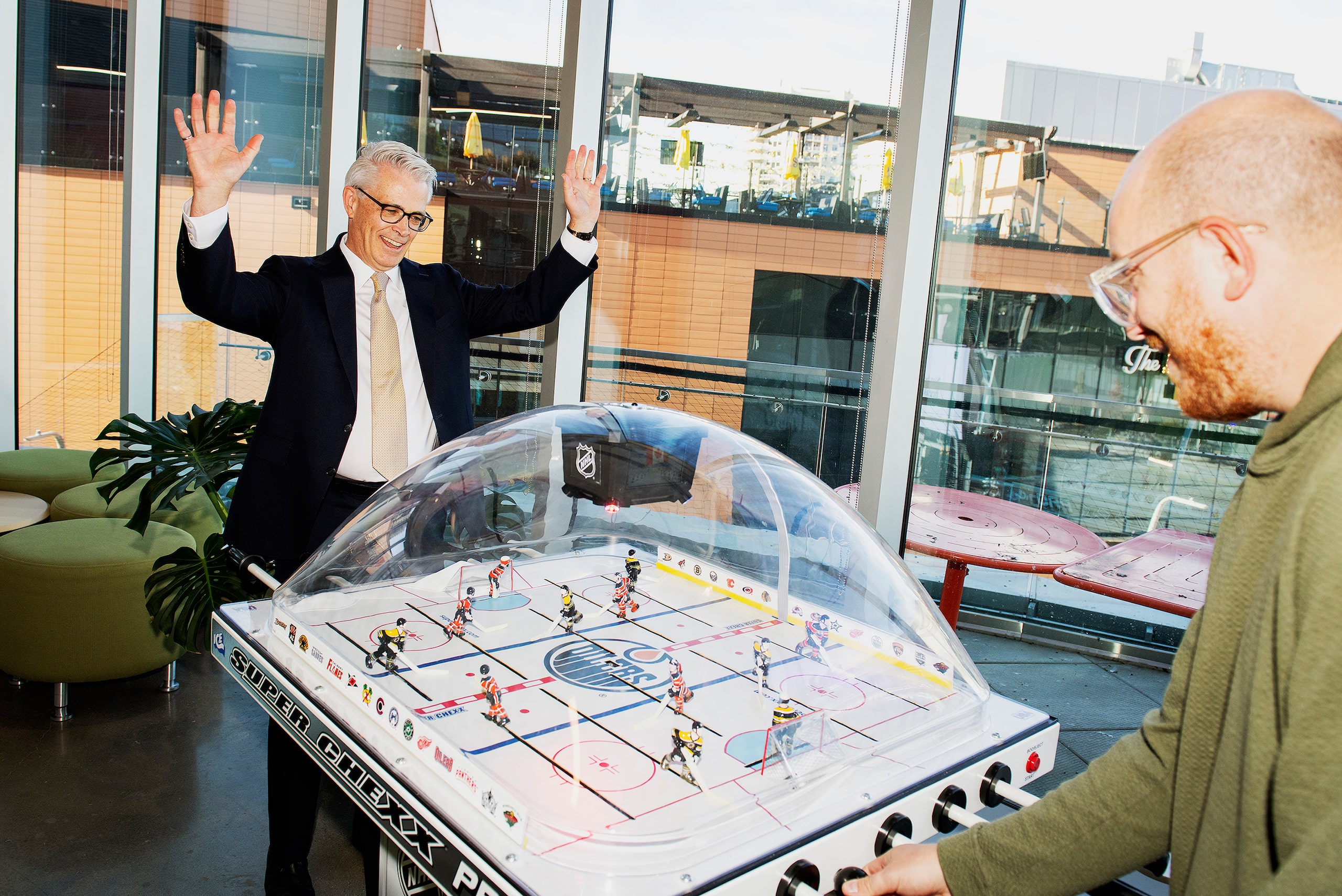
Johnston wonders how to explain the importance of something like this, “because it’s so dumb.” Essentially, the idea is: We’re all working hard, so we might as well have some fun while we’re at it. The same ethos seems to underlie the decision to sometimes include a CEO blooper reel in Johnston’s year-end video messages to the workforce. At a pizza luncheon where Johnston and another exec fielded questions from about 50 young staffers, one of the participants gushed about the bloopers: “They show how human you are!”
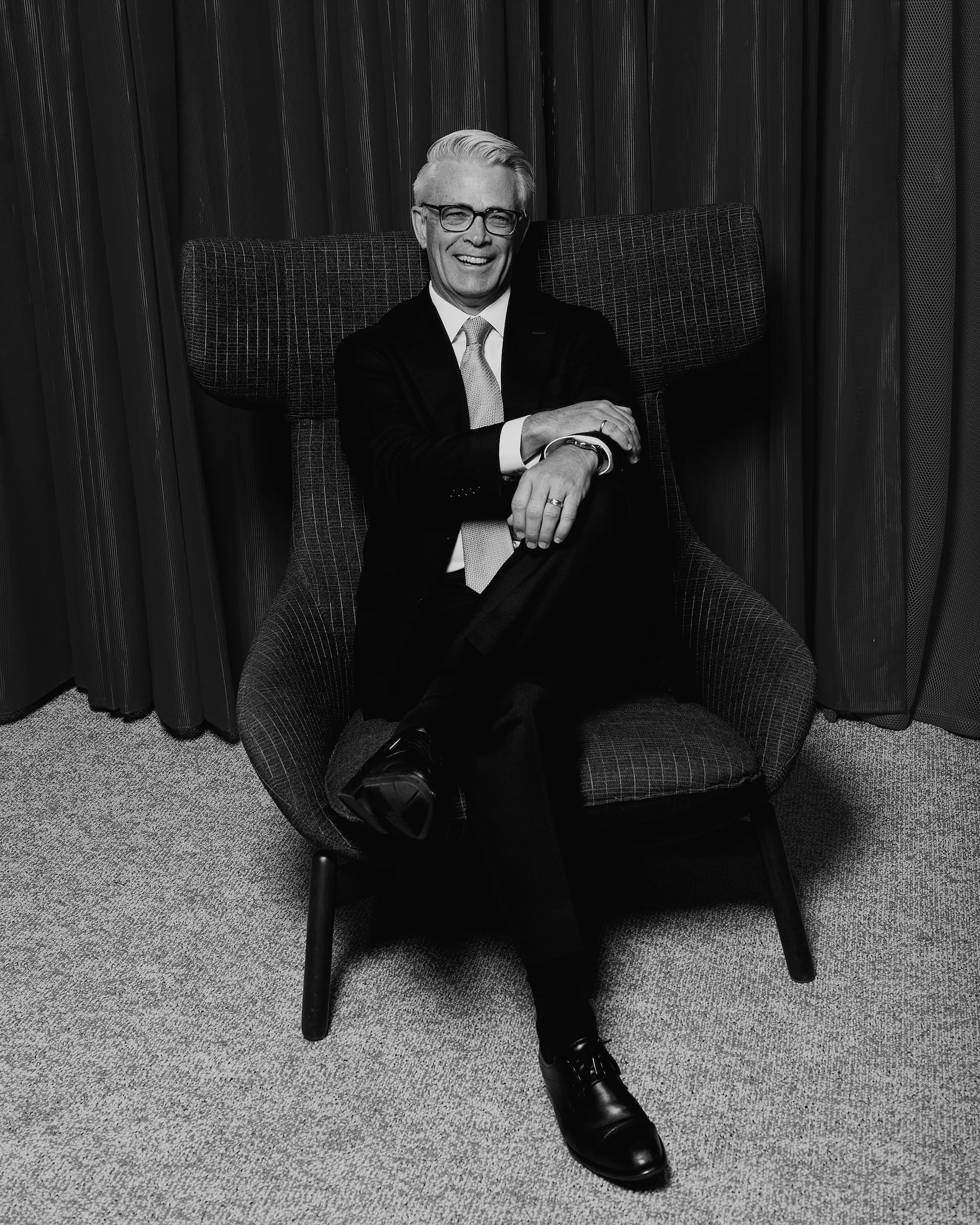
People talk about Johnston in ways you don’t normally hear people describe the CEO of an enormous global enterprise. “He has a very disarming way about him,” says Jang. “He’s very easy to talk to.”
Susan Reisbord, now Stantec’s COO for North America, was head of an environmental services and infrastructure firm called Cardno when Stantec acquired several of its strategic assets in 2021. She’d had 27 suitors for the company and, feeling pressure to do right by her firm and employees, she met with the leadership of every one of them in the lead-up to the decision. When she met with Johnston over dinner, she was struck by her physical sense of relief as she sat next to him. “It just felt like I had known him forever.”
Johnston’s approachability has practical benefits. It encourages underlings to knock on his door with concerns or ideas. Working relationships and partnerships with other firms form more readily. He models openness and supportiveness for Stantec’s vast ranks of project managers, reducing the potential for jerks.
Kenna Houncaren was part of the legal team handling M&A and just getting to know Johnston when he tasked her with leading the sale of the construction division. What impressed her was his ability to give the group room to work. Then, as soon as the job was completed, her husband was diagnosed with cancer and died. That’s when another side of Johnston emerged.
A mother with two young kids, Houncaren’s M&A job required her to travel around the world, often at a moment’s notice. She couldn’t do it anymore. Johnston quickly came back to her with a new job—chief of corporate services—that required no travel at all. “I really appreciated his deep humanity in the moment,” she says, tears in her eyes. “For me, it built loyalty for life.”
You can put numbers to this. It’s a fact that employees tend to leave a workplace due to their manager experience. In Stantec’s industry, the average voluntary turnover rate—the number of staff who choose to leave—is roughly 13%. Stantec’s is 10%, the best of the bunch. This directly boosts the bottom line, reducing the costs of adding new people, and bringing them up to speed on the company’s systems and culture.
Those people eager to stay factor directly into Stantec’s push for organic growth, which it has achieved at an annual rate of about 7% over the past couple of years. One of the big contributors is its improved “utilization” metric. In a business whose assets are people, you want more of those assets generating billable hours.
Sure, engineers see their work as a vocation, says Johnston. “But it’s okay to make money doing this.” That means a constant emphasis on driving costs down while looking for revenue. “Operational efficiency is something the industry chases overall,” says Houncaren. “We’re in the upper quartile, but we could improve. You have to challenge yourselves. Did you spend too much on marketing for that? Did you have too many IT people? Is that eroding your returns to shareholders?”
Johnston compares Stantec to a gangly teenager: a body that looks fully grown but isn’t as coordinated as it will be. “That’s where I’m so excited,” he says, “because we are full-grown. But I know there’s so much more we can do to get better. More efficient, so we can really grow into our body.”
Part of being more efficient is trying to get a jump on opportunities. Johnston’s Stantec doesn’t wait on requests for proposals to start work on potential projects. Instead, they try to anticipate. Regional leaders keep feelers out so as to get in front of major projects, which can gestate for five or seven years before they’re announced. Then they try to expand the scope of the firm’s work across as many of its verticals as possible.
In a meeting with Scott Argent, regional leader for the Prairies and Territories, Johnston pored over colour-coded sheets Argent had produced showing 19 projects in Western Canada. Yellow indicated those the company was already engaged on; green showed the government-announced nation-building projects in the region; purple highlighted projects Stantec was actively pursuing; a remaining unmarked few were of no interest or connected to another firm.
It’s usually the environmental services team that gets in early on an infrastructure, energy or building project, says Argent—when they might, say, address concerns related to wildlife or wetland habitats. So he tries to strategize with them. “Where do they see downstream activity and opportunity, and what do we need to do?”
They want to take “wallet share” from their competitors. And when they identify the projects in a region that can help them do that, says Argent, they “swarm” the account management teams with intel and resources to help set them up for success.
Meanwhile, Johnston looks for opportunities to meet CEO to CEO. A few weeks before, a U.K. client was in the final selection process for a large project, so he flew out to meet with the regional team, get conversant on the issues and look for ways to contribute to the discussion. A competing firm sent their CEO, as well, but he didn’t do the prep work. “So this guy came in,” says Johnston, “said, ‘Hi I’m Joe Blow. I’m an executive with the company.’ But he didn’t contribute. So the feedback from the client was, ‘Thank you for coming, but you actually got points off, because what are you here for?’”
This is the benefit of having an engineer at the top. Johnston has run major projects and understands a client’s pain. “Some of the CEOs of the other big global North American firms aren’t engineers,” he says. “So it’s harder for them to actually add value.”
Since jettisoning the construction segment late in 2018 and starting the work of increasing Stantec’s margins and productivity, the value-add of having Johnston at the top has been clear. “What Gord has been able to do,” says RBC’s Khan, “is get this firm that was just a good firm to one that is now a global leader.”
There are no baby birds in the company, no jerks. Just 34,000 people engaged in the sometimes clandestine work of designing the world around us. And a single squishy foot that must be found.
CEOs of the Year 2025
Corporate Citizen of the Year: Mike Garcia, Algoma
Innovator of the Year: Neil Cawse, Geotab
Newcomer of the Year: Bill Lomax, First Nations Bank of Canada
Each year, Report on Business magazine celebrates exceptional corporate leaders across Canada. Come behind the scenes as photographer Duane Cole photographs the CEOs of the Year for 2025 in Sault Ste. Marie, Oakville, Edmonton and Vancouver.