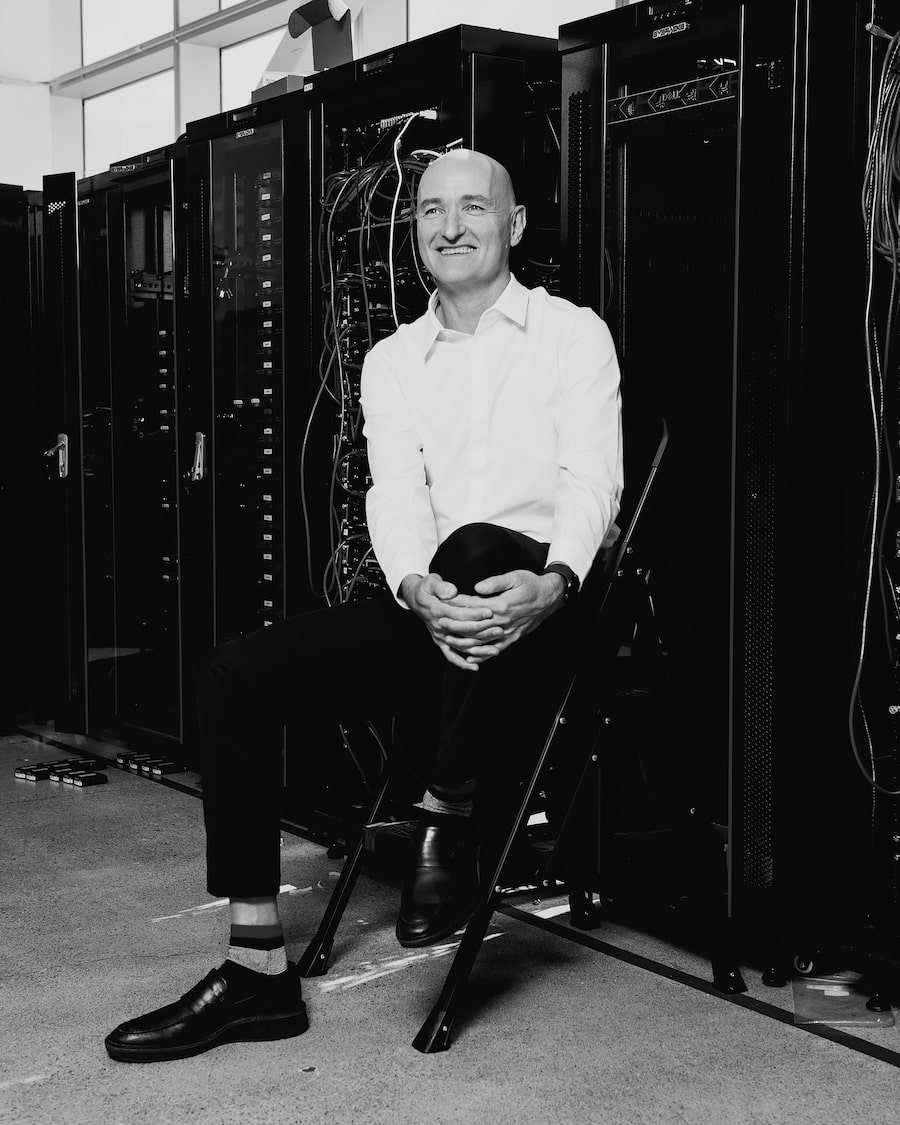
Time for a pop quiz: Name a Canadian tech CEO whose company is a global leader in its sector, has customers on every continent (Antarctica, too), and counts the U.S. government, PepsiCo, UPS and New York City as clients. This guy’s company generates more than $1 billion in annual revenue and well over $125 million in operating profits. He owns most of it, too, which means he’s a billionaire, though you’d never guess it.
Much like Shopify’s Tobias Lütke, our mystery man—an electrical engineer by trade—is a techie to the core who’s grown into the role of executive leader and eyes-ahead strategist. He oversees a sophisticated, elbows-up IP powerhouse that’s beaten more than seven legal challenges by patent trolls, and acquired five firms, including two smaller rivals in $100-million-plus deals apiece. And he recently launched a fast-growing side business that leverages the 100 billion anonymized data points his company processes daily to sell traffic insights to customers.
Unless you’re an avid reader of trade publications like Automotive Fleet, you’re likely still scratching your head.
The answer is Neil Cawse, founder and CEO of Geotab Inc., an Oakville, Ont.-based company with 2,700 employees that’s one of Canada’s largest privately held tech companies. It’s one of a few global leaders in a niche industry called telematics—electronically gathering data from commercial vehicles, including location, speed and fuel consumption, along with information on whether drivers are speeding or braking hard, and even whether they’re wearing seatbelts. Telematics is a must-have tech for any fleet operator, as the data helps them decide how to more efficiently manage their vehicles.
Geotab’s key rival, publicly traded Samsara Inc., is worth about US$20 billion and growing fast. But with 100,000 customers and more than 5.6 million vehicles carrying its tech as of October, Geotab has ranked as the top telematics provider for four years running, according to market intelligence firm ABI Research. It also won one of the world’s largest telematics deals in 2022, a 10-year contract with the U.S. Postal Service worth close to US$300 million. San Francisco–based Samsara appealed the award several times but ultimately failed.
As for smaller rivals, many have disappeared or thrown in their lot with Geotab, joining the hundreds of resellers that help get its tech into fleet vehicles. And Cawse maintains that it will get increasingly difficult for all but the biggest players to break into the business, especially since his company spends US$150 million a year on R&D, much of it these days focused on artificial intelligence. That scale of effort, he says, “is absolutely needed to be able to compete in this space.”
So if Geotab is a global giant in telematics, why’s Cawse practically unknown here at home? First off, he’s never needed to raise outside capital—he funded the company himself after emigrating from South Africa 25 years ago. His business doesn’t sell to consumers, and it doesn’t play in a vast market. His ultimate customers are fleet managers—nary a TikTok influencer among them—so flash is definitely not required.
He’s even a bit of a mystery to his fellow tech CEOs. This past September, he had a coming-out of sorts at an event hosted by the Council of Canadian Innovators. As he detailed his origin story in front of a room full of tech execs in Toronto, many were gobsmacked at just how big Geotab is. “Everyone in the room was enamored by him,“ says CCI president Benjamin Bergen. “In Canada, we have a lot of hype in certain sectors of AI, but not many firms that have had those kinds of returns.”
Lots of people watched Star Trek growing up. For Cawse, it was more than just TV time: Star Trek’s quaint techo-optimism provided a roadmap for his life’s ambitions. “I used to dream up plans for tricorders and transporters,” he says.
You can see that influence today in Geotab’s core tech, a sleek wireless dongle about the size and weight of a bar of soap (97 grams, to be exact) called the GO9+. The black box plugs into a vehicle’s diagnostic port, under the steering wheel, and pulls data from its onboard computer and streams it in real time via the cloud.
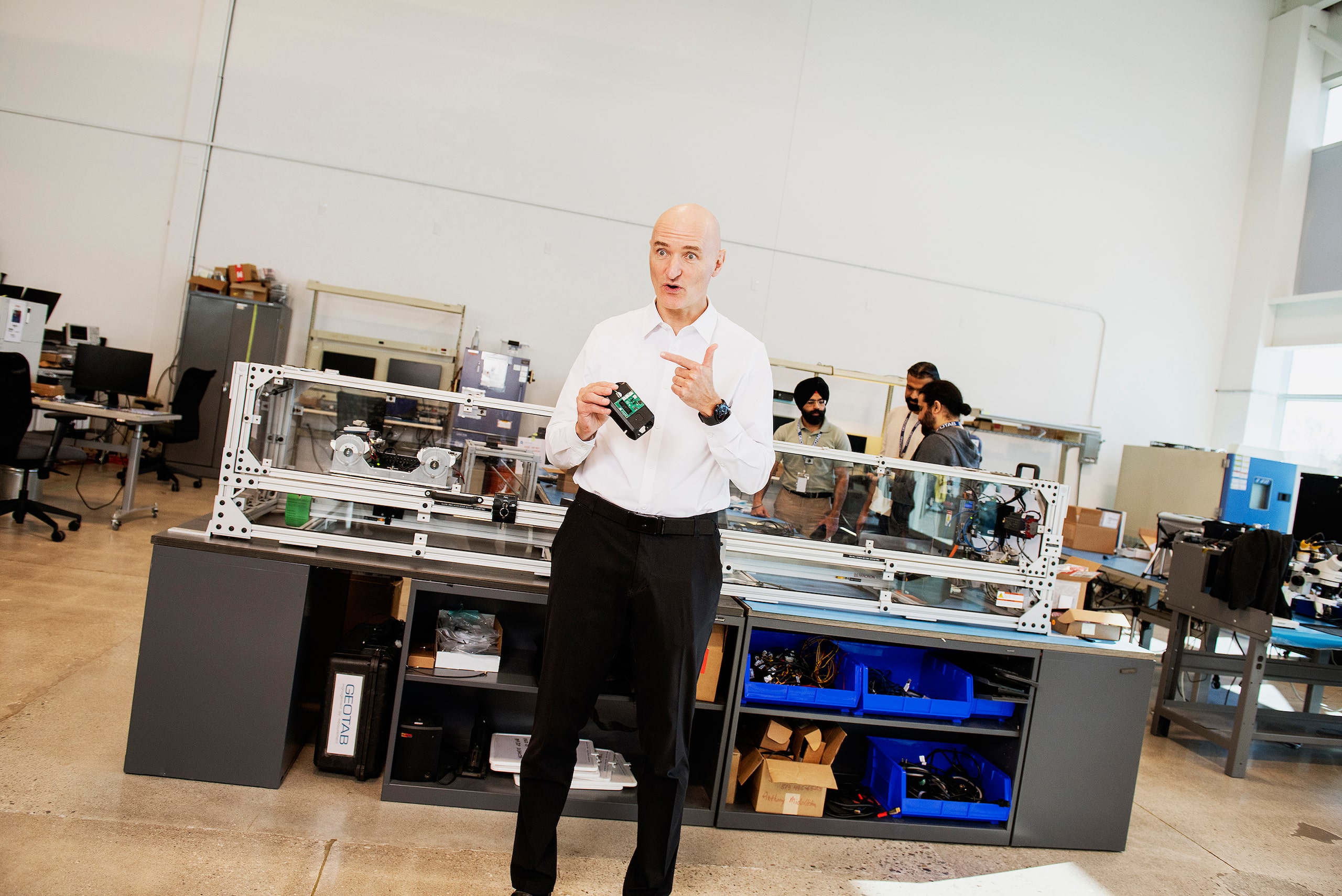
That data is analyzed at Geotab’s high-ceilinged headquarters, which feels much like a military-industrial mission control. Wall-to-wall full-colour screens announce the number of active Geotab-equipped vehicles in use, how many subscribers are signed on, the total kilometres driven by connected vehicles (now hundreds of millions a day), and how quickly data is streaming. “We’re processing more records per second than most of the largest banks,” says Cawse, his wiry frame clad in a black golf shirt, tan chinos and slip-ons.
The cost of managing all that data is encapsulated in a metric called slot utilization. “It’s another way of saying there’s a whole pool of machines sitting at Google somewhere,” says Cawse, and the more Geotab data they handle, the more it costs. “So we have to manage that.”
Cawse could easily veer into didactic territory as he ushers visitors through Geotab’s facility. But he has a knack for dumbing down tech talk without coming off as condescending, which helps explain, at least in part, why the company has been so successful in an industry striving to bring high tech to the trucker set. “Neil is probably the smartest guy in the room, but he never tries to show that he’s the smartest guy in the room,” says Mark Maybank, managing partner with Maverix Private Equity, which has been trying to persuade Cawse for years to let it invest in Geotab—unsuccessfully.
Cawse acknowledges the screens are part of a deliberate effort to showcase how Geotab thinks and operates. “Everything is data first,” he says. “Decisions are made based on data and analytics, and we measure everything. The same way we offer a product to our customers is how we operate internally. We have a philosophy that you cannot manage what you don’t measure.”
What Geotab measures is incredibly valuable to customers. Drivers who speed or drive too aggressively, idle excessively or take circuitous routes cost companies money in wasted fuel and accidents. Using telematics, fleet operators can get the data they need to take action. Geotab even predicts and flags when vehicles require maintenance—before they break down.
It has a convincing collection of customer case studies. One freight company in California cut idling costs by 59% after installing Geotab’s tech. A distributor of construction supplies in Atlanta saw seatbelt use nearly double and aggressive driving incidents fall by 62%.
The company’s early devices weren’t nearly as useful. Three times bigger than the GO9+, they had to be hard-wired into each vehicle, and primarily tracked where a driver had gone in the days or weeks before. After each trip, drivers had to manually upload the route data by pressing a touchkey to the device and waiting up to eight minutes for it to upload. Then they had to download the data in the office, which could take another eight minutes. You had to be a pretty dedicated fleet manager to get at the limited information Geotab initially gathered.
But the more data Geotab’s technology delivered to customers, the more useful it became. “If you just plug in a device, there’s no ROI there,” says Bob Zimmer, the senior manager in charge of supply-chain fleet technology at Pepsi, one of Geotab’s larger customers. “It’s what you do with the data you’re getting. Having a reliable telematics provider is critical as your fleet grows. It’s very helpful when you connect to get that rich data.”
Cawse has always had a knack for connectivity. He was a teenage tech whiz, and when his dad brought home a primitive ZX81 personal computer in the early 1980s, Neil programmed it to create a digitized clock that appeared on the family’s TV. The young nerd was also hypercompetitive with his younger brothers. Everything was a contest, including who could run, eat and even bathe the fastest. When his mother told him as a teen that his younger brother Clive would likely make more money because he was more entrepreneurial, Cawse became determined to start his own business.
It’s a story he loves to tell, though it leaves Clive—Geotab’s executive vice-president—rolling his eyes. “I don’t know anyone who’s more competitive than Neil,” he says. All the Cawses are—but they’re also incredibly close-knit. “It’s a healthy dynamic,” says Clive. “When something hits the fan, everything gets dropped, and we come together as a pack.”
In fact, Geotab is essentially a family business. Three of its eight top execs are Cawses: Neil, who’s 55, along with Clive and Alan, Geotab’s chief security officer. (He and Clive, along with a few hundred Geotabbers, own a third of the company; Neil owns the rest, and employees must sell their stakes back to the company upon leaving.) Sister Lindy was once VP of HR before switching to an advisory role. A few cousins work there, too. So did Cawse’s parents, Jill and Robert.
Many of them followed Cawse to Canada from Johannesburg, where he studied electrical engineering at the University of the Witwatersrand. In 1994, when he was just 24, Cawse co-founded a tech consultancy called Vircom. South Africa was nearing the end of the Apartheid era, and Vircom landed a high-profile assignment: helping to build the database that would tabulate votes in the country’s first free and fair election, and communicate real-time results to the media.
“Decisions are made based on data and analytics, and we measure everything. The same way we offer a product to our customers is how we operate internally. We have a philosophy that you cannot manage what you don’t measure.”
– Neil Cawse, founder and CEO of Geotab Inc.

The run-up to the April election was tumultuous, and Cawse and his team had just six weeks to build the program, working in tight quarters on flimsy folding tables. During the live broadcast of results, sometime after 1 a.m., Cawse came to a terrible realization: The program was incorrectly tabulating the votes—and it was his fault. “A cold shiver ran down my spine,” Cawse says. He fixed the bug, but it created a 15-minute suspension of the feed and prompted accusations of tampering.
Many would prefer to simply forget that episode. Not Cawse: “I was the kid who made a stupid mistake. I wrote the code. I take full ownership.”
As dot-com fever heated up, Vircom thrived, and Cawse began to show promise as a leader, according to Clive, who describes his big brother as persistent and “one of the best negotiators ever.” In 1999, Cawse turned down a handsome takeover offer for Vircom, only to sell at four times the price eight months later.
By then, Vircom was working on a joint venture—called Geotab—to develop a device that could track a vehicle’s whereabouts, tapping into the global positioning system. Vircom’s new owner wasn’t interested, so Cawse and his partners held onto their Geotab stake.
The original idea was to disable vehicles that were carjacked, a big problem in South Africa at the time. It also allowed fleet owners to monitor drivers to ensure they weren’t moonlighting in company vehicles or collaborating with thieves. In short, Cawse was trying to solve business problems for a country undergoing a messy and increasingly violent rebuilding process. Eventually, he decided it was time to move away.
Cawse assembled his siblings and parents to break the news: He and his wife, Tammy, planned to emigrate, and they wanted everyone to come along. Ever the engineer, he’d produced a report assessing English-speaking countries based on a range of measures. “Canada came out on top,” he says. His parents moved with him and his wife in 2000. By 2009, all the siblings had joined them.
Cawse, now a father of three sons, launched Geotab 2.0 almost as soon as he landed in Canada and offered his old partners the chance to invest. They passed.
Today, the original Geotab is a reseller of the Canadian company’s products.
You’d think, given the potential savings at stake, that telematics would be an easy sell from the get-go. That most definitely wasn’t the case. Cawse says some prospective customers initially recoiled at the idea of spying on their drivers. It didn’t help that the company’s original logo featured a giant eyeball. “It was literally Big Brother looking at you,” says Colin Sutherland, the first non–family member to join Geotab, running sales and marketing in 2002. (He left in 2024 to buy a media company.) The creepy eye, he told Cawse, had to go.
The use of telematics has largely been normalized these days, thanks to tech giants surveilling all of us 24-7 through our phones. Geotab acknowledges there’s still potential for blowback, though. In 2022, New York City’s largest public employee union successfully fought against bad-driving reports—based solely on data collected by Geotab devices—being used to discipline members.
For most customers, and even for a lot of drivers, the savings and safety enhancements are worth it.
One of Geotab’s earliest landmark customers was UPS. The delivery giant, which now has roughly 120,000 Geotabbed vehicles on the road, wanted to use telematics to minimize fleet downtime. To win the deal, Geotab figured out—on spec, and with no expectation of compensation—how to read fault codes from engine computers and predict when they’d need to be serviced. It got the contract, and Geotab’s tech helped transform how UPS maintains its vehicles: Bringing them in for proactive overnight repairs reduced downtime to 2% from close to 10%, says Sutherland.
For Pepsi, Geotab adapted its tech to inform drivers when they needed to slow down, cutting fuel costs and increasing safety. “We shaped the roadmap of the hardware around the big customers,” says Sutherland.
Orkin, the Atlanta-based pest-control outfit, was Geotab’s first big get. To win that one, Cawse and his brother Alan spent four weeks over the Christmas 2003 break rewriting their software to run on Microsoft SQL Server, as per the company’s request. Orkin’s tech team was impressed. The deal showed Cawse could win on technical prowess. But his approach shone through in other ways. He reached out to the vendor Geotab had displaced, not to gloat but to apologize and make an offer: Would the company be interested in becoming a Geotab reseller?
Until that point, Geotab had no sales force. Suddenly it had to decide how to build its go-to-market muscle. Instead of keeping all of Orkin’s money, Cawse gave a share to the company that had referred them in the first place. From then on, it would generally sell its tech through third parties. “That was a very important moment in Geotab’s history,” says Sutherland. Sticking to that strategy, he says, enabled the company to focus on what it excels at: innovation.
In October, however, Geotab acquired Verizon’s European and Australian telematics business. In addition to adding 400 staff, 44,000 customers and more than US$100 million in sales, it has also inherited Verizon’s direct European sales force.
Perhaps the biggest boon for Geotab came in December 2017, when a U.S. government mandate went into force ordering truckers to replace their paper logbooks with tamper-proof electronic logging devices (ELD) to ensure they weren’t driving too long and getting fatigued. Suddenly, scads of trucking companies needed exactly what Geotab was selling. After 17 years of product innovation, “we had a better suite of products when it mattered,” says Cawse. “I wish we could say we were so smart or that we realized the ELD mandate would bring in so many people. We knew it would help. We didn’t realize how much.” Two months after the mandate went live, Geotab hit a million tracked vehicles; this past September, it surpassed five million.
Geotab has also been a big promoter of electric vehicles, backed by in-house research that shows batteries are lasting longer and lifetime vehicle costs dropping. It’s not just about sustainability—a big buzzword at Geotab—but efficiency, an even bigger buzzword for fleet bosses: Geotab regularly informs fleet operators how many of their vehicles could be replaced economically by comparable EVs. Geotab data suggests that 75% of light commercial vehicles could be replaced by EVs right now; on roughly half those, lifetime savings could amount to $15,900. (Cawse puts his money where his mouth is: Geotab offers employees thousands in subsidies if they buy an EV.)
With access to so much data, Geotab recently spun up a market research firm called Altitude, which it pitches to governments and other organizations to inform their plans for roads, infrastructure and safety projects. Two recent findings: Trucks are moving faster on 44% of Manhattan roads since it introduced congestion pricing, while ongoing construction on Toronto’s Gardiner Expressway has doubled travel times in key areas.
Last year, the company also launched a safety centre to produce predictive insights, enabling clients to pinpoint the drivers deemed most likely to get into an accident. One fleet manager, shown how the system worked, declared, “You found my knuckleheads!”
Cawse has been fascinated by AI for much of his life. He even considered pursuing a master’s degree in it. To say he’s all in now would be a vast understatement. “AI is like quicksand,” he says. “Every week that goes by, there are innovations happening around you.”
To hear him talk, Geotab’s continued existence depends on getting things right in the ChatGPT era. “If we do not pivot this company right now to being AI-first,” he says, “then we will lose out to our competitors.”
Geotab recently launched an AI copilot for customers called Ace and introduced AI-powered cameras that can be installed in fleet cabins for further monitoring. Given generative AI tools’ propensity to hallucinate, Geotab focused on getting Ace up to 100% accuracy—and hit that target, Cawse say. “That has been damned, damned hard. There’s more work that we have to do.”
Just as data has defined every corner of his company, he’s bringing a similar mindset with AI. This year, Cawse says he began “ratcheting up the temperature” to compel Geotabbers to use AI in their work—even lawyers, recruiters and marketers. Asked by employees if they’d be replaced by AI, he replied no, but added that if they didn’t start using the technology, they’d be replaced by humans who did. Geotab even started assigning everyone an AI score based on how much they use it. Enforcing that, he says, “is the next stage of the game. Otherwise, we won’t survive.”
That may seem alarmist, but you know what they say about the paranoid. And besides, Sutherland thinks Cawse is getting a kick from it all. “Neil is motivated by the engineering thrill, by the evolution of technology,” he says. “He’s completely in his sweet spot with AI.”
As for the rest of Canada’s business sector, Cawse’s message is clear: This is a do-or-die moment.
Some of the measures that made Canada look like a great place to land 25 years ago have deteriorated significantly, including productivity, growth in GDP per capita and what the World Bank calls “ease of doing business.” A recent study by Leaders Fund shows that a growing number of high-potential Canadian founders have moved away to build their startups. Using the same measures he applied 25 years ago, Cawse isn’t even sure Canada would be his destination of choice today.
Don’t worry—he isn’t going anywhere, and he has no plans to sell out. More than anything, he’s proven that despite all the griping, Canada is still a great place to build a prosperous business. “The idea that Canadian tech entrepreneurs must move to Silicon Valley to succeed has absolutely proven false,” says Cawse. “We’ve done it, and there have been zero compromises.”
CEOs of the Year 2025
Strategist of the Year and overall winner: Gord Johnston, Stantec
Corporate Citizen of the Year: Mike Garcia, Algoma
Newcomer of the Year: Bill Lomax, First Nations Bank of Canada
Each year, Report on Business magazine celebrates exceptional corporate leaders across Canada. Come behind the scenes as photographer Duane Cole photographs the CEOs of the Year for 2025 in Sault Ste. Marie, Oakville, Edmonton and Vancouver.