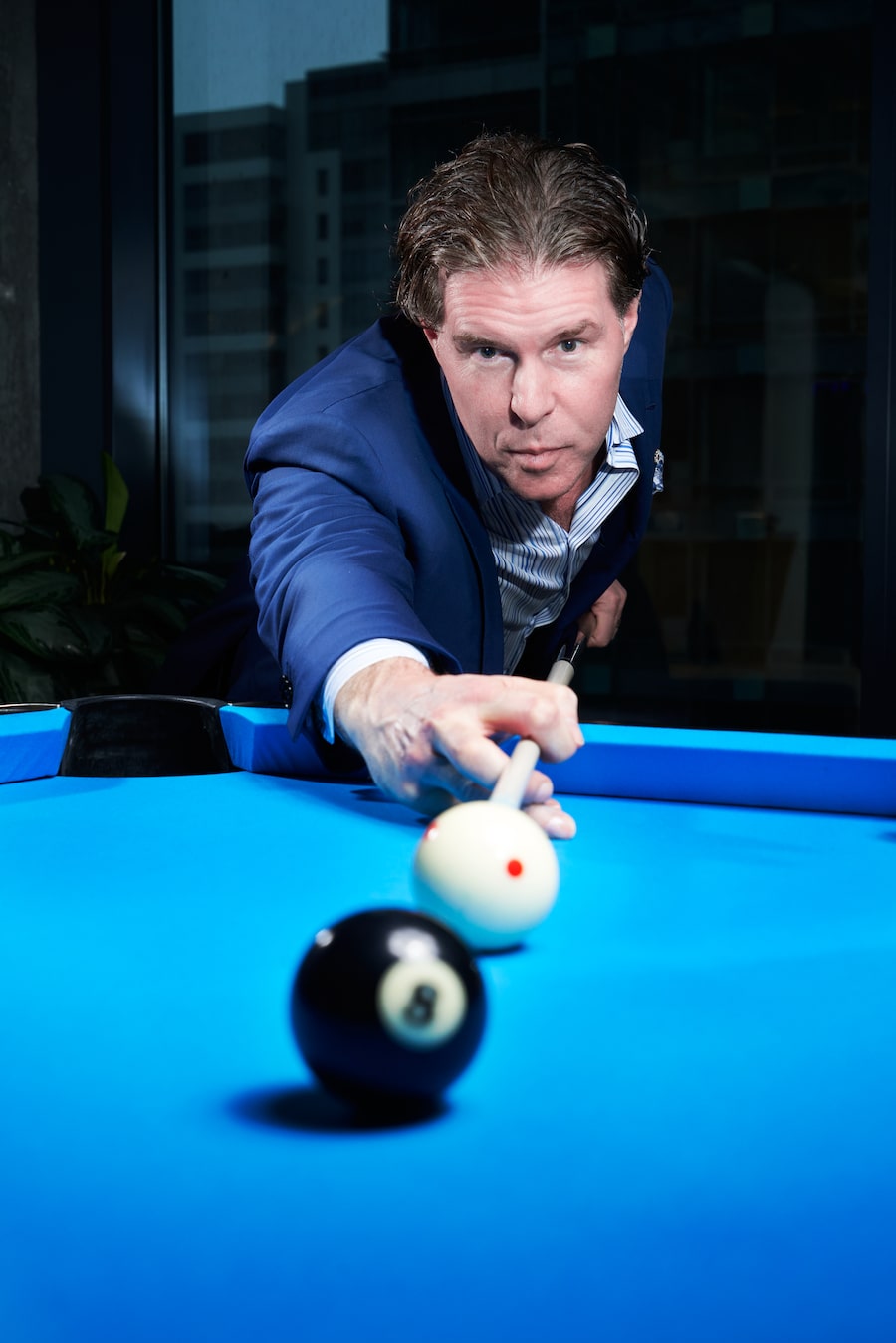
On April 3, 2023, at 5:12 p.m., Ryan Beedie strolled up to the pool table in his downtown Vancouver office, swatted the cue ball with his stick – a pregame ritual – and leaned in for the break. He let go a shot so powerful that the white ball bounded back after hitting the pyramid head-on. Within seconds, six balls were down, all stripes. He’d just set a Guinness World Record, for “most pool balls potted off the break (same suit).”
Winning is kind of Beedie’s thing. There’s the daily Wordle, Quordle and Octordle battles with his eponymous company’s in-house counsel. An annual cribbage tournament, which he usually wins. When he golfs solo, he plays with three or four balls at a time. “Ryan is good at everything, whether it’s cornhole or golf or random things, and you’re like, ‘Really, are you good at that, too?’” says Cindy Beedie, his wife of 34 years. “It’s kind of annoying.”
Prepare to be just a bit more annoyed by Beedie, a trim, fit, 6-foot-3 mogul, socialite and philanthropist with great hair and good looks reminiscent of 007-era Pierce Brosnan. He has a net worth in the mid-to-high single-digit billions. After being named business leader of the year by the Canadian Chamber of Commerce, inducted into two business halls of fame and receiving a King Charles III Coronation Medal – all within the past three years – and topping Vancouver Magazine’s most recent power list, they might be running out of awards to give him. No wonder Global B.C. TV anchor Chris Gailus jokingly calls him “Mr. Perfect.” You almost wouldn’t be surprised if he donned a cape and fought crime on the side.

Ryan Beedie and his father Keith at the company's former Kingsway location in 1992. At the time it was known as Beedie Construction Ltd.Supplied
Twenty-five years after taking over the real estate development company founded by his late father, Keith, Beedie oversees an empire that few folks east of B.C.’s Coast Mountains know much about (except for Royal Bank of Canada CEO Dave McKay—Beedie is one of the bank’s top two corporate lending clients). And like a rack of balls off the break, everything is expanding.
Beedie (the company) has developed 35 million square feet of industrial space, mostly in Greater Vancouver, where it’s the biggest player, but also in Alberta, Ontario and Las Vegas. It has 365 tenants across 200 properties within a 15-million-square-foot portfolio ranging from small buildings for small businesses to distribution centres. (It sold an Amazon centre in 2024 to the founder of Zara for nearly $400 million.) Beedie has 400-plus acres of industrial land and is cooking up a deal with a Canadian pension fund that would see it sell several buildings into a $1-billion joint venture and expand further nationally.
The company’s residential arm, meanwhile, has completed 13 condo projects, with plans for 25 more (though the market has slowed); 16 are slated for Fraser Mills, a 96-acre riverfront spread in Coquitlam that will eventually have 5,500 homes, 300,000 square feet of commercial space, plus parks, recreational facilities and 400-plus childcare spaces. Also in the works: greater Vancouver’s highest-elevation residential tower, which Beedie plans to build on Cypress Mountain.
Then there are the side hustles. Beedie (the man) has done well investing in tech companies and recently sold down his stake in Nettwerk Music Group, the legendary label that once managed Sarah McLachlan, Barenaked Ladies and Coldplay.

Beedie loves Slurpees so much, he once wrote a LinkedIn post in praise of his icy beverage of choice.
His best trick shot, however, is that he’s also established himself as B.C.’s latest kingmaker mining financier. Beedie is the largest shareholder in Artemis Gold Inc., which last year began producing at Blackwater Mine in central B.C. The mine, which is undergoing an expansion, is one of the highest-margin, lowest-cost gold producers globally. Beedie invested $193.5-million for its stake in the TSX Venture–listed company; it’s grown to $2.5-billion. Even after the recent gold selloff, Artemis was trading above $37 a share in late March – 13 times Beedie’s average cost.
He’s backed other mining and metals plays, too, with more to come; overall, his non–real estate investments have generated an exceptional average return of about 30 per cent since 2010.
Then there’s the philanthropy. Beedie treats giving like it’s a division of the company – one that pays societal, not financial, dividends. He’s well aware it’s not exactly cool to be ultrawealthy these days, as the rich get relatively richer than everyone else and some pull back from philanthropy. (Silicon Valley tech investor Peter Thiel has even encouraged billionaire signers of the Giving Pledge – which commits them to giving away half their wealth – to unsign, calling it an “Epstein-adjacent fake boomer club.”)

That doesn’t sit right with Beedie, whose family has committed more than $190-million and counting to worthy causes. “This rejection of philanthropy by some very successful people – I don’t get that,” he says during an interview at his Vancouver office. “I believe firmly that for society to accept a capitalistic system that has some inequality, those who have had success not only should give back but be seen as giving back.” There’s always a component of good fortune, good luck and good timing to wealth creation, he adds. “Isn’t it just the right thing to do to contribute a chunk of that back into the society that gave rise to this?”
But Mr. Perfect doesn’t have everything figured out – particularly when it comes to who will succeed him. There’s no Kendall-versus-Shiv-versus-Roman feud brewing at Beedie. Quite the opposite: None of Beedie’s three grown children work at the company, and none are interested in one day leading it. The lack of a third-generation successor bothers him. “I’m disappointed in that, for sure,” he says.
To be clear, he has no plans to retire any time soon (or ever). But as Beedie approaches 60, he knows it’s time to start planning for what the world – and the company he leads – will look like without him. “These issues are top of mind,” he says, “because there’s no one behind me.”
You’re probably wondering, how did the Guinness folks authenticate Beedie’s record break, anyway? Simple: He had four ceiling-mounted cameras recording the game from multiple angles. This is a guy who takes his pool seriously – the cameras are partly for instant replays to settle any disputes that might arise, but mostly so he can share highlights of his best shots.
He typically plays with Rob Fiorvento, a partner in Beedie’s residential division. Their tournaments stretch for days; the first to 25 victories prevails. (Beedie spots his opponent an eight-game handicap.) When Beedie sinks a tough shot, he’ll sometimes jump up and down and run off, whooping.
Yes, he has some quirks. He loved Slurpees so much, he once wrote a LinkedIn post about them – not “how drinking Slurpees made me a better executive” slop, just a gleeful, celebratory post. He likes to curate unique experiences with mates from his Young Presidents’ Organization (YPO) forum, including setting up a backstage meeting with Bruce Springsteen’s guitarist Steven Van Zandt and a tour of drug lord Pablo Escobar’s former mansion.
He’s really, really into music, especially ’80s and ’90s rock, and he knows the era “better than I do,” admits Nettwerk co-founder Terry McBride, who was in the middle of it. “Probably the only thing that can beat Ryan Beedie on knowledge about music of the ’80s and ’90s would be an AI bot that scraped Ryan Beedie.”
Beedie’s love of U2 is next-level; during the band’s residency in Vegas, he saw them 15 times; even Bono told him he was crazy. “Look, my doctor said that I get so much joy from it that I should do it as much as I want,” Beedie says. He credits a lyric from the U2 song “Gone” for snapping him out of a period in his 30s when he was self-indulgent, full of swagger, partying too much and staying out late: “What you thought was freedom was just greed.”
Beedie reads seven newspapers a day and describes himself as having a “pinball-machine brain.” He’s pretty sure he has ADHD and says he’s “maybe a bit too much” of an open book. A media trainer would likely cringe at just how open he is, but it’s refreshing to hear a multibillionaire speak so candidly about what makes him tick.

Ryan Beedie celebrates his 1991 graduation from Simon Fraser University with his father Keith. In 2011, SFU's business school was renamed the Beedie School of Business in recognition of a sizeable donation from the father and son.Supplied
Beedie is different in many ways from his dad, Keith, who built his first structure in 1946: a workshop for his fledgling woodworking business. Keith was a relentless 19-year-old who started out building radio cabinets, furniture and exhibition ticket booths, and eventually homes, and commercial and industrial buildings. He deployed a new technique, pouring concrete into horizontal forms on a job site that, once cured, could be tilted up into place. It was simple, cost-effective and helped the company grow.
A child of the Great Depression, Keith was frugal and debt-averse; once, when a purchase order for paper clips crossed his desk, he demanded to know why the company needed new ones. When he found out they were attached to outgoing deposit slips, he asked the bank to collect and return them.
Keith’s penny-mindedness was understandable. He was embezzled twice by a staffer and once flipped a coin to decide whether to declare bankruptcy during a downturn in the early 1960s. It landed on tails – go bankrupt. He decided to forge on anyway, and by the time Ryan came along, the business was humming.

Beedie and his father at the company's Vancouver office in 2012. After earning his MBA at UBC and marrying wife Cindy in 1992, Beedie joined Keith and his older brother Colin at the family firm.Michael Connolly/Supplied
With Keith’s all-consuming focus on the company, young Ryan wanted for nothing – except his dad’s attention. His three older half-siblings, from Keith’s previous marriage, often babysat him, and Ryan felt he wasn’t a priority for his father. “Getting his approval and wanting him to be happy with me was an early motivator,” says Beedie, fuelling a lifelong desire to be seen as his own man. Growing up in socioeconomically diverse Burnaby also grounded him – Beedie’s best friend sometimes came to school with tomato-paste sandwiches or no lunch at all.
Beedie eventually bonded with his dad, accompanying him on Sunday drives to job sites and Canucks games. The old man would barrel through traffic, arriving during the national anthem – then make them leave with a minute to go in the game to beat the rush, missing buzzer-beaters and three-star callouts. But the habit stuck; even as Beedie’s beloved Seattle Seahawks won the NFC Championship at home this past January, “we watched the end walking out of the building,” says his friend Al Coen, a Global TV videographer.
Beedie also picked up some foundational values from Keith and his mom, Betty: Never lie. Your word is your bond. Don’t compromise your principles. And when you commit to something, follow through.

Young Ryan Beedie polishes his pool skills with an assist from his mom Betty in 1972.Supplied
Beedie had committed to joining the family business from an early age. After starting on the path to becoming a chartered accountant, he realized he might not have much time to learn from his dad, then a 65-year-old smoker. (Keith lived to 91.) Beedie plowed through his MBA at UBC, married Cindy days after graduating in 1992 and joined Keith at the company, where he worked closely with his older half-brother Colin, who left the business in 1999. By then, Ryan was handling every land acquisition and lease, thriving on the go-go pace of deal-making.
Two years later, Keith was ready to turn over the reins to his youngest, who’d earned his full trust. Beedie tried to return the favour by buying the Canucks with fellow second-gen scions Francesco Aquilini and Tom Gaglardi. His dad “lit up with excitement” at the prospect of co-owning a team he’d loved since its Western Hockey League days. But Aquilini ended up buying the team himself. The other partners sued and lost. Beedie has since buried the hatchet with Aquilini (Gaglardi now own the Dallas Stars). While his dad quickly moved on, Beedie lost his love for the Canucks. “Imagine loving chocolate, and then one day you don’t,” he says. “I talk to my therapist about it.”
By 2009, Beedie had overseen a five-fold expansion in the company’s net asset value, to more than $500 million since joining. The company was developing more land and bigger buildings than ever. That October, he was named EY’s Entrepreneur of the Year for the Pacific. “That’s when I felt, wow, the community sees me on my own, separate from my dad.”
Conventional wisdom has it that it’s hazardous to do business with friends, and at the YPO – which Beedie joined in his early 30s – investing in your forum mates’ businesses is frowned upon. Beedie ignored all that. He has lots of friends and a lot of time for them. They’re also the secret to much of his business success.
His closest friend, Todd Yuen, a former real estate broker, runs Beedie’s industrial division. Beedie was best man at Fiorvento’s wedding. Neither are yes men, and “God help you if you tell Ryan something that you think he wants to hear, if you don’t think it’s the right decision,” says Yuen.
In 2010, he hired Randy Garg, a pal from MBA school, to create Beedie Capital and manage his non–real estate investments, which at the time included Nettwerk and a chain of local yoga studios that McBride (a YPO connection) started. Garg cleaned up the portfolio and persuaded Beedie to build a business offering debt to growing tech companies with equity components attached, like warrants. “That way, you got all the benefits of downside protection but could play for the upside,” Garg says.
Garg split in 2015 to do the same thing on his own, founding Vistara Capital Partners; Beedie has anchored all five of his buddy’s funds, and they’ve been among the most consistent performers in Canadian venture capital.
Beedie tapped Beedie Capital’s second-in-command, David Bell, to take over. Bell has hired 15 people and fashioned a four-pillar strategy, investing in private capital funds, tech companies, mining and metals companies, and opportunistic private equity plays. On Bell’s watch, it’s gone from investing $20 million a year to $200 million.

Beedie looks over the model of the Station Square project in October, 2012. By 2009, Beedie had overseen a five-fold expansion in the company’s net asset value, to more than $500 million since he joined.Jeff Vinnick/The Globe and Mail
As friend-turned-business-partner relationships go, however, nothing tops his bond with Steven Dean. The pair met in 1999 after Dean moved from Australia to lead Teck Cominco. Their kids were in kindergarten together, and the men became close. Dean got Beedie into YPO; Beedie cut Dean into an industrial development deal, “which turned out to be a great investment for me,” says Dean.
After leaving Teck, Dean founded mining companies, some of which Beedie backed. Things took off after Dean formed Atlantic Gold, with a plan to develop a mine near Halifax. In 2014, Dean showed the plans to Beedie, who thought it was a no-brainer and bought in. Five years later, Beedie’s $40-million investment returned $190 million when Aussie miner St Barbara Ltd. purchased Atlantic for $802 million.
Dean and team spun some assets the buyer didn’t want into a new public company called Artemis, then found an un-developed gold property owned by New Gold in central B.C. Dean figured that if Artemis could secure the site, it could develop the mine in stages, funding expansion with cash flow.
Beedie could relate: It was like building out an industrial park. He even agreed to personally guarantee $120 million of the purchase price from New Gold, without charging for the privilege. The bet paid off; the stock soared on news of the acquisition in 2020, Artemis did a bought-deal share issue, and Beedie’s short-term guarantee was expunged. Today, the Artemis mine “is probably the best-producing gold asset in the world not owned by a major,” says Bell.
But it’s not just free-wheeling nepotism at Beedie. Keeping a close watch is David Simpson, the man Beedie calls “The Guru.” His Vancouver company does behavioural assessments on prospective and existing employees with a test used to assess the capabilities of Navy SEAL recruits. Beedie says he won’t hire anyone without submitting them to the test, which has also helped identify high-potential employees including Bell and chief financial officer Mason Bennett. And he won’t make any senior personnel move without consulting Simpson first.
Asked for his take on Beedie, Simpson says his head and his gut work together like a “fine-tuned clock” – a rare combination in a CEO. He’s also very generous. “When he knows somebody needs to go, he’ll often do everything he can to try to keep them on the team,” Simpson says. “He has always made the tougher decision, but I’ve never seen him make an off-the-cuff one.”
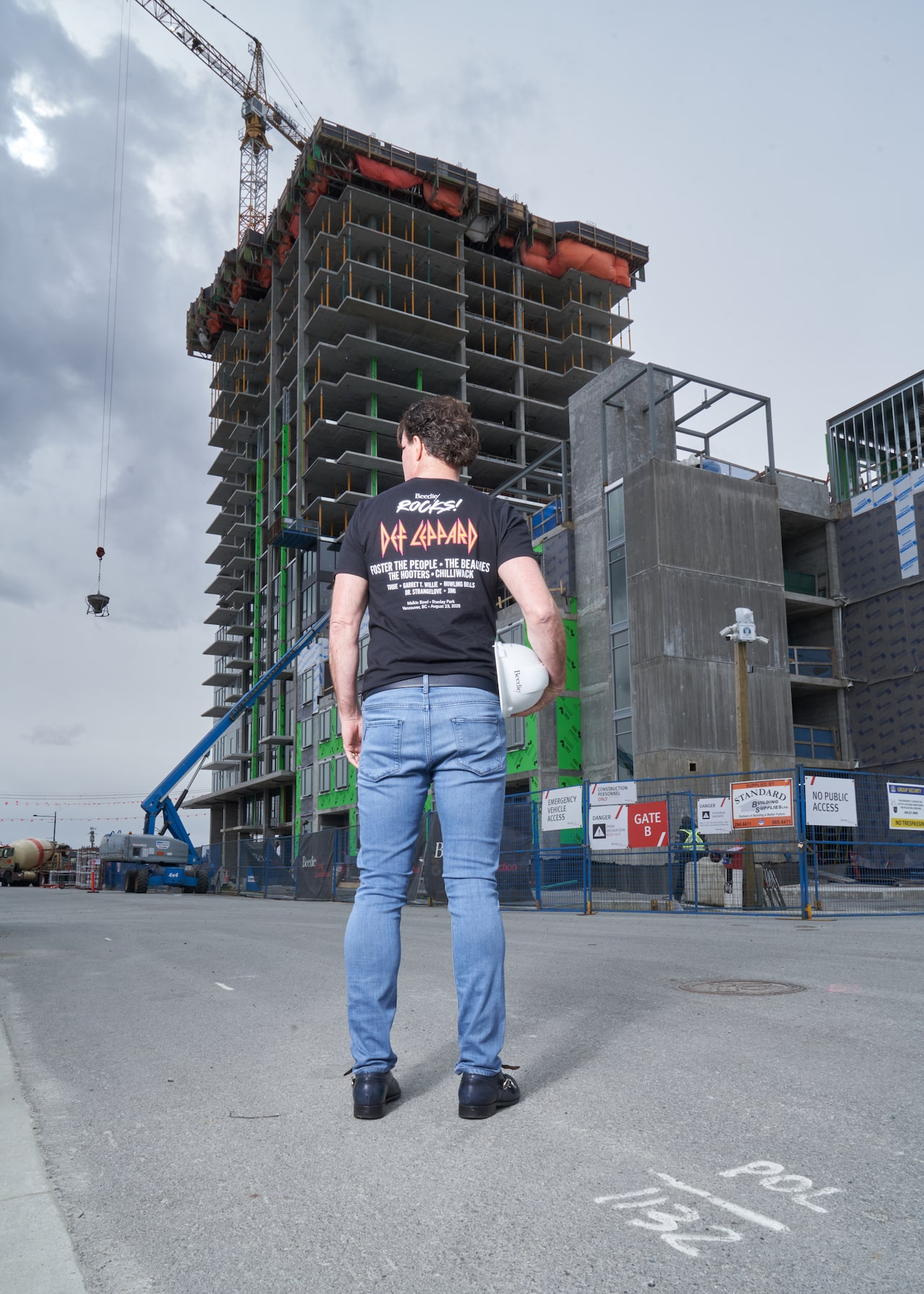
Beedie’s 31-year-old son, Trevor, remembers the first job he got on his own merits, working for a software startup. “I thought to myself, I won’t be in my dad’s shadow anymore,” he says. “Then I stepped into a shadow and looked up.” Blocking out the sun was a building being erected by his dad’s company. “I felt the universe was sending me a message.”
Growing up the son of the guy whose name was on buildings, magazine covers and Simon Fraser University hoodies (the business school is named for Beedie, an SFU alum, and his dad) was hard for an introverted video-game enthusiast. Trevor says he’s “not really much of a numbers guy” and decided he didn’t want to wear a suit to work. He still hasn’t wrapped his head around the fact that his dad is so rich.
He’s trying to establish himself as an online content creator and doesn’t want any attention that he doesn’t earn himself. “It’s been a journey for me to find my own place,” Trevor says. “I don’t know anything about the way succession is going to work. I just know it sure as hell isn’t going to be me.”
His sisters, both in their 20s, are similarly un-involved in the business (all three kids and Cindy sit on the Beedie Foundation board). Grace, the extrovert among them, is an actor who just wrapped a movie with Molly Ringwald. Paige is in L.A. trying to make it as a singer-songwriter. Their parents have helped out and dutifully followed the advice of a family-business expert years ago who told them to let their children forge their own paths. “I just want my kids to be happy and find their own success,” says Cindy, adding she’d be happy if what they wanted was to join Beedie. “But I would never want them to feel burdened by that responsibility.”
But they’re also likely beneficiaries and future owners of a sizeable company. Beedie hopes maybe Trevor’s two kids will assume the mantle some day – Trevor thinks his son might “have an affinity for this” and hopes to expose his children to his dad’s business to pique their interest. “This sounds crazy, but if I hold on long enough, and if I’m okay health wise,” says Beedie, “if the grandkids showed interest and were capable and all those things, you could see a situation where you skip a full generation and hand it off to them.” But his grandkids are just two and four.
“I believe firmly that for society to accept a capitalistic system that has some inequality, those who have had success not only should give back but be seen as giving back.”
– Ryan Beedie
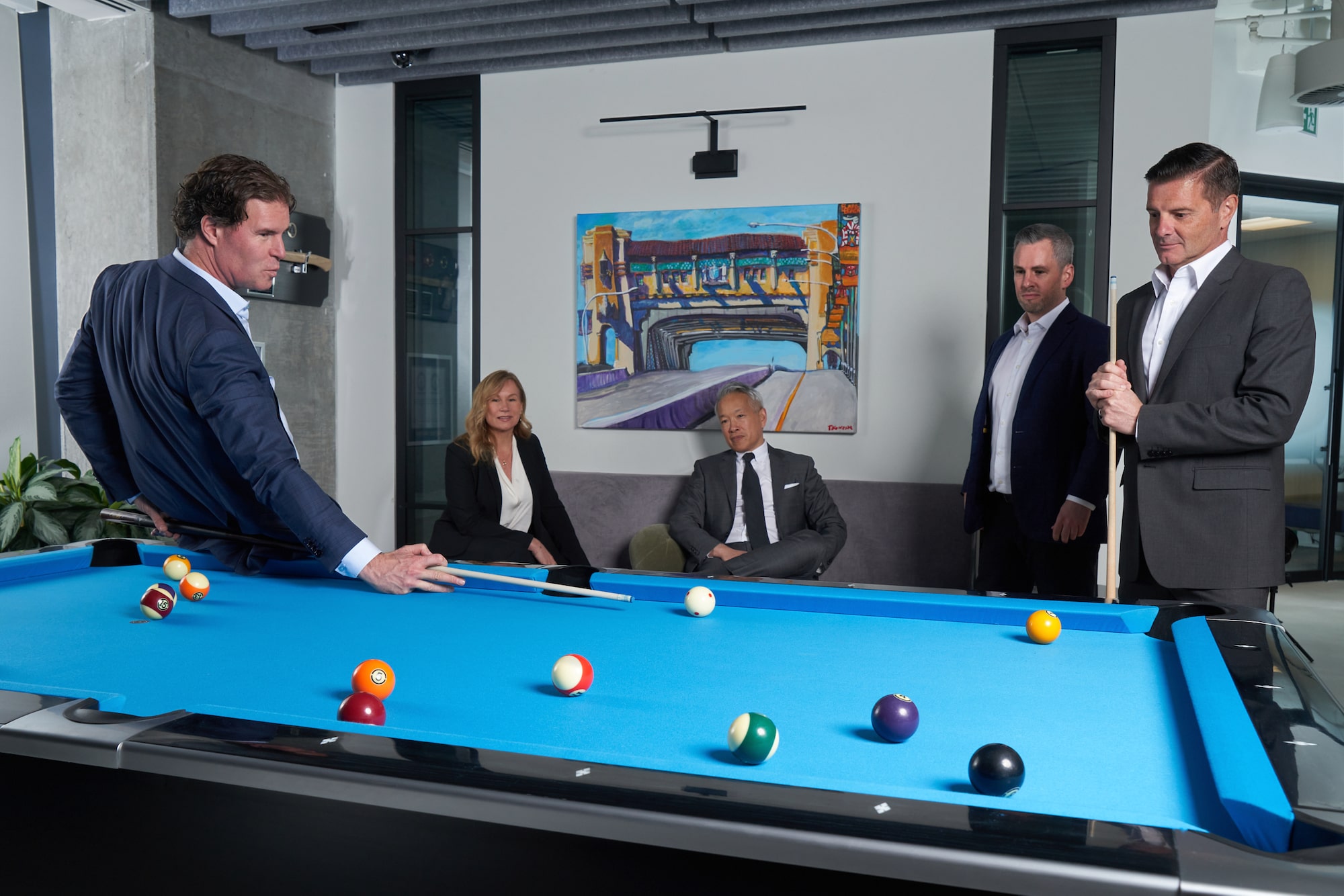
To help the family navigate all this, Beedie has assembled a board of advisers that includes Yuen; real estate lawyer Pat Julian; Amar Doman, CEO of building materials supplier Doman Building Materials Group; and retired KPMG Canada head Elio Luongo. Cindy and Trevor are also on the board.
Its role, says Julian, is to act “kind of like the Senate, where we’re giving him sober second thought.” Mainly, their job is to plan for the hit-by-a-bus scenario; two years ago, Beedie drafted a letter of wishes that would guide what would happen next.
The board is there to help the kids if they want to learn more, get involved and become good owners. “If something happens to me, you’ve got a quasi-governance structure in place” that would become the board of directors, Beedie says. That said, he wants to work till he dies, meaning he’s only half-way through his career, if he lives as long as his dad, as he puts it.
“I keep telling Ryan he has to stay healthy,” Luongo says. “But we are a backup plan.”
Facing the prospect that he’s the end of the line for a two-generation family business is tough for Beedie. He wants it to continue, he says, but “my kids – they’ll be fine no matter what. Do they really need a bazillion dollars? No, if they’re not going to be active owner-participants. I want the enterprise to carry on, but these things don’t have to go on forever.” He wonders to what extent the business should remain owned by the family or maybe a public foundation. “I’d like to get them all to a place where they could be good owners and stewards,” he says. “The door is open to all of them.”
For now, Trevor is starting to get a bit more interested in contributing to the Beedie legacy. He’s come to realize that the dad who grew up longing for his own father’s attention may feel lonely without kids to teach the ways of business. Trevor has decided he wants to show up, “the way he showed up for me during those school recitals and events.”
“I empathize with him,” says Trevor. “That’s why I’m trying to get more confidence regarding business and business administration, and respecting his legacy and being involved. I’d like to be there for him.”
GIVE IT AWAY: A few of Beedie’s philanthropic greatest hits
The Beedies have supported their community for decades, but after mining entrepreneur Seymour Schulich called out Canada’s ultrawealthy for lacking generosity, Ryan stepped up. In 2011, he and his dad donated $22 million for naming rights to Simon Fraser University’s business school. The family has committed $25 million to six Lower Mainland hospitals. Beedie supports Lady Gaga’s Born this Way Foundation and sits on the board of Bono’s ONE organization. A decade ago, he and his wife, Cindy, created a biennial rock festival in Stanley Park that has raised millions for charities, including the Greater Vancouver Food Bank.
But the initiative he’s most proud of is Beedie Luminaries, a $50-million commitment, made on his 50th birthday, to provide scholarships of up to $44,000 to students facing adversity to pursue postsecondary education. Luminaries has funded 1,050 individuals via a nine-figure windfall from one of his mining ventures; Beedie has plans to re-up the bequest.
“Every deal he and I have ever talked about, it’s always ‘How can it benefit the foundation?’” says Nettwerk co-founder and long-time friend Terry McBride. “That guides so much of what he does.”