

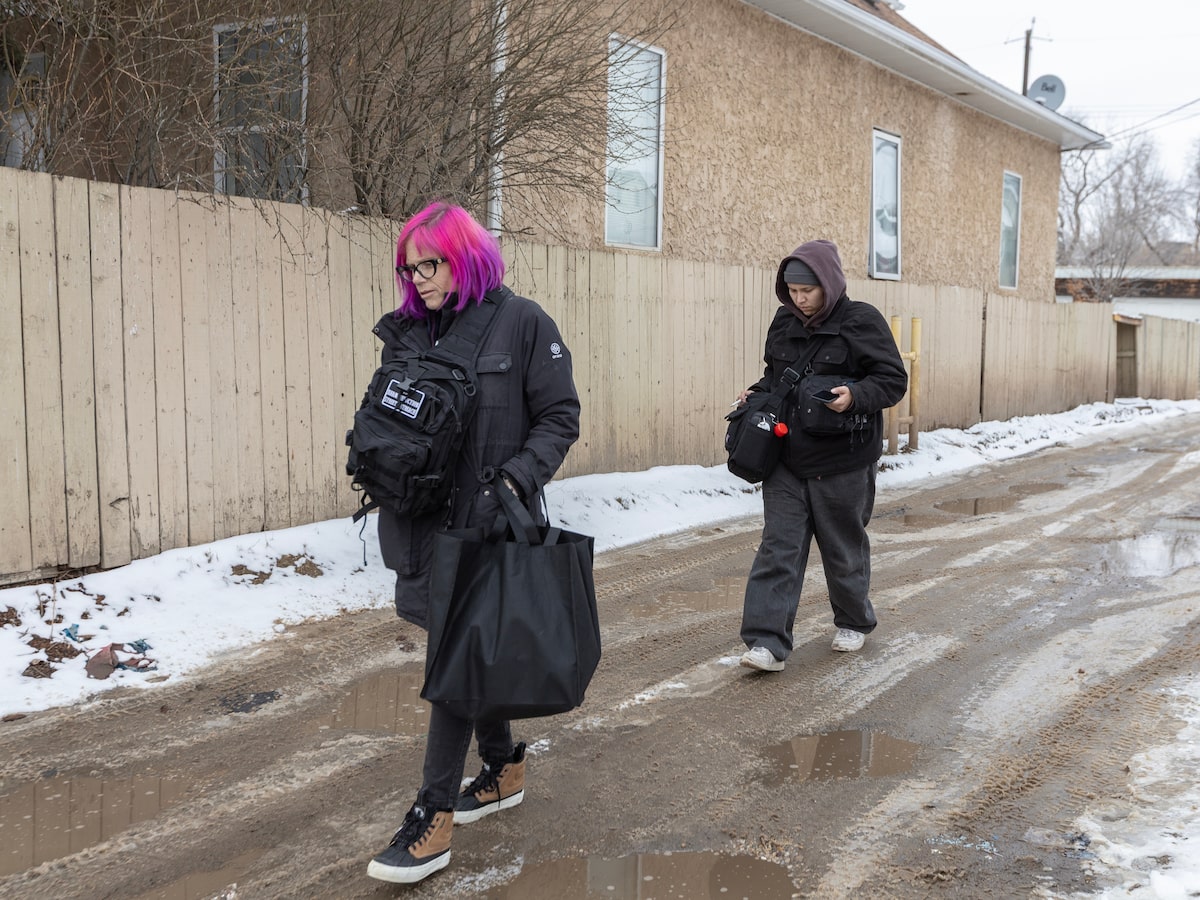
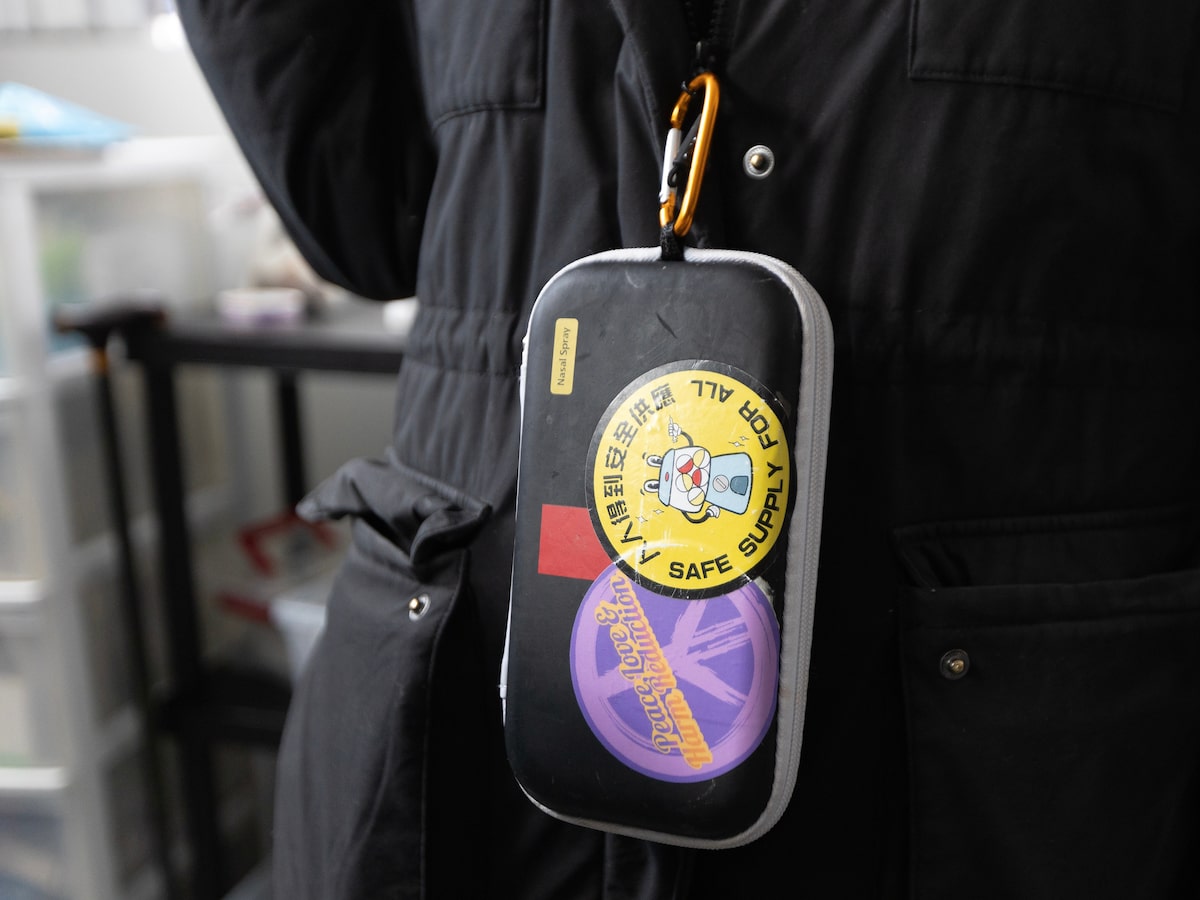
In downtown Edmonton, outreach volunteer Angie Staines digs into bags hanging from her back and arms to fish out safer drug-use supplies for a group that has gathered outside a local health centre. She distributes sterile pipes, needles and cookers to anyone who needs them, while offering snacks, bandages and cigarettes.
It would be easy to lose sight of her among the swelling crowd if it weren’t for her neon pink and purple hair. The signature style has earned her the nickname “purple-haired nurse” among people living rough in Alberta’s capital city.
Ms. Staines, a licensed practical nurse who has spent countless hours trekking Edmonton’s streets armed with naloxone, started a volunteer-led group, 4B Harm Reduction Society, roughly six years ago to honour her son Brandon Shaw. Mr. Shaw, three years into recovery, now volunteers alongside her.
She estimates that she has reversed more than 150 drug poisonings since 2020. Each year, Ms. Staines has the same thought: It can’t get any worse. But it does.
Walking down a snow-covered alleyway in mid-April, she stretches out her finger and points. “I can picture doing reversals there and there and there,” she says. “Only two have I not been able to bring back.”

Drug deaths have been steadily declining in Canada and the United States over the past two years, sparking hushed optimism from government leaders and addictions experts that the drug-poisoning crisis has finally turned a corner. But national figures obscure a more complicated picture at the local level.
While most jurisdictions are experiencing a downward trend, there are significant disparities in pockets of both countries where drug deaths continue to mount. In the U.S., that includes Arizona, Colorado and New Mexico. In Thunder Bay, Ont., the death rate is five times higher than the provincial average.
In some cities, grim annual records are still being broken.
Edmonton is the only Alberta city that surpassed its deadliest year for drug-related deaths in 2025. It is one of seven cities profiled in provincial data, which have been collected since 2016.
The data show 764 people died last year, which nearly mirrors the previous record of 763 fatalities in 2023. However, only deaths that have been certified by the medical examiner are included in the figures, meaning the death tally is expected to further eclipse the previous record once pending cases are certified. Last year represented an increase of 12 per cent from 2024.
There’s no single explanation for why some cities are outliers. Experts say there is a complex interplay of factors, including a highly volatile illicit drug supply and reduced access to support services, such as supervised drug-use sites where people can use substances under medical supervision.
There are also differences in the makeup of a city’s drug-using population. How many people are using drugs, what type of drugs they take and how (through inhalation, injection or snorting) all play a role. Additionally, public-health experts and people who are unhoused have said increased police enforcement is aggravating the crisis.
In Edmonton, the city’s police service has greatly expanded its enforcement against encampments since late 2023, removing tents, people and their belongings from sidewalks and alleyways. Police have defended the efforts as a way to improve public safety and protect the vulnerable.
But Tristan Yateman, who has spent eight years on and off Edmonton’s streets, said police are pushing people into more precarious situations. While being ushered away from the entrance of a grocer in Chinatown in April, she told The Globe and Mail that it feels like there are fewer and fewer places for people who are unhoused to get help and feel safe.
She said people are living deep in the North Saskatchewan River valley and other places far away from public view, where there is no one around to help in the event of an overdose.
Ms. Yateman, 28, said she can’t keep count of how many friends she’s lost to poisoning. “It’s become something I’m used to,” she said. “Most people here, they’ve lost that hope.”
The rapid, continuing evolution of the illicit drug market is a major driver of the crisis.
In particular, public-health experts are gravely concerned about the increasing circulation of “tranq-dope,” which is a mixture of opioids and tranquillizers, such as veterinary sedatives xylazine and medetomidine. This dangerous blend can lead to severe respiratory depression – slow, shallow or ineffective breathing – and increase the risk of poisoning.
Naloxone is a life-saving medication that reverses the effects of an opioid overdose, but it is not effective against other drugs, including sedatives, benzodiazepines and stimulants.
“It used to be that I could go and give somebody one, maybe two doses, and 15 minutes later, they were up and walking away. I would say now, 80 per cent of the time, they are being transported with no level of consciousness,” Ms. Staines said.
Opioids remain the leading cause of overdose deaths.
Fentanyl is the most dominant opioid in Canada, but analogues of the powerful synthetic, which are chemically related to fentanyl and often more lethal, have surged in the drug supply. Carfentanil is one example, estimated to be 100 times more potent than fentanyl.
Elaine Hyshka, an associate professor at the University of Alberta’s School of Public Health, said the circulation of carfentanil helps explain the scourge of Edmonton deaths last year. Provincial data show carfentanil was involved in 69 per cent of fatalities in the region. For comparison, it was linked to just 16 per cent of deaths in Calgary.
Drug-checking services that identify the contents of unregulated drugs are severely limited in Alberta, added Dr. Hyshka, making it nearly impossible for people to know what they are consuming.
“In that context, it’s very difficult to avoid overdose,” she said.
When Dr. Hyshka started tracking carfentanil early last year, there was a simultaneous rash of carfentanil deaths in Saskatoon, which is connected to Edmonton by Highway 16.
Highway corridors are the bloodstream of the illicit drug market, allowing traffickers to move large quantities over great distances. For that reason, these corridors also experience intense supply deviations, noted Ally Arnaiz.
Across the southern border in Denver, Ms. Arnaiz focuses on overdose prevention for the city health department. Denver, like Edmonton, is also on track to have its deadliest year in 2025.
Ms. Arnaiz highlighted Denver’s placement on Interstate 25, a major north-south corridor. She said frequent seizures by law enforcement agencies along major highway routes can drive unpredictability.
Traffickers often pivot to more potent and synthetic alternatives as a replacement because smaller quantities are needed, making it cheaper, faster to produce and easier to conceal. This increases the toxicity of unregulated drugs.
Carfentanil is so potent that even small amounts of it can be lucrative for smugglers. The RCMP seized this carfentanil in a bottle of printing ink imported from China.RCMP via AP
In Alberta, carfentanil seizures have “waxed and waned” over time, but there was a significant decrease in 2024 ahead of last year’s surge, said Richelle Booker, a forensic pharmacologist with Alberta Law Enforcement Response Teams.
She said there are regional differences in the drug supply, but not so much that it explains why Edmonton is faring worse than most other cities. Ms. Booker said it is likely linked to how big the drug-using population is and their drugs of choice.
Provincial data hint at Edmonton having a larger drug-using population. It has the highest dispensation of naloxone, opioid dependency medications and opioid prescriptions for chronic pain management of any Alberta city. The capital also has a bigger unhoused population than Calgary, despite having a smaller population.
Across the country in Thunder Bay, an isolated community in Northern Ontario, Kandace Belanger also points to a larger homeless population as a variable in the city’s burden of opioid-related harms. So too are high rates of poverty, geographic isolation and limited health services.
Ms. Belanger, who manages outreach and harm-reduction programs with the Thunder Bay District Health Unit, added that the city is home to a large Indigenous population, which is disproportionately affected by the drug crisis, with mortality rates up to eight times higher than those of non-Indigenous people.
The latest data from Public Health Ontario show that drug-related deaths have declined in the area from 2024, but the mortality rate is the highest in the province at 44.8 per 100,000 people in the first three quarters of 2025. The provincial average is 8.5.


The artwork around CO*LAB stresses the need for empathy and withholding judgment of drug users.
Ms. Staines, before hitting the wind-whipped Edmonton streets in April, said she has considered ending her non-profit. There are weeks that stretch into months where anger and sadness consume her, but she can’t shake the feeling that if she doesn’t show up for those affected by the crisis, who will?
She knows that the type of outreach she does, which includes wound care, is needed more than ever as other such organizations dwindle. Ms. Staines is thankful that 4B doesn’t rely on government funding, but admits it’s difficult to depend on donations and the “Bank of Angie.”
Politics play a leading role in the crisis, particularly in Alberta.
The governing United Conservative Party has drastically limited access to harm-reduction services in favour of recovery-focused supports. This has included closing supervised drug-use sites and ending funding for safer supplies programs and street outreach groups.
Last March, the UCP closed the only drug-use site in Red Deer, which the government has said did not increase harm. New provincial data show that opioid-related calls for emergency services have reached levels never seen before. In March, the city recorded its highest monthly tally of EMS calls, at 32.
Alberta has said attributing the closing to the increase is “misleading.” Two drug-use sites, down from four, remain operational in Edmonton, but the province also intends to close them. The timing is unknown.

Safeworks, Calgary’s only supervised drug-use site, is due to close its doors this summer. Edmonton still has two supervised sites, but the province plans to close them too eventually.Jeff McIntosh/The Canadian Press
Other provincial governments, particularly those that are conservative-leaning, are taking a similar path to Alberta. Ontario has cut funding or banned nearly every drug-use site in the province from operating, including the only site in Thunder Bay. The prevailing argument is that harm-reduction services fuel – rather than address – addiction.
Marliss Taylor, a registered nurse who recently retired after three decades working with Edmonton’s vulnerable community, said recovery services do little to reduce drug poisonings. She added that not all people who use illicit drugs require or respond to such supports; some are not ready or willing, while for others, it doesn’t meet their needs.
“Imagine that diabetes, which is a very complex condition and has many layers of severity, was responded to by the government saying only one treatment is available. Insulin for everyone,” Ms. Taylor said. “That is what is happening here with a single response to overdose deaths.”


Ms. Staines believes her work is important, but there are times when she has considered ending her non-profit.Alanna Smith/The Globe and Mail
Ms. Staines didn’t head home after hours of outreach last month. She drove across the city to host a 4B event in an Edmonton bookstore, as warm, golden light spilled through its windows. In front of a small group, she taught them how to recognize and respond to an overdose.
Blue lips, slow or stopped breathing and contorted sleeping positions are all red flags, she explained, before her co-host held up a small, glass vial of injectable naloxone. The medication must be drawn out with a needle before the plunger is pressed gently to remove any air bubbles.
It can then be administered, preferably in fatty areas such as the stomach and thigh, Ms. Staines explains. She doesn’t sugarcoat for the audience what is happening in Edmonton.
“I think it’s only going to get worse,” Ms. Staines said. But she stresses that being armed with this knowledge may save lives at a time when it is more crucial than ever. “This is a marathon, not a race.”

Opioids in Canada: More from The Globe and Mail
The Decibel podcast
Fatal overdoses disproportionately kill tradespeople with full-time jobs. To their families, death is an immeasurable loss, but to their employers, the costs are real and quantifiable. Reporter Jason Kirby spoke with The Decibel about what he learned from workers, unions and health researchers. Subscribe for more episodes.
From our ‘Poisoned’ series
Why have opioid deaths declined so sharply in Canada? These five factors help explain why
Taking bold steps on opioids, an Ontario city struggles to find its footing