Patrice Henry and her mother Dorothy Johnson moved through life as a bonded pair. Over decades and across continents, they lived together, travelled together, and had sleepovers every Friday, chatting sleepily in the dark. “I love no one else like this,” Ms. Henry says.
But they did have a fight, once. It was more than four decades ago in Spanish Town, Jamaica, when Ms. Henry was still a teenager, sitting under the ackee tree in the backyard while her mother scrubbed the laundry. That’s when she broke the news.
“She said, ‘my love’ – she always called me ‘my love’ – ’when I die, I’m gonna give up my body to science,’” Ms. Henry recalls. “I’m like, what you mean?
“And then we started cussing.”

Patrice Henry holds a photo of her mother Dorothy Johnson at the ceremony of gratitude at McMaster on May 8.
Her mother was telling her that she wanted to some day donate her body to a medical school, where it would be used to train future doctors. Ms. Henry was furious. How would she visit her grave? Where would she go to lay yellow roses, her mother’s favourite?
They didn’t speak for the rest of the day, and years would pass before Ms. Henry fully accepted her mother’s decision. But Ms. Johnson never wavered in her plan.
On Sept. 27, 2025, Dorothy Louise Johnson – known to most as Daisy – died from lung cancer in St. Catharines, Ont., at the age of 90. But instead of being prepared for burial, her body was transported to McMaster University in Hamilton, where she was received by the anatomy lab.
In doing so, Ms. Johnson became one of hundreds of Canadians who donated their bodies last year, contributing to a millennia-old tradition of using human cadavers to advance medical education and science.
Before ancient physicians made their first dissections, our own bodies were an unexplored land. Human dissection laid the groundwork for everything we now understand about our own anatomy, and the use of cadavers in medical education has endured for centuries despite waves of religious condemnation, public opposition and scandal prompted by grave-robbing or even murder.
Nowadays, budgetary and time constraints pose the bigger threat to anatomy programs that rely on human cadavers, especially in the face of emerging technologies offering cheaper and less ethically complex alternatives.
But many anatomists firmly believe that when it comes to teaching the human body, there is no replacement for the real thing – especially when training students whose future professions deal in matters of life or death.
In Canada, the availability of this critical teaching resource relies entirely on individual acts of radical generosity, and also a leap of faith. While the impact of organ donation is easy to grasp – a life is saved – the benefits of whole-body donation are less tangible and harder to measure.

Surgical tools in the university's anatomy lab.
It takes a special person to gift their own body in the name of education. But it’s a gift that ripples out in ways that are as unpredictable as they are far-reaching; a medical student learns to save a life; a physiotherapist gains a deeper understanding of how to rehabilitate; a researcher takes their first steps toward a cure.
“Their one selfless act is a force multiplier,” says Andrew Deane, McMaster’s assistant dean of anatomy.
Across Canada, this force multiplier effect is playing out every year at the roughly two dozen postsecondary institutions with body bequeathal programs. But it is a rarefied universe, often hidden from view.
This spring, The Globe and Mail was invited into the anatomy lab at McMaster University in Hamilton to meet the people who inhabit a world made possible by the dead – the bequeathal co-ordinators, the educators, the embalmers, the students and the families whose loved ones are gone, but continue to shape the living world.

Lily Harmer, left, and Sarah Harmer, daughters of Alan Harmer, at the ceremony of gratitude at McMaster on May 8.
When Sarah Harmer’s parents first announced their plans to donate their bodies, she instinctively reacted as many people do: by recoiling.
“Thinking of both of my parents on a table, with medical students cutting into them … it’s creepy,” says Ms. Harmer, the Canadian singer-songwriter. “I do remember thinking that’s kind of gross.”
It’s a natural response, one we’re hardwired to have. A body is never just a body; it’s a sacred vessel that once contained a life, a loved one, an entire private universe. And, as many people believe, a soul.
The systematic use of human bodies for medical education began in Italy during the Renaissance, and spread across Europe as universities and medical schools began to proliferate.
But the history of cadaver procurement has dark chapters. In the beginning, medical schools relied on the bodies of executed criminals. The 18th and 19th centuries gave rise to grave robbing – sometimes perpetrated by medical students themselves – and there were high-profile cases of body snatchers who even resorted to murder.
The more recent practice of using unclaimed bodies is ethically fraught, exploiting society’s most marginalized. But today in Canada, the only legal means of acquiring cadavers is through voluntary donation, and ethics and human dignity are paramount. This means that when it comes to ensuring a steady stream of body donations for medical education, the most important currency is trust.
The Harmer children aren’t exactly sure how their parents got the idea to become body donors, but they suspect it was their mother’s idea. On Sept. 19, 2025, however, their father was the first to go.
Days before his death, Sarah Harmer was driving in Oakville, Ont., when she suddenly remembered her parents’ wishes. She pulled over to the side of the road and dialled the number that had been saved in her phone and pinned to her parents’ fridge ever since they first announced their decision.
The person who answered was Maureen Letang. As McMaster’s bequeathal program co-ordinator, she handles all of the administrative work and liaises with donors and their families; she also organizes the annual ceremony of gratitude, a solemn event where the university thanks the donors and their families with tributes from educators, students and a symbolic dove release.
But unofficially, she is the program’s beating heart, the person who infuses the body donation process with the care and humanity that keeps it alive.

As McMaster’s bequeathal program co-ordinator, Maureen Letang handles all of the administrative work and liaises with donors and their families. She also organizes the annual ceremony of gratitude.
Ms. Letang has the safe, inviting presence of a psychotherapist, which people have sometimes mistaken her for. When grieving families call the bequeathal program, it’s almost always her warm and gentle voice on the other line, even when the phone rings in the middle of the night.
Her first task when Ms. Harmer called was to determine her father’s eligibility – does he have communicable diseases such as tuberculosis or Mpox? Does he meet the weight and height limits? An hour or so later, Ms. Letang phoned her back. “We would be honoured to have your father teaching with us,” she said.
The conversation could have been painful, even traumatic. But Ms. Harmer was struck by Ms. Letang’s professionalism and reverence for her father’s personhood and life. “It went a long way for me to think that that’s where my dad would go.”

Lily Harmer holds a picture of her father, Alan Harmer, at the ceremony of gratitude.
For Ms. Harmer, it’s been difficult to think of her father as just a body. Alan Clement Harmer was a shy but charming man full of wit, love and life. He had a wife of 67 years, six children and a sprawling brood of grandkids. He practised quiet generosity, fostering children and sponsoring refugee families.
Ms. Harmer remembers his sweet hands, calming presence and beautiful singing voice. In the clinical context of an anatomy lab, where does all of that go?
“He’s now a body, and the student who is working on my dad – they have no idea the animation that was in that body,” Ms. Harmer reflects. “It’s just a fascinating thing.”
But some of that humanity felt restored when she met Ms. Letang, along with her sister and mother. She remembers Ms. Letang showing them their father’s application form, which he had filled out years ago. And there it was; his handwriting on the page, proof of his existence and the intention with which he executed his final wish.
Tears instantly filled her eyes. “It was so nice to see,” Ms. Harmer says. “Alright dad. We’re helping fulfill what you wanted.”
When a body donor dies, their corporeal form begins a new life. Their body continues to imprint itself upon the world, touching the lives of people that its former occupant never got to meet.

Andrew Palombella, an embalmer and dissector, says when he first started working with cadavers, he couldn’t eat lunch for weeks. Now, he has embalmed at least 561 bodies at McMaster.
At McMaster, the first person to greet them is usually Andrew Palombella, a 40-year-old cycling enthusiast with a thicket of dark, curly hair. Officially, Mr. Palombella’s title is “anatomical technician and demonstrator” but in plainer English, one might call him an embalmer and dissector.
“I’ve studied anatomy since my first year of undergrad and it always just blows my mind,” he says. “How complex it is; how simple it is. How it works out, how it’s put together, the pathologies, clinical applications – it’s endless.”
Anatomy is the language of health science, according to Dr. Deane. So for medical students, anatomy class is basically their version of kindergarten, where they learn the alphabet they’ll need for the rest of their professional lives. “If you can’t speak conversational anatomy, you can’t be a functioning clinician,” he says.
But Mr. Palombella is the first to acknowledge that the view from inside an anatomy lab “isn’t normal.” Whenever new people come through, he always reassures them: “It’s okay to not feel okay.”
And certainly, some people are not. Dr. Deane has come to expect that with every fresh crop of medical students who enter the lab for the first time, one or two will start wobbling or “staring into the middle distance.” He still remembers the student who barely stepped foot inside the lab when she “went down like a slinky” (she wound up being one of the top dissectors in his class).

Surgical residents and fellows work on a table with a body donor during a workshop.Nick Iwanyshyn/The Globe and Mail
When Mr. Palombella first started working with cadavers, he couldn’t eat lunch for weeks. But with time and experience, he’s found ways to cope. Today, he has embalmed 561 bodies at McMaster, sometimes starting his work day sipping coffee from a novelty mug labelled “embalming fluid.”
At McMaster, there are about 145 donors at various stages of “teaching” at any given time. Whenever a new donor arrives, usually within hours of their death, Mr. Palombella’s job is to receive and prepare them. The first task is to remove hospital gowns or medical paraphernalia; if they died by MAID – a group that now comprises about 12 per cent of McMaster’s donors – he’ll remove the clothes they chose for their final day.
After shaving and cleaning the body, the embalming begins. Mr. Palombella always works with a partner – important for both physical and emotional support – and the job is never rushed, even if they’ve been called into the lab at 2 a.m.
Embalming can be as much of an art as a science. In a textbook, a typical anatomical illustration looks like “a 25-year-old Olympian,” Mr. Palombella says; in his lab, he’s worked with bodies as old as 109, many of which have seen the ravages of cancer, muscle loss, or chronic disease.
Circulation issues are a challenge. Embalming fluids are injected into the carotid artery and carried throughout the body via the circulatory system. But if there’s a blockage, the embalming fluid might not reach the lower limbs, meaning Mr. Palombella will have to get creative – going through alternative sites, or using needle injections.
Some level of detachment is required in this work, but Mr. Palombella resists fully dissociating; to do so would be a disservice, he believes. He is moved by signs of the life once lived; the “get well soon” teddy bear that one donor was clutching, or the cyclist whose tan lines from his biking shorts looked identical to Mr. Palombella’s own.

A row of trolleys containing body donors and specimens at McMaster on April 30. There are about 145 donors at various stages of 'teaching' at any given time at the school.
“Things like that – they stay with you,” he says, his voice breaking.
(There have been moments of unexpected levity, too. Mr. Palombella recalls one extremely tall man who joked that staff should cut off his feet so that he could meet the suggested height limit. When he later died, Mr. Palombella unzipped his body bag to discover the man had tattooed a dotted line across his shins, along with the words: “cut here.”)
For Mr. Palombella, he considers himself a steward of the people who gifted society with their most precious and personal possession. And in the anatomy lab, he is their most constant companion; often the first to greet them, but also the one to bid them farewell, preparing their remains for cremation.
“One of the last things they ever decided to do was to donate here, so people could learn off them,” he says. “We care for these people. They decided to be here and their families accepted them being here. And we take that very seriously.”
Walking into an anatomy lab, the first sensation isn’t what you see, but what you smell. The sickly sour odour of embalming chemicals invades your nasal cavity somewhere deep and tender, where it stubbornly lingers long after you leave.
The sights, however, are engrossing. There are rows of shelves filled with preserved organs and body specimens; a kidney encased in lucite, or a pancreas floating in a Tupperware of preservative. There is a literal closet full of skeletons, and metal trolleys where medical students can examine everything from a limb to a lumbar plexus.
“The way to think of this room is that it’s the library,” Dr. Deane says. “Come in and look at whatever anatomy you’re interested in.”
In his 25 years teaching anatomy, Dr. Deane has watched the field evolve. The pandemic placed unprecedented pressures on anatomy programs, which have always been expensive, complex and fraught with ethical considerations. (It costs McMaster about $8-million a year to run the anatomy lab and $250,000 for the bequeathal program, which isn’t allowed to make a profit).

Andrew Deane, McMaster’s assistant dean of anatomy, says 'if you can’t speak conversational anatomy, you can’t be a functioning clinician.'
Some medical schools are also turning to new technologies, such as VR headsets and touchscreen tables that can display a real, digitized body, allowing students to perform “virtual dissections.”
But these newer technologies fail to capture human variation, nor can they replicate the power of touch-based learning, Dr. Deane says. “You need to interact,” he says. “You’d never want … a pilot that hadn’t been in an actual plane.”
Aside from teaching anatomy, donors’ bodies have other important uses, including for research. This was the case with Rebecca Grundy, a vibrant 35-year-old woman who worked as a lobbyist with the government of Ontario and died in January, 2025, from glioblastoma, a devastating and incurable brain cancer.
In the anatomy lab, Ms. Grundy has now been a “teacher” to students in nearly every program, from medicine to midwifery. But her brain was also gifted to a glioblastoma research project, which is studying how these complex tumours evolve over time.
This research has already identified new therapeutic targets and the data it yields will be made available to researchers worldwide. It’s a fitting legacy for someone like Ms. Grundy, who was the living embodiment of generosity, her sister Christina Pageau says.

Christina Pageau holds a picture of her sister, Rebecca Grundy, a 35-year-old who worked as a lobbyist with the government of Ontario and died in January, 2025, from glioblastoma.
“This isn’t just an ending for my sister, but a continuation of who she is and was,” she says. “Me and my family find a lot of comfort in knowing that she’s still making an impact.”
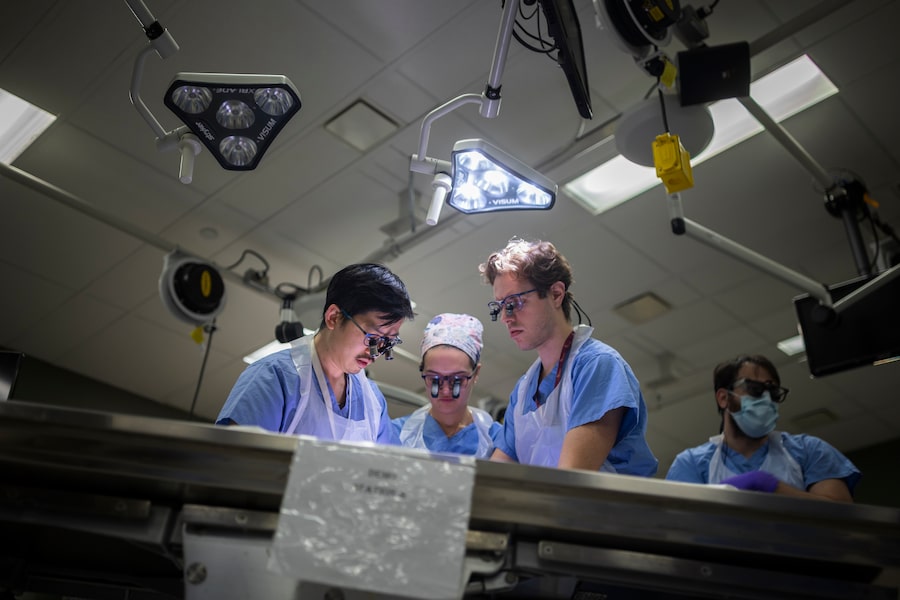
And of course, cadavers are critical for teaching surgical skills. On a recent Thursday, six cadavers were laid on steel tables under the bright glare of operating room lights, where they were used for a surgical course on peripheral nerves.
As an instructor demonstrated an ulnar nerve release – an increasingly common surgery in our modern age, as a treatment for “cellphone elbow” – about a dozen medical residents, rehabilitation professionals and visiting surgeons from as far as Argentina craned their necks to get a closer view of the “patient,” asking questions or swapping techniques and ideas.
Afterward, the learners split into smaller groups to practice what they learned. One of them was Inyani Keri, a third-year neurosurgery resident at McMaster, who aspires to become an epilepsy neurosurgeon. He is already performing three or four spinal surgeries a day but when it comes to carpal tunnel surgeries, he’s only so far done a few.

Surgical residents and fellows gather around a table with a body donor during a peripheral nerve workshop.
At one point, a fellow suggests that he be more aggressive with his incision. But Dr. Keri is hesitant.
“I’m scared,” he admits good-naturedly, handing over the scalpel for the fellow to demonstrate.
Dr. Keri, a refugee from South Sudan, is the first person in his family to become a doctor or surgeon. Throughout his training, he has been deeply touched by the donors who’ve gifted their bodies to his education.
He says the knowledge these strangers have given him is invaluable; when you touch an internal structure, or feel the contours of an organ, it’s a lesson that stays imprinted in your memory forever.
And for him, the donors have also imparted a deeper lesson.
“It’s reinforced … that the centre of the whole industry is the patient, and preserving the dignity of the patient,” he says. “This is a human being.”

Ms. Letang hugs Patrice Henry, daughter of Dorothy Johnson, at the ceremony of gratitude on May 8.
That day in Jamaica, when Dorothy Johnson first announced her plan to donate her body, she said something else that stayed with her daughter far longer than that initial flash of anger.
“She touched me like this,” Ms. Henry remembers, tapping her own heart. “She said your flowers will always be here. I will never leave you.”
In the decades since, Ms. Henry has come to not only accept her mother’s choice, but admire it. She recently did something that would have been unfathomable to her teenaged self; she updated her will to say that she, too, would be donating her body to medical education.
And when her own “teaching” time is over, Ms. Henry wants to be interred next to her mother at the McMaster University crypt. It will be her and her mama, together again.
This, too, is how body donation becomes a force multiplier. Ms. Henry has now heard from several people who’ve been inspired by her mother to consider body donation. Ms. Pageau, Rebecca Grundy’s sister, was so affected by her experience that she is now thinking about becoming a bequeathal co-ordinator herself.
For the Harmer family, they’ve already felt the reverberations from the kind of gift their father chose to leave behind. Days after Mr. Harmer’s death, his eldest daughter Lily went to see her family doctor and mentioned her father’s decision to donate his body to McMaster.
Her doctor was taken aback; she herself had studied at McMaster, where she’d learned from a body donor. She remembers the deep respect she had for that person, and always wondered about their life and family.
For Ms. Harmer, who was still grappling with her father’s decision, it felt like the universe was showing her the true meaning of his last, generous act.
“I was just like, Oh my God. Here I am being treated by a doctor, who was helped by someone just like my dad,” Lily Harmer says, smiling through tears.
“It was like a circle.”
Editor’s note: Due to an editing error, an earlier version of this story misidentified Lily Harmer in a photo caption. It has been corrected.

Family members of donors release doves after the ceremony of gratitude.