
Care Between the Lines is a summer series, which will introduce you to volunteers in health care who fill gaps and provide compassion in a system that can be isolating and scary.
Rosie, Ruby and Charlie weren’t the usual visitors at the Village Langley, a unique community for people living with dementia in Langley, B.C.
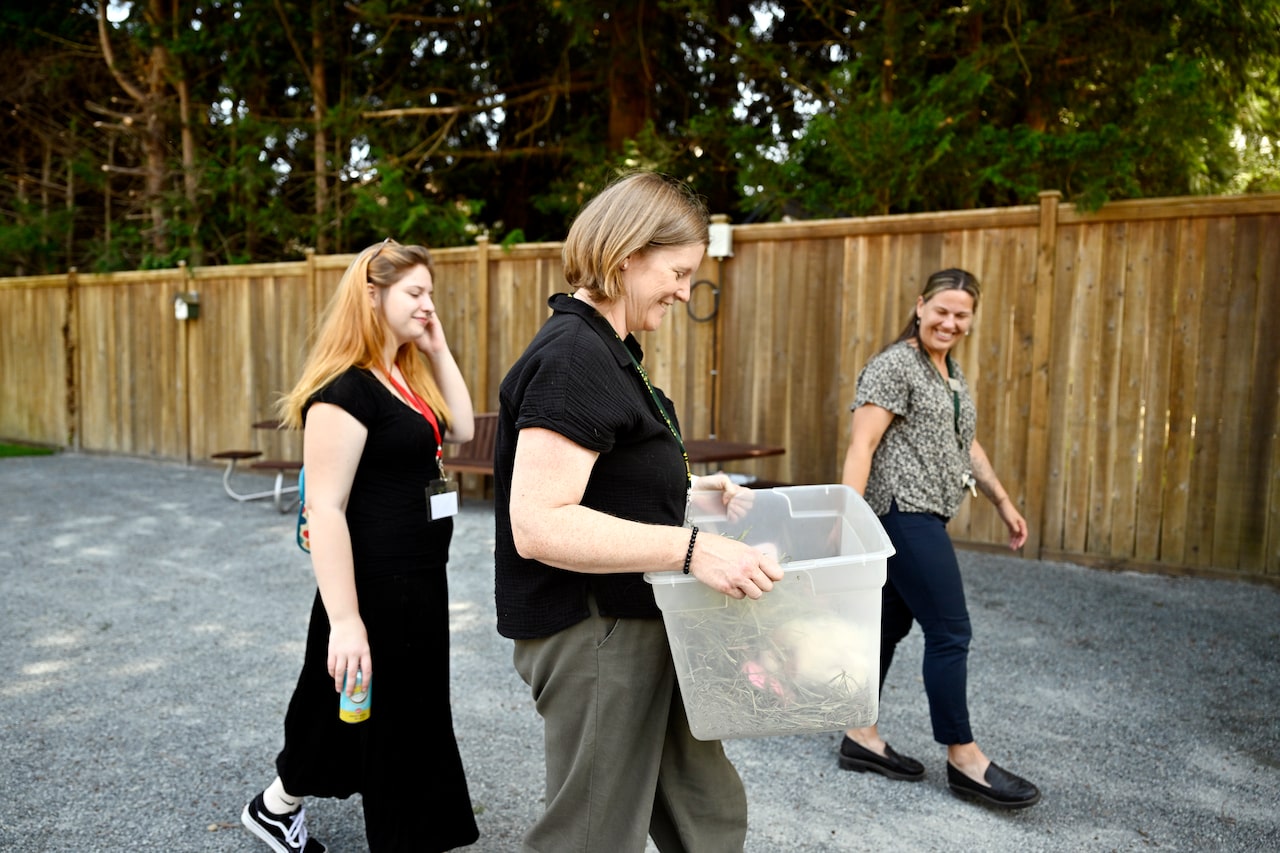
On a sunny day in July, the three guinea pigs came along with Brenda and Celeste Archer, a mother-daughter team who’ve been volunteering with residents here since the spring of 2024.
In that time, Ms. Archer, 48, and Celeste, 16, have come to know the seniors well. For many, pets and farm animals have been a big part of their lives.
With their white and caramel manes and tiny pink paws, Charlie, Rosie and Ruby proved popular on their visit. The seniors loved Rosie’s long hair, nicknaming her “Toupée” and “Fabio.” They were amused, watching Ruby wolf down the lettuce they’d grown themselves in a vegetable garden outside. And they appreciated that Charlie, 7, was enjoying her own relaxed life as a senior. Several nurses joined to cuddle the trio – a moment of reprieve for them, too.
Like other volunteers in Canadian nursing homes and long-term care, Ms. Archer and her daughter offer relief not just to residents, but to their families and the nurses, support workers and facilitators juggling care duties here. The mother-daughter volunteers play a vital emotional role, keeping residents company, listening the way friends would, and drawing them out into the community.
“They are wonderful,” said Natalie Podwinski, the village’s life enrichment manager. “They do make the difference.”
Opened in 2019, the Village Langley provides assisted living support and long-term and complex care for up to 78 residents with mid- to late-stage dementia, neurocognitive disorders and various memory-related conditions.

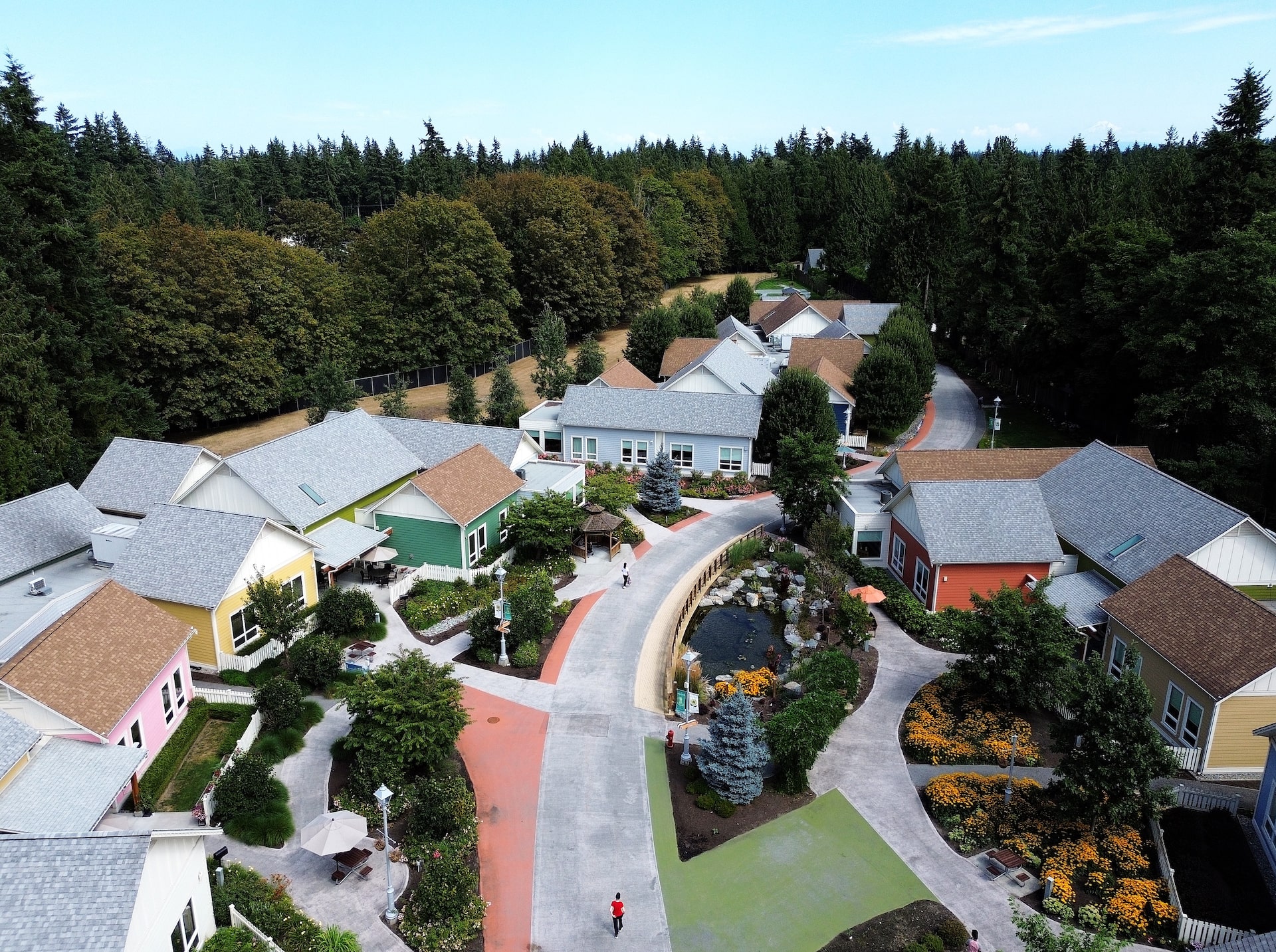
The Village Langley is a unique cottage-style retirement community that offers residents with complex care needs a fuller life than what can be had at many traditional long-term care facilities.
Following similar models in the Netherlands, it was designed not to feel like a hospital. Set on five wooded acres, the place is a throwback to the fifties, with white picket fences, ornate street lamps and six cottage-style homes splashed in retro hues of rust and avocado green. There’s a general store and café, a hair salon, an art room and workshop, a koi pond, gardens and a barn with chickens and goats.
Residents are free to stroll outdoor paths, with the village secured by seven-foot fencing set back discreetly in the tree line. The idea is to try and give people here a full life, instead of warehousing them.
While the privately run community may be out of reach for many families (monthly residency fees start at $11,740 for assisted living, and $15,740 for extended and complex care), it’s an innovative model helping fill a growing demand for care.

As of last year, more than 770,000 people were living with dementia in this country, according to the Alzheimer Society of Canada. That number is estimated to rise to 1.7 million people by 2050, a jump of 120 per cent. Even a decade ago, the combined health care system and out-of-pocket costs of dementia were estimated at $10.4-billion, a figure set to grow as the need for specialized care increases.
This summer, researchers from Simon Fraser University in B.C. and McMaster University in Hamilton are studying how aspects of the Village Langley affect seniors’ quality of life, mobility, social engagement and participation in activities. Specifically, they’re interested in the village’s use of the Green Care Farm approach, which blends long-term care with time outdoors, horticulture and animal care to promote autonomy, cognitive stimulation and emotional well-being for those living with dementia.
The researchers are looking at implications for programs and policy in Canada, and the potential for other countries to learn from this care model, said Habib Chaudhury, a Simon Fraser University gerontology professor who is one of the research leads. The team aims to publish its findings in late 2027.
By this November, Ms. Podwinski hopes to double the ranks of volunteers at the village from 20 to 40.
“The more volunteers, the better,” she said, explaining that their companionship helps stave off loneliness, which can bring its own negative health effects.
Ms. Archer and Celeste are the only mother and daughter duo among the current roster, and Celeste is also the youngest, arriving when she was in Grade 9 and considering a career in health care.
The family’s connection is also personal: Ms. Archer’s grandmother had dementia. Ms. Archer wishes she could have aged in a place like this, instead of a more institutional setting.
Since arriving, the two have formed close connections with the residents, or villagers as they’re known here.
“I don’t think they remember our names, but a lot of them see us as people they can trust,” Celeste said. “A familiar, safe face,” her mother chimed in.
The volunteers know who comes to musical bingo night just to dance. They know the senior who loves feeding chickens, who stows away extra feed in her pockets as the birds climb in her lap. Another resident grows upset in the evenings, riding waves of emotion as they stroll together. They’ve learned that she calms while recounting her childhood playing baseball – the tomboy who never fit in.
“You could find someone who is, at that moment, in upset, despair or confusion because of the symptoms of their dementia. If you can get them to come out of the house and participate, you see how a light switch flips. They are able to find parts of themselves that are happy and engaged,” Ms. Archer said.
“Each moment you spend with people who need help, love, friendship, attention and care – you get something back instantly from it.”


With the village’s 103 paid staff members often caring for multiple elders at the same time, volunteers excel at the more personal touches.
“The small details – they matter,” Ms. Podwinski said.
Celeste, who loves Pinterest, and her mom, a seasoned Girl Guides leader now in retail, are naturals at arts and crafts. With the seniors, they’ve made cards for Valentine’s Day and bookmarks for back-to-school. They’ve led paint nights and picked flowers together in the garden. Celeste joined the village’s baking program, making strawberry blondies and red velvet cookies with residents.
They’re also here to support families. They’ve been moved, watching grandchildren accompany a resident grandparent out to the barn, or seeing multiple generations share Christmas dinner in the bistro. They’ve sat with adult children distraught about how dementia changed their parents, sharing stories about who they were before the diagnosis.
“They can trust that when they go home, there’s still someone here talking to their dad,” Celeste said.

She remembers listening to orchestral music with a resident, who remarked that her mother would take her to the orchestra in the 1850s. It was clearly impossible, but the teen didn’t interrupt.
“It’s important not to get stuck on the details,” Celeste said. “It was about learning that she likes music. That’s what she appreciates.”
In the dementia care sector, more attention is now paid to educating families on how to communicate more empathetically with loved ones who have this condition. Ms. Archer wishes her own mother had this kind of guidance and support when her grandmother was diagnosed with dementia.
“With my own family’s experience, something my mom expressed struggling with was that you have to meet people where they’re at, where their brain is at in that moment,” Ms. Archer said. “If their brain thinks it’s a time that was 20 years ago, that’s where they are. Meet them there, be there with them, and figure out how to make that place feel okay for them.”

Since arriving two years ago, the mother-daughter volunteer duo have formed close connections with both the residents and their families.
Each time they set foot in the village, the mother and daughter find themselves learning from elders.
“As a volunteer, maybe you’ve worked all day, or you’ve got homework, or a house to clean. Maybe you have something stressful going on. You think, ‘Oh, but I’ve committed to going.’ As soon as you walk through the door here, it just all goes away,” Ms. Archer said.
“This older generation, they know how to enjoy the simple things in life. A cup of tea, a conversation, putting on the radio – these are ways to be peaceful. The rest of us younger people have managed to complicate our lives in a lot of ways that they haven’t.”
Her teenage daughter feels it too. Some friends have seemed bewildered by her choice to volunteer in a dementia village.
“With a lot of younger people I’ve talked to about my experience, they’re so afraid of death, they don’t want to be around old people,” Celeste said.
“But all I see there is life – 90-year-olds living every day to its fullest.”
Care between the lines
Volunteer drivers go the distance to bridge rural Saskatchewan's health care transportation gaps
Women’s Auxiliary Volunteers at SickKids bring warmth to patients and their families