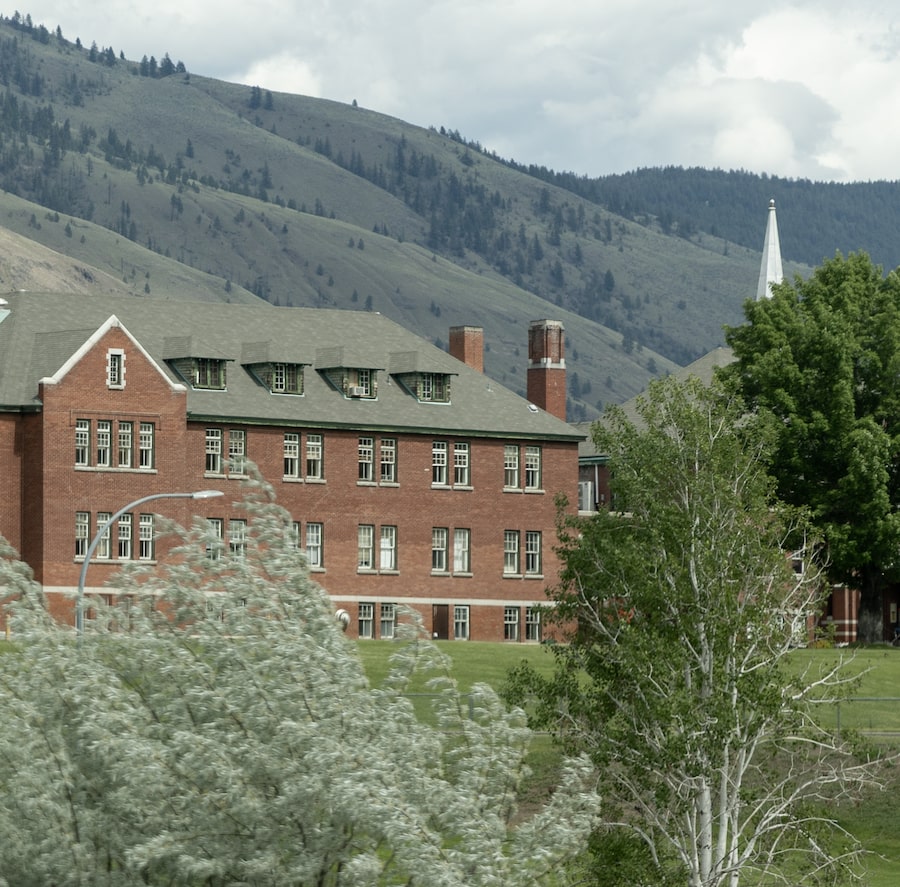
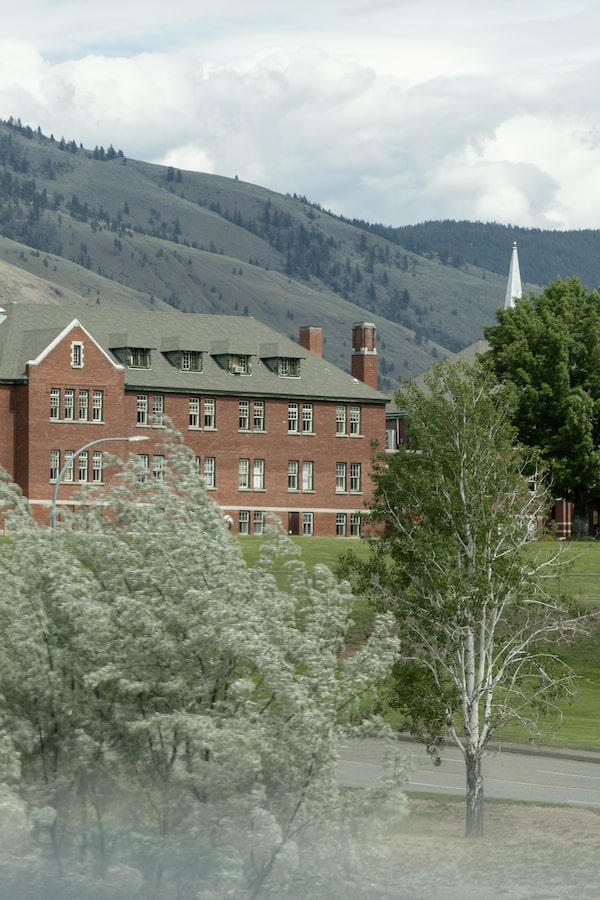
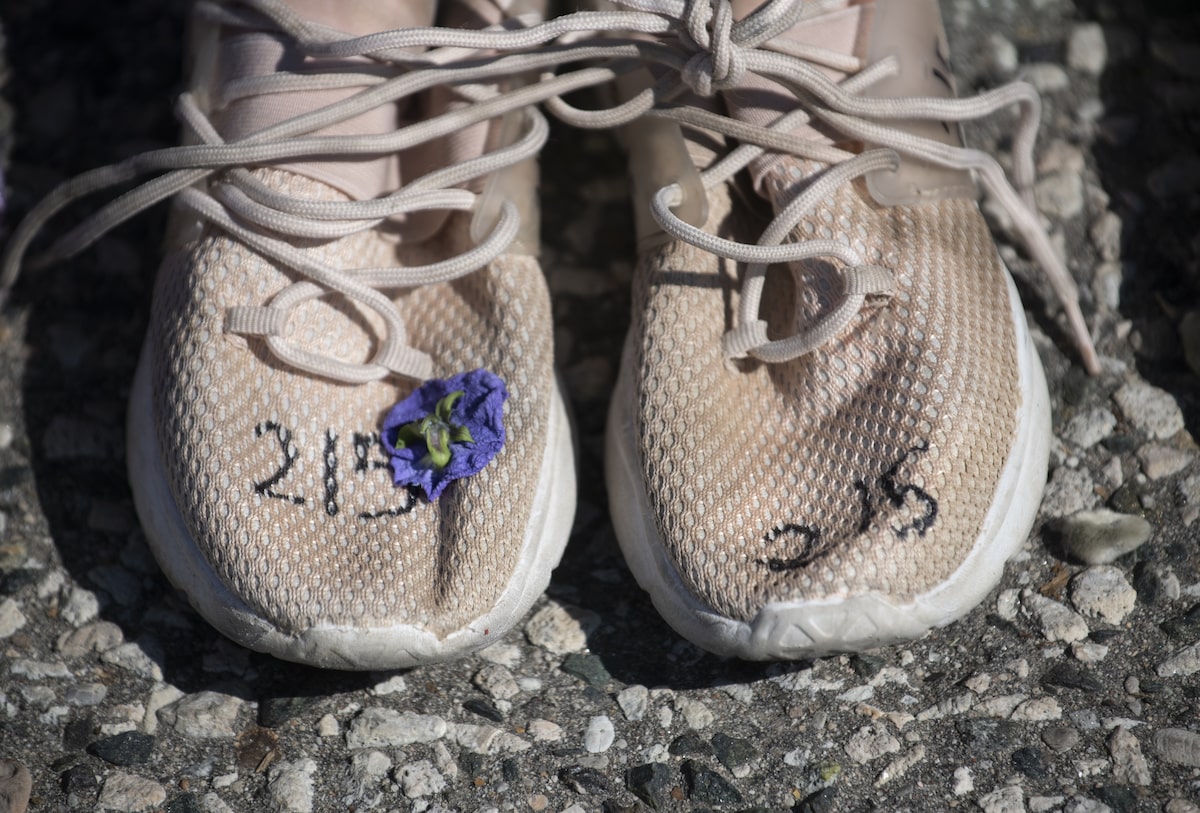
Five years ago, Rosanne Casimir, Chief (Kúkpi7) of the Tk’emlúps te Secwépemc First Nation, issued a 600-word press release that broke the country’s heart. The announcement said that using radar technology, her community had found the remains of 215 former residential school students, some as young as three years old.
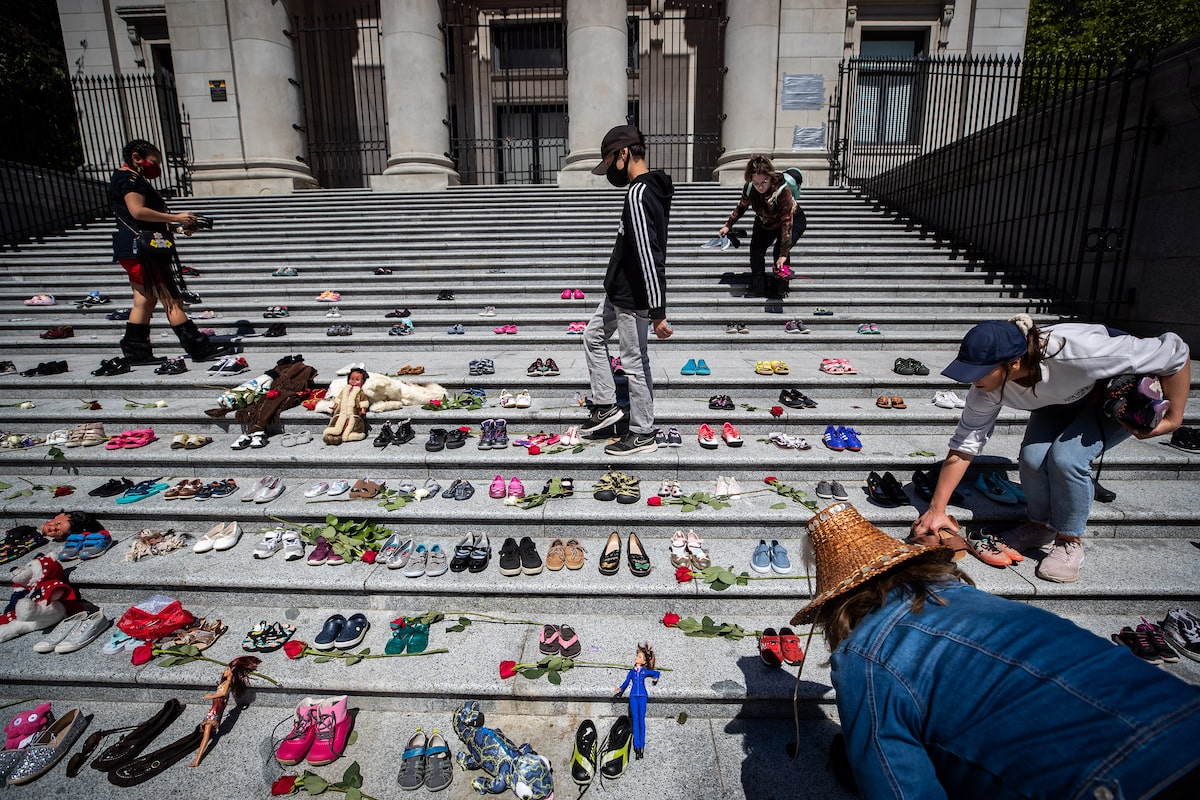
The announcement touched off an unprecedented period of national grieving. Ottawa lowered flags for five months, established the National Day for Truth and Reconciliation and sent hundreds of millions of dollars to First Nations searching for missing victims of residential schools. Across the country, people held vigils, tied orange ribbons to power poles and fence posts, created symbolic displays of kids’ shoes outside churches and government buildings. Pope Francis apologized to residential school survivors in 2022.
But five years on, the country is still trying to understand what it is the First Nation found at the Tk’emlúps site, in an old apple orchard. The truth remains buried by two acres of dirt and a Tk’emlúps leadership that has, so far, resisted demands to bring up the dead.

Since the announcement in 2021, the story of the Tk’emlúps 215 has moved from certainty to ambiguity. Ms. Casimir’s first press release said the community had located “the remains of 215 children.” Her latest, issued on Feb. 17 of this year, is a model of equivocation: “As with any investigation, circumstances evolve as assumptions are tested, data is verified and new information emerges,” it states. “While the investigation has been more complex than we initially thought, we are making progress and will continue adapting our methodologies and information as it advances.”
The uncertainty has given rise to a loud contingent of skeptics and denialists. Many insist that the community’s reluctance to provide more information – or conduct an archeological dig that would prove, once and for all, whether bodies lie beneath the site – is proof of a vast hoax that warrants a serious reassessment of the country’s broader push for reconciliation. B.C. MLA Dallas Brodie, who was expelled from the provincial Conservative Party caucus last year over her views on residential schools, has called the Tk’emlúps discovery “the greatest lie in Canadian history.”

Children who died at the residential school are known as Le Estcwicwéy̓ (the missing) in Secwepemctsín, the language used on this stop sign near the site.Alison Boulier/The Globe and Mail
But hundreds of pages of government documents obtained through access-to-information legislation, along with interviews with members of the First Nation and a video recording of a seminar on the investigation, all undermine those disparagements and give insight into the delays.
Facing relentless requests from international media and growing skepticism around their claims, the community initiated an informal media blackout, leaving the narrative around the site to conjecture. But behind the wall of silence, they were following federal guidance, conducting new searches and laying out a detailed plan to dig the site by 2027 – all on their own terms and timeline.
And regardless of what they find, the fact remains that more than 3,500 children are named on the National Centre for Truth and Reconciliation‘s registry of students who died as a result of the residential school system, which operated in Canada for more than 160 years.
But even knowing that, Canadians have become impatient for news of the investigation. An Angus Reid poll last summer found that 63 per cent of Canadians won’t accept that children are buried at the Tk’emlúps site until excavation provides further evidence. On social media, a more toxic tone has taken hold, with accounts posting the slogans “#stopthegrift,” “Every Hoax Matters” and “Dig Up or Shut Up.”
One First Nations leader says only the truth can stop that sentiment from metastasizing. “A lot of the comments call me a grifter and call other leaders grifters, saying that we’re just out to take taxpayer dollars,” said Aaron Pete, Chief of Chawathil First Nation, a Stó:lō community located 170 kilometres southwest of Kamloops, who has interviewed many Tk’emlúps critics on his podcast. “I understand that it’s a small minority, but if those comments don’t get responded to with open dialogue and debate, my fear is that those voices will continue to grow and build the divide between Canadians and Indigenous people.”


Tk’emlúps means ‘where the rivers meet’ in Secwepemctsín, a language the residential school forbade children from speaking. Some survivors of the school grew up hearing stories of burials nearby.Alison Boulier/The Globe and Mail
The old orchard overlooks the Secwepemcétkwe, or South Thompson River, a wide stretch of water meandering through a valley that has served as the arid backdrop for movies set in Afghanistan, Mexico and California.
Last summer, an area of fencing placarded with “KEEP OUT” warnings was the only suggestion of the tragedy and controversy surrounding the site.
Much of the area around the orchard is easily accessible. Sculpted animals representing cultural values surround the inside perimeter of a large open-roofed log roundhouse that hosts the nation’s annual summer powwow.
Inside the band office halls, just a short walk from the powwow grounds and adjacent to a museum and heritage park, Ms. Casimir greeted a reporter.
For nearly five years, she had not responded to Globe interview requests. Those requests began in the days immediately after the announcement, when it became clear that the nation had yet to uncover any physical remains. Instead, an archeologist hired by Tk’emlúps, Sarah Beaulieu, had used a ground-penetrating radar device to locate 215 underground abnormalities that she said were consistent with the size, depth and layout of human burials.
At a news conference held seven weeks after the original announcement, Dr. Beaulieu tried to clarify precisely what she had and had not found. After reviewing a previous dig that had uncovered no remains on a portion of the orchard site, she revised the number of suspected graves down to 200 while injecting uncertainty: “With ground-penetrating radar we can never say definitively that they are human remains until you excavate,” she said, “which is why we need to pull back a little bit and say that they are probable burials.”
How does ground-penetrating radar work?

Ground penetrating radar, or GPR, is increasingly
being seen as an effective tool to locate
unmarked gravesites, such as those believed to
be present around Canada’s residential schools.
But experts say the work requires careful meth-
odology, protocols and standards to ensure the
findings are accurate and warn that the stakes
are high.
Sites are divided into grids to ensure accurate data collection
Monitor
Operator
Antenna
Control
unit
High-
frequency
radio waves
GPR works by passing back and forth over a
gridded survey site with a portable cart-mounted
unit. The control unit emits a continuous series of
high-frequency radio waves, which pass through
the ground. The strength and rate at which this
electromagnetic energy is reflected back from
various materials is measured. Different substanc-
es have various capacities to store or reflect elec-
trical energy; metal has a high capacity to reflect
energy, while dry sand has much less. The data is
then displayed as a radargram that can be inter-
preted by experts.
Example of
a GPR cross-
sectional
radargram
JOHN SOPINSKI AND murat yükselir /THE
GLOBE AND MAIl, sources: leica; geomodel
inc. (radargram); sensors and software
inc.; groundpenetratingradar.co.uk; geo-
physical.com

Ground penetrating radar, or GPR, is increasingly
being seen as an effective tool to locate unmarked
gravesites, such as those believed to be present
around Canada’s residential schools. But experts say
the work requires careful methodology, protocols and
standards to ensure the findings are accurate and
warn that the stakes are high.
Sites are divided into grids to ensure accurate data collection
Monitor
Operator
Antenna
Control
unit
High-
frequency
radio waves
GPR works by passing back and forth over a gridded
survey site with a portable cart-mounted unit. The
control unit emits a continuous series of high-fre-
quency radio waves, which pass through the ground.
The strength and rate at which this electromagnetic
energy is reflected back from various materials is
measured. Different substances have various capaci-
ties to store or reflect electrical energy; metal has a
high capacity to reflect energy, while dry sand has
much less. The data is then displayed as a radargram
that can be interpreted by experts.
Example of
a GPR cross-
sectional
radargram
JOHN SOPINSKI AND murat yükselir /THE GLOBE AND
MAIl, sources: leica; geomodel inc.(radargram);
sensors and software inc.; groundpenetratingra-
dar.co.uk; geophysical.com

Ground penetrating radar, or GPR, is increasingly being seen as an
effective tool to locate unmarked gravesites, such as those believed
to be present around Canada’s residential schools. But experts say
the work requires careful methodology, protocols and standards to
ensure the findings are accurate and warn that the stakes are high.
Monitor
Operator
Antenna
Control
unit
High-
frequency
radio waves
Sites are divided into grids to ensure accurate data collection
GPR works by passing
back and forth over a
gridded survey site with
a portable cart-mounted
unit. The control unit
emits a continuous series
of high-frequency radio
waves, which pass
through the ground. The
strength and rate at which
this electromagnetic
energy is reflected back
from various materials is
measured. Different sub-
stances have various
capacities to store or
reflect electrical energy;
metal has a high capacity
to reflect energy, while
dry sand has much less.
The data is then displayed
as a radargram that can
be interpreted by experts.
JOHN SOPINSKI AND murat
yükselir /THE GLOBE AND
MAIl, sources: leica; geo-
model inc. (radargram);
sensors and software inc.;
groundpenetratingradar.
co.uk; geophysical.com
Example of
a GPR cross-
sectional
radargram
Interpreting ground-penetrating radar readings is an imprecise science – more like interpreting a weather map than, say, reading an MRI.
Inconsistencies in the soil – such as rocks, water and roots – show up as indistinct radar blips that have to be interpreted for size and density. Like a meteorologist predicting the next cold snap, an archeologist will assign probabilities for each blip. Depending on its shade and shape – wavy, conical, vertical – an experienced GPR technician can surmise what the anomaly is. It’s a science, but one built on probabilities. Even the weatherman doesn’t always get it right.
Recently in Tulsa, Oklahoma, archeologists used ground-penetrating radar and oral stories to pin-point what they believed was a mass grave from the city’s 1921 race massacre. When they excavated the area in 2020, they found construction debris, artifacts and dirt, but no remains.
“It demonstrated exactly why you don’t claim too much from anomalies,” said state archeologist Kary Stakelbeck in an interview. The Tulsa search has since uncovered remains in other areas.
There are ways of limiting the uncertainty without excavating. When radar is combined with two other search methods – human-remains detection dogs and a new technology called soil spectroscopy – searchers can determine with almost 100-per-cent certainty whether buried remains are present, according to Kisha Supernant, Director of the University of Alberta’s Institute of Prairie and Indigenous Archaeology.
“If all those methods coalesce around a specific location, that’s about as close as we can get to saying there’s a human burial in that location without excavation,” said Dr. Supernant, who has worked on more than a dozen school searches over the past four years.

Kisha Supernant is an expert in searching for buried human remains, and has worked on several searches of residential school sites.Jason Franson/The Canadian Press
With soil spectroscopy, a light-emitting probe capable of detecting the fatty acid salts associated with decayed remains is inserted in the ground. As it moves through the soil, the thumb-sized probe sends back instantaneous chemistry readings, meaning the salts can be detected with little ground disturbance.
The company behind the technology, Ohio-based S4 Mobile Laboratories, has tested the probes in at least seven First Nations and sold three units to groups searching for unmarked graves in Canada.
In its February update, Tk’emlúps said it has used detection dogs and LiDAR, a remote-sensing method using laser pulses, but makes no mention of soil spectroscopy.
Ms. Casimir declined to speak with the Globe reporter in-person and referred an interview request to Jeanette Jules, manager of the Tk’emlúps unmarked grave investigation, and a former band councillor. The offices of the investigation, called Le Estcwicwéy̓ (’The Missing’), are nestled in the basement of the former Kamloops Indian Residential School, which holds a commanding physical presence atop a small hill.
Ms. Jules agreed to meet as long as the conversation remained off the record, wanting to vet the reporter prior to granting an interview. She ultimately declined an on-the-record conversation, citing the need to prioritize information-sharing with community members over the media.
The Tk’emlúps announcement touched off dozens of similar searches across the country. First Nations scoured archives and hired radar units. Eventually, most adopted the same impenetrable communication strategy, intent on working according to their own customs and timelines with as few external distractions as possible.

In recent years, a cottage industry of podcasts, blogs, YouTube videos and books have sprouted to fill the gaping information void.
One popular theory questioning the presence of remains comes from an anonymous blog called Graves in the Apple Orchard. Drawing on historical blueprints of the residential school, the author hypothesized in 2022 that Dr. Beaulieu’s radar had actually captured a defunct septic system.
Ms. Casimir addressed the notion earlier this year, saying in a news release that radar and LiDAR scans had “ruled out the presence of utility lines and clay tiles in these locations.”
Other critics have fixated on the lack of any digging at Tk’emlúps to show for the millions of dollars in federal funds committed to Le Estcwicwéy̓. Ms. Brodie, the B.C. MLA, has declared that the entire sum should be returned to Ottawa with interest.

‘Dig them up’ was a common call across Canada in 2021, when this graffiti appeared near a Toronto statue of Egerton Ryerson. (The 19th-century educator was a leading proponent of residential schools.)Fred Lum/The Globe and Mail
But records obtained through access-to-information legislation show the funds were earmarked for a range of activities that included, but did not require, excavation. The documents consist mainly of funding requests and agreements with the federal government. While they provide a broad-strokes description of expenses the community thought it would incur during the project, precise spending details have been redacted.
Tk’emlúps made its initial request to the federal government’s Residential Schools Missing Children Support Fund on July 5, 2021 and requested $9,541,302 over two years. The attached workplan shows myriad activities and hires with dollar figures redacted: forensic archeologists, mapping technicians, knowledge keepers, micro-fiche scanners, medicine gathering, four security guards, two communications staff and DNA sampling – among other costs. It anticipated 65 days of specialized fieldwork in 2021-22, followed by another 1,720 hours of “analysis and reporting” in 2022-23. It also mentions conducting a “Forensic Archeological Excavation of the 215 ancestors.” Three months later, Ottawa approved 77 per cent of the request, or $7,386,566.
By March, 2026, the federal commitment to Tk’emlúps through the Fund had reached $9.5-million, according to the office of Crown-Indigenous Relations Minister Rebecca Alty.
But excavation was not mandatory under the agreement. A federal funding letter stipulated that the sums dedicated to each activity could be reallocated, as long as they still went toward locating, documenting, maintaining or commemorating burial sites linked to former residential schools.
Tk’emlúps explained in a 2022 expenditure report to the government that it had been unable to complete all of its initial objectives “due to COVID-19, and delays in hiring Program Managers.” Two-thirds of the federal money budgeted for the first year of the project went unused, according to the report, and would be rolled over into the next fiscal year in compliance with Ottawa’s fixed funding rules.
Ms. Alty’s office confirmed to The Globe that excavation was not required under the terms of the funding.
“It is important to note that communities determine how best to advance their work, whether that includes fieldwork investigations, archival research, community engagement, cultural events, mental health supports, memorialization initiatives, or other steps guided by Survivors and Elders,” said Alec Wilson, press secretary for Ms. Alty’s office. “Excavation is not required, nor is it appropriate in all cases.”
The department has not asked for the money back and says Tk̓emlúps is meeting all accountability requirements.

Jeanette Jules, a former Tk’emlúps band councillor, now manages the investigation of unmarked graves.Jeff Bassett/The Globe and Mail
In an online seminar hosted by the National Advisory Committee on Residential Schools Missing Children and Unmarked Burials last June, Jeanette Jules and Thomas James, a Tk’emlúps project manager, provided a rare look into the investigation and touched on a number of complications that have prolonged the search.
Ms. Jules told The Globe that she thought the talk would be recorded as a private resource for other nations doing similar investigations. Instead, it was posted to the National Centre for Truth and Reconciliation’s YouTube account, where it has attracted just more than 100 views.
In the video, she states that the nation has completed its radar work but continues to gather oral evidence from more than 100 school survivors while it considers other methods of remote sensing, including soil spectroscopy.
Perhaps the biggest reveal is that a site excavation is scheduled to proceed by 2027, pending consent from Tk’emlúps and the roughly 120 communities throughout western Canada that sent children to the school.
“It will have to be a forensic archeological dig,” Ms. Jules said during the presentation. “And that means total blocking off – no contamination of the site, no contamination of the ancestors, the children that are found.”

Prior to excavation, the community has a major legal and scientific challenge on its hands. Ms. Jules laid out plans to collect DNA samples from members of Tk’emlúps and other nations that sent children to the school from 1890 until 1978. Scientists and genealogists will compare collected DNA with any DNA extracted from the excavation, checking for familial matches.
If there’s a positive match, Tk’emlúps will work to reconnect the living and the dead, and, if desired, repatriate remains.
“If we cannot identify a match of children then there is the traditional adoption ceremony that we will need to do for the children so that they have that connection,” Ms. Jules said in the video.
It’s tricky work requiring layers of permission from dozens of communities and hundreds of individuals. But that consent will only be granted if both the ancestral remains and the collected DNA have ironclad legal protections against misuse. Mr. James, the project co-ordinator, said in the video that provincial legislation “denies Indigenous authority over ancestral remains and fails to adequately protect burial places.”
Until such protections are put in place, the work could be compromised, the presenters said.
“We had people wanting to line up right at the beginning to give their DNA samples,” said Ms. Jules in the video, “but I told them we need to get [consent issues] in place before we do that.”
Ms. Jules declined further comment on the record saying she would not speak about the investigation until the Tk’emlúps membership was informed about the process at a general meeting.
Ms. Casimir also declined to comment.
The precise timeline remains uncertain.
But what if, like the Tulsa archeologists, they ultimately find nothing?
The lowered flags, the vigils, the hundreds of millions in government funding, the national reckoning – what if all of it was dedicated to 215 burials that don’t exist?

Garry Gottfriedson, one of the knowledge keepers advising Le Estcwicwéy̓, is a survivor of the residential school.Darryl Dyck/The Canadian Press
Garry Gottfriedson has an answer for that.
A Tk’emlúps cultural knowledge keeper and poet, Mr. Gottfriedson teaches a Shuswap language course to a group of local residents. He finds solace in the language, just as he does in the quiet moments of the dawn at his ranch in the mountains north of Kamloops.
He recalls the 24 hours after the grave story broke as “hell” with thousands of people gathering before many in the community had even heard the news.
“We learned it in the media, really, and it sent horrific waves throughout the community,” said Mr. Gottfriedson, who is part of an advisory group of knowledge keepers providing cultural direction to Le Estcwicwéy̓. He comes from one of the 13 founding families that Tk’emlúps leaders are consulting for cultural protocols respective of Secwepemc laws as they navigate the investigative process.
Since then, he has chosen to fill the information vacuum with literature. A survivor of the Kamloops Indian Residential School, Mr. Gottfriedson grew up hearing the stories of other students buried on the school property. His 2024 award-winning book The Flesh of Ice describes in verse the crushing toll of abuses at the school. In one poem, he recounts entering a school barn and seeing a student – Kenny, he calls him – hanging dead from the rafters. Others relay keys to survival that students whispered, such as “never go pee alone” because a brother with “devil desires” lurks.
Regardless of whether there are children in the orchard, there are dozens of school survivors memorialized throughout his book. Their names have been changed, but their experiences of sexual abuse, beatings and death are all true, he said.
His work squares with the findings of the Truth and Reconciliation Commission. Between 1920 and 1950, the death rate at residential schools was up to five times higher than children in the general population, owing largely to unsanitary conditions, bad diets and high rates of tuberculosis. The Commission found that while some received proper burials many were buried in unmarked graves in formal or informal cemeteries.
Mr. Gottfriedson knows Tk̓emlúps cynics might dispute his poetic testimony. That kind of thing used to bother him. “It challenges people’s identity and concept of who they are as Canadians,” he said. “So what do they do? They revert to denial.”

Kim Murray, a special interlocutor for unmarked graves, has used her federal post to advocate against ‘denialists’ of what happened at Tk’emlúps.Justin Tang/The Canadian Press
Kimberly Murray said she sensed a broader shift away from the TRC findings and towards denialism in 2022, shortly after the federal government appointed her as special interlocutor for missing children and unmarked graves. In an interim report she noted that “denialists” had tried to break into the Tk’emlúps apple orchard “in the middle of the night, carrying shovels.” She urged Ottawa to implement penalties for such acts.
Ms. Murray finds the unrelenting demand for bones morbid and unnecessary.
Countless burial sites around residential schools have yielded remains over the years, she said.
When a flood washed out the Dunbow Industrial School’s cemetery in Alberta in 1996, it exposed the remains of more than 70 children buried along the riverbank. Some of those bodies went into the river and were never recovered, Ms. Murray said.
“I think a lot of denialism’s roots go back to the fact that lots of these folks don’t want to acknowledge or face the fact that atrocities happened to children,” said Manny Jules, chief of Tk’emlúps through much of the 1980s and nineties.
In the months after the grave announcement, Mr. Jules chaired the committee of founding families. They decided remains should be exhumed so the dead could be given proper burials in their home communities. Years on, he still stands by that.
“I’m confident in the processes that we’ve laid out, that we will ultimately get to the point of excavation,” said Mr. Jules, who is no longer involved in the investigation. “We’re going to eventually get to the bottom of the situation in Kamloops.”
Editor’s note: The caption accompanying the photo of the healing ceremony held one year after the Tk’emlúps announcement incorrectly referred to the structure as a longhouse. It is an arbour.
Truth and reconciliation: More from The Globe and Mail
The Decibel podcast
Pope Francis’s death last spring was a chance for Indigenous people to reflect on his historic apologies for the Church’s role in residential schools. Anishinaabe journalist Tanya Talaga spoke with The Decibel about what those gestures meant and where reconciliation could go from there. Subscribe for more episodes.
Commentary
Tanya Talaga: First Nations must be treated as economic equals in Canada
Jody Wilson-Raybould: B.C.’s UNDRIP law was doomed from the start
Joseph T. Robertson: Clarity in the law of Aboriginal title is not optional