Major-General Jeannot Boucher is no stranger to hard tasks. The decorated former helicopter pilot served in the war in Afghanistan, where he helped launch Canada’s aviation battalion and worked with allies on night-flying capabilities. Determination was instilled at an early age. His late mother’s philosophy was always to find a solution, to figure things out. “Can’t do it” is dead, she used to tell him.
His voice catches when recounting that story now, as he faces another urgent challenge: How to improve commissioned officer training in the Canadian Armed Forces.
Maj.-Gen. Boucher has been commander of the Canadian Defence Academy, in charge of the military’s education branches, for about a year.
On a recent Friday, he sits in his office at the edge of the historic Royal Military College’s Kingston campus. A book on how universities are governed rests on a table. Hand-scrawled notes and charts cover the whiteboards on his walls.
“The focus on defence and security in the country right now is an opportunity,” Maj.-Gen. Boucher said. “The CAF is growing. How are we going to do this?”

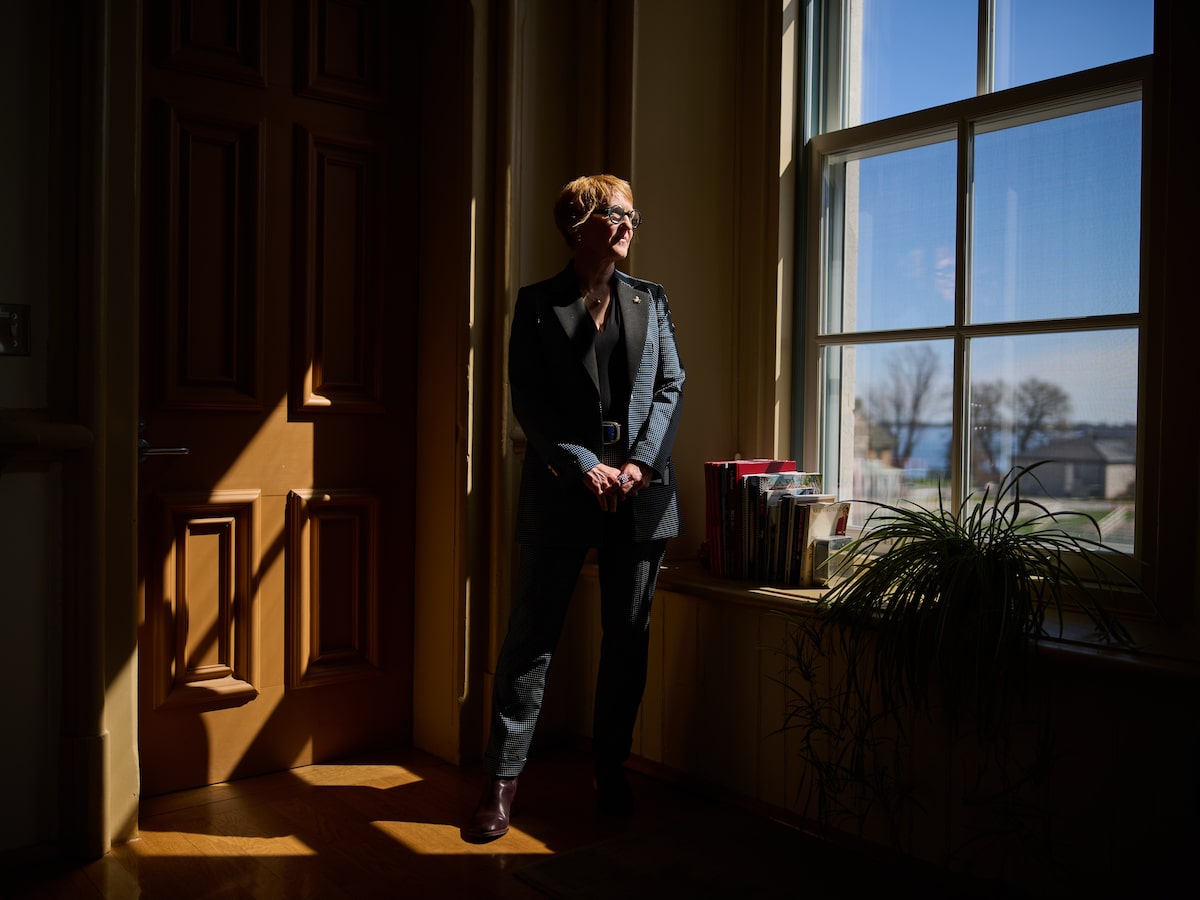
As head of the Canadian Defence Academy, Major-General Jeannot Boucher is preoccupied with how to train more officers.
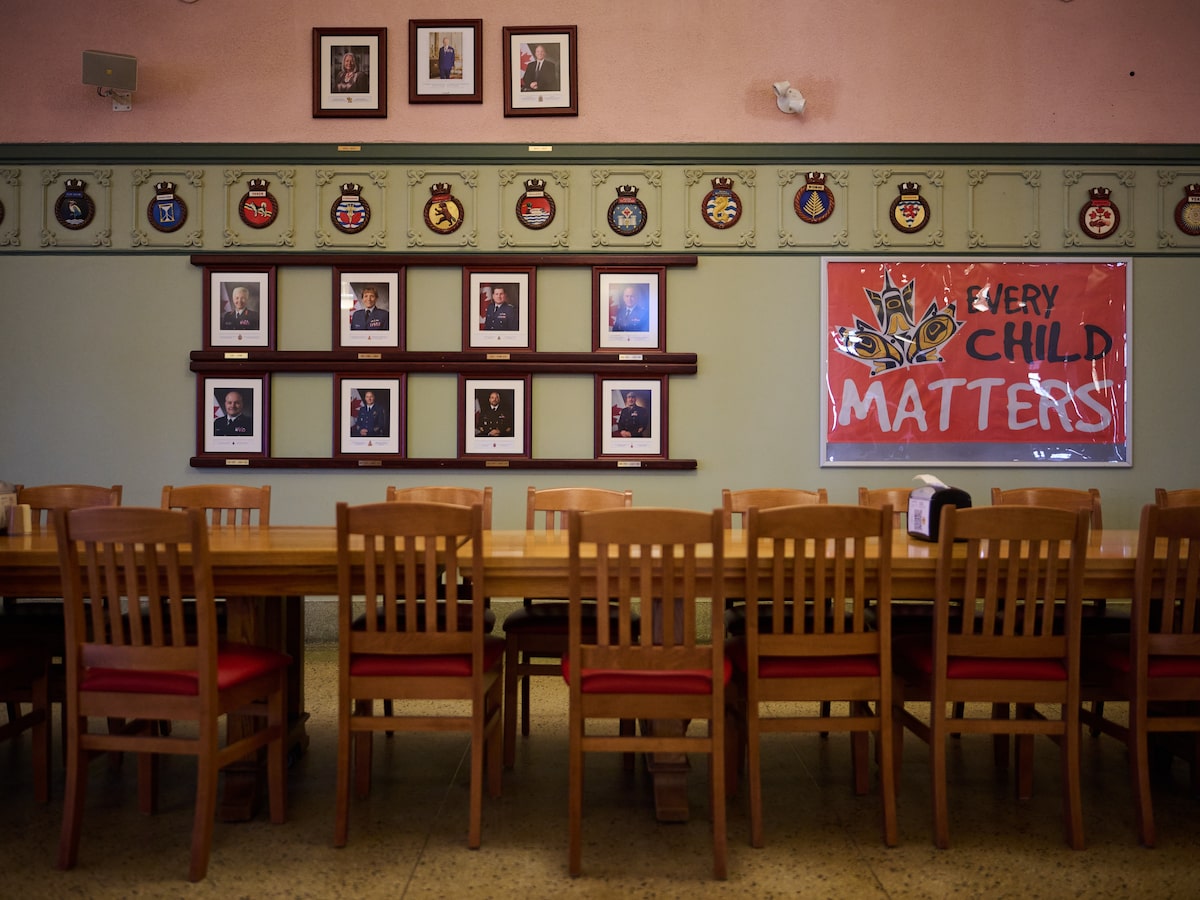
RMC Kingston traces its origins to 1876, an era when the world’s dominant power, Britain, was withdrawing military support from the newly confederated Canada and the country needed to build its own armed forces. The old stone buildings evoke a school with a grand tradition, but not that long ago it was at risk of being shut down.
Former Supreme Court justice Louise Arbour delivered what sounded like a death blow in a landmark 2022 report to the minister of national defence. Canada’s military colleges – RMC Kingston and its French-language counterpart, RMC Saint-Jean in Quebec – appeared to be “from a different era,” she wrote. They were expensive to run and plagued by sexual misconduct, and they fell short on measures of gender and racial diversity. She concluded that there was legitimate reason to question whether they should remain open, and that alternative models must be considered.

Louise Arbour was recently announced as the next Governor-General, the commander-in-chief of the armed forces. Four years earlier, she wrote a landmark report on toxic military culture.Adrian Wyld/The Canadian Press
The questions raised were then closely scrutinized by the Canadian Military Colleges Review Board, a committee of academic and military experts created in response to her report. In January, 2025, it concluded the schools should continue in their current role, but it also issued stinging criticisms in its own report – including that the academies were failing to deliver enough military leadership training.
The need to modernize has become more pressing given what Prime Minister Mark Carney described in his Davos speech as a rupture in the world order. For the first time in generations, Ottawa is preparing to spend billions more on the military, with a 2-per-cent-of-GDP target hit this year and a goal of 5 per cent of GDP by 2035.
Canada’s military colleges are being asked to train officers for a rapidly changing global security environment – but they can’t do so without addressing the problems of the past. They’ve started by changing their disciplinary procedures and enhancing safety and inclusivity measures for women. They also intend to streamline their educational program, emphasizing that the colleges are first and foremost military academies. And the military is also going to try something new: A pilot project to deliver core training pillars to a cohort on a civilian campus.

Things already look a lot different than when Maj.-Gen. Boucher graduated from RMC Kingston nearly three decades ago.
For starters, about a quarter of the naval and officer cadets at the military academies are women. Maj.-Gen. Boucher wants to see that proportion increase to 33 per cent, a threshold that is seen within the military as a tipping point that would help weed out sexism and harassment.
Sexual misconduct has long been an issue at RMC Kingston and RMC Saint-Jean. In her report, Ms. Arbour wrote she had been told that almost every female cadet had experienced sexual harassment, and in some cases worse. A 2020 Statistics Canada study of the schools found nearly 70 per cent of respondents had witnessed or experienced unwanted sexualized behaviour in the past year.
“There’s a lot of work that’s been done on having an inclusive culture,” said Maj.-Gen. Boucher, who has focused much of his time on delivering the recommendations made by the Canadian Military Colleges Review Board. “We feel that we’ve improved tremendously. When something happens, people speak up, we immediately take action on it.”
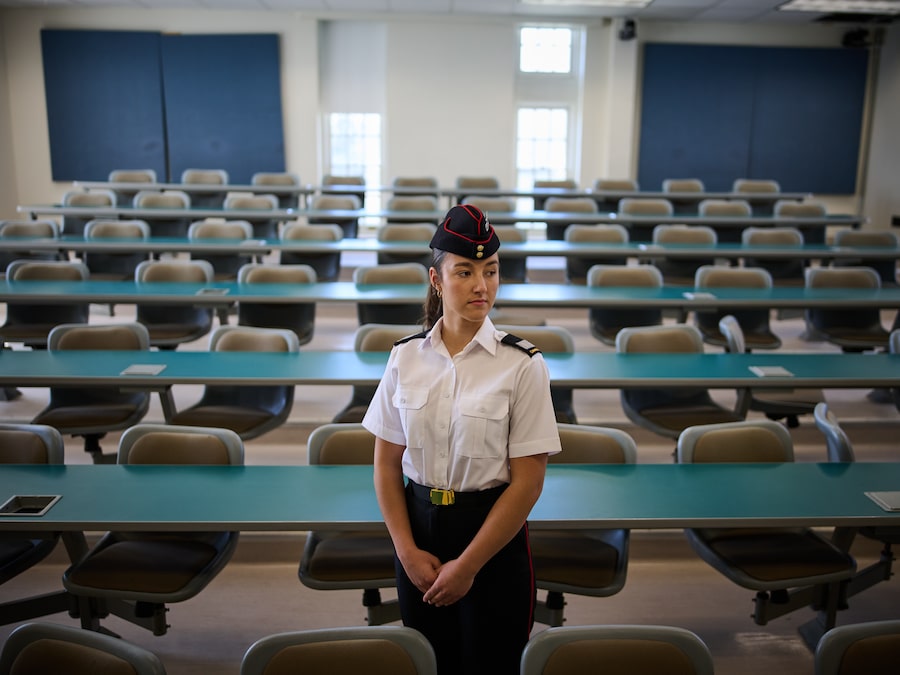
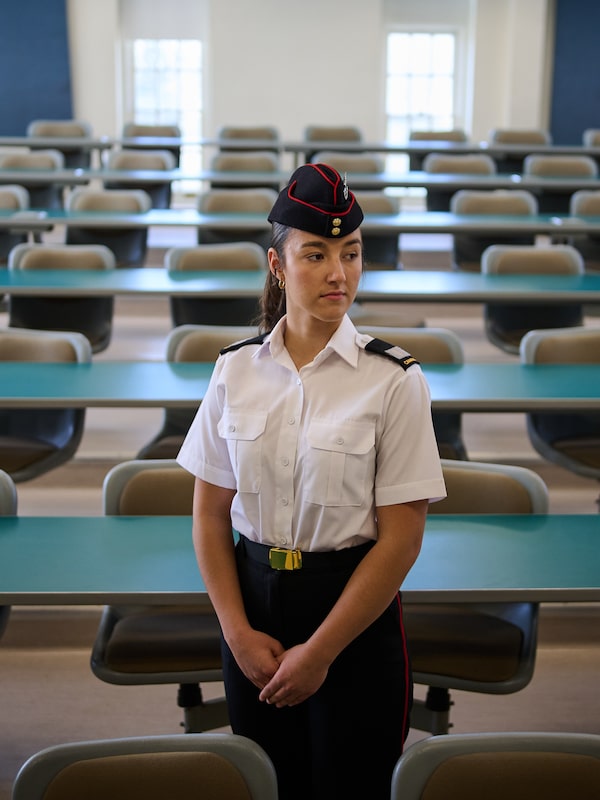
Officer Cadet Maggie Luna Masse, from Val-Morin, Que., just finished her first year at RMC Kingston. The 18-year-old was drawn to RMC by a desire to push herself mentally and physically and to feel proud of her work. She hasn’t experienced anything resembling sexual harassment in her time at the school, she said, although she’s aware it has been an issue in the past.
“If something were to happen, we have a great chain of command and they have pushed this message very much that we can always go to them for any issue, big or small,” she said.

Officer cadet Maggie Luna Masse came to RMC from Val-Morin, Que., northwest of Montreal.
The military has also acted to end the practice of having cadets in control of disciplinary matters involving other peers – a change Maj.-Gen. Boucher said was the right call.
And it’s easier to dismiss cadets when issues of misconduct arise, he added. In the past, the military often waited to act until the justice system or other processes had run their course; now they can move more swiftly.
For a time, much more drastic measures were being floated. One of the plans considered by the review board was to scrap the military colleges altogether, and have all officer candidates get their degrees at civilian universities.
That’s how two-thirds of Canada’s serving commissioned officers (who must hold university degrees) were educated, divided primarily between those who joined the Regular Officer Training Plan and had their studies paid for at a civilian university, and those who entered the military after obtaining an undergraduate degree on their own dime.
The remaining one-third came through the military colleges, where the government covered the cost of their schooling and paid them an annual salary (currently nearly $35,000, minus room and board).
In exchange, they committed to spending at least five years in the military after graduation.
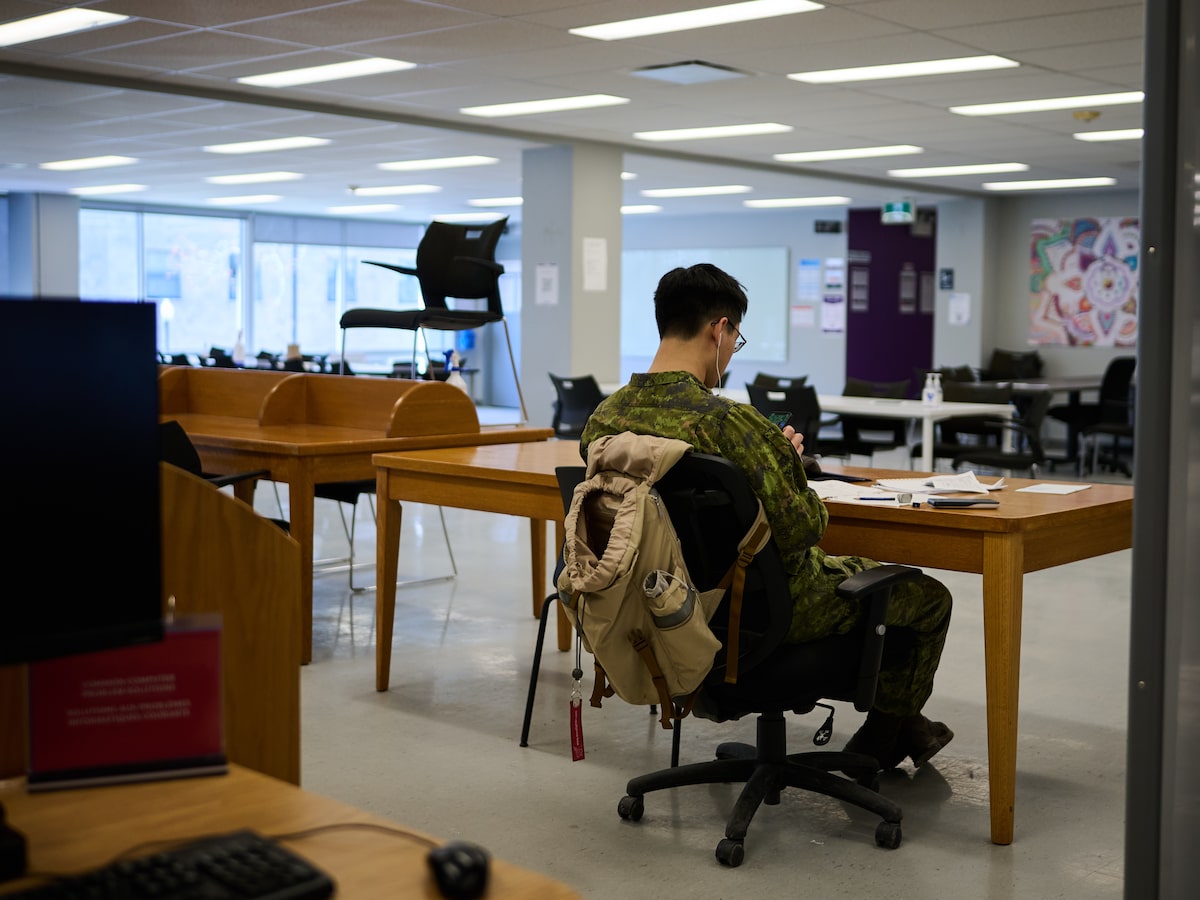
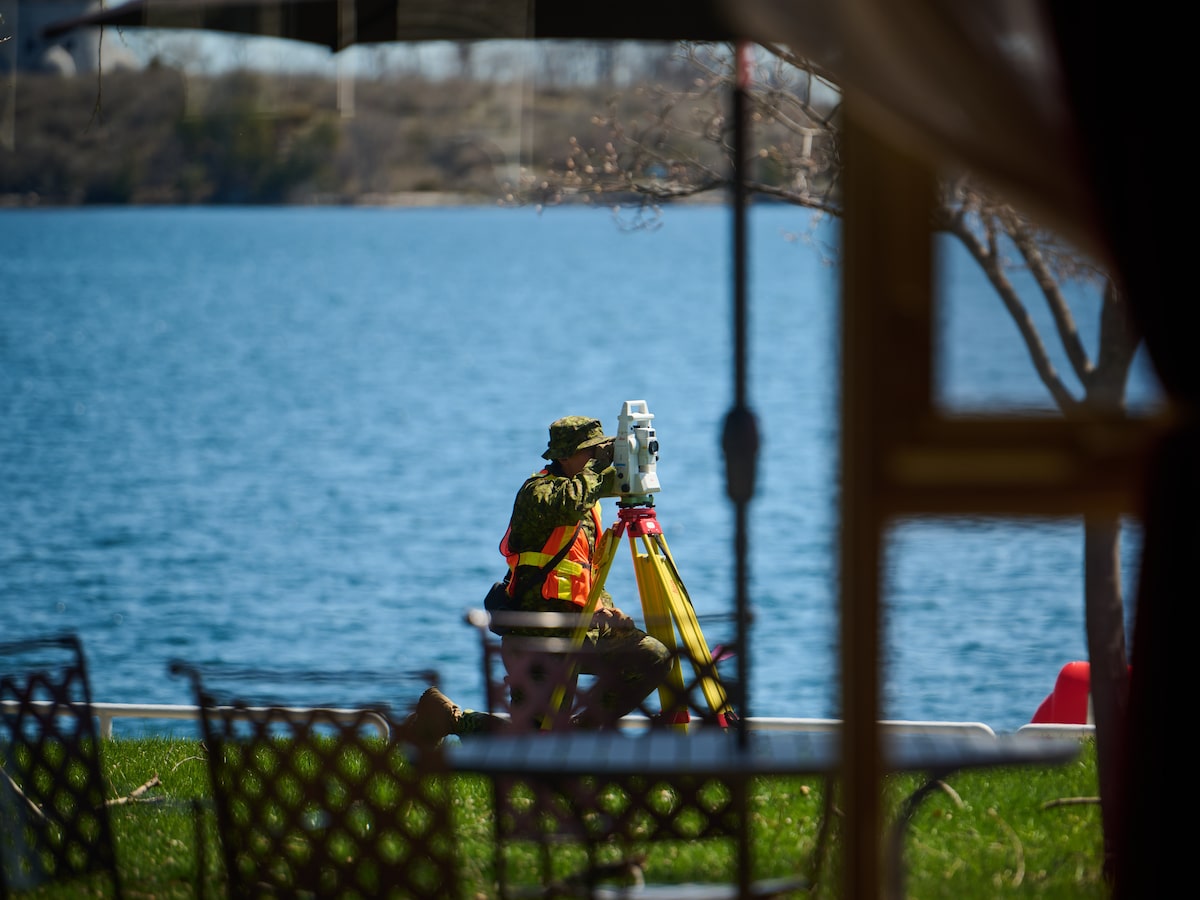
But some of the most detailed criticisms the colleges have faced focus on their curriculums – both academic and military.
Students follow a training program based on what the military calls its four pillars: health and wellness (which used to be just fitness), academics, military leadership and official bilingualism. The review board criticized it for failing to deliver enough actual military preparation, describing it as ad hoc, vague and “insufficient.”
Military leadership training during the academic year, the report said, consists of a two-hour session once a week and one weekend of training a month. At best, some cadets see it as an inconvenience; at worst it’s considered “a waste of time.” A recent survey found 70 per cent of graduates wished they had learned more on the subject.
Maj.-Gen. Boucher said the colleges are looking at reallocating some of the time spent on the core academic curriculum (which he says is very robust) to military leadership training.
“Our value proposition is that unique blend of those four strands. But we’re trying to rebalance. We need to strengthen that military strand.”

'We want to be first and foremost a military academy, but we don’t want to lose the good of a high-calibre university education,' Maj.-Gen. Boucher says.
On the academic front, the review board described problematic staffing levels and called for a minimum ratio of 15 students for every class (some have as few as three officer cadets). It singled out four programs that have recently failed to graduate even 15 students in any given year, despite having more than 40 academic faculty members.
At the moment, it costs about 60 per cent more to educate a student through RMC Kingston – which has roughly 1,100 naval and officer cadets – than a civilian university, largely owing to economies of scale. At Saint-Jean, which has slightly more than 300 cadets, the cost is four times greater, the report said. In short, there are a lot of programs and professors for a relatively small number of students.
Defenders of RMC Kingston point out that it also has to sustain a graduate school and a research infrastructure, both of which are cost-intensive and important to the military.
Jill Scott, the college’s principal, is aware of all the criticisms, particularly those regarding high costs. But the review board put all options on the table, including closing the colleges, and concluded they should be saved – so clearly they saw something of value, she said.
Dr. Scott says she believes that for young officer cadets, being part of an exclusively military cohort is important to building an identity and shared purpose.
“The overwhelming message is that the military colleges need to be military in their approach, in their orientation and in their operation,” she said. “We try to put our students into very challenging circumstances, partly because of where they’re going.”

Officer Cadet Philip Yoo, an 18-year-old from Winnipeg, just completed his first year at RMC Kingston, studying humanities. He was attracted by the challenge the school represents, plus a desire to pursue the road less taken, as he put it.
“I came here to find out what I’m capable of,” he said. “I wanted to take ownership of who I am and where my career is headed, and I knew that meant taking on something challenging, something worthwhile, something meaningful. That’s what RMC is to me.”
Maj.-Gen. Boucher said the blend of civilian and military education plays an important role in developing the critical thinking and judgment that officers rely on throughout their career.
“We want to be first and foremost a military academy, but we don’t want to lose the good of a high-calibre university education. Professors seek truth in a way that opens the mind, challenges perspectives,” he said. “I want to protect that.”


The recruiters at this job fair in Terrebonne, Que., are part of a nationwide program to get more people in the Canadian Armed Forces.Cory Wright/The Globe and Mail
Over the past two years, the CAF has exceeded its recruitment goals. Now the colleges are in its sights. Maj.-Gen. Boucher said the military wants to see the number of cadets at the two institutions grow to more than 1,800, an increase of about 25 per cent. (That recruitment is also overseen by the military, not by the schools themselves.)
Maj.-Gen. Boucher said his aim is to optimize the military colleges, but not to expand beyond a certain point.
In April, he signed an agreement on a pilot project with Royal Roads University on Vancouver Island. Royal Roads was once a military college itself, but it was closed in 1995 as part of cost-cutting. Since then it has been a civilian university focused mainly on graduate education, with about 5,000 students.
Starting this September, the school will welcome a cohort of 40 first-year students to a new officer pathway program. The participants will take classes while following a four-pillar style program similar to what is offered at RMC Kingston and Saint-Jean. (They will also receive pay and have their tuition covered.) The military may provide personnel on campus to oversee some aspects of training.
Students will be allowed to wear military uniforms on campus part of the time, which is important to enhancing visibility, Maj.-Gen. Boucher said. The cohort, which will grow to a total of 160 over four years, will live together on campus, supported by the Canadian Forces. The university is rapidly converting old military dorms, which had become offices, back to residences.

Maj.-Gen. Boucher and Philip Steenkamp, president of Royal Roads University, shake hands at last month's unveiling of a planned expansion agreement for the Canadian Forces.
“We thought there was a distinctive opportunity for us to put together a proposal for a customized program,” Royal Roads president Philip Steenkamp said. “Recruits will come into our civilian undergrad programs with civilian students. But in addition, Royal Roads is going to offer programs in military leadership, ethics, second language training and health and wellness.”
Thirty-three applicants applied to the program before it even launched, according to Dr. Steenkamp. Royal Roads would be willing to take more students in time, he said, and his bet is that interest will exceed the number of seats available.
“They’ve got these incredibly ambitious recruitment targets. Our pitch was, you’re going to have to attract students from across the country and some will want to stay on the West Coast, initially, for their education.”
Dr. Steenkamp acknowledged there are some sensitivities about the integration of military education on a civilian campus. “What we really have to guard against is that there’s no sense that this is a return to being a military college. It’s a civilian university.”
Maj.-Gen. Boucher is keen on this model of partnership because it’s flexible and it allows the Canadian military to expand in other regions.
“A lot of the narrative has been about how do we grow and scale,” he said. “In a few years, maybe funding will reduce again. We don’t want to have grown something that then we need to shrink. I think it’s smarter to optimize what we have and partner.”
If the Royal Roads pilot succeeds, he’d next like to partner with a francophone institution in Quebec, and then another school in the Maritimes and possibly the North. Already several universities have expressed interest.
“We’re trying to find that right blend of academic and experiential learning,” Maj.-Gen. Boucher said.

Canada on guard: More from The Globe and Mail
The Decibel podcast
Canada will be the host country of a new defence bank, designed to help NATO and its allies share the costs of a global arms race. Reporter Pippa Norman spoke with The Decibel about how that fits into Ottawa’s broader strategy. Subscribe for more episodes.
Military preparedness in focus
Success rate for basic training in Canadian military drops
NATO exercise in Latvia reveals Western alliance’s drone vulnerabilities
Arctic snowmobile trek pits Rangers’ resolve against a ‘nightmare’ storm