
Great Bear Lake in the Northwest Territories is the fourth-largest body of water by surface area in North America.Kimberly L. Howland, Fisheries and Oceans Canada (DFO)/Supplied
Resembling a giant amoeba on the map, Great Bear Lake is an unmistakable feature of the Northwest Territories and the largest body of freshwater entirely within Canada’s borders.
Now, scientists say, the vast reservoir is undergoing an epic change, with unknown consequences for the lake’s ecosystem and those who depend on it.
The change is not visible to the eye, but has emerged from hundreds of hours of peering through a microscope at sediments collected from the bottom of the lake.
“What’s happening below the waterline, under the radar, is a total shift in ecology,” said John Smol, an environmental scientist at Queen’s University in Kingston.
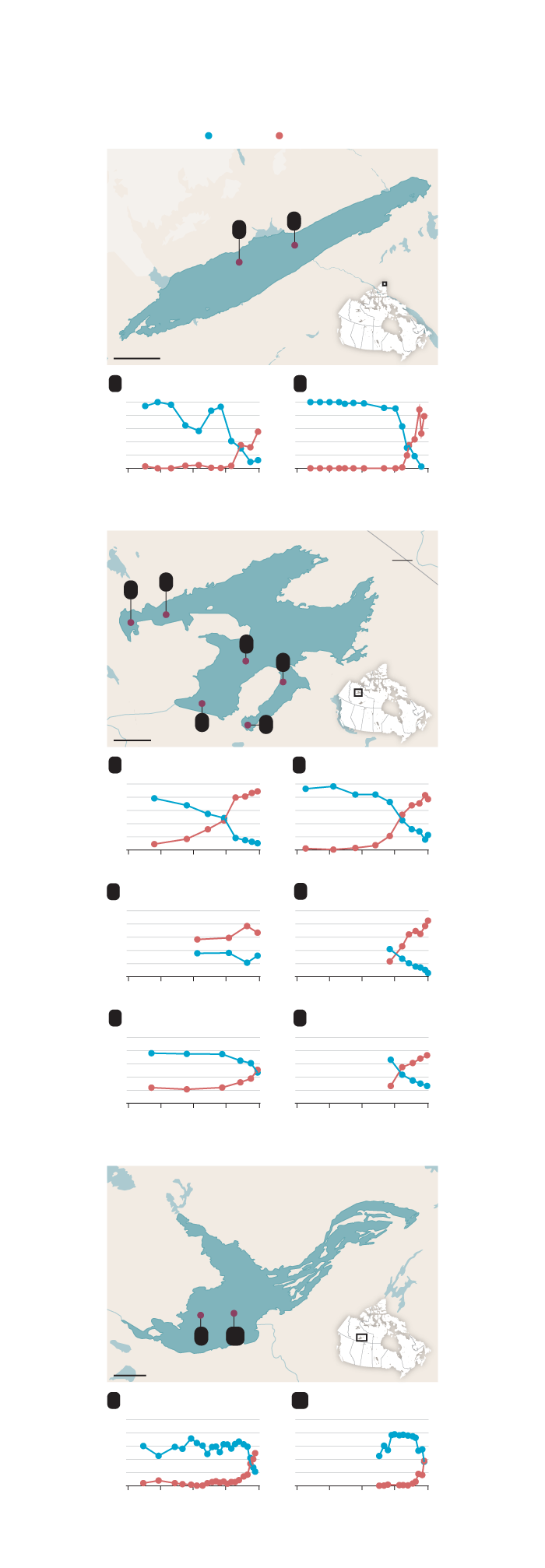
In a newly published study, Dr. Smol and his colleagues reveal that over the past few decades, the lake’s long-established community of diatoms – single-celled algae that help to form the base of the food chain – has been replaced almost entirely by a different set of species.
Opinion: Feeling the heat on the front lines of the climate crisis
“It’s like a farmer seeing that the grass where his cattle are grazing has suddenly become cacti,” Dr. Smol said.
In 2023, the team reported similar changes in Great Slave Lake, another giant freshwater system located about 350 kilometres south.
And Nunavut’s Lake Hazen, Canada’s largest High Arctic lake, which is located many hundreds of kilometres farther north, also shows the same pattern.
Data from all three lakes are presented in the current study, which was published Monday in the Proceedings of the National Academy of Sciences. Collectively, the results suggest the region has experienced a remarkably consistent and widespread change that is strong enough to outweigh latitude and other differences between the lakes.
Great Bear Lake is the fourth-largest body of water by surface area in North America and is also one of the deepest. Because it straddles the Arctic Circle, it is covered by ice during much of the year.

Frustule of Aulacoseira islandica, a large-celled, chain-forming diatom that dominated the pre-2000 CE Great Slave Lake sediment records.Paul Hamilton, Canadian Museum of Nature. CANA 131034/Supplied
Since the end of the 20th century, Arctic warming caused by climate change has reduced the period of ice cover on the lake by about three weeks a year and also lowered average wind speeds. This has made Great Bear Lake both warmer and calmer at the surface. As a result, the lake is now more stratified, with less mixing between its lower and upper layers.
To understand the effect of this on the ecology of the lake, scientists identified and counted the accumulated remains of diatoms in sediment extracted from the bottom of the lake at six different locations. Samples are collected during winter months, when ice cover provides a stable platform for researchers.
Like plants, diatoms convert sunlight into energy and provide food for zooplankton, the lake’s smallest animals. These, in turn, are eaten by fish, which move nutrients further up the food chain.
Because the cell walls of diatoms contain silica, they are preserved over time. When they die, their remains are deposited on the lake bottom where they form a year-by-year record of species present in the lake.

An image of discostella pseudostelligera (internal view of valve) from the West Basin of Great Slave Lake. This is one of the small-celled cyclotelloid diatoms that dominated the 21st-century sediment samples of Great Bear Lake, Great Slave Lake and Lake Hazen.Paul Hamilton, Canadian Museum of Nature. CANA 131034/Supplied
The sediment cores show that for the past couple of centuries, Great Bear Lake has been dominated by relatively large diatoms that are roughly one-third to one-half the diameter of a human hair.
But now that there is less vertical mixing of lake water, these organisms tend to sink in the water, and die off when out of reach of sunlight. More recent sediments reveal that they have been replaced by other kinds of diatoms which are only about one-tenth the size and float more easily.
This poses a problem, said Kathleen Ruhland, a research scientist who is also at Queen’s University, and first author on the study.
“The large diatoms are really high protein or high calorie food sources for zooplankton and small fishes,” she said. That means even if the lake now has a longer ice-free season when plankton can grow, “it doesn’t necessarily mean that the quality of food has increased.”
The researchers were cautious about drawing further conclusions, but said that the changes would have an impact on fish populations in some way.
The changes seen at Great Bear Lake are echoed in two sediment cores at Great Slave Lake and two in Lake Hazen.

Great lake shift
Sediment samples from three large Northern Canadian lakes show an abrupt shift in the relative abundance of different types of diatoms – micro-organisms important to the lakes' food chain. In recent years larger benthic species have decreased while smaller types, called cyclotella, have become more abundant. The shift is tied to the surface warming of the lakes and lower wind speeds, which reduces mixing between upper and lower layers of water.
Relative abundance of diatom group
as a percentage of all sampled
Benthic
Cyclotella
NUNAVUT
2
1
Lake Hazen
10 km
2
Main (HM 2013)
1
Blister (HB 2017)
100%
80
60
40
20
0
1880
1914
1948
1982
2017
1880
1914
1948
1982
2017
NORTHWEST
TERRITORIES
NUNAVUT
4
3
Great Bear
Lake
6
8
5
7
50 km
3
SMITH-1
4
SMITH-2
100%
80
60
40
20
0
1880
1914
1948
1982
2017
1880
1914
1948
1982
2017
6
Keith-2
5
Keith-1
100%
80
60
40
20
0
1880
1914
1948
1982
2017
1880
1914
1948
1982
2017
7
McVicar-1
8
McVicar-2
100%
80
60
40
20
0
1880
1914
1948
1982
2017
1880
1914
1948
1982
2017
NORTHWEST
TERRITORIES
Great
Slave Lake
9
10
50 km
9
GSL12
10
GSL19
100%
80
60
40
20
0
1880
1914
1948
1982
2017
1880
1914
1948
1982
2017
*Numbers may not add up to 100 per cent because
there are other categories of diatoms in the mix.
MURAT YÜKSELIR / THE GLOBE AND MAIL, SOURCE:
K. RUHLAND, J. SMOL, QUEEN'S UNIVERSITY

Great lake shift
Sediment samples from three large Northern Canadian lakes show an abrupt shift in the relative abundance of different types of diatoms – micro-organisms important to the lakes' food chain. In recent years larger benthic species have decreased while smaller types, called cyclotella, have become more abundant. The shift is tied to the surface warming of the lakes and lower wind speeds, which reduces mixing between upper and lower layers of water.
Relative abundance of diatom group
as a percentage of all sampled
Benthic
Cyclotella
NUNAVUT
2
1
Lake Hazen
10 km
2
Main (HM 2013)
1
Blister (HB 2017)
100%
80
60
40
20
0
1880
1914
1948
1982
2017
1880
1914
1948
1982
2017
NORTHWEST
TERRITORIES
NUNAVUT
4
3
Great Bear
Lake
6
8
5
7
50 km
3
SMITH-1
4
SMITH-2
100%
80
60
40
20
0
1880
1914
1948
1982
2017
1880
1914
1948
1982
2017
6
Keith-2
5
Keith-1
100%
80
60
40
20
0
1880
1914
1948
1982
2017
1880
1914
1948
1982
2017
7
McVicar-1
8
McVicar-2
100%
80
60
40
20
0
1880
1914
1948
1982
2017
1880
1914
1948
1982
2017
NORTHWEST
TERRITORIES
Great
Slave Lake
9
10
50 km
9
GSL12
10
GSL19
100%
80
60
40
20
0
1880
1914
1948
1982
2017
1880
1914
1948
1982
2017
*Numbers may not add up to 100 per cent because
there are other categories of diatoms in the mix.
MURAT YÜKSELIR / THE GLOBE AND MAIL, SOURCE:
K. RUHLAND, J. SMOL, QUEEN'S UNIVERSITY
Great lake shift
Sediment samples from three large Northern Canadian lakes show an abrupt shift in the relative abundance of different types of diatoms – micro-organisms important to the lakes' food chain. In recent years larger benthic species have decreased while smaller types, called cyclotella, have become more abundant. The shift is tied to the surface warming of the lakes and lower wind speeds, which reduces mixing between upper and lower layers of water.
Relative abundance of diatom group as a percentage of all sampled
Benthic
Cyclotella
NUNAVUT
2
1
Lake Hazen
10 km
2
Main (HM 2013)
1
Blister (HB 2017)
100%
80
60
40
20
0
1880
1914
1948
1982
2017
1880
1914
1948
1982
2017
NORTHWEST
TERRITORIES
NUNAVUT
4
3
Great Bear
Lake
6
8
5
7
50 km
3
SMITH-1
4
SMITH-2
100%
80
60
40
20
0
1880
1914
1948
1982
2017
1880
1914
1948
1982
2017
6
Keith-2
5
Keith-1
100%
80
60
40
20
0
1880
1914
1948
1982
2017
1880
1914
1948
1982
2017
7
McVicar-1
8
McVicar-2
100%
80
60
40
20
0
1880
1914
1948
1982
2017
1880
1914
1948
1982
2017
NORTHWEST
TERRITORIES
Great
Slave Lake
9
10
50 km
9
GSL12
10
GSL19
100%
80
60
40
20
0
1880
1914
1948
1982
2017
1880
1914
1948
1982
2017
*Numbers may not add up to 100 per cent because there are other categories of diatoms in the mix.
MURAT YÜKSELIR / THE GLOBE AND MAIL, SOURCE: K. RUHLAND, J. SMOL, QUEEN'S UNIVERSITY
Homa Kheyrollah Pour, who directs the Cold Regions Research Centre at Wilfrid Laurier University and who was not involved in the study, said that while the trend it reveals is not surprising, the pace and magnitude of the change in all three lakes is surprising.
“These are among the largest, deepest and most thermally buffered freshwater systems in the Arctic and subarctic,” said Dr. Pour, who added that such substantial and frigid bodies of water should be among ecosystems that are most insulated from the effects of climate change. “Yet the results suggest that even these iconic lakes have undergone substantial ecological reorganization within only a few decades.”
The study adds weight to the idea that biological systems that appear to be withstanding the effects of rising global temperature can change abruptly once they reach a certain threshold.
This matters when people are tied to ecosystems undergoing change. While Lake Hazen is uninhabited because it lies so far north, the other lakes in the study have supported Indigenous communities for generations.
“These lakes are far more than water bodies,” Dr. Pour said. “They are central to transportation, food security, culture, identity and livelihoods.”
Dr. Smol noted that Canada’s Northern “great lakes” are historically understudied. He said the new findings underscore why they should be monitored more closely going forward to better predict future changes to fish populations and other species that can ultimately affect people.