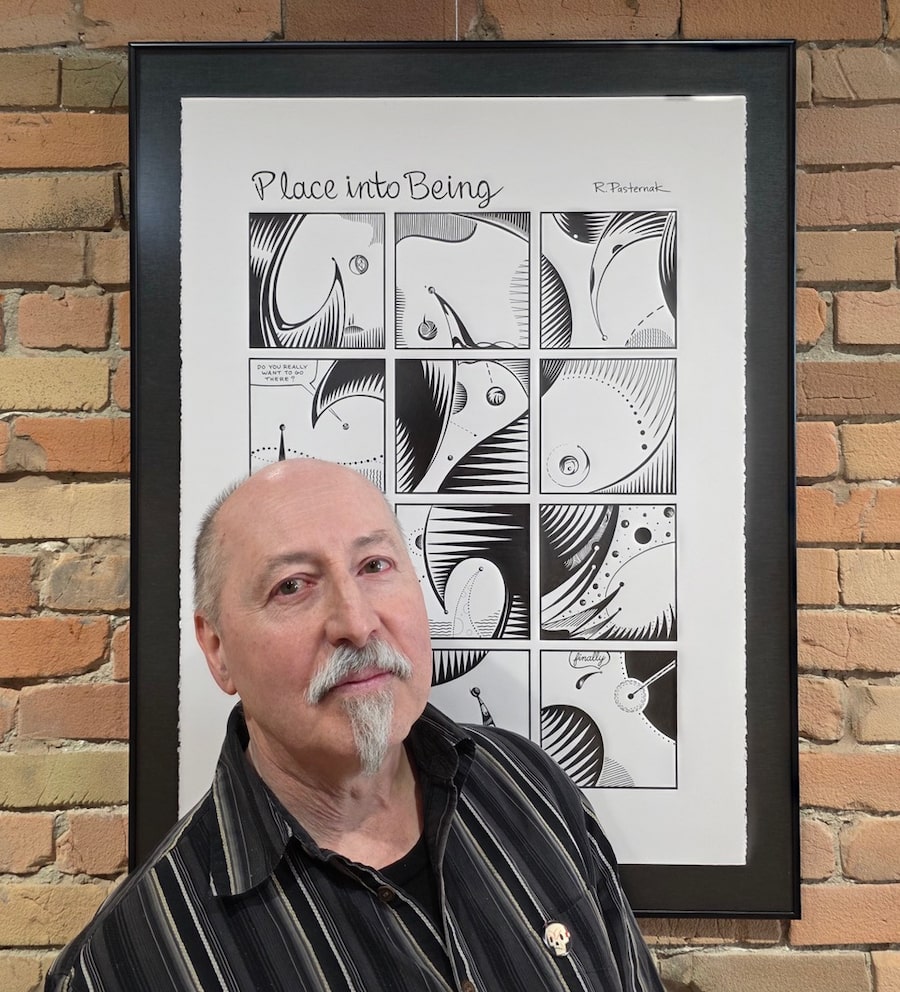
In the early 2000s, as he shuffled between midnight buses, heading home late from his studio in Winnipeg, Robert Pasternak looked forward to the transit transfer tickets he’d receive. They were highly specific. Only commuters in the wee hours saw a tiny blank space between the cookie-cutter script about the pass’s validity and the two giant notations demarcating the present year.
That little space on paper, just a few centimetres at best, was Pasternak’s artistic oasis. Over the years, he repeatedly doodled on those tickets freehand, using ink pens to create fire-like, breathy sketches – a signature motif of his work. Similar patterns appeared on many of his larger-scale paintings and assemblages. However, the transfer passes remain, in many ways, integral to his evolution, explaining why he can’t help but keep returning to miniaturism.
This fascination with petite figurines and drawings is at the heart of Pasternak’s new exhibition, dubbed The Art of Noticing, now on show at Winnipeg’s Katie + Gunner Gallery, his first major display after a 10-year hiatus.

Eighty original works are displayed in a gallery within the gallery, some of which echo larger pieces in the surrounding space.Supplied
Situated at the centre of the exhibition is a gallery within the gallery: A fully realized display with walls lined by more than 80 original paintings, sculptures and animated imagery on screens – but just one-twelfth the size of the actual walls of Katie + Gunner itself.
The intricate miniatures are playing with scale to echo some of the 15 pieces of abstract drawings, collage work, hyper-realistic renderings, and acrylic and India ink canvases on the gallery’s main walls. Debating which ones are replicas (and which ones are just very, very similar) is part of the fun.
It is an eminently modern, interactive exhibition that encapsulates Pasternak’s decades-spanning, genre-bending career as a graphic designer, illustrator, abstract comics creator, novelty product inventor and surrealist filmmaker.
Both inside the smaller gallery and its regular-scale counterpart, viewers will find Pasternak’s experimental short films on display. They are a slice of his larger body of motion-picture work, which has been screened before at international festivals in Venice, London, Melbourne, Montreal and Los Angeles.

Over the years, Pasternak doodled on his transit transfer tickets, using ink pens to create fire-like, breathy sketches in the negative space.Supplied
In another corner, the exhibition features a pop-up shop called Nakfactorium. Available for sale are Pasternak’s novelty pieces, priced at affordable rates, such as a handmade pack of gum that, when taken out of its wrapping, is actually a clay-based activity or puzzle, different each time. Next to that is a selection of his books, including the 2024 graphic novel Twilight of Echelon and the kaleidoscopic 2019 comic Place Into Being.
“There’s a lot going on here. But, really, it’s always been that way,” Pasternak told The Globe and Mail.
Born and raised in Winnipeg, the 62-year-old visual artist received wide acclaim in the nineties and early aughts. But in 2012, Pasternak had to give up his duplex after the owner decided to sell the unit. Once he found new living arrangements, the higher payment made renting his long-time downtown studio financially untenable on an artist’s income. As bills racked up, he was also forced to take up an unrelated day job at a marketing firm.

The miniature gallery (filled with tiny patrons) displays work on walls just one-twelfth the size of those in the human-sized exhibition space.

Recurrences of congruent geometric shapes become powerfully alluring in Abstr #628.Supplied
Without a dedicated space to work from, inspiration became hard to come by, especially for paintings or installations. For the next few years, he worked on a documentary, some books and performance pieces with the local orchestra company. It wasn’t until his son moved out recently that Pasternak could use his second bedroom, with its bright natural lighting, as a new studio.
There, he has struck a personal renaissance. “I’m finishing the things that I started before, and creating newer works, some of which you see in this exhibition, exploring it all – all over again,” he says.
Pasternak’s work has always been atypically genreless, in part because his interests – or “creative obsessions and eccentricities,” as he likes to call them – vary so broadly.
Such is the case with The Art of Noticing, too, which moves seamlessly from science-fiction illustrations and metaphysical paintings to hand-processed film and collages with raw materials found on city streets.
Recurrences of congruent geometric shapes and lines – either so meticulously sharp they feel brutal and cold (such as in the graphite rendering It’s 5 O’clock), or so deliberately soft they become powerfully alluring (such as with the comic drawing Abstr #628) – abound in the exhibition. It can be difficult, though, to discern a linear narrative with this collection, much like a lot of other modern art.
And yet, the dream-like quality that is ubiquitous in the collection as a whole seems purposeful, leaving its interpretation open for everyone.
Loose Leaf No. 5 and Loose Leaf No. 7 are likely crowd favourites. Looking at the two works from afar, they seem like neatly torn pages of a lined notebook, with doodles drawn on them by pencil. But up close, they are both acrylic paintings on board.
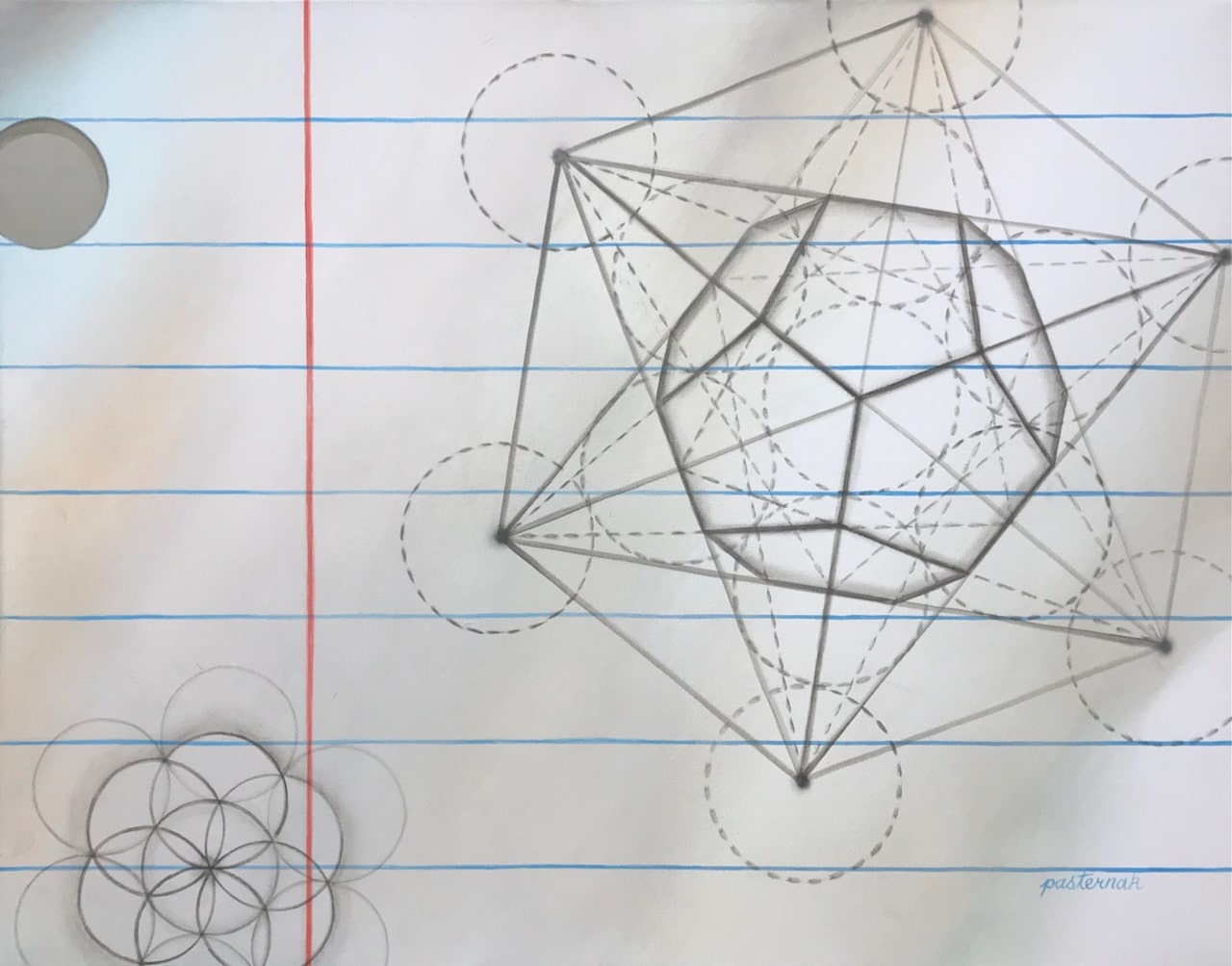
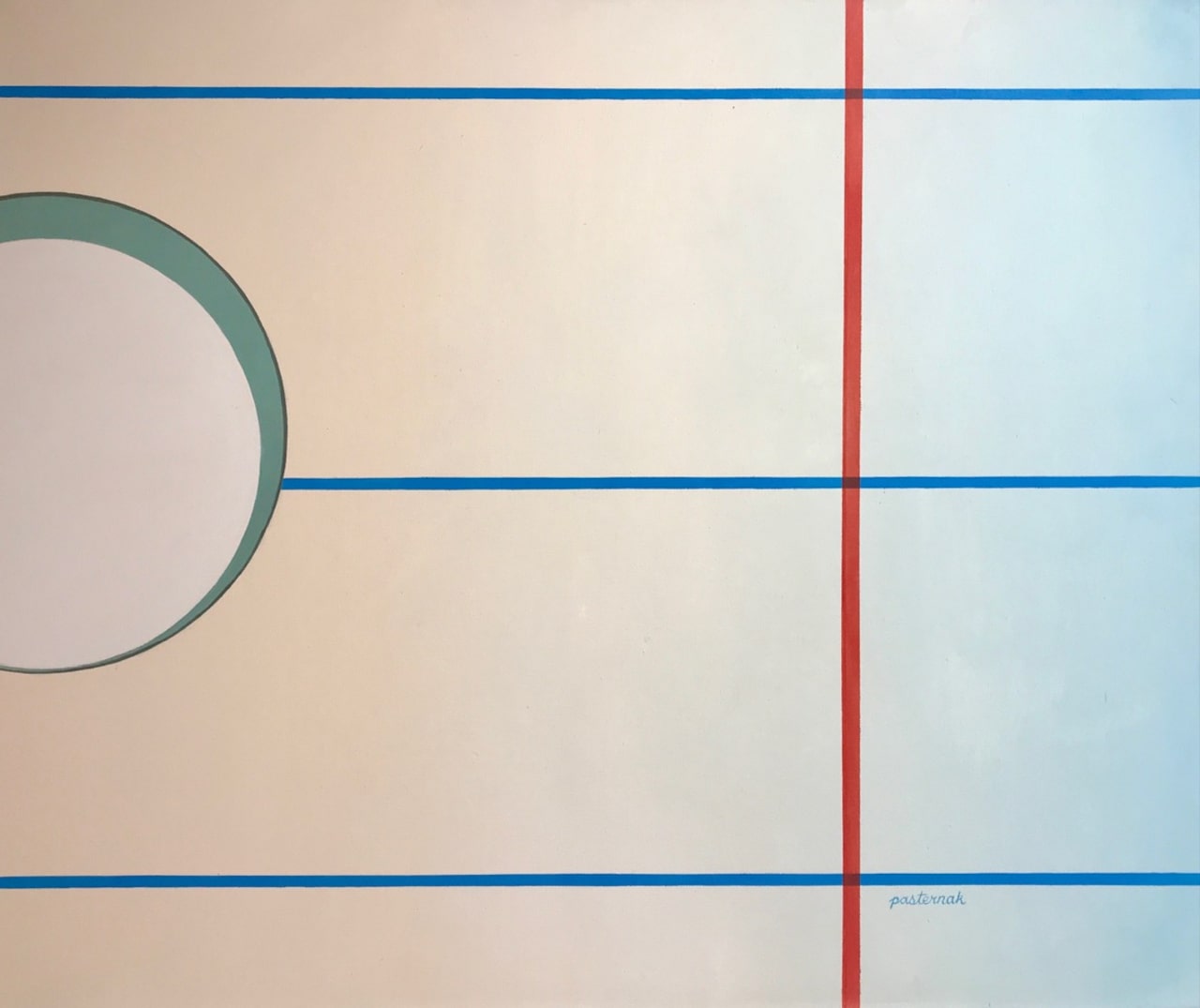
“For me, it’s about investigating the edges and corners of, yes, the page, but also any sort of medium at all,” Pasternak explains.
“Even with those bus transfers, that’s been the key: Finding meaning and purpose through abstraction and representation. My art practice aims to move fluidly between those concepts, switching them up with scale, from one form to another medium to another form, and so on.”
And with his new work, which invites viewers to “look closely to find meaning, so that the miniature become monumental,” Pasternak achieves his overarching ambition in spades.
The Art of Noticing continues at Katie + Gunner Gallery in Winnipeg until June 6.