
An illustration from 1937 highlights Canada, Australia, India and large regions of Africa in the red that 19th- and 20th-century map makers traditionally used to denote the British Empire. Decolonization after the Second World War would greatly reduce the red areas; meanwhile, the United States would surpass Britain as a global superpower.The Christian Science Monitor
John Rapley is the co-author, with Peter Heather, of the new book Why Empires Fall: Rome, America and the Future of the West.
In the current discussions about how to re-energize the Canadian economy and restore its former dynamism we can easily overlook one vital element of its tremendous prosperity – that over the past two centuries the global economy was extraordinarily favourable to Canada, dominated as it was by a Western world order.
However, that world is now coming to an end. The future will look quite different from what we’ve known.
Canada has long seen itself as the world’s good neighbour; a corporate PR campaign once said that “the world needs more Canada.” The country came by that reputation honestly enough, with a history that stands out for its relative harmony. Yes, it built its prosperity by taking other people’s land. However, it did so with more negotiation, and somewhat less violence, than elsewhere in the Americas. Similarly, by comparison to its neighbours, the country’s experience with slavery was brief and limited. Meanwhile, despite the historical animosity between French and English, the two nations managed to agree a governing compact without descending to the sort of civil war that roiled its southern neighbour.
So it’s not surprising that, in my experience, when asked to mention attributes they associate with Canadians, foreigners typically say “nice” (along with the corollary of a relatively uneventful existence, “boring”). A common explanation is that Canadians became the world’s good guys because they were never the bad guys. Having had the experience of being a colony, dominated first by the British and then by the Americans and thus, according to the nationalist view, relegated to being the hewers of wood and drawers of water that fed those manufacturing powers, it was natural that Canadians would feel sympathy for the underdogs.

A 1794 pamphlet at the Wilberforce House Museum in Hull demonstrates the brutalities of slavery, which was still practiced in Canada at that time.Russell Boyce/Reuters
Except that, like so many foundational myths, a large part of the story is pure fiction. With the exception of the country’s Indigenous occupants, Canadians were not victims of imperialism, but beneficiaries. From the early days of European settlement, Canada was woven into the triangle trade that tapped into the surpluses generated by the slave economies of the Caribbean and American south, enabling European settlers to profit from African forced labour while keeping a comfortable distance from the institution’s horrors.
Along with cities such as Bristol and Nantes, Halifax rode this globalized economy to prosperity, forging ties between Atlantic Canada and the Caribbean so close that the Bank of Nova Scotia would open a Jamaican branch before it bothered with one in Toronto. To this day, the national dish of Jamaica remains ackee and salted cod, the latter a legacy of the days it was imported from Newfoundland as a cheap protein-source for enslaved labourers.
Reaping the benefits of exploitation but leaving the dirty work to others would, in fact, be the model for Canada’s imperial economic history. After slavery’s abolition in the British Empire, India became the economic jewel in the imperial crown. It also quickly occupied an important role in Canada’s economic development – yet again, indirectly. Britain usually ran a surplus on its trade with India, but ran a deficit on its overall imperial balance of payments. In effect, it recirculated surpluses generated in its Indian colonies toward investment elsewhere in its empire, notably its “white dominions” like Canada, among other things providing much of the capital that built the national railway.

Members of a local Liberal association in Stouffville, Ont., dress as British dominions (including India) in 1930.John Boyd/The Globe and Mail
In this way, Canada sat at the pinnacle of a web of global exploitation, able to secure most of the economic benefits of imperial domination while bearing few of its costs: colonial wars, expensive navies, imperial administrations. And so, as Canada rose in the 19th century, India fell backward. From producing a fifth of the world’s industrial output in 1800, India’s share of global manufacturing fell to one-20th at the century’s end, its firms swamped by imports from British factories. Its scale of descent was surpassed only by China, whose “century of humiliation” at the hands of Europe’s great powers turned it from the world’s biggest economy to an impoverished backwater, its workers scouring the empire for scraps of work – some even ending up on the construction sites of Canada’s national railway.
European imperialism reached its peak in the 19th century. After the 1884 Congress of Berlin launched the “Scramble for Africa,” most of the last remaining continent to withstand colonization was quickly taken under European rule. By century’s end, the British Empire covered a bigger land mass than any previous one, something celebrated in a 1898 Canadian Christmas stamp that boasted “We hold a vaster empire than has been.”

For Queen Victoria's Diamond Jubilee, the Illustrated London News prepared this map of the empire's extent at the start of her reign in 1837, and then 60 years later.
Yet while the British Empire’s days were then numbered, Wilfrid Laurier was surely right when he predicted in 1904 that the 20th century would belong to Canada. For, unlike its former imperial master, Canada was only just starting its ascent.
Once the two World Wars weakened Europe’s empires, enabling nationalist movements to seize power in the colonies, the empires wanted to strike back. However, exhausted and nearly bankrupted by the wars, they could do so only with American assistance, and the Americans were having none of it. But not because the United States wanted to end the imperial order, far from it. The Americans merely eschewed the European approach of direct control from the imperial capital.
Instead, the U.S. in 1944 gathered its allies at a conference in a small New Hampshire town to construct a model of empire strikingly similar to one that had emerged earlier in history, and which would put an end to the old pattern of competing empires to create one, integrated whole.

Canada's delegate sits at the corner of the meeting table in Bretton Woods, N.H., in 1944.United Nations
In Rome, the Americans had always found inspiration, the architecture of their capital being based on classical design. As the half-millennium of its existence unfolded, the Roman Empire had increasingly functioned not as a centralized conquest state but as an “inside out” empire. Local elites collected taxes and administered in Rome’s name, sending some of the taxes to the capital in return for its military protection. What held the Empire together was not political diktat but a shared culture among its landowning elites, all the way from Scotland to Iraq, one defined by what my colleague, the historian Peter Heather, has called “Latin, towns and togas,” mediated by a common language all provincial administrators were expected to master.
The American delegation at Bretton Woods proposed a similarly confederal model for the postwar world, for which it won the backing of a core group of key allies, mostly consisting of those with whom it had just fought and won the largest conflict in human history and who together dominated the global economy.
Institutions like the World Bank and International Monetary Fund helped put in place a global financial system in which the U.S. dollar was the common currency of exchange, while the General Agreement on Tariffs and Trade (later to become the World Trade Organization) laid down the rules that would ensure trade moved freely in a common economic space. The newly independent states that decolonization created were then invited to join these institutions – which they generally did, eager as their new governors were to gain access to the capital and markets of the developed world. The U.S. would further cement the ties among its closest allies by leading the creation of NATO, the OECD and the Group of Seven.

At the NORAD command centre in Colorado, a U.S. general and Canadian air marshal work together in 1966 to control the air defence of the continent.The Associated Press
As a founding member of the Bretton Woods system, Canada sat at the cabinet table of empire, quickly assuming the role of a sort of good cop within the imperial order. Able to shelter under the U.S. military umbrella, not only was it able to spend much less on defence than it would otherwise have done, but it was also able to take the moral high ground, acting as a mediator. Active in United Nations peace missions, serving as a sounding-board at the IMF and World Bank for countries that wanted to know what the Americans thought, it wasn’t the U.S.’s most important ally, but it was perhaps the one that understood it best.
Given the extent of co-ordination among Western capitals and the close economic, cultural and personal ties that developed among their peoples, this core was able to create an international economic order which privileged their interests. In particular, a trading system that favoured developed over developing countries generated surpluses from the global periphery that were banked in Western financial centres – much as India had done for Britain, but on a far larger scale.
Playing adjutant to the imperial capital served Canada handsomely. The U.S. had already supplanted Britain as the largest market for Canada’s products, and the country rode the U.S.-led global boom that emerged from the wartime rubble. And what a boom it proved to be, with this newly confederal Western empire going on to become the richest and most extensive imperial system that humanity had ever known. At its peak in 1999, it accounted for four-fifths of the world economy.
Relative to the rest of the planet, its citizens had become phenomenally wealthy, capping two centuries of Western domination. Whereas in 1800 the per capita incomes of the planet’s various countries had been more or less equal, after two centuries of Western imperialism the citizens of the West earned 60 times more than the rest of the world – with the bulk of those gains occurring after the war, under the U.S.-led system.
But a paradoxical thing about empires is that what makes them great is what ultimately brings them down. The life cycle of powerful imperial systems is determined by a simple rule: they grow rich off the exploitation of their periphery, but in the process inadvertently develop that periphery until it acquires the capacity to first resist, and then reverse imperial domination.
In Rome’s case, that reversal eventually expressed itself militarily, after the peripheral states acquired the demographic, economic and organizational capacity to match Roman legions on the battlefield, the result being the so-called barbarian invasions. Today, despite the fever-dreams of some far-right blowhards who liken illegal migrants to Rome’s barbarians, the unravelling of empire is not a military but a political, diplomatic and economic process. The rising periphery is undermining imperial domination not on the battlefields, but at the trade fairs and in international conference halls.

Police block a Seattle street in 1999 during a World Trade Organization summit that would dramatically change the West's relationship with the developing world.Loren Callahan/rEUTERS
If the Roman Empire faced the dawn of a new postimperial world order at the Battle of Adrianople in 378, which ultimately led to Gothic migrants being granted recognized control of prime imperial real estate in southern Gaul, the modern Western empire did so at a trade summit in 1999. It had long been the practice among the Western powers to agree to trade accords among themselves and present them to the rest of the world for approval at such gatherings. But in Seattle that year, delegates from the developing world got together and demanded inclusion at the table or an end to proceedings. The Summit collapsed.
Much had changed since the postwar independence wave that had overlapped with the advent of the Bretton Woods system. When Europe’s empires decamped from their colonies, they left behind threadbare administrations. The regimes of the early postcolonial period could do little more than go along with the rules of the Western game, because they were too focused on building their internal capacity to spend time on diplomacy. But over the subsequent decades, they had been able to develop civil services, train their diplomats and build effective institutions.
Meanwhile, even though the Bretton Woods system ensured that rich countries secured most of the fruits of global growth, the so-called Third World was still growing. As the century neared its end, the balance was tipping. As one trade negotiator who’d attended the Seattle Summit told me, by 1999 developing countries had something rich countries needed: growing markets. To gain access, developed countries had to give more ground than in the past, and the playing-field of global trade grew more level. This combination of greater capacity and heft meant that the periphery was now in a position to challenge Western hegemony.
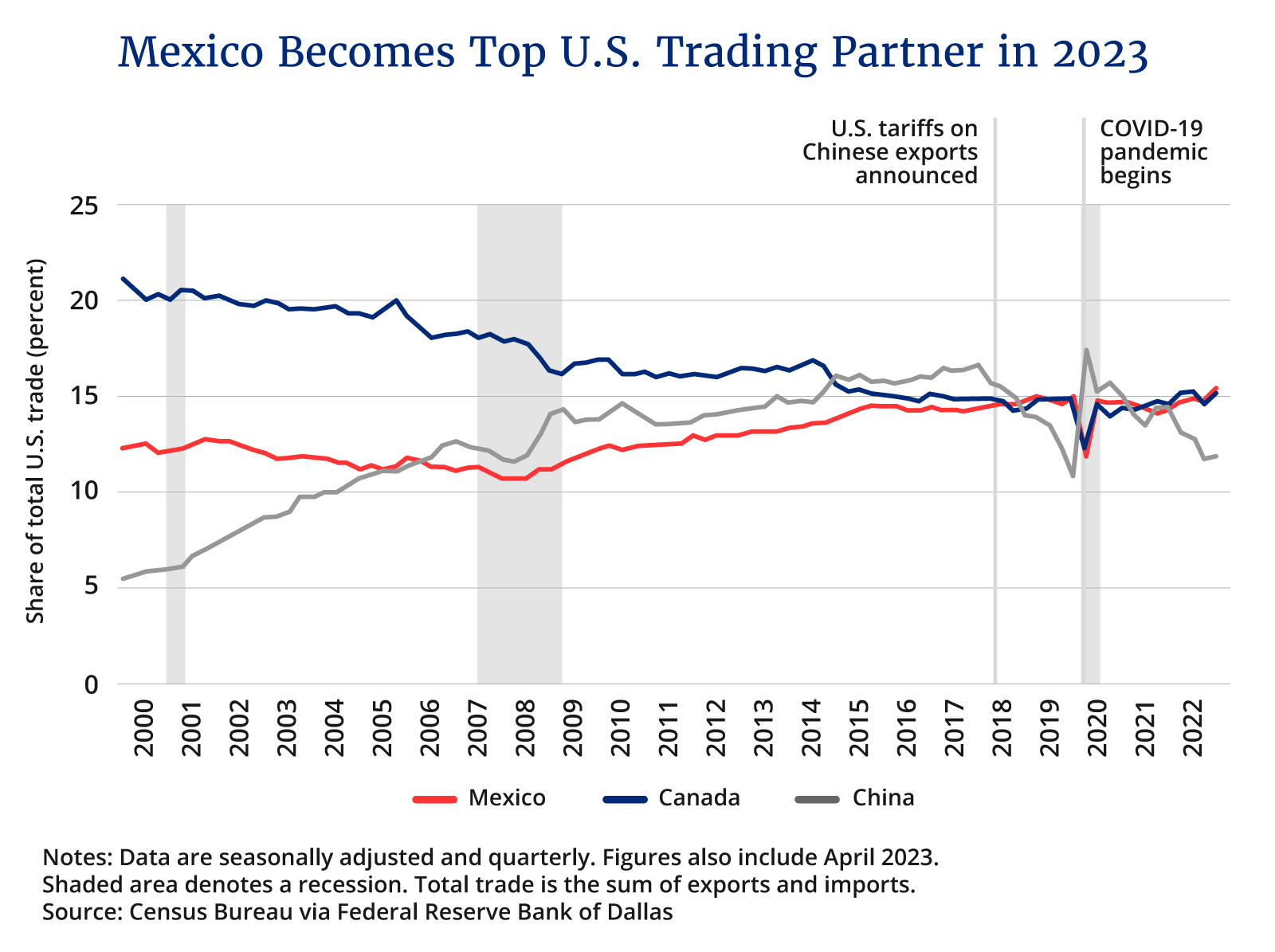
Since then, the decline has been rapid and inexorable. From that 1999 peak of four-fifths, the West’s share of global output plunged to three-fifths after the 2008 financial crisis, and it’s now on a slow but steady path of continued relative decline. With the playing field levelling out, the economies of the global periphery are starting to outcompete rich countries in many industries. Canada knows how this feels, having been pushed aside as the U.S.’s biggest trading partner first by China then by Mexico. Meanwhile, with Western societies aging and productivity slowing, the greater returns lie in the global South, which is why Western pension funds (including Canada’s) are increasingly putting their money there. The barbarians had to invade the Roman Empire to obtain its capital. Western fund-managers are doing the job today, because it will be the only way they can keep their clients in the style to which they’ve grown accustomed.

A Canadian flag flies over Toronto's financial district, where anxieties about global economic decline are a fact of daily life.Nathan Denette/The Canadian Press
This is what the end of empire looks like. It would be facile to say Canada grew as rich as it did simply by sucking resources from the global periphery, but it would be equally facile to say the empire played no part in its astounding prosperity. In fact, the decline of the empire goes a long a way toward explaining Canada’s growing economic sluggishness. Shorn of the advantages of empire and forced to compete on more level terms with a rising periphery, the country is finding the global economy a less friendly place. What future awaits it?
There is one fundamental difference between Rome’s imperial trajectory and ours. In antiquity, the world economy was essentially agricultural and steady-state. If someone rose, someone else had to fall, since new land could not easily be found to create more landowners. Today, thanks to technological progress, even if we are growing more slowly as our share of global output diminishes, we can still keep growing. The domestic challenge will be for Canada to shift its rhetoric away from hoping to recapture its part glories and to distribute what it has in a way that maintains political support among all its citizens.
However, the international landscape will continue to look volatile, as the rising powers of the periphery challenge Western dominance. Negotiating a new world order will not be easy. Canada may actually have a role to play in this, though, because it possesses a distinctive attribute that few countries in the world have: an unusually good ability to see things from several sides.
For Laurier was also right to predict that “Canada shall be the star towards which all men who love progress and freedom shall come.” Over the generations, Canada has indeed been a magnet for some of the best and brightest from around the world. As a result, Canada is today one of the planet’s rare countries able to claim it has created a harmonious political order out of disparate peoples. That experience, and the deep resources of talent that the country has in its diverse population, may give the country a unique ability among Western countries to understand and bridge the divides of a more conflictual world.
When it comes to being a global citizen, Canada has often talked the talk while leaving most of the walking to others. Perhaps that should change. Because if there ever were a time that the world really could use more Canada, this is probably it.