Dressed in a white T-shirt, blue shorts and running shoes, César Rincón looked like everyone else trying to stay cool on a hot afternoon in Madrid’s Casa de Campo park. No one took much notice of him until he stepped into the shade of a tall pine, picked up a large red cape and started moving it to the familiar sway of a matador.
Even at the age of 60 and well past his days as one of the best bullfighters of all time, Mr. Rincón guided the cape effortlessly and skipped his feet with the powerful grace of a ballet dancer. The only sound was a slight hiss he made as he imagined the horns of a 600-kilogram bull rushing by.
“The bull is a species unique in the world,” the Colombian maestro explained as a few onlookers stopped to gawk. “His natural instinct is to attack. And when you can take advantage of this instinct as a bullfighter, it’s magical. Magical.”

Famed Colombian bullfighter César Rincon, 60, right, practises in Madrid’s Casa de Campo Park with Gustavo Garcia during a visit to the city’s Escuela de Tauromaquia.
He’d come to Madrid for the annual San Isidro festival, where nightly bullfights take centre stage in the city’s Las Ventas bullring and the country debates whether las corridas de toros are a form of art or cruelty.
The debate has intensified in recent months as attendance at bullrings falls and polls show a majority of Spaniards would like to see the spectacles abolished.
Earlier this year, Spain’s Minister of Youth and Children, Sira Rego, proposed banning children from attending bullfights, arguing that these “cruel and bloody” events “cause serious harm for their development.” The socialist government is also under pressure to repeal a 2013 law that requires public authorities to “guarantee the preservation of bullfighting and promote its enrichment.”
The proposal has been met with fierce opposition from aficionados, but animal-rights groups believe it’s only a matter of time before bullfighting comes to an end in Spain.
“We know that bullfighting will end naturally, but we just want it to happen quicker,” said Brooke Spurling, a volunteer with Spain’s AnimaNaturalis.
It’s hard to imagine Spain without bullfighting. From the art of Francisco Goya and Pablo Picasso to the writings of Ernest Hemingway, it has been part of Spanish culture for centuries.
It’s also deeply entwined with the country’s Catholic faith. No bullring is complete without a chapel where matadors pray to the Virgin Mary before meeting their fate in the ring. Bullfights themselves are filled with Christian symbolism: death, blood, sacrifice.

Brooke Spurling, right, is a volunteer with AnimaNaturalis and among the many activists in Spain campaigning to ban bullfighting.
“Every single time we attend a torero, there is a risk of life for the sake of the sacrifice,” said Daniel-Aníbal Garcia-Diego, a Madrid lawyer who belongs to a bullfighting fan club. The religious-like rituals “are a way to make a real sacrifice and to honour the life of the bull.”
But traditions have changed, and Spain is rapidly becoming an outlier.
Colombia is banning bullfighting next year. Cuba outlawed it more than a century ago. Governments in Ecuador and Mexico City, home to the largest bullring in the world, have banned the killing of bulls, much like Portugal.
Even in Spain, a handful of regions − notably Catalonia, Asturias and the Canary Islands − have taken steps to prohibit bullfights.

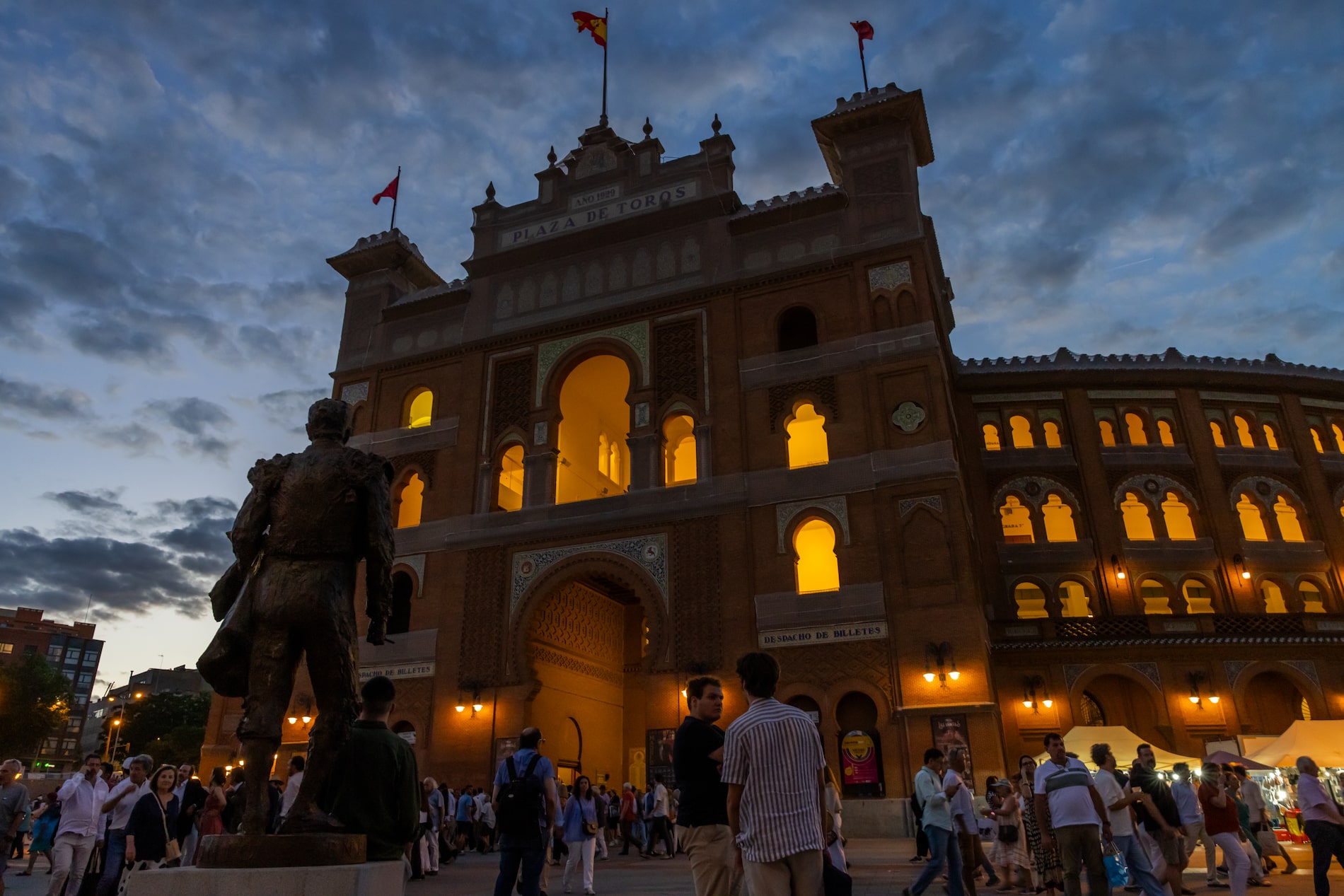
A statue outside the Las Ventas bullring celebrates Jose (Yiyo) Cubero, a graduate of the city’s famous Escuela de Tauromaquia who died in a bullfight in 1985 in Colmenar Viejo, Spain.
Only Peru, Venezuela and parts of Mexico and France still permit traditional corridas.
Defenders remain adamant. Conservative politicians argue bullfighting is the essence of Spanish identity and a source of national pride. They point to the popularity of local fiestas where bulls are celebrated as the main attraction. More young men have also been drawn to bullfights as a kind of countercultural rebellion, and patriotic chants have become common in bullrings.
The politics of bullfighting play out on the streets of Madrid throughout the San Isidro festival.
In a popular tourist area, La Taurina restaurant enticed diners with giant murals of bullfighters and television screens tuned to the action at Las Ventas. A few blocks away, the Lush Cosmetics store displayed a memorial to the bulls about to die. “There’s nothing saintly about killing,” read a sign in the window.
“I was brought up seeing bullfighting as something normal, dramatic and heroic in a way, with a class of people, the toreros, who were always big lovers. The narrative was very powerful,” said Emilio Sáenz-Francés San Baldomero, an adjunct professor of international relations at Madrid’s Comillas Pontifical University who has written about bullfighting. “Nowadays, there are more balanced debates, and everything is political.”
On a warm midweek evening, Luis Llorente took his seat at Las Ventas and tried to articulate the appeal of bullfighting. “The fight between an animal that is very dangerous and a man, I don’t know, it’s the sort of thing that we cannot explain. But we love it,” he said.
He makes a living organizing events for luxury car brands but still gets to a couple of bullfights a week. He nodded toward a young boy seated a few rows down and shook his head at the prospect of banning kids. “It would be stupid because here you have some values that you don’t have in other places.”

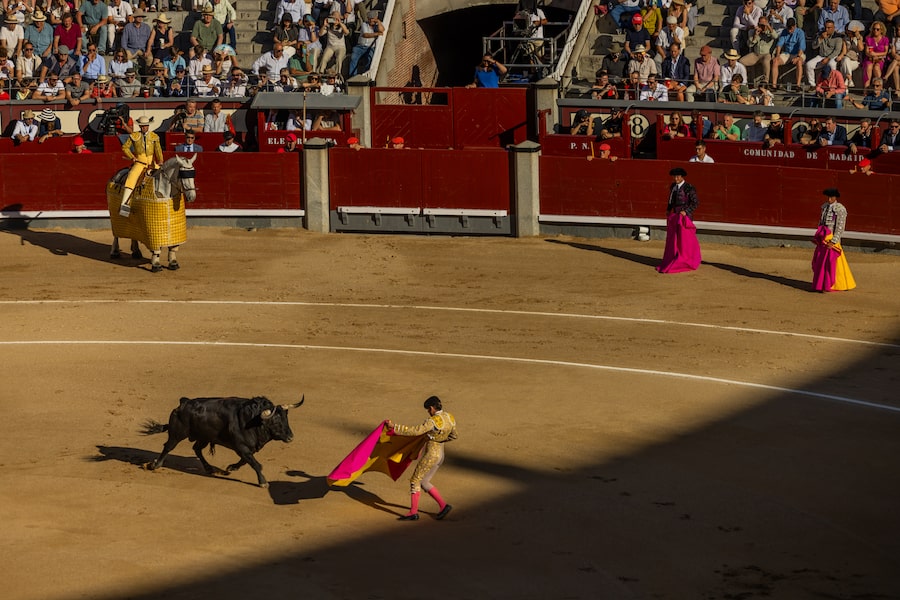
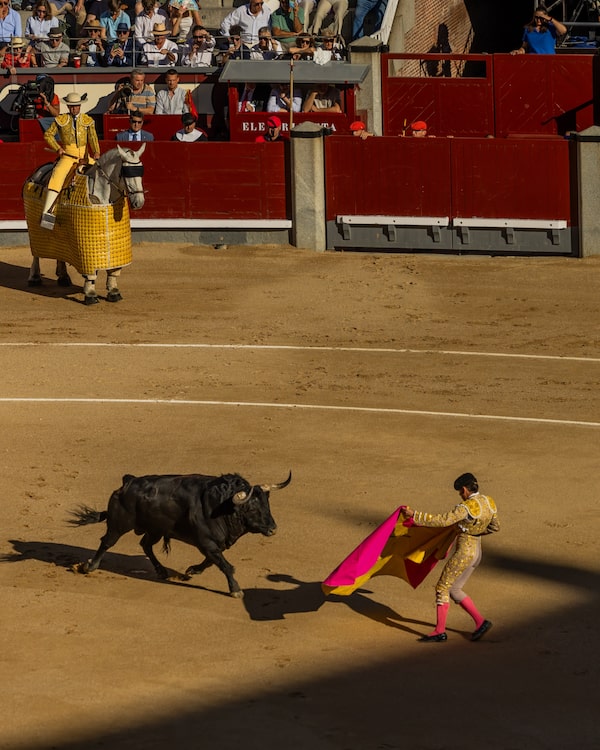
The crowd of more than 20,000 fans gets ready to watch three matadors take on six bulls.
Around 20,000 fans had come to watch three matadors − José Garrido, Ismael Martin and Samuel Navalon − take on two bulls each.
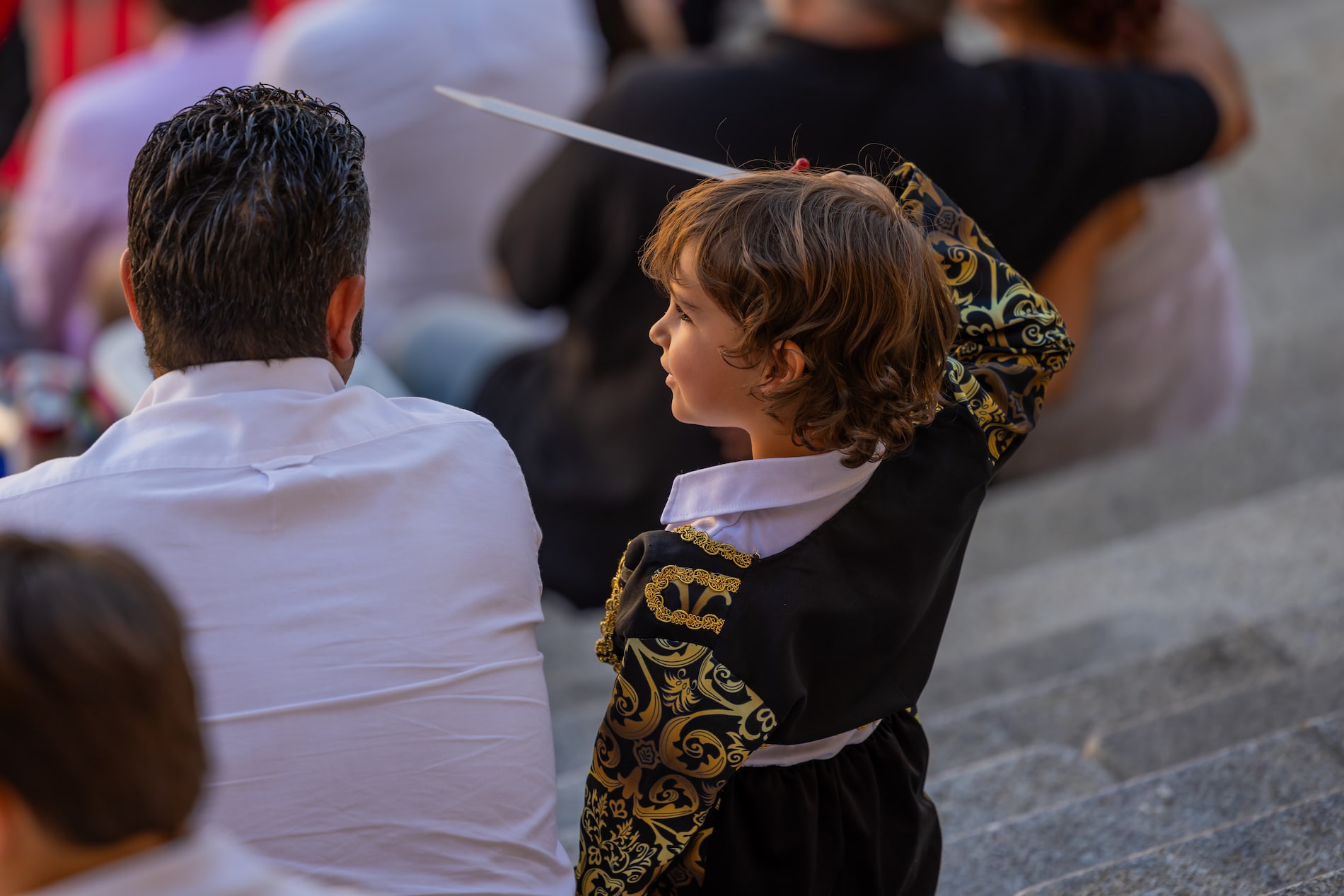
The spectators sat on concrete benches that circled the stadium, much like patrons in Rome’s Colosseum watching gladiators. Cigar smoke wafted through the air, and a 36-piece brass band played traditional Spanish songs. Some children came dressed as matadors, complete with tiny plastic swords.
The evening was steeped in tradition, from the opening parade of horses to the introduction of each bull − by name and weight. The matadors were dressed in their trajes de luces − suits of lights − with intricate golden details, pink socks for luck and black slippers.
Each bull charged into the ring and immediately faced two picadors on horseback who jabbed it with spears. Then a trio of banderilleros sporting pink capes planted three pairs of banderillas − small, dart-like sticks − into the bull’s back to wear it down.
The matador came out for the third and final act − the tercio de muerte. Each taunted the bull with a red cape known as a muleta before plunging his sword into a small area behind the animal’s neck.

Jesus Benito waves a white handkerchief during a bullfight at Madrid’s Las Ventas bullring. His 10-year old daughter Teresa is training to become a bullfighter.
The bull staggered for several minutes before keeling over in a pool of blood. A team of three horses dragged out the carcass as the band played and spectators waved white handkerchiefs.
Carlota Alvarez couldn’t get enough. She’s 13 and has been coming to bullfights with her family since she was 7. “It’s the best,” she said excitedly as she filed out of the stadium. When she was younger, she cried when the bull died, “but now, not so much.”
Bullfights teach important lessons for her generation, she said. “You learn what is real in life.”

Jaime Posada stopped going to bullfights when he was 16 years old.
Jaime Posada used to think that way. He grew up watching bullfights on TV with his grandfather. When he was 16, he saw a bull die for the first time at Las Ventas. He was so disgusted that he joined a campaign to ban bullfighting and now owns a vegan restaurant in Madrid.
He doubts the city will ever ban bullfighting. “We have a lot of people who like it because it’s all about money,” he said.
Teresa Benito flicked her red cape quickly as instructor Francisco Callejo moved toward her holding a set of horns. “Good,” he shouted as he made another pass, and she leaped away with a flash of the cape.
She’s 10 years old and trains twice a week at a bullfighting school in Colmenar Viejo, outside Madrid. On this day, she was one of three girls and about a dozen boys honing their technique in Colmenar’s Plaza de Toros.

Francisco Callejo instructs Teresa Benito, 10, at the Escuela Taurina Miguel Cancela in Colmenar Viejo, Spain.
“I want to be a bullfighter,” Teresa said emphatically. She’s taking fencing lessons to improve her sword skills and competes in a matador suit made by her grandmother.
Teresa shrugged off questions about banning children from bullfighting. “It should be up to the parents,” she said before racing off.
There are dozens of bullfighting schools across Spain. Most are financed by the government and teach children as young as 8 for free.

A student practices his matador technique at the Escuela de Tauromaquia.
Madrid’s Escuela de Tauromaquia − dedicated to matador Jose (Yiyo) Cubero, who died in the ring in 1985 − is among the largest, with roughly 100 students, mostly teenage boys, who train as many as six evenings a week.
It’s run by the municipal government, which also owns a nearby stable for bulls used at Las Ventas. The stable closed in 2015, but the city took it over last year and plans to reopen it as part of an effort to preserve Madrid’s bullfighting heritage.
“You need leg strength, agility and the capacity to move from one physical state to another quickly,” said Fernando Garcia Robleno, a former matador who is an instructor at the school. “I don’t go to a bullring for the blood. What I see is the communion between the man and the animal.”

The students train for free three hours a day, six days a week.
On this night, Mr. Garcia Robleno was putting 30 boys through fitness exercises and cape work.
Among his most dedicated pupils is 20-year-old Alexander Paul. He moved to Madrid from Britain when he was 7 and fell in love with bullfighting. He joined the school as a teenager without telling his parents. When he finally told them, they were so angry that he moved out.
Tall and lanky, Mr. Paul spends almost every evening at the school and works as a tour guide at Las Ventas. He’s fought a few small bulls and did not hesitate to draw his sword for the kill.

Alexander Paul moved to Spain from Britain when he was a child and fell in love with bullfighting.
“You’re playing a character; you’re expressing some part about yourself,” he said. “I think in one word, bullfighting is about emotion.”
He’s had lots of arguments with his parents over bullfighting, but can’t understand banning children. “What are you hiding your child from? You’re hiding the reality of the death of an animal. Well, kids who grow up on farms know all about that.”
If he makes it to Las Ventas as a matador, he’d like his parents to come.
“I don’t think they’ll ever like it, and I don’t expect them to. Hopefully they can come and understand it.”
