Syria’s prime minister said Monday that most cabinet ministers were back at work after rebels overthrew leader Bashar al-Assad, but some state workers failed to return to their jobs, and a United Nations official said the country’s public sector had come “to a complete and abrupt halt.”
Meanwhile, streams of refugees crossed back into Syria from neighbouring countries, hoping for a more peaceful future and looking for relatives who disappeared during al-Assad’s brutal rule.
There were already signs of the difficulties ahead for the rebel alliance now in control of much of the country. The alliance is led by a former senior al-Qaida militant who severed ties with the extremist group years ago and has promised representative government and religious tolerance.
Analysis: Fall of Assad regime in Syria leaves Iran’s regional influence network in tatters
The rebel command said Monday they would not tell women how to dress.
“It is strictly forbidden to interfere with women’s dress or impose any request related to their clothing or appearance, including requests for modesty,” the command said in a statement on social media.
Nearly two days after rebels entered the capital, some key government services had shut down after state workers ignored calls to go back to their jobs, the UN official said, causing issues at airports and borders and slowing the flow of humanitarian aid.
Rebel leader Ahmad al-Sharaa, who was long known by his nom de guerre Abu Mohammed al-Golani, also met for the first time with Prime Minister Mohammad Ghazi Jalali, who stayed in Syria when al-Assad fled.
“You will see there are skills” among the rebels, al-Sharaa said in a video shared on a rebel messaging channel.
Opinion: The fall of Syria’s Bastille marks the country’s rebirth
Israel said it carried out airstrikes on suspected chemical weapons sites and long-range rockets to keep them from falling into the hands of extremists. Israel also seized a buffer zone inside Syria after Syrian troops withdrew.
In northern Syria, Turkey said allied opposition forces seized the town of Manbij from Kurdish-led forces backed by the United States, a reminder that even after al-Assad’s departure, the country remains split among armed groups that have fought in the past.
The Kremlin said Russia has granted political asylum to al-Assad, a decision made by President Vladimir Putin. Kremlin spokesperson Dmitry Peskov declined to comment on Assad’s specific whereabouts and said Putin did not plan to meet with him.
Damascus was quiet Monday, with life slowly returning to normal, though most shops and public institutions were closed. In public squares, some people were still celebrating. Civilian traffic resumed, but there was no public transport. Long lines formed in front of bakeries and other food stores.
There was little sign of any security presence though in some areas, small groups of armed men were stationed in the streets.
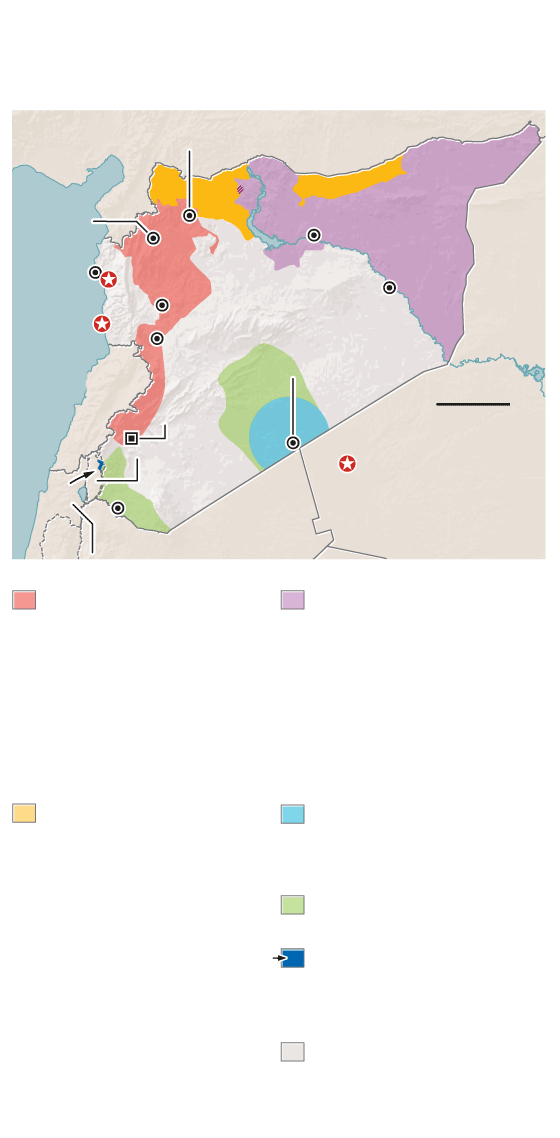
Key Syrian rebel groups
Syrian rebels who ousted Bashar al-Assad and seized
Damascus include fighters from different factions, while other
groups hold territory elsewhere in the country
TURKEY
Aleppo
Idlib
Raqqa
Deir
al-Zour
Latakia
Hama
IRAQ
SYRIA
Tartus
Homs
Al-Tanf
LEBANON
100km
Damascus
Golan
Heights
Russian bases
Future of Russia’s
military presence in
Syria in doubt
Daraa
ISRAEL
JORDAN
HAYAT TAHRIR AL-SHAM (HTS)
Main rebel group behind Assad’s
ouster, first emerged as al-Qaeda
affiliate at start of Syria’s 2011
uprising, but broke ranks with
jihadist group in 2016. Despite
trying to shed extremist roots,
the U.S. and others still consider
HTS a terrorist group.
SYRIAN DEMOCRATIC FORCES
(SDF) Alliance of Kurdish-led militias,
backed by U.S. Formed to hold back
the advance of the Islamic State
in Syria in 2014, it now controls some
of the country’s biggest oil fields.
Turkey regards SDF as a terrorist
group linked to Ankara’s proscribed
PKK movement.
SYRIAN NATIONAL ARMY (SNA)
Umbrella alliance of Turkish-backed
militias believed to have given tacit
approval to HTS’ recent offensive.
Turkey first sent troops into Syria
from 2016 to push Kurdish
militants and Islamic State
away from the border .
AL-TANF DECONFLICTION ZONE
55km area around U.S. military
base in Al-Tanf
UNIDENTIFIED OPPOSITION GROUPS
ISRAEL DEFENSE FORCES (IDF)
Entered buffer zone in Golan Heights
for “defensive purposes” on Dec. 8
LOST SYRIAN REGIME TERRITORY
Source: graphic news; reuters; BBC; Institute for the Study of War
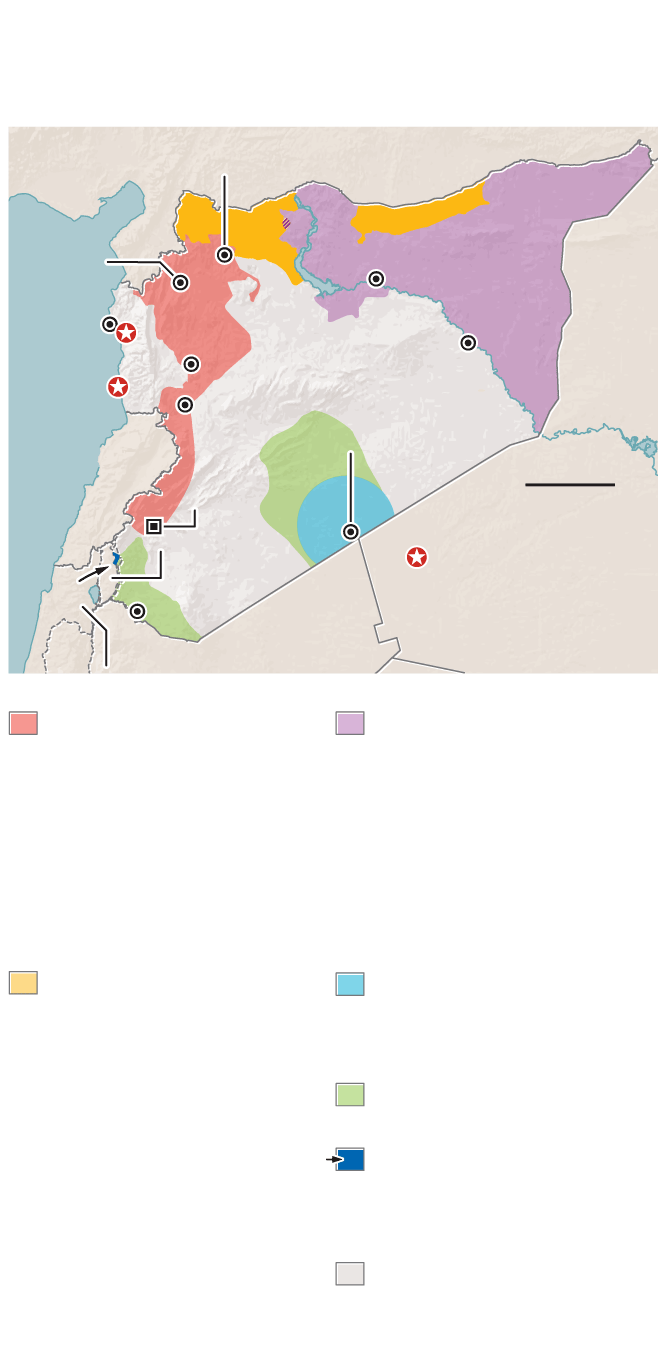
Key Syrian rebel groups
Syrian rebels who ousted Bashar al-Assad and seized
Damascus include fighters from different factions, while other
groups hold territory elsewhere in the country
TURKEY
Aleppo
Idlib
Raqqa
Deir
al-Zour
Latakia
Hama
IRAQ
SYRIA
Tartus
Homs
Al-Tanf
LEBANON
100km
Damascus
Golan
Heights
Russian bases
Future of Russia’s
military presence in
Syria in doubt
Daraa
ISRAEL
JORDAN
HAYAT TAHRIR AL-SHAM (HTS)
Main rebel group behind Assad’s
ouster, first emerged as al-Qaeda
affiliate at start of Syria’s 2011
uprising, but broke ranks with
jihadist group in 2016. Despite
trying to shed extremist roots,
the U.S. and others still consider
HTS a terrorist group.
SYRIAN DEMOCRATIC FORCES
(SDF) Alliance of Kurdish-led militias,
backed by U.S. Formed to hold back
the advance of the Islamic State
in Syria in 2014, it now controls some
of the country’s biggest oil fields.
Turkey regards SDF as a terrorist
group linked to Ankara’s proscribed
PKK movement.
AL-TANF DECONFLICTION ZONE
SYRIAN NATIONAL ARMY (SNA)
Umbrella alliance of Turkish-backed
militias believed to have given tacit
approval to HTS’ recent offensive.
Turkey first sent troops into Syria
from 2016 to push Kurdish
militants and Islamic State
away from the border .
55km area around U.S. military
base in Al-Tanf
UNIDENTIFIED OPPOSITION GROUPS
ISRAEL DEFENSE FORCES (IDF)
Entered buffer zone in Golan Heights
for “defensive purposes” on Dec. 8
LOST SYRIAN REGIME TERRITORY
Source: graphic news; reuters; BBC; Institute for the Study of War
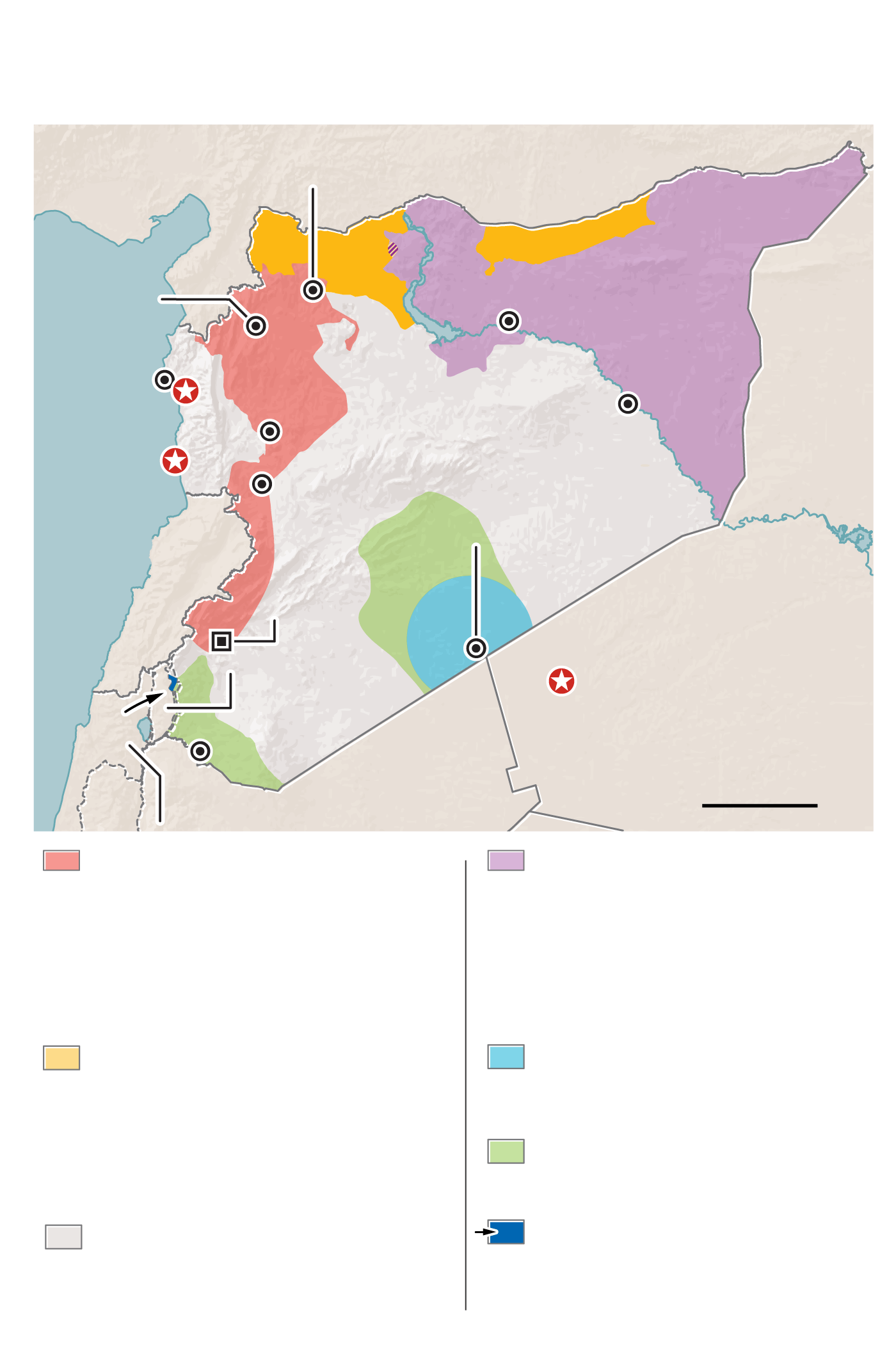
Key Syrian rebel groups
Syrian rebels who ousted Bashar al-Assad and seized Damascus include fighters
from different factions, while other groups hold territory elsewhere in the country
TURKEY
Aleppo
Idlib
Raqqa
Deir
al-Zour
Latakia
Hama
IRAQ
SYRIA
Tartus
Homs
Al-Tanf
LEBANON
Damascus
Golan
Heights
Russian bases
Future of Russia’s military
presence in Syria in doubt
Daraa
100km
ISRAEL
JORDAN
HAYAT TAHRIR AL-SHAM (HTS)
Main rebel group behind Assad’s ouster, first
emerged as al-Qaeda affiliate at start of Syria’s
2011 uprising, but broke ranks with jihadist group
in 2016. Despite trying to shed extremist roots,
the U.S. and others still consider HTS a terrorist
group.
SYRIAN DEMOCRATIC FORCES (SDF)
Alliance of Kurdish-led militias, backed by U.S.
Formed to hold back the advance of the Islamic
State in Syria in 2014, it now controls some
of the country’s biggest oil fields. Turkey regards
SDF as a terrorist group linked to Ankara’s
proscribed PKK movement.
AL-TANF DECONFLICTION ZONE
SYRIAN NATIONAL ARMY (SNA)
Umbrella alliance of Turkish-backed militias
believed to have given tacitapproval to HTS’
recent offensive. Turkey first sent troops into
Syria from 2016 to push Kurdish militants and
Islamic State away from the border .
55km area around U.S. military base in Al-Tanf
UNIDENTIFIED OPPOSITION GROUPS
ISRAEL DEFENSE FORCES (IDF)
Entered buffer zone in Golan Heights
for “defensive purposes” on Dec. 8
LOST SYRIAN REGIME TERRITORY
Source: graphic news; reuters; BBC; Institute for the Study of War
Across swathes of Syria, families are now waiting outside prisons, security offices and courts, hoping for news of loved ones who were imprisoned or who disappeared.
Just north of Damascus in the feared Saydnaya military prison, women detainees, some with their children, screamed as rebels broke locks off their cell doors. Amnesty International and other groups say dozens of people were secretly executed every week in Saydnaya, and they estimate that up to 13,000 Syrians were killed between 2011 and 2016.
“Don’t be afraid,” one rebel said as he ushered women from packed cells. “Bashar Assad has fallen!”
Families desperately scoured the filthy cells of Syria's forbidding Sednaya prison on Monday for any sign of long-detained relatives after its gates were flung open by rebels, in hopes of finding missing loved ones.
Reuters
Opinion: Will Syrians be able to unite as they forge a new future?
In southern Turkey, Mustafa Sultan was among hundreds of Syrian refugees waiting at border crossings to head home. He was searching for his older brother, who was imprisoned under al-Assad.
“I haven’t seen him for 13 years,” he said. “I am going to go see whether he’s alive.”
Prime minister says government is operational, but UN official says it’s paralyzed
Jalali, the prime minister, has sought to project normalcy since al-Assad fled.
“We are working so that the transitional period is quick and smooth,” he told Sky News Arabia TV on Monday, saying the security situation had already improved from the day before.
At the court of Justice in Damascus, which was stormed by the rebels to free detainees, Judge Khitam Haddad, an aide to the justice minister in the outgoing government, said Sunday that judges were ready to resume work quickly.
“We want to give everyone their rights,” Haddad said outside the courthouse. “We want to build a new Syria and to keep the work, but with new methods.”
Fact check: AI-generated image of supposed prisoner among misleading claims from Syria
But a UN official said some government services had been paralyzed as worried state employees stayed home.
The public sector “has just come to a complete and abrupt halt,” said UN Resident and Humanitarian Coordinator for Syria Adam Abdelmoula, noting, for example, that an aid flight carrying urgently needed medical supplies had been put on hold after aviation employees abandoned their jobs.
“This is a country that has had one government for 53 years and then suddenly all of those who have been demonized by the public media are now in charge in the nation’s capital,” Abdelmoula told The Associated Press. “I think it will take a couple of days and a lot of assurance on the part of the armed groups for these people to return to work again.”
Britain, U.S. considering removing insurgent group from terror list
Britain and the U.S. are both considering whether to remove the main anti-Assad rebel group from their lists of designated terrorist organizations.
Hayat Tahrir al-Sham began as an offshoot of al-Qaeda but cut ties with the group years ago and has worked to present a more moderate image.
The group’s leader, al-Sharaa, “is saying some of the right things about the protection of minorities, about respecting people’s rights,” British Cabinet minister Pat McFadden said, adding that a change would be considered “quite quickly.”
But British Prime Minister Keir Starmer, speaking later during a visit to Saudi Arabia, said it was “far too early” to make that decision.
Who is Abu Mohammed al-Golani, the leader of the insurgency that toppled the Syrian regime?
In Washington, a Biden administration official noted that HTS will be an “important component” in Syria’s future and that the U.S. needs to “engage with them appropriately.”
Another administration official said the U.S. remains in a “wait and see” mode on whether to remove the designation.
Both officials requested anonymity to discuss the ongoing internal deliberations.
The U.S. also announced it was sending its special envoy for hostage affairs to Beirut to seek information about the whereabouts of Austin Tice, a journalist who vanished in Syria 12 years ago and who President Joe Biden has said is believed to be alive.
Israel confirms it struck suspected chemical weapons and rockets
Israelis welcomed the fall of al-Assad, who was a key ally of Iran and Lebanon’s Hezbollah militant group, while expressing concern over what comes next. Israel says its forces temporarily seized a buffer zone inside Syria dating back to a 1974 agreement after Syrian troops withdrew in the chaos.
“The only interest we have is the security of Israel and its citizens,” Israeli Foreign Minister Gideon Saar told reporters Monday. Saar did not provide details about the targets, but the British-based Syrian Observatory for Human Rights said they included weapons warehouses, research centers, air defense systems and aircraft squadrons.

A man holds a rifle as people gather at Sednaya Prison, where thousands of people were said to be detained and tortured by the Assad regime over the last decade, as families came to find information about detained and missing relatives on Dec. 9, 2024 in Damascus, Syria.Getty Images/Getty Images
Israel has carried out hundreds of airstrikes in Syria in recent years, targeting what it says are military sites related to Iran and Hezbollah. Israeli officials rarely comment on individual strikes.
Syria agreed to give up its chemical weapons stockpile in 2013, after the government was accused of launching an attack near Damascus that killed hundreds of people. But it is widely believed to have kept some of the weapons and was accused of using them again in subsequent years.
Turkey says its allies have taken northern town
Officials in Turkey, which is the main supporter of the Syrian opposition to Assad, say its allies have taken full control of the northern Syrian city of Manbij from a U.S.-supported and Kurdish-led force known as the Syrian Democratic Forces, or SDF.
The SDF said a Turkish drone struck in the village of al-Mistriha in eastern Syria, killing 12 civilians, including six children.
Turkey views the SDF, which is primarily composed of a Syrian Kurdish militia, as an extension of the banned Kurdistan Workers’ Party, or PKK, which has waged a decades-long insurgency in Turkey. The SDF has also been a key ally of the United States in the war against the Islamic State group.
Turkish Foreign Minister Hakan Fidan on Monday expressed hope for a new era in Syria in which ethnic and religious groups can live peacefully under an inclusive government. But he warned against allowing Islamic State or Kurdish fighters to take advantage of the situation, saying Turkey will prevent Syria from turning into a “haven for terrorism.”